Mumbai, officially renamed from Bombay in 1995, is the capital of Maharashtra state and the most populous city in India. The country’s economic capital and home of Bollywood, it is mostly visited in the south, on the old peninsula: the Gateway of India facing the sea, Chhatrapati Shivaji Terminus and the Unesco-listed Victorian and Art Deco ensembles, the Marine Drive seafront, then the Elephanta Caves by boat. If you want to visit Mumbai, here is the essential: what to see, when to go to avoid the monsoon and what precautions to take.
We add our own calculations based on official normals: the share of the year’s rain that falls during the monsoon, the number of rainy days to expect in a week and sunset time on Marine Drive.

Our travel deals for Mumbai
Affiliate links: we earn a commission, at no extra cost to you.
 FlightsKiwi.comCompare flights and airline combinations to Mumbai.Compare flights
- Airport transferKiwitaxiPrivate driver booked in advance at a fixed price.Book a transfer
- Tickets and toursTiqetsEntry tickets and guided tours to book online; compare with the official price.See tickets
- eSIMAiraloData plan to install before you leave (eSIM-compatible phone).See plans




Mumbai at a glance
- Population 12,478,447 in 2011, more than 18 million in the metropolitan area (Wikipedia)
- Currency Indian rupee
- Time zone UTC+5:30 all year: 5 h 30 ahead of London in winter, 4 h 30 in summer; 10 h 30 ahead of New York in winter
- Entry visa, e-visa or OCI card required for US and UK citizens; UK citizens need a passport valid 6 months after arrival with 2 blank pages (GOV.UK); see entry requirements
- Airport Chhatrapati Shivaji Maharaj International Airport (BOM), in Santacruz and Sahar
- Unesco sites Chhatrapati Shivaji Terminus (2004), Victorian and Art Deco ensembles (2018), Elephanta Caves
- Best time November to February; monsoon from June to September
Safety: the UK FCDO (GOV.UK, updated 7 October 2026) states that terrorists are very likely to try to carry out attacks in India and that monsoon rains can cause disruption in big cities due to flooding. The FCDO advises against travel to some areas far from Mumbai, such as parts of Jammu and Kashmir and the India-Pakistan border area: see our India travel guide.
What to see in Mumbai: the highlights
The Gateway of India and Colaba
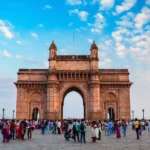
A 26-metre (85 ft) basalt arch completed in 1924, the Gateway of India commemorates the landing of King George V in December 1911, the first British monarch to visit India. Designed in Indo-Saracenic style by the architect George Wittet, it faces the bay. Just behind stands the Taj Mahal Palace hotel, another example of Indo-Saracenic architecture. The surrounding Colaba district is best explored on foot. Boats for Elephanta also leave from here.
Chhatrapati Shivaji Terminus (Victoria Terminus)
Listed as a Unesco World Heritage Site in 2004, the former Victoria Terminus was designed by the British engineer Frederick William Stevens in an exuberant Gothic Revival style. Built from 1878 to 1887, the year of Queen Victoria’s jubilee, it opened to the public on 20 May 1888 and was renamed Chhatrapati Shivaji Terminus in 1996. It is still a working station, headquarters of the Central Railway: admire it from outside or from the concourse, avoiding rush hours.
The Victorian and Art Deco ensembles
Around the Oval Maidan, a vast recreation ground once called the Esplanade, Unesco listed an ensemble of 94 buildings in 2018: to the east, the Victorian Gothic public buildings (Bombay High Court, the University of Mumbai with the Rajabai Clock Tower); to the west, the Art Deco buildings of Back Bay and Marine Drive. It is one of the finest architecture walks in the city.
Chhatrapati Shivaji Maharaj Vastu Sangrahalaya
The former Prince of Wales Museum, renamed in 1998, is the city’s main museum and traces the history of India from prehistory to modern times. It occupies an Indo-Saracenic building surrounded by a garden, near the Gateway of India, and holds about 50,000 items. Check opening hours and closing days on its official website.
Marine Drive and Chowpatty
A 3 km (2 mi) promenade along the bay, built in 1940, Marine Drive is nicknamed the « Queen’s Necklace »: at night, seen from above, its streetlights look like a string of pearls. It links Nariman Point, to the south, with Girgaon Chowpatty beach and Malabar Hill, to the north. It is the classic place for sunset (see the exact time in our table).
The Elephanta Caves
On Elephanta Island (Gharapuri), in Mumbai Harbour, about ten kilometres (6 mi) to the east, temples carved into basalt are mainly dedicated to Shiva. A Unesco World Heritage Site, the caves contain high-relief sculptures; the island also has Buddhist remains. Allow half a day from the Gateway of India; ask about crossings, especially during the monsoon.
Dhobi Ghat, Banganga and the living city
Dhobi Ghat, an open-air laundry built in 1890, is best viewed from a bridge: the dhobis wash linen for hotels and hospitals there. On Malabar Hill, the sacred Banganga Tank is part of the Walkeshwar Temple complex. Mumbai is also the capital of Bollywood, one of the largest film industries in the world.
Itinerary: Mumbai in 2 or 3 days
| Day | Plan | Tip |
|---|---|---|
| 1 | Gateway of India, Colaba, CSMVS museum, Oval Maidan, Chhatrapati Shivaji Terminus | Start early, before the heat |
| 2 | Elephanta Caves in the morning, Marine Drive at sunset | Check crossings the day before |
| 3 | Dhobi Ghat, Banganga and Malabar Hill, a district of your choice | Avoid suburban trains at rush hour |
When to go to Mumbai
From November to February, the dry season is the most pleasant: almost no rain (1.6 mm / 0.1 in in December, 0.2 mm in January) and cooler nights (16.9 °C / 62 °F in January), according to the India Meteorological Department’s 1991-2020 normals for the Santacruz station. March to May become oppressive, with 33.7 °C (93 °F) in the afternoon in May and nights at 27.0 °C (81 °F). The monsoon, from June to September, brings huge amounts of rain: 920 mm (36.2 in) in July and 27.0 days of significant rain.
| Month | High °C (°F) | Low °C (°F) | Rain mm (in) | Rainy days (≥ 2.5 mm) | Verdict |
|---|---|---|---|---|---|
| January | 31.2 (88) | 16.9 (62) | < 1 (< 0.1) | 0.2 | ✅ Dry, cool nights |
| February | 31.7 (89) | 18.1 (65) | < 1 (< 0.1) | 0.0 | ✅ Dry |
| March | 33.1 (92) | 21.1 (70) | < 1 (< 0.1) | 0.1 | ⚠️ Hot, dry |
| April | 33.4 (92) | 24.2 (76) | < 1 (< 0.1) | 0.1 | ⚠️ Hot, humid |
| May | 33.7 (93) | 27.0 (81) | 7 (0.3) | 1.3 | ⚠️ Very muggy, before the monsoon |
| June | 32.5 (90) | 26.6 (80) | 526 (20.7) | 17.5 | ❌ Monsoon arrives |
| July | 30.4 (87) | 25.5 (78) | 920 (36.2) | 27.0 | ❌ Height of the monsoon |
| August | 30.2 (86) | 25.2 (77) | 561 (22.1) | 27.4 | ❌ Monsoon |
| September | 30.9 (88) | 24.9 (77) | 384 (15.1) | 18.9 | ⚠️ End of the monsoon |
| October | 33.6 (92) | 23.9 (75) | 91 (3.6) | 5.7 | ⚠️ Hot, dry weather returns |
| November | 34.1 (93) | 21.4 (71) | 11 (0.4) | 0.7 | ✅ Dry, hot |
| December | 32.6 (91) | 18.4 (65) | 2 (0.1) | 0.4 | ✅ Dry, ideal |
These values are those of the Mumbai column on our page on when to go to India.
96% of the year’s rain in four months
Of the 2,502 mm (98.5 in) that fall on average each year at Santacruz, 2,390 mm (94.1 in) fall from June to September, or 96%. From December to April, less than 2 mm falls in total. Over a one-week stay, you can expect on average 6.1 days of significant rain in July, against 0.0 in January. Destination de Voyage calculation based on the IMD 1991-2020 normals (days ≥ 2.5 mm × 7 ÷ days in the month).
| Month | Rain (mm) | Rainy days in 7 days | Sunset (on the 15th) | Ahead of London |
|---|---|---|---|---|
| January | < 1 | 0.0 | 6:21 pm | +5 h 30 |
| February | < 1 | 0.0 | 6:38 pm | +5 h 30 |
| March | < 1 | 0.0 | 6:48 pm | +5 h 30 |
| April | < 1 | 0.0 | 6:55 pm | +4 h 30 |
| May | 7 | 0.3 | 7:05 pm | +4 h 30 |
| June | 526 | 4.1 | 7:17 pm | +4 h 30 |
| July | 920 | 6.1 | 7:19 pm | +4 h 30 |
| August | 561 | 6.2 | 7:06 pm | +4 h 30 |
| September | 384 | 4.4 | 6:41 pm | +4 h 30 |
| October | 91 | 1.3 | 6:16 pm | +4 h 30 |
| November | 11 | 0.2 | 6:00 pm | +5 h 30 |
| December | 2 | 0.1 | 6:03 pm | +5 h 30 |
To extend to other regions of India, see our Goa page and where to go in December.
Getting there and getting around Mumbai
- By plane: Chhatrapati Shivaji Maharaj International Airport (BOM) is the second busiest in India. Nonstop and one-stop options vary by airline and season: check current schedules with the airport and airlines. GOV.UK notes that some places, including Mumbai, have two airports a considerable distance apart: check your airport when booking.
- Suburban trains: the « local » network carries more than 7.5 million passengers a day: very handy outside peak hours, to be avoided at rush hour with luggage.
- Taxis and ride-hailing: useful for linking the south with the suburbs; allow extra time, as traffic is heavy.
- By boat: from the Gateway of India to Elephanta.
GOV.UK notes that India has a high death rate from road accidents: hiring a driver is preferable to driving yourself.
Transfer from the airport
The airport is in the north of the city, far from the southern sights. For a night arrival or with luggage, a transfer booked in advance avoids haggling. A car with a driver is preferable to self-drive rental.
Where to stay
South Mumbai (Colaba, Fort) puts the Gateway of India, the museums and Marine Drive within walking distance or a few minutes by taxi. Areas near the airport suit a transit night.
If you… then…: choosing your trip
| If you… | Then… |
|---|---|
| have a one-day stopover | Gateway of India, Chhatrapati Shivaji Terminus, Oval Maidan, Marine Drive |
| love architecture | the Victorian and Art Deco ensembles, the CSMVS museum |
| want ancient history | the Elephanta Caves, outside the monsoon |
| come during the monsoon | a flexible programme, museums, follow flood alerts |
| want to extend in the sun | continue to Goa from November to February |
Entry requirements, health and safety
US citizens
- According to the U.S. Department of State (travel.state.gov, last updated August 11, 2025), you need a valid US passport and a valid Indian visa or an Overseas Citizen of India (OCI) card to enter and exit. You can apply for an eVisa at least 4 days before arriving; eVisas are not valid at land border crossings. Visa rules change often and with little warning.
UK citizens
- According to the UK FCDO (GOV.UK foreign travel advice, updated 7 October 2026), you must have a visa unless you hold an OCI card; you may be able to apply for an e-visa (check restrictions on ports of entry). Your passport must have an expiry date at least 6 months after your arrival and at least 2 blank pages.
- All foreign nationals must complete an e-arrival card online, up to 72 hours before arrival; it is not a visa. Make sure your passport is stamped on arrival.
Health and safety
- Health: GOV.UK lists dengue and malaria among the health risks in India and advises checking vaccine recommendations with TravelHealthPro at least 8 weeks before you travel; see a travel health clinic before you leave and protect yourself against mosquitoes.
- Terrorism: GOV.UK states that terrorists are very likely to try to carry out attacks in India; stay alert in crowded places.
- Monsoon: according to GOV.UK, the monsoon season usually runs from June to November and can cause flash floods, landslides and disruption in big cities due to flooding.
- Women travellers: GOV.UK reports that female travellers often experience verbal and physical harassment, and the U.S. State Department advises women against travelling alone in India.
- Road safety: India has a high death rate from road accidents (GOV.UK); take care crossing streets, especially at night.
- Emergencies: dial 112 (ambulance, fire, police).
- Sea: the U.S. State Department notes that strong currents cause drownings every year in areas including Mumbai and Goa, and advises avoiding swimming in the ocean during the monsoon season.
- Women’s helpline in Mumbai: 103 (travel.state.gov).
See also our guides to travel documents and travel insurance.
Mobile data and money
The currency is the Indian rupee. For mobile data, a local SIM card or an eSIM bought before departure avoids roaming charges: check that your phone is compatible (see our travel eSIM guide) and follow the exchange rate with our currency converter.
Frequently asked questions
Bombay or Mumbai?
Both names refer to the same city: the official name has been Mumbai since 1995; « Bombay » is still widely used.
What can you see in Mumbai in one day?
The Gateway of India and Colaba, the CSMVS museum, Chhatrapati Shivaji Terminus and the buildings around the Oval Maidan, then Marine Drive at sunset.
When is the best time to visit Mumbai?
From November to February, during the dry season. From June to September, the monsoon brings 96% of the annual rainfall (920 mm / 36.2 in in July), according to the IMD 1991-2020 normals.
Do you need a visa for Mumbai?
Yes. US and UK citizens need a valid Indian visa or e-visa, or an OCI card (travel.state.gov, GOV.UK). UK citizens need a passport valid at least 6 months after arrival with 2 blank pages.
Is Mumbai safe?
GOV.UK warns that terrorists are very likely to try to carry out attacks in India and that monsoon flooding can disrupt big cities. Stay alert in crowded places, follow flood alerts and dial 112 in an emergency.
Our sources
- WMO 1991-2020 normals, Mumbai (Santacruz) station, WMO 43003, India Meteorological Department, NOAA/NCEI file downloaded on 24 October 2026
- Entry requirements, health and safety checked on 26 October 2026: U.S. Department of State, India country information (last updated August 11, 2025) and UK FCDO, GOV.UK foreign travel advice for India (updated 7 October 2026)
- Wikipedia: « Mumbai », « Gateway of India », « Chhatrapati Shivaji Terminus », « Victorian Gothic and Art Deco Ensembles of Mumbai », « Chhatrapati Shivaji Maharaj Vastu Sangrahalaya », « Marine Drive, Mumbai », « Elephanta Caves », « Dhobi Ghat (Mumbai) », « Banganga Tank », « Mumbai Suburban Railway », « Chhatrapati Shivaji Maharaj International Airport », consulted on 24 October 2026
- Destination de Voyage calculations: monsoon share of rainfall, rainy days in 7 days, sunset (NOAA algorithm), time difference (IANA database)
- Our methodology
Updated October 2026.
To go further, see our India travel guide, our page on when to go to India, our Goa page and our destinations in Asia.