This Goa travel guide starts with safety: the UK FCDO advises against travel to some parts of India, such as areas of Jammu and Kashmir, the India-Pakistan border area and Manipur, but Goa is not one of them. GOV.UK does flag specific risks there (opportunistic crime, drink spiking, a ban on drinking alcohol in public places, dangerous currents), detailed below. Check the official travel advice before you leave.
Goa is the smallest state in India, on the Arabian Sea coast. A Portuguese colony until 1961, it combines baroque churches, colourful houses, Hindu temples, rice paddies and around a hundred kilometres (60 mi) of beaches. The north is livelier, the south quieter. This guide helps you choose your beaches, sights and base for a stay of one to two weeks.
Our travel deals for Goa
Affiliate links: we earn a commission, at no extra cost to you.
FlightsKiwi.comCompare flights and airline combinations to Goa.
Languages: Konkani (official language), Marathi, Hindi; English is widely spoken in tourism
Airports: Dabolim (south) and Manohar International at Mopa (north)
Flights: usually with a connection, via the Gulf, Mumbai or Delhi; check the total journey time when booking
Best time: November to February
Time zone: UTC+5:30 all year: 5 h 30 ahead of London in winter, 4 h 30 in summer; 10 h 30 ahead of New York in winter
Entry: visa, e-visa or OCI card required before departure for US and UK citizens; see entry requirements
Currency: the Indian rupee
Indicative budget: roughly ₹3,200 to ₹6,000 per person per day on a budget, roughly ₹9,500 to ₹19,000 in comfort
What to see in Goa: the highlights
Old Goa and its churches
The former capital of the Portuguese colony, Old Goa (Velha Goa) is now a group of churches and convents scattered among greenery, a Unesco World Heritage Site. The Basilica of Bom Jesus holds the tomb of St Francis Xavier; opposite, the Sé Cathedral (St Catherine’s) is one of the largest churches in Asia. The site is about ten kilometres (6 mi) from Panaji. Come in the morning, before the heat, and wear clothes covering shoulders and knees.
Panaji and the Fontainhas quarter
A small capital on the Mandovi estuary, Panaji is easy to explore on foot. The Church of Our Lady of the Immaculate Conception and its great white staircase dominate the centre. The Fontainhas quarter has kept its lanes of houses with yellow, blue or ochre façades and Portuguese-style balconies, now home to galleries, cafés and guesthouses. In the evening, boats offer cruises on the Mandovi.
North Goa beaches: Calangute, Baga, Anjuna and Vagator
North Goa has most of the nightlife. Calangute and Baga are the busiest beaches, lined with restaurants, bars and water sports. Anjuna is known for its Wednesday flea market, in season; Vagator and its red cliffs are overlooked by Chapora fort, with a fine view over the river mouth at sunset.
The far north: Morjim, Ashvem, Mandrem and Arambol
Further north, beyond the Chapora river, the beaches of Morjim, Ashvem and Mandrem are wider and quieter, with bungalow accommodation. Arambol attracts visitors interested in yoga, meditation and music, with gatherings at sunset on the beach.
South Goa beaches: Palolem, Agonda, Benaulim and Colva
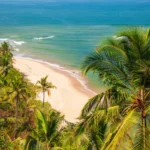
South Goa is more peaceful. Palolem is a crescent of sand lined with coconut palms, with huts and beach restaurants in season; neighbouring Agonda is even quieter. Further north in the south, Colva and Benaulim have long stretches of fine sand, popular with Indian families. Margao, the main town in the south, has a busy market, and some fine colonial mansions stand in the surrounding villages, such as Chandor.
Spice plantations and the temples of Ponda
Inland, around Ponda, several spice plantations welcome visitors for a guided walk, often followed by a meal. The area is also home to Goa’s main Hindu temples, such as Shri Mangueshi and Shri Shantadurga, recognisable by their lamp towers (deepastambha).
Dudhsagar Falls
On the border with Karnataka, Dudhsagar Falls drop in several tiers through the forest, crossed by a railway line. They are most impressive at the end of the monsoon. Access is usually by jeep from the Mollem area, on organised excursions; it may be closed during heavy rain: ask locally.
Things to do in Goa: activity ideas
Choose your beach: lively in the north (Calangute, Baga, Anjuna), quieter in the far north (Mandrem, Ashvem) and the south (Palolem, Agonda)
Browse the Anjuna flea market, on Wednesdays in season
Watch the sunset from Chapora fort or on Arambol beach
Practise yoga and meditation in Arambol
Take a cruise on the Mandovi from Panaji
Visit a spice plantation and the Hindu temples of Ponda
See Dudhsagar Falls, most impressive at the end of the monsoon
Discover the colonial mansions in the villages around Margao, such as Chandor
Itinerary ideas for Goa
One week:
Days 1-2: Panaji, Fontainhas and Old Goa
Days 3-4: North Goa, Chapora fort, Anjuna market (Wednesdays in season), sunset at Arambol
Day 5: spice plantation and the temples of Ponda
Days 6-7: relax on a southern beach (Palolem or Agonda)
Two weeks:
Days 1-3: Panaji, Fontainhas, Old Goa and a Mandovi cruise
Days 4-7: North Goa, staying in Mandrem or Ashvem
Day 8: Ponda and its plantations
Day 9: Dudhsagar Falls (depending on the season and whether access is open)
Days 10-14: South Goa, between Palolem, Agonda and the villages around Margao
Goa combines well with Kerala, further south, or with Hampi, in neighbouring Karnataka, reachable by train or overnight bus.
Budget for a stay in Goa
Goa is more expensive than the Indian average, especially in high season, but remains affordable. Indicative amounts per person per day, excluding flights (converted from euros at the European Central Bank rate of 23 October 2026):
Item
Budget
Comfort
Accommodation (based on a shared double room)
roughly ₹1,100 to ₹2,700
roughly ₹4,300 to ₹10,500
Meals
roughly ₹900 to ₹1,600
roughly ₹2,100 to ₹4,300
Transport (scooter, taxi)
roughly ₹500 to ₹1,100
roughly ₹1,600 to ₹3,200
Sights and activities
roughly ₹300 to ₹1,100
roughly ₹1,600 to ₹3,200
Total per day
roughly ₹3,200 to ₹6,000
roughly ₹9,500 to ₹19,000
Indicative estimates, varying with the season: accommodation prices rise sharply between Christmas and New Year.
To cut costs: eat in small local restaurants (thali, Goan fish curry), stay in villages rather than on the seafront, and travel outside the end-of-year holidays.
Getting around Goa
Taxi: the simplest way to cover long distances. Prefer prepaid taxis at the airports or a booking app, and agree the fare before setting off in other cases.
Scooter: very popular with visitors. To drive in India, US citizens need a valid Indian or international driver’s license, as a US license is not valid (travel.state.gov); UK citizens need the 1949 international driving permit plus their UK licence (GOV.UK). Wear a helmet and take great care, especially at night: GOV.UK notes that India has a high death rate from road accidents.
Bus: public buses link Panaji, Mapusa, Margao and the main towns cheaply, but they are slow and often crowded.
Train: the Konkan line serves stations including Thivim (north) and Madgaon/Margao (south), useful for reaching Mumbai or Kerala.
From the airports: Mopa is closer to the northern beaches, Dabolim to Panaji and the south; GOV.UK points out that the two are a considerable distance apart, so check your airport when booking. Allow one to two hours by road to cross the state.
Where to stay in Goa
The choice depends mainly on the atmosphere you want. The north (Calangute, Baga, Candolim) has the widest choice of hotels and nightlife; the far north (Mandrem, Ashvem, Arambol) suits quieter stays and yoga lovers; the south (Palolem, Agonda, Benaulim) suits families and travellers looking for peace. Panaji is a good base for culture, with guesthouses in old Fontainhas mansions.
Options range from wooden beach huts, put up for the dry season, to guesthouses, rental villas and large hotels with pools. During the monsoon, many beach places close, while permanent hotels stay open at reduced prices.
When to go to Goa
✓ Ideal~ Good, with caveats✕ AvoidAverage max. temperature · click a month to see where to go
✅ Best months: January, February, March, November, December
❌ Period to avoid: June, July, August
The best time is November to February: practically no rain, 32 to 33 °C (90 to 91 °F) in the afternoon and nights around 20 to 23 °C (68 to 73 °F) according to IMD normals. March and April stay dry but more humid. From June to September, the monsoon brings very heavy rain and swimming becomes dangerous. Month-by-month climate and events: our article on when to go to Goa.
Entry requirements, health and safety
US citizens
According to the U.S. Department of State (travel.state.gov, last updated August 11, 2025), you need a valid US passport and a valid Indian visa or an Overseas Citizen of India (OCI) card to enter and exit. You can apply for an eVisa at least 4 days before arriving; eVisas are not valid at land border crossings. Visa rules change often and with little warning.
UK citizens
According to the UK FCDO (GOV.UK foreign travel advice, updated 7 October 2026), you must have a visa unless you hold an OCI card; you may be able to apply for an e-visa (check restrictions on ports of entry). Your passport must have an expiry date at least 6 months after your arrival and at least 2 blank pages.
All foreign nationals must complete an e-arrival card online, up to 72 hours before arrival; it is not a visa. Make sure your passport is stamped on arrival.
Health and safety
Health: GOV.UK lists dengue and malaria among the health risks in India and advises checking vaccine recommendations with TravelHealthPro at least 8 weeks before you travel; see a travel health clinic before you leave and protect yourself against mosquitoes.
Terrorism: GOV.UK states that terrorists are very likely to try to carry out attacks in India; stay alert in crowded places.
Monsoon: according to GOV.UK, the monsoon season usually runs from June to November and can cause flash floods, landslides and disruption in big cities due to flooding.
Women travellers: GOV.UK reports that female travellers often experience verbal and physical harassment, and the U.S. State Department advises women against travelling alone in India.
Road safety: India has a high death rate from road accidents (GOV.UK); take care crossing streets, especially at night.
Emergencies: dial 112 (ambulance, fire, police).
Crime in Goa: GOV.UK reports that opportunistic criminals operate in Goa because of the high number of tourists, and that there have been serious incidents involving British nationals, including sexual assaults. Avoid isolated beaches and streets after dark.
Drink spiking: be wary of accepting drinks or food from strangers or leaving drinks unattended; there have been reports of spiked drinks and of methanol poisoning (GOV.UK).
Alcohol: it is illegal to drink alcohol in public places in Goa, such as an open beach or road; you can drink within a registered beach shack or bar (GOV.UK).
Scams: the U.S. State Department warns that some vendors sell jewellery and gemstones that are not as promised.
Swimming: strong currents cause drownings every year in areas including Goa; avoid swimming in the ocean during the monsoon (travel.state.gov). Most beaches have no flags or lifesaving equipment, so take local advice (GOV.UK).
Rabies: the State Department lists rabies from dogs, bats and monkeys as a risk; seek medical help quickly after any bite.
Practical tips for Goa
Money: ATMs are plentiful in towns and resorts; keep small notes for taxis, markets and beach shacks.
Mobile data: a data SIM or eSIM is useful for maps and taxi apps; buying a local SIM requires your passport and a photo.
Etiquette: nudity and topless sunbathing are frowned upon; cover up away from the beach and in churches and temples, where you remove your shoes.
Tipping: about 5 to 10% in restaurants if service is not included.
Drugs: according to GOV.UK, possession of any illegal drug, even a small amount, can lead to a prison sentence.
Animals: stray dogs are numerous; do not approach them.
Goa: who is it for?
Our verdict by traveller type, based on the information in this guide:
Traveller type
Our verdict
Beach and relaxation
Ideal: the south (Palolem, Agonda) and the far north (Mandrem, Ashvem) are the quietest.
Partying
Yes: Calangute, Baga and Anjuna have most of the nightlife; watch out for the drink spiking reported by GOV.UK.
Yoga and wellness
Ideal: Arambol is focused on yoga, meditation and music.
Families
Yes: the south (Colva, Benaulim, Palolem) suits best, with long beaches; take care when swimming.
Culture
Yes: the churches of Old Goa, the Fontainhas quarter, the temples and spice plantations of Ponda.
Budget travellers
Ideal: roughly ₹3,200 to ₹6,000 per person per day staying in villages and eating local.
A week lets you see Panaji, Old Goa, a northern beach and a southern beach. Allow two weeks to add Ponda, Dudhsagar and some rest.
North or South Goa: where should you stay?
The north for buzz, restaurants and nightlife; the south for calmer beaches and a slower pace. Panaji is a good base for heritage.
Do you need a visa for Goa?
Yes. US and UK citizens need a valid Indian visa or e-visa, or an OCI card, before departure (travel.state.gov, GOV.UK). Check on the official Indian visa website that your airport of entry accepts the e-visa.
Are there direct flights to Goa?
Most travellers from the US and the UK connect via the Gulf or a large Indian city such as Mumbai or Delhi. Check current schedules when booking, and note that Goa has two airports, Mopa and Dabolim.
Is Goa safe for women travelling alone?
Goa welcomes many women travellers, but GOV.UK reports serious incidents including sexual assaults and warns about drink spiking, and the U.S. State Department advises women against travelling alone in India. Watch your drink, avoid isolated places at night and use booked taxis.
Which beaches should you choose in Goa?
In the north, Calangute and Baga are the busiest, Anjuna and Vagator more party-oriented. In the far north, Morjim, Ashvem and Mandrem are wide and calm. In the south, Palolem and Agonda are more peaceful, Colva and Benaulim popular with Indian families.
What is there to do in Goa besides the beaches?
Visit Old Goa and its Unesco-listed churches, stroll through the Fontainhas quarter in Panaji, take a cruise on the Mandovi, discover a spice plantation and the temples of Ponda, or see Dudhsagar Falls.
Our sources
Climate normals: published by the India Meteorological Department (IMD) for the Panaji (Panjim) station


 FlightsKiwi.comCompare flights and airline combinations to Goa.Compare flights