
Choose Guadeloupe if you like hopping from island to island (Les Saintes, Marie-Galante, La Désirade), hiking in the national park and diving in the Cousteau reserve. Choose Martinique if you prefer a single compact island, Caribbean-coast beaches with easy snorkeling, the history of Saint-Pierre and the rum distillery route. On everything else (entry rules, currency, best season, budget) the two islands are almost level.
Guadeloupe or Martinique is the most common dilemma before a trip to the French West Indies. The two destinations share the same language, the euro, the same entry rules and the same tropical climate. The difference comes down to geography and style of stay. This comparison uses data from our guides to Guadeloupe and Martinique.
Guadeloupe or Martinique: key points
- Best time (both): mid-December to April, the dry season (carême)
- Best value (both): late April to June, with June the best compromise
- Hurricane season (both): June 1 to November 30, with the highest risk from August to October
- Budget (identical): about 70 to 110 € per person per day on a tight budget, 150 to 250 € for comfort, excluding flights
- Guadeloupe: an archipelago, more variety (outlying islands, volcano, waterfalls, Cousteau diving)
- Martinique: a more compact island, calm beaches in the south and on the Caribbean coast, heritage and rum
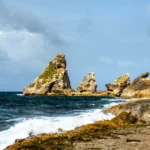
Guadeloupe or Martinique: the criterion-by-criterion comparison
| Criterion | Guadeloupe | Martinique | Advantage |
|---|---|---|---|
| Best time | Mid-December to April (February is the driest month at Pointe-à-Pitre) | Mid-December to April (March is the driest month at Fort-de-France) | Tie |
| Climate | Wettest months: September to November (more than 200 mm (7.9 in) a month) | Wettest months: August to November (more than 210 mm (8.3 in) a month) | Tie |
| Budget on the ground | About 70-110 €/day (tight), 150-250 € (comfortable) | About 70-110 €/day (tight), 150-250 € (comfortable) | Tie |
| Main airport | Pointe-à-Pitre | Martinique Aimé-Césaire airport (Le Lamentin) | Tie |
| Entry rules | Same for both: see the entry requirements section below; euro | Same for both: see the entry requirements section below; euro | Tie |
| Type of trip | Archipelago: main island plus Les Saintes, Marie-Galante, La Désirade | A single island, shorter drives between sights | Guadeloupe (variety) / Martinique (simplicity) |
| Crowds | Quieter in May-June and outside French school holidays in the dry season | Same quiet periods | Tie |
| Safety | Currents on the Atlantic coast, hurricane vigilance, thefts from cars | Same precautions; swimming also dangerous in the north (Anse Couleuvre) | Tie |
Verdict from the table: on practical criteria, neither island wins. The choice depends on what you want to do once you are there.
Entry requirements for Guadeloupe and Martinique
Both islands are overseas departments of France and part of the EU, so the same rules apply. Check the official pages before you book, as rules change.
US citizens
According to the U.S. State Department (travel.state.gov, last updated September 9, 2026), US citizens need a US passport with at least six months of validity to enter the French West Indies. No visa is required for stays of up to 90 days if you have an onward or return ticket, confirmation of accommodation and evidence that you can support yourself. Closed-loop cruises that begin and end in the United States do not require a passport, but the Department advises always travelling with one.
UK citizens
According to the UK FCDO (GOV.UK travel advice for Guadeloupe, updated 22 October 2026, and Martinique, checked 12 November 2026), your passport must have an expiry date at least three months after the date you plan to leave. You can visit without a visa for up to 90 days for tourism or business. A yellow fever vaccination certificate is required if you arrive from a country listed as a transmission risk.
Which island to choose for your profile
For a first trip to the French West Indies
Advantage Martinique. A single island and short distances: in 7 to 14 days you can stay in the south (Trois-Îlets, Sainte-Anne) and make day trips to Saint-Pierre, the Route de la Trace and the Caravelle peninsula without changing accommodation often. Guadeloupe takes more organisation: two « wings » (Grande-Terre and Basse-Terre) and boat crossings to the neighbouring islands.
Couples
A tie, with a slight edge to Guadeloupe for those who like getaways: a night on Les Saintes or Marie-Galante changes the mood. In Martinique, the small coves of the Caribbean coast (Anses-d’Arlet, Grande Anse) and the south suit a calmer stay.
Families
Advantage Martinique for young children: our guides recommend choosing supervised beaches on the Caribbean coast and in the south, where the sea is calmest, and the island limits long drives. In Guadeloupe, the beaches of southern Grande-Terre (Sainte-Anne, Saint-François) also suit families; the waterfalls and the national park will appeal to older children. On both islands, swimming is often dangerous on the Atlantic coast.
Tight budget
A tie. Our guides give the same ranges: about 60 to 90 € for a double room or gîte, 20 to 35 € for meals per person and 30 to 45 € for car rental per day on a tight budget. To pay less, aim for May, June, or September to mid-November outside French school holidays, keeping the hurricane season in mind.
Beaches, snorkeling and diving
Advantage Guadeloupe for diving, thanks to the Cousteau reserve around the Pigeon Islets, reached from Malendure (Bouillante), and the white-sand beaches of Grande-Terre. Advantage Martinique for easy snorkeling: at Anses-d’Arlet and Grande Anse, turtles are often visible near the shore; Diamond Rock and the wrecks in the Bay of Saint-Pierre attract divers.
Nature and hiking
Advantage Guadeloupe. La Soufrière, the national park and the Route de la Traversée with its waterfalls offer the most hikes. Martinique holds its own with Mount Pelée, the Route de la Trace, the Balata garden and the Caravelle peninsula.
Culture, history and rum
Advantage Martinique. Saint-Pierre, destroyed by the eruption of Mount Pelée in 1902, with its ruins and museum, the Cap 110 memorial at Le Diamant and the distilleries of the Atlantic north make up a dense heritage circuit. In Guadeloupe, heritage is found more island by island, notably on Marie-Galante.
Getting around and where to stay: what changes
On both islands a rental car is almost essential: public transport exists but is impractical for a visitor, especially in the evening and on Sundays. Traffic drives on the right, and the mountain roads (Basse-Terre, northern Martinique) are narrow and winding. The difference is boats: in Guadeloupe they are part of the trip, with regular services from Pointe-à-Pitre to Marie-Galante and Les Saintes, from Trois-Rivières to Les Saintes and from Saint-François to La Désirade, to be booked in high season. In Martinique, ferries mostly link Fort-de-France to Les Trois-Îlets, a practical alternative to the road.
| Base | Guadeloupe | Martinique |
|---|---|---|
| First stay, beaches | Sainte-Anne, Saint-François, Le Gosier: the widest choice, close to beaches and the airport | Les Trois-Îlets (Pointe du Bout, Anse Mitan): the widest choice, linked by boat to Fort-de-France |
| Quiet and snorkeling | Deshaies, Bouillante, Pointe-Noire (leeward coast, diving) | Les Anses-d’Arlet (snorkeling, sunsets) |
| Dry south and beaches | — | Sainte-Anne, Le Marin, Le Diamant |
| Mountains and hiking | Southern Basse-Terre (Trois-Rivières, Saint-Claude), base for La Soufrière | The north (Saint-Pierre, Le Carbet, Le Morne-Rouge), base for Mount Pelée |
| Islands and small stays | Marie-Galante and Les Saintes: guesthouses and gîtes, book early | — |
In practice: in Martinique, two bases are often enough (the south, then the north); in Guadeloupe, plan one base on Grande-Terre, another on Basse-Terre and, if possible, one or two nights on a neighbouring island. The cost of living is higher than in mainland France on both islands, notably for imported goods at the supermarket.
Why not both?
A Guadeloupe-Martinique combination is possible: the two islands are neighbours in the Caribbean arc. Allow at least two weeks so you do not spend your time in transit, for example a week on each island. Check inter-island connections (flight or ferry) when you book: we do not publish schedules or fares, which change often.
When to go: the same calendar for both islands
The dry season (carême) runs from mid-December to April on both islands. It is also high season, with much higher prices at Christmas and during winter school holidays. Late April to June offers the best compromise between weather and price. From June to November is hurricane season: the risk is highest from August to October, and September-October are the months our guides advise against. Sargassum seaweed can wash ashore for much of the year, very unevenly: check the official bulletins. Month-by-month details: when to go to Guadeloupe and when to go to Martinique.
On events, carnival enlivens both islands from January to Ash Wednesday. Martinique hosts the Tour des Yoles Rondes in late July to early August; Guadeloupe, the Fête des Cuisinières in August. The abolition of slavery is commemorated on May 22 in Martinique and May 27 in Guadeloupe. Check dates each year.
Frequently asked questions
Which is the prettier island, Guadeloupe or Martinique?
There is no objective answer: Guadeloupe offers more variety (archipelago, volcano, waterfalls, white-sand beaches), Martinique a more compact territory between southern beaches, Mount Pelée and heritage. Choose according to what you want to do.
Which island is cheaper?
Our guides give the same ranges for both: about 70 to 110 € per person per day on a tight budget, 150 to 250 € for comfort, excluding flights. Timing matters more than the island: May-June and September to mid-November are the cheapest.
When is the best time to go to Guadeloupe and Martinique?
Mid-December to April, in the dry season. Late April to June is the best compromise between price and weather. September and October are best avoided (rain, hurricane risk).
Do you need a passport to go to Guadeloupe or Martinique?
Yes, for US and UK citizens. According to travel.state.gov (updated September 9, 2026), US citizens need a US passport valid for at least six months and no visa for up to 90 days. According to GOV.UK, UK citizens need a passport valid for at least three months after departure and no visa for up to 90 days.
Which island is best with children?
Martinique, which is more compact and has calm, supervised beaches on the Caribbean coast and in the south, is the simplest with young children. Guadeloupe suits older children, who will enjoy the waterfalls, hiking and boat trips.
Can you visit both islands on the same trip?
Yes, allowing at least two weeks. Check inter-island connections (flight or ferry) when you book.
Further reading
- Guadeloupe travel guide
- When to go to Guadeloupe
- Martinique travel guide
- When to go to Martinique
- All our destination comparisons
Our sources
- Our published guides, the source of all data on this page (climate, budget, airports): Guadeloupe, when to go to Guadeloupe, Martinique (Météo-France normals for Fort-de-France), when to go to Martinique
- U.S. Department of State, French West Indies country information (travel.state.gov, last updated September 9, 2026)
- UK FCDO, Guadeloupe (GOV.UK, updated 22 October 2026) and Martinique (GOV.UK, checked 12 November 2026)
- Our methodology
Updated November 2026.