This Martinique travel guide is built around one simple plan: allow 7 to 14 days, a hire car and a base in the south, then in the north. That is the best way to see the beaches, the volcano and the distilleries. Martinique is a French island in the Lesser Antilles that uses the euro. In about sixty kilometres (40 mi), it goes from the sheltered beaches of the south to the forested slopes of Mount Pelée in the north, with a strong Creole identity, from its food to its agricultural rum distilleries.
To locate the towns, regions, relief, natural parks and airports, see our map of Martinique.
Martinique at a glance
CapitalFort-de-FranceFrench single territorial collectivity
AirportsMartinique Aimé Césaire International Airport (FDF), at Le Lamentin
EntryUS and UK: no visa for up to 90 days; US: passport valid 6 months; UK: passport valid 3 months after departure · travel.state.gov · GOV.UK
Electricitycheck voltage and plug type before you travel · plugs
Budgetroughly €70–110 per person per day on a budget, €150–250 for comfort · details
In short: what to do in Martinique
Swim in the south: Grande Anse des Salines, Sainte-Anne, Le Diamant
Snorkel with turtles at Les Anses-d’Arlet and Grande Anse
Climb Mount Pelée and explore the ruins of Saint-Pierre
Cross the rainforest on the Route de la Trace and visit the Balata garden
Visit an agricultural rum distillery (Habitation Clément, the north Atlantic coast)
Take a boat to the « fonds blancs » sandbanks from Le François or Le Robert
Walk the Caravelle peninsula and see the Cap 110 memorial
When to go to Martinique
The best time is the carême, the dry season, from roughly December to April: less rain, steady trade winds and no hurricane risk. It is also the high season, expensive at Christmas and in February. The hivernage, from June to November, is wetter, with the highest hurricane risk from August to October. June is often a good compromise between weather and prices. Météo-France normals and month-by-month advice are in our article on when to go to Martinique. For the end of the dry season, Martinique weather in April details rain, sea conditions and the Easter period.
What to see in Martinique: the highlights
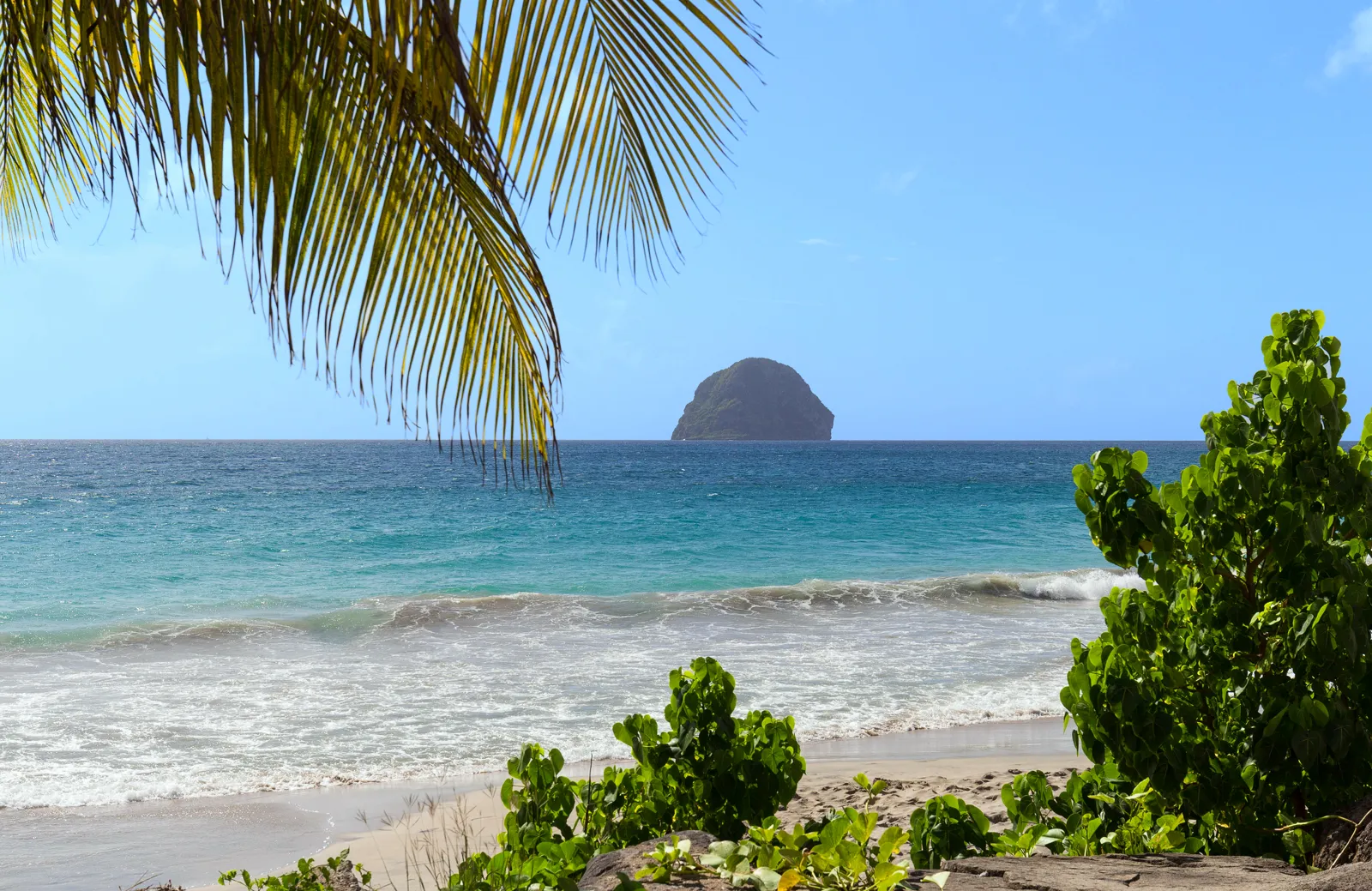
Caribbean Sea beach facing Diamond Rock, Martinique
Fort-de-France
The capital can be visited in half a day: the Schœlcher Library, a building with a metal structure, Saint-Louis Cathedral, the large covered market and its spices, and La Savane park facing the bay. Fort Saint-Louis, still used by the French Navy, can be visited on terms that vary: ask locally. Come in the morning, when the town is at its liveliest.
Les Trois-Îlets and Anse Mitan
Across the bay from Fort-de-France, this town has a wide choice of accommodation, beaches and the Pointe du Bout marina. Ferries link the area with Fort-de-France, avoiding the traffic jams. You can also visit the Domaine de la Pagerie, birthplace of Empress Joséphine.
The south: Sainte-Anne and Les Salines
The southern tip has the busiest beaches: Grande Anse des Salines, a long beach lined with coconut palms, and the neighbouring coves reached on the coastal path. Sainte-Anne, a quiet small town, makes a good base. At weekends many locals come too: arrive early.
Les Anses-d’Arlet and Diamond Rock
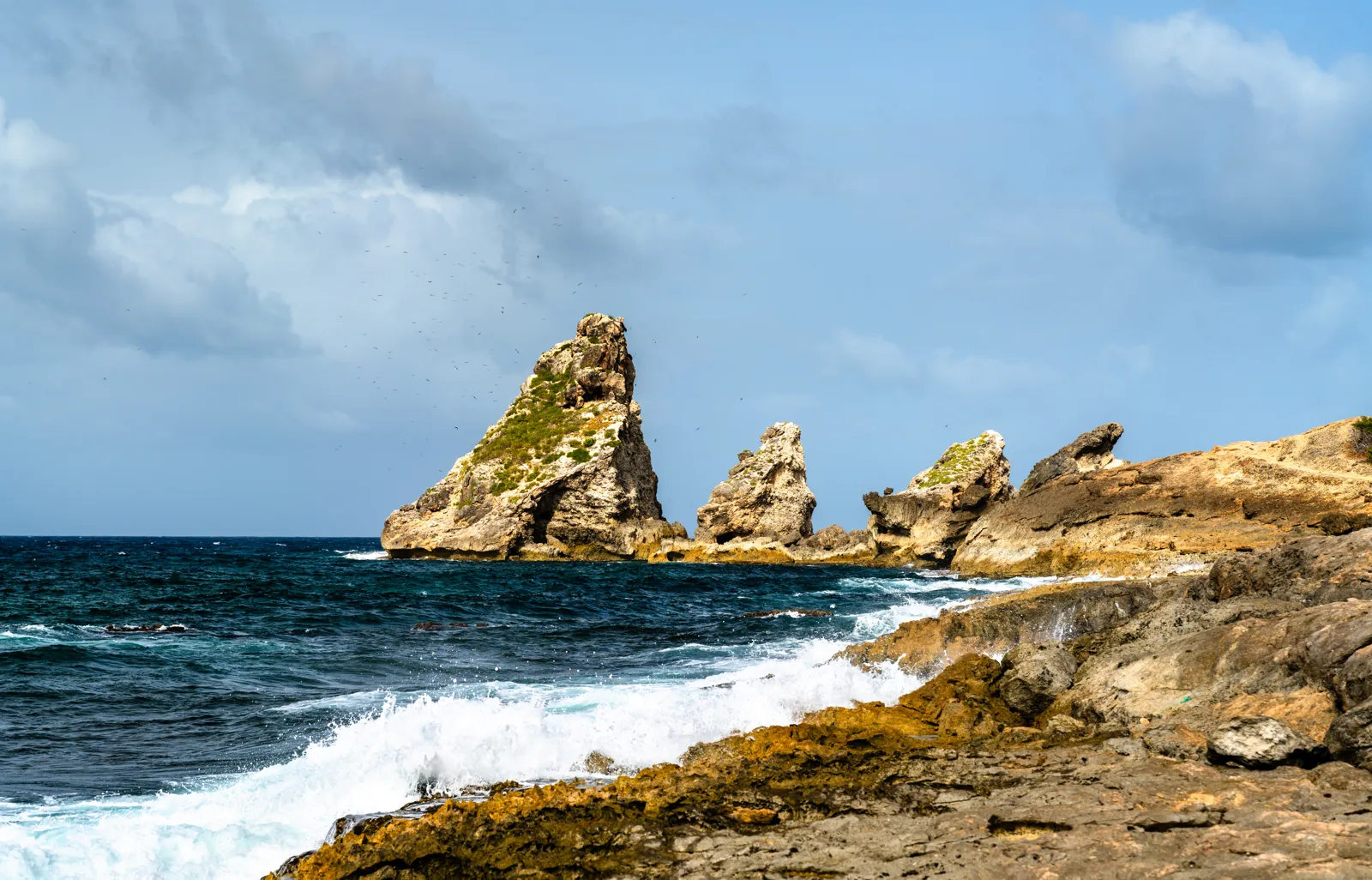
On the Caribbean coast, the village of Les Anses-d’Arlet, with its church and pier, and Grande Anse are known for snorkelling, with turtles often seen close to the shore. Further south, Diamond Rock (Rocher du Diamant), an islet rising off the coast, is a well-known dive site. Anse Noire and Anse Dufour, two small neighbouring coves, are also worth the detour.
Le Diamant and the Cap 110 memorial
At Le Diamant, at Anse Caffard, the Cap 110 memorial lines up white stone statues facing the open sea. A work by Martinican sculptor Laurent Valère, unveiled in 1998, it commemorates the 1830 wreck of an illegal slave ship, the last of its kind known in Martinique. Its name comes from the 110° bearing towards the Gulf of Guinea. The site also offers a fine view of Diamond Rock.
Saint-Pierre and Mount Pelée
Once the island’s economic capital, Saint-Pierre was destroyed by the eruption of Mount Pelée in 1902. You can walk through the ruins of the theatre and the old prison, and a museum tells the story of the disaster. The bay holds wrecks of ships sunk during the eruption, explored by divers. The volcano (1,397 m / 4,583 ft) is climbed on several trails, including the Aileron trail from Morne-Rouge: allow a day, bring water and a rain jacket, as the summit is often in the clouds. According to the UK FCDO (GOV.UK, updated 23 October 2026), Mount Pelée is an active volcano that is closely monitored by the Martinique volcanological and seismological observatory.
In the north of the island, our page on the Mount Pelée hike details routes, official durations and safety advice.
The Route de la Trace and Balata garden
The Route de la Trace links Fort-de-France with the north through the rainforest, between the Pitons du Carbet. The Balata garden, along the way, displays thousands of tropical plants and has rope bridges suspended in the trees. Several trails start from the road, such as the Trace des Jésuites.
The north Atlantic coast: Grand’Rivière and the distilleries
At the end of the road, Grand’Rivière, a fishing village backed by cliffs, is the start of a coastal trail to Le Prêcheur. The north Atlantic coast is also sugarcane country: several agricultural rum distilleries can be visited, for example at Basse-Pointe or Le Lorrain, and Habitation Clément, at Le François, combines a distillery, a Creole mansion and a park.
The Caravelle peninsula and the fonds blancs
The Caravelle peninsula, at Trinité, is a nature reserve crossed by a loop trail through mangroves, dry savannah and cliffs, as far as the ruins of the Château Dubuc. Further south, off Le François and Le Robert, the « fonds blancs » are sandy shallows where you can stand in the open sea: you reach them on a boat trip, often with a stop on an islet. For an English-speaking island nearby, Barbados and its beaches have their own guide.
Le Prêcheur and Anse Couleuvre
At the end of the Caribbean coast road, at Le Prêcheur, Anse Couleuvre is a black-sand beach framed by cliffs, in the Le Prêcheur marine nature reserve. The car park has only about ten spaces: come early. Currents make swimming dangerous; people come mainly for the scenery and to hike.
Things to do in Martinique by interest
Interest
Where in Martinique
Good to know
White-sand beaches
Les Salines, Sainte-Anne, Anse Mitan
Arrive early at weekends
Snorkelling, turtles
Les Anses-d’Arlet, Grande Anse, Anse Noire, Anse Dufour
A mask and snorkel are enough
Diving
Diamond Rock, Saint-Pierre wrecks
With a dive centre, depending on your level
Hiking
Mount Pelée, Trace des Jésuites, Caravelle, Grand’Rivière – Le Prêcheur
Days 1 to 3: settle in at Les Trois-Îlets or in the south, Les Salines beaches, Sainte-Anne, the coastal path
Day 4: Les Anses-d’Arlet, Anse Noire and Anse Dufour, snorkelling, viewpoint over Diamond Rock
Day 5: Fort-de-France in the morning (market, Schœlcher Library), then the Route de la Trace and Balata garden
Days 6 and 7: Saint-Pierre, climb of Mount Pelée early in the morning, Grand’Rivière
Days 8 to 10: Atlantic coast: Caravelle peninsula, Habitation Clément, boat trip to the fonds blancs
2 weeks: the full tour
Days 1 to 5: the south (Sainte-Anne, Les Salines, Le Diamant, Les Anses-d’Arlet), with a dive trip
Days 6 and 7: Les Trois-Îlets and Fort-de-France, Domaine de la Pagerie
Days 8 to 11: the north, changing accommodation: Saint-Pierre, Mount Pelée, Route de la Trace, Grand’Rivière, distilleries
Days 12 to 14: the Atlantic coast: Caravelle, Le François, fonds blancs and islets, kitesurfing at Le Vauclin for enthusiasts
Changing accommodation once or twice (south, then north or the Atlantic coast) avoids long daily drives: traffic is often heavy around Fort-de-France and Le Lamentin at rush hour.
Budget for a trip to Martinique
Item (per day)
Budget
Comfort
Accommodation (double room or holiday rental)
Roughly €60–90
Roughly €130–250
Meals (per person)
Roughly €20–35
Roughly €50–80
Car hire
Roughly €30–45
Roughly €50–80
Activities (boat trips, diving, entry fees)
Roughly €0–20
Roughly €30–80
Indicative ranges excluding flights, varying by season: prices are noticeably higher at Christmas and in February.
Overall, allow roughly €70–110 per person per day on a budget and €150–250 for comfort. Imported goods are expensive. Markets, small grocery shops and beach snack bars offering a dish of the day help keep costs down. The flight often weighs as much as the stay, and its price varies widely with the season.
Getting around Martinique
A hire car is almost essential: public transport exists but is impractical for visitors, especially in the evening and on Sundays. Traffic drives on the right. According to the UK FCDO (GOV.UK, updated 23 October 2026), French driving laws apply and you may need an international driving permit (IDP) as well as your UK licence: check with the hire company. The U.S. Department of State (travel.state.gov, last updated September 9, 2026) notes that seatbelt laws are strictly enforced, children under 12 may not sit in the front seat and night driving can be dangerous on winding mountain roads. Roads in the north are narrow and twisty, and traffic jams are frequent around Fort-de-France and Le Lamentin at rush hour: count in time rather than kilometres.
Ferries link Fort-de-France with Les Trois-Îlets (Pointe du Bout, Anse Mitan, Anse à l’Âne), a practical alternative to the road for visiting the capital. For the fonds blancs and the islets, book a boat trip from Le François or Le Robert.
Where to stay in Martinique
Les Trois-Îlets (Pointe du Bout, Anse Mitan): the largest choice of hotels, close to the airport and linked by boat to Fort-de-France; convenient for a first stay
Sainte-Anne, Le Marin, Le Diamant: the drier south, close to the best beaches; holiday rentals, apartment hotels and small hotels
Les Anses-d’Arlet: quieter, ideal for snorkelling and sunsets
The north (Saint-Pierre, Le Carbet, Le Morne-Rouge): a base for Mount Pelée and the Route de la Trace, rentals surrounded by greenery
Atlantic coast (Le François, Trinité, Le Vauclin): for the fonds blancs, the Caravelle and board sports
Types of accommodation: holiday rentals (gîtes) are very common and often better value than a hotel for a week
Entry requirements for Martinique
US citizens: according to the U.S. Department of State (travel.state.gov, French West Indies page, last updated September 9, 2026), you need a U.S. passport with at least 6 months’ validity. No visa is required for stays of up to 90 days if you have an onward or return ticket, confirmation of accommodation and evidence that you can support yourself.
UK citizens: according to the UK FCDO (GOV.UK, updated 23 October 2026), Martinique is an overseas department of France and part of the EU. You can visit without a visa for up to 90 days for tourism or business. Your passport must have an expiry date at least 3 months after the date you plan to leave. A yellow fever vaccination certificate is required only if you arrive from a country listed as a transmission risk.
The two sources differ on passport validity (6 months on the US page, 3 months after departure on GOV.UK): if in doubt, check with the French embassy or consulate and your airline.
Customs: GOV.UK states that you cannot bring meat, milk or products containing them into EU territory (with a few exceptions such as powdered baby milk). For what you can bring home, check your home country’s customs allowances (e.g. CBP in the US, HMRC in the UK).
Health and safety
Health: the UK FCDO (updated 23 October 2026) lists Zika, dengue and chikungunya among the health risks, as does the U.S. Department of State for chikungunya and dengue (last updated September 9, 2026): use repellent and cover up at the end of the day. According to GOV.UK, healthcare facilities are of a similar standard to those in France, and UK travellers need a GHIC or EHIC for medically necessary state healthcare; it does not replace travel insurance. The U.S. Department of State reminds US travellers that Medicare and Medicaid do not apply overseas and strongly recommends insurance covering medical evacuation; it notes a hyperbaric chamber at the university hospital in Fort-de-France. Never shelter under a manchineel tree, a coastal tree whose sap and fruit are toxic (often marked with red on the trunk). When large amounts of sargassum seaweed wash ashore, avoid staying close to it for long and follow local health authority advice.
Safety: the Atlantic coast has strong currents and swell: swim in supervised areas and respect the flags. According to GOV.UK, crime levels are low, but avoid isolated areas, including beaches, after dark; the U.S. Department of State advises not leaving valuables visible in vehicles: this applies to car parks near beaches and trailheads. The hurricane season normally runs from June to November (GOV.UK): follow Météo-France and local authority alerts. The FCDO also notes that demonstrations can take place with little warning. Emergency number (GOV.UK): 112.
Practical tips for Martinique
Money: the euro; bank cards are widely accepted and there are ATMs in the towns. Keep some cash for markets and snack bars.
Internet and phone: check your carrier’s roaming charges before you leave, or use a local SIM card or an eSIM; coverage can be weak in the north and in the forest.
Etiquette: say hello (bonjour) when entering a shop and avoid beachwear in town. French is understood everywhere; a few words of Creole are appreciated, and English is less widely spoken.
Opening hours: the day starts early; many shops close in the middle of the day, and Sundays are very quiet.
Food: try accras, colombo, fish blaff, saltfish chiquetaille and coconut sorbet; Martinique agricultural rum has a protected designation of origin (AOC), to be enjoyed in moderation.
What to pack: reef-safe sunscreen, mosquito repellent, closed shoes for hiking, a light rain jacket.
Martinique: who is it for?
Our verdict, profile by profile, based on the information in this guide:
Profile
Our verdict
Families
Yes: sheltered beaches in the south, turtles seen while snorkelling at Les Anses-d’Arlet.
Hikers
Yes: Mount Pelée, Trace des Jésuites, Caravelle peninsula, the Grand’Rivière to Le Prêcheur trail.
Divers
Yes: Diamond Rock and the wrecks of Saint-Pierre bay, with a dive centre.
Couples
Yes: quiet Les Anses-d’Arlet, sunsets, a boat trip to the fonds blancs.
Without a car
Not well suited: a hire car remains the best way to see the beaches, the volcano and the distilleries.
Budget travellers
Possible: roughly €70–110 a day excluding flights, with holiday rentals, markets and snack bars; living costs are high.
US and UK citizens need a passport but no visa for stays of up to 90 days. According to the U.S. Department of State (last updated September 9, 2026), US citizens need a passport valid for at least 6 months, plus an onward or return ticket, proof of accommodation and of sufficient funds. According to the UK FCDO (updated 23 October 2026), a UK passport must be valid for at least 3 months after the date you leave.
How much does a week in Martinique cost?
Excluding flights, allow roughly €70–110 per person per day on a budget and €150–250 for comfort. The price of the flight varies widely with the season.
When is the best time to visit Martinique?
From December to April, during the dry season (carême). June is a good compromise for lower prices. September and October, at the heart of the hurricane season, are the least favourable months. Month-by-month details are in our article on when to go to Martinique.
How many days do you need in Martinique?
A week to ten days lets you see the south, the north and Fort-de-France. Two weeks give you time to add the Atlantic coast and the fonds blancs without rushing.
Martinique or Guadeloupe: which should I choose?
Both islands have the same climate and the same seasons. Martinique is more compact, with a single main island; Guadeloupe is an archipelago, with several islands to explore by boat. See also our Guadeloupe travel guide and the page on when to go to Guadeloupe to compare.
What are the must-sees in Martinique?
The southern beaches (Les Salines, Les Anses-d’Arlet), Saint-Pierre and Mount Pelée, the Route de la Trace and Balata garden, the Caravelle peninsula, an agricultural rum distillery and a boat trip to the fonds blancs.
Where should I be careful when swimming in Martinique?
On the Atlantic coast and in the north (Anse Couleuvre, for example), where currents and swell are strong. Choose supervised beaches on the Caribbean coast and in the south, and respect the flags.
Transparency: this page contains affiliate links, labelled as such. If you book through them we may earn a commission at no extra cost to you; it does not influence our content or recommendations. How we fund the site.