
Sicily or Sardinia? Choose Sicily for a cultural trip: Greek temples, Baroque towns, Palermo, Etna and a renowned street-food scene. Choose Sardinia for the sea: coves, beaches and boat trips, on a wilder island with fewer historic sites.
The two largest islands in the Mediterranean have similar calendars, the same entry rules and the same time zone. Sicily is a little cheaper on the ground and hotter in summer; Sardinia is windier and more expensive in August, especially on the Costa Smeralda. This comparison draws on our guides to Sicily and Sardinia and on the official normals cited in our « when to go » pages.
Sicily or Sardinia: key facts
- Culture and heritage: Sicily, clearly
- Beaches and coves: Sardinia
- Best time: late April to June and September to mid-October (Sicily); late May to late June and September to early October (Sardinia)
- Budget on the ground: roughly €75 to €130 per person per day in Sicily, €80 to €135 in Sardinia on a tight budget
- Getting there: Catania and Palermo are the main gateways to Sicily; Cagliari, Olbia and Alghero serve Sardinia, with ferries from Corsica and the mainland
- Car: essential on both islands for a road trip
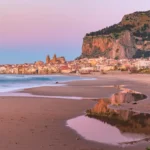
Sicily or Sardinia: comparison table
| Criterion | Sicily | Sardinia | Advantage |
|---|---|---|---|
| Best time | Late April to June, September to mid-October | Late May to late June, September to early October | Sicily: longer season |
| Summer climate | Around 34 °C (93 °F) average high in July and August (Catania) | Around 32 °C (90 °F) in July and August (Cagliari), frequent wind | Sardinia: less hot |
| Winter climate | 17 °C (63 °F) to 18 °C (64 °F) in the afternoon, good for sightseeing | Around 15 °C (59 °F), coast out of season | Sicily |
| Budget (tight) | Roughly €75 to €130 per day | Roughly €80 to €135 per day | Sicily (slightly) |
| Budget (comfort) | Roughly €155 to €295 per day | Roughly €170 to €325 per day | Sicily |
| Getting there | Airports at Catania and Palermo | Airports at Cagliari, Olbia and Alghero; ferries from Corsica and the mainland | Tie |
| Entry requirements | See the entry requirements section below | Same | Tie |
| Type of trip | Cultural road trip, cities, volcanoes, food | Beach holiday, boats, coastal walks, villages | Depends on your plan |
| Crowds | August (Italian holidays), Holy Week | August (Ferragosto), access to some beaches limited in summer | Tie |
| Safety | Petty crime; volcanic and seismic risk; wildfires in summer (UK FCDO, U.S. Department of State) | Petty crime; extreme heat and wildfires in summer (UK FCDO) | Tie |
Climate: two Mediterranean islands, Sicily hotter
Both islands have long, dry summers and rain concentrated in autumn and winter. The difference is the heat: the Catania plain reaches an average high of around 34 °C (93 °F) in July and August, against around 32 °C (90 °F) in Cagliari. Sardinia, on the other hand, is often swept by wind, in particular the mistral, which cools the air but stirs up the sea on some coasts: in a mistral, the east coast and the south are more sheltered.
| Month | Sicily (Catania) | Sardinia (Cagliari) | Best choice |
|---|---|---|---|
| January | ⚠️ 17.5 °C (64 °F) / 64 mm (2.5 in) | ⚠️ 14.7 °C (58 °F) / 37 mm (1.5 in) | Sicily |
| February | ⚠️ 18.2 °C (65 °F) / 46 mm (1.8 in) | ⚠️ 15.0 °C (59 °F) / 34 mm (1.3 in) | Sicily |
| March | ✅ 20.4 °C (69 °F) / 43 mm (1.7 in) | ⚠️ 17.5 °C (64 °F) / 32 mm (1.3 in) | Sicily |
| April | ✅ 23.8 °C (75 °F) / 30 mm (1.2 in) | ✅ 19.9 °C (68 °F) / 46 mm (1.8 in) | Sicily |
| May | ✅ 27.1 °C (81 °F) / 18 mm (0.7 in) | ✅ 24.1 °C (75 °F) / 26 mm (1.0 in) | Tie |
| June | ✅ 32.0 °C (90 °F) / 11 mm (0.4 in) | ✅ 28.7 °C (84 °F) / 13 mm (0.5 in) | Tie |
| July | ⚠️ 35.1 °C (95 °F) / 8 mm (0.3 in) | ⚠️ 31.7 °C (89 °F) / 3 mm (0.1 in) | Sardinia |
| August | ⚠️ 35.5 °C (96 °F) / 10 mm (0.4 in) | ⚠️ 32.1 °C (90 °F) / 11 mm (0.4 in) | Sardinia |
| September | ✅ 31.5 °C (89 °F) / 51 mm (2.0 in) | ✅ 28.1 °C (83 °F) / 39 mm (1.5 in) | Tie |
| October | ✅ 27.0 °C (81 °F) / 59 mm (2.3 in) | ✅ 23.9 °C (75 °F) / 44 mm (1.7 in) | Tie |
| November | ⚠️ 22.2 °C (72 °F) / 66 mm (2.6 in) | ❌ 19.0 °C (66 °F) / 74 mm (2.9 in) | Sicily |
| December | ⚠️ 18.0 °C (64 °F) / 79 mm (3.1 in) | ⚠️ 15.7 °C (60 °F) / 55 mm (2.2 in) | Sicily |
In practice: for a road trip in spring or winter, Sicily is milder. In midsummer, Sardinia is a little less stifling. In June and September, both islands are excellent. Details: when to go to Sicily and when to go to Sardinia.
Culture: Sicily well ahead
Sicily has an exceptional heritage: the Valley of the Temples at Agrigento, the temples of Segesta and Selinunte, the theatre at Taormina, the Arab-Norman route of Palermo and Monreale, the Baroque towns of the Val di Noto (Noto, Ragusa, Modica), the mosaics of the Roman villa at Casale, Ortygia in Syracuse. Several of these sites are UNESCO World Heritage sites. Add Etna, Europe’s highest active volcano, and the Aeolian Islands.
Sardinia has a quieter but distinctive heritage: the nuraghi, stone towers of the Nuragic civilisation (Su Nuraxi di Barumini, a UNESCO site), the Phoenician and Roman sites of Nora and Tharros, the Castello district of Cagliari, Alghero and its Catalan past, and the villages of the Barbagia with their masked carnivals.
Beaches and sea: advantage Sardinia
Sardinia is the « sea » island of the two: the coves of the Gulf of Orosei (Cala Luna, Cala Goloritzé) reached by boat or on foot, the La Maddalena archipelago, the dunes of Chia, the beaches of Villasimius and Costa Rei, La Pelosa with its shallow water, the quartz beaches of the Sinis. Some beaches limit access in summer: check with the local municipality.
Sicily also has fine coastline, such as the Zingaro reserve, Cefalù or the Aeolian and Egadi islands, but beaches are not the main reason to go.
Budget: Sicily slightly cheaper
Our ranges are close: roughly €75 to €130 per person per day on a tight budget in Sicily, €80 to €135 in Sardinia. The gap widens at comfort level and in August, when the Costa Smeralda is the most expensive area. In Sicily, street food (arancine, panelle, sfincione) and trattorias make it easy to eat well cheaply; in Sardinia, agriturismi (farm stays) often offer fixed-price meals of local produce. On both islands a tourist tax may be added depending on the municipality (UK FCDO, GOV.UK: many major Italian cities charge one, usually paid at the hotel).
Sicily or Sardinia by traveller profile
First trip to an Italian island
Advantage Sicily. Catania and Palermo are well-served gateways, the trip is easy to organise in 7 to 10 days in the east and south-east, and the stops are very varied: Greek sites, Baroque towns, a volcano, the sea.
As a couple
Advantage Sardinia in summer, Sicily out of season. In June or September, a week between the Gulf of Orosei and La Maddalena, staying in agriturismi, suits two people well. In spring or autumn, Taormina, Ortygia and Noto offer a more urban, food-focused trip.
With family
Advantage Sardinia. Sandy beaches with shallow water (Chia, La Pelosa, Villasimius), slightly less summer heat, a calmer pace. In Sicily, summer means visiting sites early in the morning because of the heat.
Culture and food
Advantage Sicily. Density of sites, the Ballarò and Capo markets in Palermo, cannoli, granita, pasta alla Norma: the food is part of the trip. Sardinia has a more pastoral cuisine, best discovered in agriturismi.
Hiking and nature
Tie. In Sicily: Etna (with an authorised guide for the summit zones), the Zingaro and the Aeolians. In Sardinia: the Supramonte, the Gorropu canyon and the coastal paths to the Orosei coves, with a guide for demanding routes.
Off season (November to March)
Advantage Sicily. Milder (16 °C (61 °F) to 17 °C (63 °F) in the afternoon in winter in Catania), with towns that are lively all year. In Sardinia the coast is out of season and November is the wettest month; the interior does, however, come alive for the February carnivals.
Why not both?
It is possible, but each island deserves at least a week. With two weeks, plan one week per island and a flight or ferry between the two, to be checked for the season. For a first stay, it is more comfortable to choose one island and explore it without rushing. If you are coming from Corsica, Sardinia is the easiest to reach by sea.
Our verdict
- You want Greek temples, Baroque towns and a volcano: Sicily
- You want coves, beaches and boat trips: Sardinia
- You are travelling in July or August: Sardinia, a little less hot (but expensive in August)
- You are travelling between November and April: Sicily
- You want to combine sightseeing and swimming: Sicily in September or Sardinia in June
Entry requirements and safety
US citizens (U.S. Department of State, travel.state.gov, last updated August 11, 2025): you must arrive with a valid passport; you may enter Italy for up to 90 days for tourist or business purposes without a visa. Your passport must be valid for at least 3 months beyond your period of stay, and you need proof of sufficient funds and a return ticket.
UK citizens (UK FCDO, GOV.UK, updated 21 October 2026): Italy follows Schengen rules. Your passport must have been issued less than 10 years before you arrive and be valid for at least 3 months after the day you plan to leave the Schengen area. You can travel without a visa for up to 90 days in any 180-day period. The EU Entry/Exit System (EES) is being rolled out, so you may need to register fingerprints and a photo at the border.
Safety: the UK FCDO says petty crime such as bag-snatching and pickpocketing is higher in city centres and at major tourist attractions, and that wildfires are a risk during the extended summer months, so check alerts and follow local authorities’ advice when driving through woodland. Both the FCDO and the U.S. Department of State mention active volcanoes in southern Italy; the State Department names Mt. Etna in eastern Sicily and warns that volcanic activity can disrupt travel, including airport closures. Dial 112 for emergencies. Sources read 26 October 2026.
Frequently asked questions
Which is better, Sardinia or Sicily?
It depends on your plan. Sicily is better for culture, food and off-season travel; Sardinia for beaches, coves and the sea. For a varied road trip choose Sicily; for a beach holiday, Sardinia.
Which island is cheaper, Sicily or Sardinia?
Sicily, slightly: roughly €75 to €130 per day on a tight budget, against €80 to €135 in Sardinia, excluding flights. The gap is wider at comfort level and in August, especially on the Costa Smeralda.
Sicily or Sardinia in August?
Sardinia is a little less hot (an average high of around 32 °C (90 °F) in Cagliari against around 34 °C (93 °F) in Catania), but August is the most expensive and busiest month on both islands. If you can, choose June or September.
Sicily or Sardinia with children?
Sardinia is often easier for families: sandy beaches with shallow water, a calmer pace, slightly less summer heat. Sicily also works, if you plan visits early in the morning.
How many days do you need in Sicily or Sardinia?
Allow 7 to 10 days for part of the island (east and south-east in Sicily, south and east coast in Sardinia) and 2 weeks to go all the way round.
Do you need a car in Sicily and Sardinia?
Yes, for a road trip, on both islands. In Sicily, historic centres are often limited-traffic zones (ZTL); in Sardinia, buses are infrequent, especially on Sundays and out of season.
Further reading
- Our Sicily guide and when to go to Sicily
- Our Sardinia guide and when to go to Sardinia
- Italy travel guide
- Crete or Sicily: which island should you choose?
- All our destination comparisons
Our sources
- NOAA (World Meteorological Organization data): 1991-2020 normals for the Catania-Sigonella and Cagliari-Elmas stations
- U.S. Department of State, Italy country information (travel.state.gov, last updated August 11, 2025), read 26 October 2026
- UK FCDO, foreign travel advice for Italy (GOV.UK, updated 21 October 2026), read 26 October 2026
- Comparison built from our published guides (reviewed 13 October 2026)
- Our methodology
Updated November 2026.