Looking for things to do in the Camargue? Watch flamingos at the Pont de Gau bird park or by the Étang du Fangassier, climb onto the roof of the church in Saintes-Maries-de-la-Mer, ride a horse through the marshes, see the pink salt pans of Salin-de-Giraud, walk the trails of the Domaine de la Palissade and finish on the wild beaches of Piémanson or Beauduc. To visit the Camargue, also plan time for Arles, gateway to the delta, and Aigues-Mortes, on the Gard side. For another great Provençal natural site, more mountainous, our guide to things to do in the Verdon Gorge covers viewpoints, the lake and trails.
Between the two arms of the Rhône, the delta forms the Camargue Regional Nature Park: more than 70 km (43 mi) of beaches between Port-Saint-Louis-du-Rhône and Saintes-Maries-de-la-Mer, lagoons, salt marshes and rice fields. The best times are April-June and September-October. This guide covers the highlights, the official park rules (Beauduc, dogs, fires, driving), an itinerary, the budget and the month-by-month climate from Météo-France. Park rules like those at Beauduc have their equivalent on the Var island: see our guide to a stay on Porquerolles.

Our travel deals for Camargue
Affiliate links: we earn a commission, at no extra cost to you.
 FlightsKiwi.comCompare flights and airline combinations to Camargue.Compare flights

The Camargue at a glance
- Location Rhône deltaBetween Arles, Saintes-Maries-de-la-Mer, Salin-de-Giraud and Port-Saint-Louis-du-Rhône (Bouches-du-Rhône); the Petite Camargue extends into the Gard around Aigues-Mortes
- Currency euro (€) · currencies
- Time zone UTC+1, UTC+2 in summer: one hour ahead of London, six hours ahead of New YorkLocal time now: –:–
- Getting there Arles station is served by TGV and regional TER trains · details
- Entry Schengen area: no visa for up to 90 days for US citizens (tourism or business) and UK citizens (in any 180-day period) · US: travel.state.gov · UK: GOV.UK
- Car very useful, the sites are far apartCycling is ideal once there
- Mosquitoes numerous from late spring to autumnBring repellent and covering clothes
- Recommended stay 2 to 3 days, 4 to 5 with Arles and Aigues-Mortes
- Budget see our budget section
When to go to the Camargue
The best times are April to June and September-October. The climate is Mediterranean: in Arles, only 12.9 mm (0.5 in) of rain falls on average in July, but summer is hot (average high of 29.8 °C, or 86 °F) and mosquitoes are numerous. The autumn rains arrive in September (83.7 mm, or 3.3 in) and last until November. Winter is cool and often windy with the mistral, but it is a very good season for birds: thousands of flamingos and migratory birds winter on the lagoons.
When to go to the Camargue: key points
- Best times: April to June, September-October
- Birdwatching: all year; spring and autumn for migration
- Swimming: June to September
- Hottest month: July, average high of 29.8 °C (86 °F) in Arles
- Wettest month: September, 83.7 mm (3.3 in) on average
- Good to know: big crowds in Saintes-Maries during the May pilgrimages
| Month | Max | Min | Rain | Crowds | Prices | Verdict |
|---|---|---|---|---|---|---|
| January | 11.3 °C (52 °F) | 3.4 °C (38 °F) | 53.5 mm (2.1 in) | Very low | Low | ⚠️ Wintering birds, cold mistral |
| February | 12.5 °C (54 °F) | 3.4 °C (38 °F) | 33.3 mm (1.3 in) | Very low | Low | ⚠️ Dry and bright, cool nights |
| March | 16.2 °C (61 °F) | 6.1 °C (43 °F) | 33.9 mm (1.3 in) | Low | Low | ✅ Migration begins, few people |
| April | 18.9 °C (66 °F) | 8.7 °C (48 °F) | 57.3 mm (2.3 in) | Medium (Easter) | Medium | ✅ Nature awakening, ideal by bike |
| May | 22.8 °C (73 °F) | 12.4 °C (54 °F) | 40.1 mm (1.6 in) | High (pilgrimage, long weekends) | Medium to high | ✅ Lovely month; Saintes-Maries very busy around the pilgrimage |
| June | 27.1 °C (81 °F) | 16.0 °C (61 °F) | 27.0 mm (1.1 in) | High | High | ✅ Hot and dry, first swims, mosquitoes |
| July | 29.8 °C (86 °F) | 18.0 °C (64 °F) | 12.9 mm (0.5 in) | Very high | Very high | ⚠️ Pleasant beaches, heat and mosquitoes |
| August | 29.6 °C (85 °F) | 17.7 °C (64 °F) | 26.9 mm (1.1 in) | Very high | Very high | ⚠️ Very hot, crowded coast |
| September | 25.3 °C (78 °F) | 14.4 °C (58 °F) | 83.7 mm (3.3 in) | Medium | Medium | ✅ Sea still warm, rice harvest, first storms |
| October | 20.7 °C (69 °F) | 11.6 °C (53 °F) | 80.9 mm (3.2 in) | Low | Medium to low | ✅ Soft light, migrating birds return |
| November | 15.2 °C (59 °F) | 7.3 °C (45 °F) | 76.5 mm (3.0 in) | Very low | Low | ⚠️ Autumn rain, quieter sites |
| December | 11.9 °C (53 °F) | 4.0 °C (39 °F) | 43.6 mm (1.7 in) | Very low | Low | ⚠️ Cool and windy, lots of flamingos |
- Spring (March to May): the ideal season for birds, horse riding and cycling, with 16 to 23 °C (61 to 73 °F) in the afternoon. The Saintes-Maries-de-la-Mer pilgrimage in late May draws huge crowds: book well ahead or avoid these dates if you want peace and quiet.
- Summer (June to August): 27 to 30 °C (81 to 86 °F) and very little rain. The wild beaches are pleasant, but heat and mosquitoes make the marshes less enjoyable in the middle of the day. According to the park, wooded areas can be temporarily closed from 1 June to 30 September.
- Autumn (September to November): September and October bring lovely light, the sea is still fine for swimming in September and migratory birds return. The rain, sometimes stormy, sets in.
- Winter (December to February): 11 to 12 °C (52 to 54 °F) in the afternoon, frequent mistral. It is the quietest season and one of the best for watching flamingos, which gather in large numbers on the lagoons.
For more spring ideas, see our selection of where to go in May, and for the shoulder season, where to go in October.
Things to do in the Camargue: the highlights
Saintes-Maries-de-la-Mer
The Camargue’s seaside capital is built around Notre-Dame-de-la-Mer, a fortified church whose roof terrace looks out over the delta and the Mediterranean. It is an important place of pilgrimage, especially for the Roma communities, every year in late May. The bullring, the seafront and boat trips on the Petit Rhône round off the visit. Beaches stretch out on either side of the village.
The Pont de Gau bird park
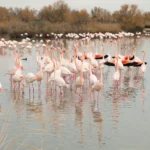
A few kilometres north of Saintes-Maries, this private park is the easiest place to see flamingos and many water birds up close, along marked trails around the marshes. Allow two to three hours, and bring binoculars and mosquito repellent in season.
The Étang de Vaccarès and the national reserve
At the centre of the delta, the Étang de Vaccarès is the largest lagoon in the Camargue. It is surrounded by a national nature reserve, part of which can be explored from the La Capelière information centre (trails and hides). The road along the Étang du Fangassier, towards Salin-de-Giraud, is one of the best places to watch flamingos. Stay on the roads and in the car parks: the park points out that driving is prohibited off roads open to public traffic.
Salin-de-Giraud and the salt pans
In the south-east of the delta, Salin-de-Giraud is a workers’ village that grew up around salt production. The salt marshes turn pink in summer, and a viewpoint looks out over the camelles, huge mountains of salt. The village is the starting point for the Domaine de la Palissade and the beaches of Piémanson and Beauduc.
The Domaine de la Palissade
Managed by the regional nature park for the Conservatoire du littoral, this 700-hectare (1,730-acre) estate between Salin-de-Giraud and Piémanson is one of the last examples of the delta before the Rhône was diked. Three trails of 1.5 km, 3 km and 7 km (1, 2 and 4 mi), with hides, can be walked freely. According to the park’s official site (checked 26 October 2026), entry costs €5 (€10 with a guided visit, free for under-12s), and pets are not allowed on the trails. Horse rides and kayak outings are offered from April to November, by reservation only.
The wild beaches: Piémanson, Beauduc, Napoléon
Piémanson, near Salin-de-Giraud, is a vast sandy beach at the end of the road. Beauduc, more isolated, is reached by several kilometres of track: a width gauge restricts access to vehicles less than 2.08 m (6 ft 10 in) wide. Plage Napoléon, at Port-Saint-Louis-du-Rhône, has the most facilities. All are exposed to the wind with no shade: bring water, a hat and a weighted parasol.
The sea dike and the lighthouses
The Digue à la Mer, closed to all motor traffic, runs along the coast between Saintes-Maries and the southern end of the Vaccarès: it is one of the finest cycling or walking routes in the delta, between lagoons and the Mediterranean. It leads towards the Gacholle lighthouse. The Faraman and Beauduc lighthouses complete this maritime heritage, built between 1835 and 1902 to guide ships along a low-lying, dangerous coast.
Manades, horses and traditions
The manades are ranches that raise Camargue bulls and horses. Several offer visits, cattle sorting demonstrations or meals: ideally choose one that welcomes small groups. A horse ride with a riding centre is the classic way to discover the marshes. The course camarguaise, in which raseteurs try to snatch rosettes from the bull’s horns without killing it, takes place in village arenas in spring and summer.
The Musée de la Camargue
Housed in a former sheepfold at the Mas du Pont de Rousty, between Arles and Saintes-Maries, the Musée de la Camargue traces the history of the delta, livestock farming, rice growing and local life. A trail leads from the museum across the farm’s land. It is also a good option on a rainy day.
Arles and Aigues-Mortes
Arles, north of the delta, is a UNESCO World Heritage Site for its Roman and Romanesque monuments: the arena, the Roman theatre and the Saint-Trophime cloister. The LUMA Foundation tower marks the entrance to the Parc des Ateliers. To the west, in the Gard, the fortified town of Aigues-Mortes can be explored along its ramparts, with views over the nearby salt pans.
Park rules and good practice
The rules below are published by the Camargue Regional Nature Park on its official site (parc-camargue.fr, checked 26 October 2026); they can change, so check them before your trip.
| Topic | What you need to know |
|---|---|
| Driving | Vehicles are prohibited off roads open to public traffic; park in the car parks and do not create new tracks. |
| Dogs | Must be kept on a leash in the park; pets are not allowed on the trails of the Domaine de la Palissade. |
| Fire risk | Smoking and lighting fires are prohibited; wooded areas can be temporarily closed from 1 June to 30 September. |
| Beauduc | Vehicles must be less than 2.08 m (6 ft 10 in) wide; motor traffic is banned on the sea dike (prefectoral order of 24 October 2002); quads and motocross bikes are banned (Arles order of 10 June 2021); camping and caravanning are prohibited. |
| Pointe de Beauduc | Access on foot, by bike or on horseback for the day; camping, bivouacking and fires prohibited; dogs on a leash; riders excluded from the point from 1 April to 30 September. |
| Wildlife and plants | Follow the waymarking, keep your distance from birds, pick nothing, and put drones away (the park links to a map of drone restriction zones). |
Checklist for a day in the Camargue
- Mosquito repellent and covering clothes (especially from May to October)
- Binoculars for the birds
- At least 1.5 litres (50 fl oz) of water per person, a hat, sunscreen
- A full tank of fuel: distances are long and petrol stations are rare in the south of the delta
- In summer, check the fire-risk level before an outing in wooded areas
- Leave the dog behind for the Domaine de la Palissade
- Take all your rubbish home
Itinerary ideas for the Camargue
2 days in the Camargue
- Day 1: Arles in the morning, the Musée de la Camargue, then the Pont de Gau bird park and sunset in Saintes-Maries-de-la-Mer
- Day 2: a horse ride or bike ride on the sea dike, the road along the Étang de Vaccarès and the Fangassier, Salin-de-Giraud, the Domaine de la Palissade and Piémanson beach
4 to 5 days between Arles, the delta and the Petite Camargue
- Day 1: Arles (arena, Roman theatre, Saint-Trophime, LUMA)
- Day 2: Musée de la Camargue, La Capelière, Pont de Gau
- Day 3: Saintes-Maries-de-la-Mer, boat trip on the Petit Rhône, a manade
- Day 4: Salin-de-Giraud, La Palissade, Beauduc or Piémanson
- Day 5: Aigues-Mortes and its ramparts
To continue to the Alpilles, Avignon or the Luberon, see our Provence guide and our tips for planning a road trip; to the east, see our guide to visiting Cassis, and to the west our page on Carcassonne.
Budget for visiting the Camargue
| Item (per person per day) | Tight budget | Comfort |
|---|---|---|
| Accommodation (sharing a double room) | roughly €25 to €50 (campsite, simple B&B) | roughly €80 to €150 (mas, hotel) |
| Meals | roughly €25 to €35 | roughly €45 to €70 |
| Transport (fuel, bike hire) | roughly €10 to €15 | roughly €15 to €25 |
| Activities (bird park, horse riding, museum) | roughly €10 to €15 | roughly €20 to €40 |
| Total | roughly €70 to €110 | roughly €150 to €260 |
Getting around the Camargue
- Train: Arles station is served by TGV high-speed, intercity and regional TER trains, about ten minutes’ walk from the centre. See our tips for travelling cheaply by train.
- Car: the most practical way to link the sites, which are far apart. The roads are straight but narrow; do not stop on the verges.
- Bike: the delta is flat and ideal for cycling, but exposed to wind and sun. The sea dike is reserved for walkers, cyclists and riders.
- Coach: regular bus lines link Arles with Saintes-Maries-de-la-Mer and Salin-de-Giraud; timetables are limited.
- Ferry: the Barcarin ferry crosses the Grand Rhône between Salin-de-Giraud and Port-Saint-Louis-du-Rhône.
Where to stay in the Camargue
Saintes-Maries-de-la-Mer has most of the hotels, campsites and rentals, close to the beaches and Pont de Gau. Camargue mas (farmhouses), often isolated between Arles and Saintes-Maries, offer a country feel with horses and rice fields. Arles is the best base without a car, thanks to its station. Salin-de-Giraud suits the southern beaches and La Palissade. Book very early for late May and summer.
Entry requirements, health and safety
- US citizens: no visa for up to 90 days in the Schengen area, including France, for tourism or business; your passport should be valid at least three months beyond your stay, and you may be asked for proof of funds and a return ticket (U.S. Department of State, travel.state.gov, last updated August 11, 2025).
- UK citizens: no visa for up to 90 days in any 180-day period; your passport must have been issued less than 10 years before arrival and be valid at least 3 months after you leave the Schengen area. Under the EU Entry/Exit System (EES), fingerprints and a photo may be taken at your first entry (UK FCDO, GOV.UK, updated 22 October 2026).
- Health: UK travellers need a GHIC or valid EHIC for state healthcare; everyone should have travel insurance covering medical costs. Emergency numbers: 15 (medical), 17 (police), 18 (fire), 112 (European emergency number) (GOV.UK, travel.state.gov).
- Mosquitoes: the park advises bringing mosquito repellent; they are very active at dusk.
- Heat and sun: there is little shade in the delta; drink regularly and avoid the marshes in the middle of the day in summer.
- Sea: the wild beaches are not supervised; beware of currents and offshore winds that carry inflatables out to sea. The UK FCDO advises swimming where lifeguards are present and following the flags.
- Bulls and horses: never enter the manades’ fields.
- Wildfires: the UK FCDO notes that the risk is highest in summer along the Mediterranean and that causing a wildfire, even by accident, is illegal.
For horse riding, kayaking or kitesurfing, check what your travel insurance covers.
Practical tips for the Camargue
- Light: birds and landscapes are at their best early in the morning and late in the day.
- Respect wildlife: keep your distance from flamingos and nests, and stay on the marked trails.
- Food: try Camargue rice, gardiane (bull stew) and fleur de sel.
- On a rainy day: Musée de la Camargue, the monuments of Arles, the church in Saintes-Maries, the ramparts of Aigues-Mortes.
- Internet: coverage is good in the villages, weaker in the south of the delta; check your home carrier’s roaming charges.
Frequently asked questions
What can you do in the Camargue in one day?
Start with the Pont de Gau bird park, visit Saintes-Maries-de-la-Mer and the church roof, then follow the road along the Étang de Vaccarès towards the Fangassier and Salin-de-Giraud to see the flamingos and salt pans, and finish at Piémanson beach.
Where can you see flamingos in the Camargue?
At the Pont de Gau bird park, on the lagoons around the Vaccarès, by the Étang du Fangassier and in the salt pans of Salin-de-Giraud. They are there all year and very numerous in winter.
What is the best time to visit the Camargue?
April to June and September-October: 19 to 27 °C (66 to 81 °F) in the afternoon in Arles according to Météo-France 1991-2020 normals, fewer mosquitoes than in midsummer and plenty of birds. Winter is ideal for flamingos, but cool and windy.
Can you drive to Beauduc beach?
Yes, along several kilometres of track, with a width gauge that restricts access to vehicles less than 2.08 m (6 ft 10 in) wide. Motor traffic is banned on the sea dike, and camping is prohibited.
Are dogs allowed in the Camargue?
Yes, on a leash, according to the regional nature park. Pets are not allowed on the trails of the Domaine de la Palissade.
Can you visit the Camargue without a car?
Partly: from Arles station, buses run to Saintes-Maries-de-la-Mer and Salin-de-Giraud. Once there, a bike lets you ride the sea dike and explore around the villages.
Our sources
- Camargue Regional Nature Park (parc-camargue.fr): pages on good practice in the park, Beauduc and the Domaine de la Palissade, checked 26 October 2026
- Météo-France: Arles climate sheet (station 13004003), 1991-2020 statistics
- Wikipedia: « Gare d’Arles » article (TGV, intercity and TER services)
- Entry requirements, health and safety checked on 26 October 2026: U.S. Department of State, France country information (last updated August 11, 2025) and UK FCDO, GOV.UK foreign travel advice for France (updated 22 October 2026).
- Our methodology
Updated October 2026.
For more ideas, see our France travel guide and our destinations in Europe.