To visit Rotterdam is to discover the other great city of the Netherlands: Europe’s largest port, a centre rebuilt after 1940 as a laboratory of modern architecture, the Cube Houses, the Markthal and the Erasmus Bridge, with the Kinderdijk windmills nearby. What to see in Rotterdam, how to plan a stay of 1 or 2 days and when to go based on the normals of the Royal Netherlands Meteorological Institute (KNMI): here are the essentials, backed by verified sources.
The country’s second city after Amsterdam, Rotterdam has about 634,000 inhabitants (2017) and lies at the mouth of the Rhine and the Meuse. The bombing of 14 May 1940 destroyed its entire centre: the city chose not to rebuild it as it was and called on contemporary architects. That is what sets it apart from the canal towns of the rest of Holland.

Our travel deals for Rotterdam
Affiliate links: we earn a commission, at no extra cost to you.
 FlightsKiwi.comCompare flights and airline combinations to Rotterdam.Compare flights
- Tickets and toursTiqetsEntry tickets and guided tours to book online; compare with the official price.See tickets
- Audio guidesWeGoTripSelf-guided audio tours on your phone.See audio tours



Rotterdam at a glance
- Location South Holland, western Netherlands, on the Nieuwe Maas
- Highlights Cube Houses, Markthal, Erasmus Bridge, Euromast, St Lawrence Church, Delfshaven, museums, Kinderdijk windmills
- Airports Rotterdam The Hague Airport north of the city; Amsterdam Schiphol is the country’s international hub; Rotterdam Centraal station is served by international trains
- In the city metro (5 lines), trams, buses (RET network), water buses and water taxis
- Entry Schengen area: no visa for short stays for US and UK citizens; see entry requirements
- Currency and time euro; UTC+1 (UTC+2 in summer), 1 hour ahead of London and 6 hours ahead of New York
- Ideal length 1 to 2 days, plus half a day for Kinderdijk
What to see in Rotterdam: the highlights
The Cube Houses and the Blaak tower
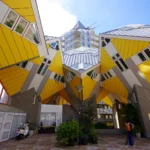
Designed by the architect Piet Blom and completed in 1984, the Cube Houses (kubuswoningen) are homes shaped like tilted cubes set on pillars. They go together with the Blaak tower, nicknamed « the Pencil ». This is the city’s best-known image, right next to Rotterdam Blaak station.
The Markthal
Opposite the Cube Houses, the Markthal opened on 1 October 2014. Designed by the MVRDV practice, it is a huge horseshoe-shaped arch housing a covered market, restaurants and 228 apartments built into its walls. Its ceiling, painted by Arno Coenen and Iris Roskam, has earned it the nickname « Sistine Chapel of Rotterdam ». A good lunch stop.
St Lawrence Church
Built in 1449 in the Brabantine Gothic style, the Laurenskerk is Rotterdam’s oldest building. Badly damaged in 1940, it was rebuilt. A statue of Erasmus, who was born in Rotterdam, stands in front. It is a few minutes’ walk from the Markthal.
The Erasmus Bridge and Kop van Zuid
Opened in 1996 and designed by Ben van Berkel, the Erasmus Bridge combines a cable-stayed section with a 278 m (912 ft) span and a bascule section. It leads to Kop van Zuid, on the south bank of the Nieuwe Maas, home to Hotel New York, the former headquarters of the Holland America Line and departure point for transatlantic crossings, the Montevideo tower and Rem Koolhaas’s De Rotterdam building (2013), the largest in the country by floor area.
The Euromast and Het Park
Built in 1958-1960, the Euromast tower overlooks Het Park, from where cruises on the Nieuwe Maas depart. It is one of the city’s most visited paid attractions, along with the Spido harbour cruises and Blijdorp Zoo.
Delfshaven
This harbour district west of the centre was spared by the bombing. It gives an idea of what Rotterdam was like before 1940, with its quays and old houses. It is also home to the Slavery Monument (Slavernijmonument).
The museums
The Museum Park brings together six museums in the heart of the city, including the Kunsthal, devoted to contemporary art, and Het Nieuwe Instituut, devoted to architecture. The Boijmans Van Beuningen museum, opened in 1849, is the best known; the Maritiem Museum recalls the port’s place in the city’s history. Check opening hours and any closures for works on the museums’ official websites before you go.
The Kinderdijk windmills
About 15 km (9 mi) east of Rotterdam, Kinderdijk has nineteen windmills, the largest and best-preserved group in the Netherlands, a testament to 18th-century water engineering. The site has been a UNESCO World Heritage Site since 1997. You can get there by Waterbus, the water bus line that also serves Dordrecht. Check the timetable before you go.
Itinerary: Rotterdam in 1 or 2 days
| Time | Day 1: centre and architecture | Day 2: the river and neighbourhoods |
|---|---|---|
| Morning | Cube Houses, Blaak tower | Erasmus Bridge on foot, Kop van Zuid, Hotel New York |
| Midday | Markthal | Cruise on the Nieuwe Maas from Het Park |
| Afternoon | St Lawrence Church, Museum Park | Euromast, then Delfshaven |
| Option | Lijnbaan, the first fully pedestrianised shopping street in the Netherlands | Half a day at Kinderdijk by Waterbus |
When to go to Rotterdam
From May to September, when maximums exceed 17.9 °C (64 °F) and the days are sunniest (up to 7.3 hours of sunshine a day in May). April is the driest month (42 mm (1.7 in)): a good compromise for visiting the city and Kinderdijk. Summer stays temperate: 22.7 °C (73 °F) on average in the afternoon in July. From August to December, rain increases: August is the wettest month (92 mm (3.6 in)), November and December the rainiest by number of days (13 days). Winter is cool, grey and windy.
| Month | Max | Min | Rain | Rainy days | Sunshine / day | Verdict |
|---|---|---|---|---|---|---|
| January | 6.4 °C (44 °F) | 1.3 °C (34 °F) | 71.0 mm (2.8 in) | 12.0 | 2.2 h | ⚠️ Cold, grey |
| February | 7.1 °C (45 °F) | 1.1 °C (34 °F) | 66.0 mm (2.6 in) | 10.0 | 3.2 h | ⚠️ Cold |
| March | 10.3 °C (51 °F) | 2.4 °C (36 °F) | 57.0 mm (2.2 in) | 12.0 | 4.6 h | ⚠️ Cool, changeable |
| April | 14.3 °C (58 °F) | 4.8 °C (41 °F) | 42.0 mm (1.7 in) | 9.0 | 6.4 h | ✅ Driest |
| May | 17.9 °C (64 °F) | 8.1 °C (47 °F) | 56.0 mm (2.2 in) | 9.0 | 7.3 h | ✅ Sunniest |
| June | 20.6 °C (69 °F) | 11.0 °C (52 °F) | 69.0 mm (2.7 in) | 10.0 | 7.2 h | ✅ Pleasant |
| July | 22.7 °C (73 °F) | 13.2 °C (56 °F) | 79.0 mm (3.1 in) | 10.0 | 7.1 h | ✅ Mildest |
| August | 22.6 °C (73 °F) | 12.9 °C (55 °F) | 92.0 mm (3.6 in) | 10.0 | 6.5 h | ⚠️ Mild but rainy |
| September | 19.3 °C (67 °F) | 10.5 °C (51 °F) | 90.0 mm (3.5 in) | 12.0 | 5.1 h | ✅ Still mild |
| October | 14.9 °C (59 °F) | 7.2 °C (45 °F) | 87.0 mm (3.4 in) | 12.0 | 3.7 h | ⚠️ More rain |
| November | 10.2 °C (50 °F) | 3.9 °C (39 °F) | 88.0 mm (3.5 in) | 13.0 | 2.2 h | ❌ Rainy, dark |
| December | 7.0 °C (45 °F) | 1.4 °C (35 °F) | 86.0 mm (3.4 in) | 13.0 | 1.8 h | ❌ Darkest |
How sunny is Rotterdam?
Rotterdam receives an average of 1,752 hours of sunshine a year according to the KNMI. Spring is the brightest season (7.3 hours a day in May), while December averages only 1.8 hours a day (Destination de Voyage calculation based on the KNMI normals).
How many rainy days over a 3-day stay?
Scaling each month’s average number of days with precipitation to a three-day stay, you can expect about 0.9 rainy days in May, compared with 1.3 in November. Rain is therefore likely over a long weekend, whatever the season: keep the museums and the Markthal for rainy spells. Destination de Voyage calculation based on the KNMI 1991-2020 normals.
| Month | Expected rainy days out of 3 | Rain in the month |
|---|---|---|
| January | 1.2 | 71 mm (2.8 in) |
| February | 1.1 | 66 mm (2.6 in) |
| March | 1.2 | 57 mm (2.2 in) |
| April | 0.9 | 42 mm (1.7 in) |
| May | 0.9 | 56 mm (2.2 in) |
| June | 1.0 | 69 mm (2.7 in) |
| July | 1.0 | 79 mm (3.1 in) |
| August | 1.0 | 92 mm (3.6 in) |
| September | 1.2 | 90 mm (3.5 in) |
| October | 1.2 | 87 mm (3.4 in) |
| November | 1.3 | 88 mm (3.5 in) |
| December | 1.3 | 86 mm (3.4 in) |
To compare with the rest of the country, see the best time to visit the Netherlands.
Getting there and getting around
- By train: Rotterdam Centraal is served by international trains, including to Belgium and France. Timetables and operators are on the rail companies’ websites.
- By air: Rotterdam The Hague Airport is north of the city; the country’s international hub is Amsterdam Schiphol, with direct trains to Rotterdam Centraal.
- In the city: the RET network runs the metro, the first in the Netherlands, opened in 1968 and now with five lines, as well as the trams and buses.
- On the water: water buses (Waterbus) to Kinderdijk and Dordrecht, and water taxis with some fifty landing stages in the city.
- By bike: about 600 km (373 mi) of cycle paths, including a lane along the Erasmus Bridge. GOV.UK warns that cyclists and mopeds have right of way and often ignore traffic rules: look out for them when crossing.
Where to stay
The centre, between Rotterdam Centraal, Blaak and the Markthal, puts you within walking distance of the main sights. Kop van Zuid, on the south bank, has views of the river and the Erasmus Bridge, with the metro to reach the centre. Delfshaven suits those who want an older setting.
If you… then…: choosing your trip
| If you… | Then… |
|---|---|
| have only one day | Cube Houses, Markthal, St Lawrence, then the Erasmus Bridge: all on foot or by metro |
| love architecture | Kop van Zuid, De Rotterdam, Rotterdam Centraal and the Van Nelle Factory, a UNESCO site since 2014 |
| are travelling as a family | Euromast, Blijdorp Zoo and a harbour cruise |
| want to see windmills | Kinderdijk by Waterbus, combined with Dordrecht |
| are heading on to the capital | continue to Amsterdam by train |
Entry requirements, health and safety
- US citizens: the Netherlands applies Schengen rules. Your passport should be valid for at least three months beyond your period of stay, and you need sufficient proof of funds and a return ticket (U.S. Department of State, travel.state.gov, last updated August 13, 2026).
- UK citizens: no visa for up to 90 days in any 180-day period. Your passport must have been issued less than 10 years before the day you arrive and be valid at least 3 months after the day you plan to leave the Schengen area. The EU Entry/Exit System (EES) is being implemented: fingerprints and a photo may be taken, free of charge (UK FCDO, GOV.UK, updated 11 August 2026).
- ID: anyone aged 14 or over must always be able to show identification; British nationals should use their passport (GOV.UK).
- Safety: GOV.UK reports regular violent incidents between organised crime gangs involved in drug trafficking in large cities including Rotterdam; these rarely involve visitors, but stay alert. Pickpockets operate on trains between the major cities. Emergencies: 112.
- Health: UK travellers need a GHIC or EHIC for medically necessary state healthcare (GOV.UK); everyone should have travel insurance covering medical costs.
- Weather: rain and wind are possible in every season; bring a waterproof jacket.
Frequently asked questions
How many days do you need to visit Rotterdam?
One day for the Cube Houses, the Markthal, St Lawrence and the Erasmus Bridge; two days to add the Euromast, Delfshaven, a cruise and a museum, plus half a day for Kinderdijk.
What is the best time to visit Rotterdam?
From May to September. April is the driest month (42 mm (1.7 in)) and May the sunniest, according to the KNMI 1991-2020 normals.
Why is Rotterdam’s architecture so modern?
The centre was destroyed by the bombing of 14 May 1940. The city chose not to rebuild it as it was and called on contemporary architects.
How do you get to Kinderdijk from Rotterdam?
The Waterbus Rotterdam-Drechtsteden serves Kinderdijk, about 15 km (9 mi) to the east. Check the timetable before you go.
Do US and UK citizens need a visa for Rotterdam?
No for short stays: the Netherlands applies Schengen rules. UK citizens can stay up to 90 days in any 180-day period (GOV.UK, updated 11 August 2026); US citizens need a passport valid at least three months beyond their stay (travel.state.gov, last updated August 13, 2026).
Our sources
- KNMI (Royal Netherlands Meteorological Institute), 1991-2020 normals for Rotterdam, via the Wikipedia climate box (article « Rotterdam »), checked on 23 October 2026
- Entry requirements, health and safety checked on 26 October 2026: U.S. Department of State, Netherlands country information (last updated August 13, 2026) and UK FCDO, GOV.UK foreign travel advice for the Netherlands (updated 11 August 2026)
- Wikipedia: « Rotterdam », « Markthal », « Cube houses », « Kinderdijk », checked on 23 October 2026
- Destination de Voyage calculations: sunshine per day, rainy days over a 3-day stay
- Our methodology
Updated October 2026.
To extend your trip, see our guides to the Netherlands and Amsterdam and our destinations in Europe.