According to UNESCO, Ohrid and Lake Ohrid form a “mixed” World Heritage property: a very ancient lake, home to more than 200 endemic species, and a town that is among “the oldest human settlements in Europe”. This guide to help you visit Ohrid covers what to see in the town and around the lake, the best season according to the official climate normals, and the entry and safety information that matters for US and UK travelers.
Ohrid is almost always combined with the capital: see our North Macedonia travel guide, our page on what to see in Skopje and the time difference in North Macedonia. The lake is shared with Albania.

Our travel deals for Ohrid
Affiliate links: we earn a commission, at no extra cost to you.
 FlightsKiwi.comCompare flights and airline combinations to Ohrid.Compare flights

Ohrid at a glance
- World Heritage inscribed in 1979 (natural) and 1980 (cultural), extended in 2019 to the Albanian part of the lake (checked on 11 November 2026 on the UNESCO site)
- Time zone UTC+1 (UTC+2 in summer): 1 hour ahead of London, 6 hours ahead of New York
- Entry no visa for short tourist stays for US citizens (under 90 days in six months) and UK citizens (up to 3 months); see travel.state.gov and GOV.UK
- Climate average high of 27.7 °C (82 °F) in August, average low of −1.5 °C (29 °F) in January (1971–2000 normals)
- Main sights St John at Kaneo, St Sophia, Our Lady Perivleptos, St Panteleimon monastery, Roman theatre, Galičica
- Language Macedonian (Cyrillic alphabet)
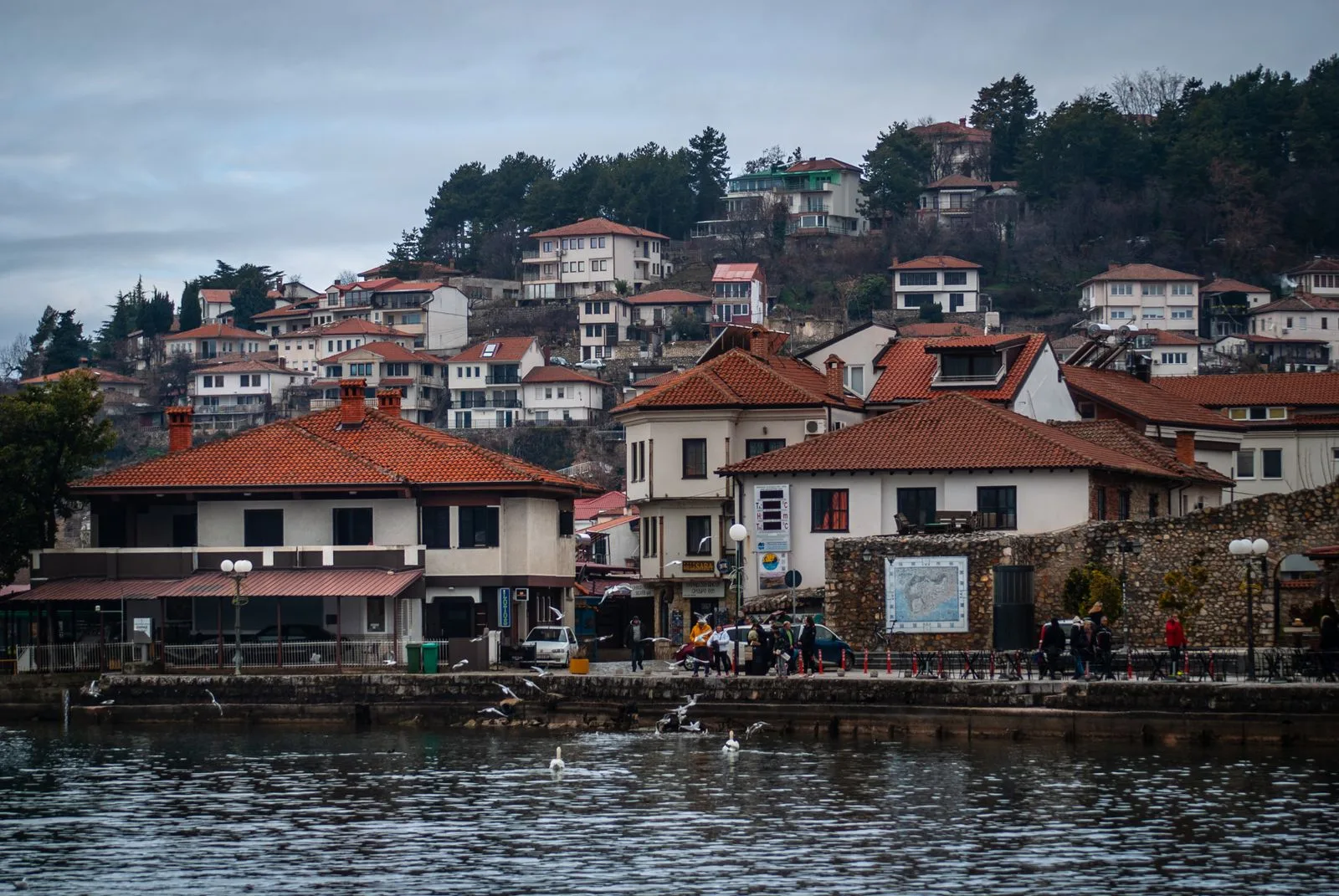
What to see in Ohrid: the old town
According to UNESCO (property page), the town was “essentially built between the 7th and 19th centuries” and its architecture is “the best preserved and most complete ensemble of ancient urban architecture” of this part of Europe. The property includes more than 2,500 m² (about 26,900 sq ft) of frescoes and more than 800 Byzantine icons made between the 11th and the end of the 14th century.
St John at Kaneo
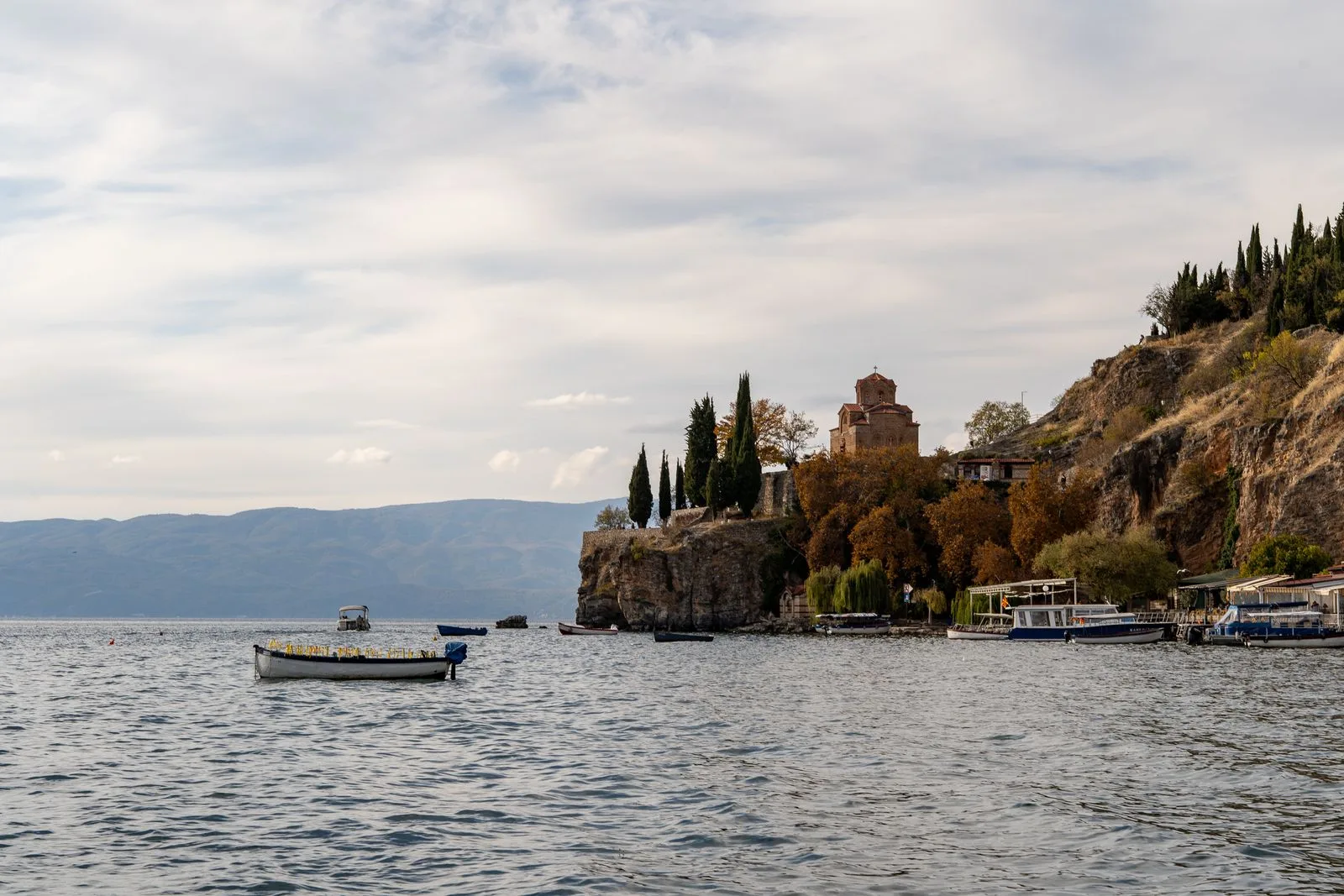
Set on a promontory above the water, the church of St John at Kaneo is the best-known image of the lake. UNESCO lists it, with St Sophia and Our Lady Perivleptos, among the churches whose frescoes show “a high degree of artistic achievement”.
St Sophia and Our Lady Perivleptos
According to UNESCO, St Sophia Cathedral dates from the 11th century. The church of Our Lady Perivleptos, in the upper part of the old town, is the other major set of frescoes to see. In churches, wear clothes that cover your shoulders and knees.
St Panteleimon monastery and the early basilicas
Ohrid is home to “the oldest Slav monastery”, dedicated to St Panteleimon, and UNESCO recalls the role of the Ohrid literary school in spreading writing and culture in the Slavic world. Seven basilicas from the 4th to 6th centuries have been uncovered in the oldest part of the town, ancient Lychnidos, some with mosaic floors.
The Roman theatre and the lanes
The ancient theatre, uncovered at the cost of demolishing late 19th-century houses, as UNESCO notes, lies in the heart of the old town. Around it, traditional 18th- and 19th-century houses line very narrow lanes: the old town is visited on foot.
Around Lake Ohrid
The lake is “deep and ancient, of tectonic origin” and has existed “for about two to three million years”, according to UNESCO. Its waters are home to more than 200 endemic species, including 17 species of fish, among them two trout.
- Galičica National Park: between lakes Ohrid and Prespa, it manages the natural heritage of its territory. If you hike, check conditions locally: GOV.UK notes that the government commonly bans entry to forest and wilderness areas in summer when wildfire risk is highest, with severe fines for non-compliance.
- Struga: at the north of the lake, the town developed on the banks of the Black Drin, which flows out of the lake; many archaeological sites bear witness to former fishing villages on stilts.
- The Albanian shore: since 2019, the UNESCO property has included the Albanian part of the lake, including the Lin peninsula and its early Christian church from the mid-6th century. Check entry requirements before crossing the border.
Boat trips and guided tours
For a boat trip, a guided tour of the churches or an excursion to Galičica, compare providers and terms: what is included, the guide’s language, the cancellation policy. UNESCO cites tourism pressure and water quality among the threats to the lake: prefer providers that follow local rules, and leave no litter.
When to go to Ohrid: climate month by month
The lake softens the climate: summers are hot without being extreme and autumn is the wettest season. The table combines the official normals with our astronomical calculations.
| Month | Avg. max | Avg. min | Rain | Rainy days | Day/night gap | Sunrise / sunset (15th) | Daylight |
|---|---|---|---|---|---|---|---|
| January | 6.2 °C (43 °F) | −1.5 °C (29 °F) | 54 mm (2.1 in) | 11 | 7.7 °C (14 °F) | 6:59 am / 4:32 pm | 9 h 33 min |
| February | 7.6 °C (46 °F) | −0.9 °C (30 °F) | 60 mm (2.4 in) | 12 | 8.5 °C (15 °F) | 6:31 am / 5:10 pm | 10 h 39 min |
| March | 11.0 °C (52 °F) | 1.2 °C (34 °F) | 56 mm (2.2 in) | 11 | 9.8 °C (18 °F) | 5:49 am / 5:42 pm | 11 h 54 min |
| April | 15.1 °C (59 °F) | 4.6 °C (40 °F) | 56 mm (2.2 in) | 13 | 10.5 °C (19 °F) | 5:58 am / 7:16 pm | 13 h 18 min |
| May | 20.4 °C (69 °F) | 8.7 °C (48 °F) | 57 mm (2.2 in) | 12 | 11.7 °C (21 °F) | 5:19 am / 7:47 pm | 14 h 29 min |
| June | 24.8 °C (77 °F) | 12.0 °C (54 °F) | 34 mm (1.3 in) | 8 | 12.8 °C (23 °F) | 5:03 am / 8:10 pm | 15 h 07 min |
| July | 27.6 °C (82 °F) | 14.0 °C (57 °F) | 30 mm (1.2 in) | 6 | 13.6 °C (24 °F) | 5:16 am / 8:08 pm | 14 h 51 min |
| August | 27.7 °C (82 °F) | 14.2 °C (58 °F) | 31 mm (1.2 in) | 6 | 13.5 °C (24 °F) | 5:45 am / 7:36 pm | 13 h 50 min |
| September | 23.6 °C (74 °F) | 11.2 °C (52 °F) | 48 mm (1.9 in) | 7 | 12.4 °C (22 °F) | 6:16 am / 6:46 pm | 12 h 30 min |
| October | 17.7 °C (64 °F) | 7.2 °C (45 °F) | 76 mm (3.0 in) | 10 | 10.5 °C (19 °F) | 6:47 am / 5:56 pm | 11 h 09 min |
| November | 11.6 °C (53 °F) | 3.1 °C (38 °F) | 90 mm (3.5 in) | 12 | 8.5 °C (15 °F) | 6:24 am / 4:18 pm | 9 h 54 min |
| December | 7.2 °C (45 °F) | 0.0 °C (32 °F) | 71 mm (2.8 in) | 13 | 7.2 °C (13 °F) | 6:54 am / 4:08 pm | 9 h 14 min |
Reading the table (Destination de Voyage calculation): the average high reaches at least 24 °C (75 °F) only in June, July and August, and these months have 6 to 8 rainy days. From June to September, 142 mm (5.6 in) falls, 21% of the annual total (662 mm / 26.1 in). November is the wettest month (90 mm / 3.5 in). For swimming, aim for July–August; to visit the churches without the heat, June and September (24.8 and 23.6 °C, or 77 and 74 °F).
Ohrid normals on the WMO site.
Where to stay in Ohrid
The old town is the most practical for sightseeing on foot, but its lanes are steep and narrow. Lakeside accommodation outside the old town is quieter. In July and August, book early. Registration with the local police is required within 48 hours of arrival: hotels do it at check-in, and if you stay in a private home you must make sure it is done (see the entry requirements below).
Getting to Ohrid and getting around
Ohrid is linked to Skopje by road and by bus lines; the town also has an airport. For flights, check the current connections with the airlines: we do not claim any nonstop flight without having seen it on the airport’s page. If you drive, the U.S. Department of State notes that high fines can be incurred for speeding, and warns that mountain roads may be narrow, poorly marked and lack guardrails; it advises against driving at night in rural mountain areas.
Transfer, bus or rental car?
For Galičica, Struga or a tour of the lake, a car gives flexibility; for a stay centred on the old town, it is unnecessary. If you rent, check permission to cross into Albania and the insurance terms. According to GOV.UK, you can use a UK photocard licence to drive in North Macedonia, but unless you are driving a rental car or have a residence permit you also need the 1968 International Driving Permit; the State Department says US citizens must have a valid US driver’s license and an International Driving Permit.
Entry requirements, health and safety
- US citizens: according to the U.S. Department of State (travel.state.gov, last updated September 10, 2026), a valid US passport is required. No visa is needed for tourist or business trips of less than 90 days within a six-month period. The State Department says foreign citizens must show travel medical insurance on entry.
- UK citizens: according to the UK FCDO (GOV.UK, updated 13 August 2026), you can visit North Macedonia for up to 3 months without a visa, and your passport must have an expiry date at least 90 days after the date you arrive.
- Registration: register with the local police within 48 hours of arrival. Hotels do it at check-in; keep the registration document until you leave. If you registered directly, the FCDO says you must de-register 24 hours before you leave. Failure to register can mean a fine (up to 250 euros according to the State Department), detention and a court hearing, or a restriction on returning.
- Theft: neither government lists any area of North Macedonia to avoid. Pickpocketing is reported mainly in crowded areas of Skopje (both sources).
- Health: the State Department notes that ambulances are not widely available except in Skopje and major tourist areas such as Ohrid, and strongly recommends insurance covering medical evacuation. Emergency number: 112.
- Natural hazards: wildfires are possible from April to October, and earthquakes occur occasionally (GOV.UK).
- Souvenirs: strict laws apply to exporting historically valuable items without the proper permit (travel.state.gov): do not take old icons or archaeological pieces out of the country without official documents.
- The two sources are consistent on the main rule (about three months without a visa) but word the limit differently, and only the State Department mentions mandatory travel medical insurance. If you are unsure, contact the Embassy of North Macedonia. See also our guide to entry requirements.
Staying connected
North Macedonia is outside the European Union, so check your carrier’s roaming rates, including if you cross into Albania. See our travel eSIM guide.
If you… then…
| If you… | Then… |
|---|---|
| Want to swim | Aim for July or August (average highs of 27.6 and 27.7 °C / 82 °F) |
| Want to visit the churches in quiet, cool conditions | Prefer June or September, early in the morning |
| Want the photo of St John at Kaneo at sunset | Check the sunset time in the table above |
| Plan to visit the Albanian shore | Take valid documents for both countries and check your mobile plan |
| Hike in Galičica | Check local conditions and wildfire restrictions first |
Frequently asked questions
What is there to see in Ohrid?
The church of St John at Kaneo, St Sophia Cathedral, the church of Our Lady Perivleptos, St Panteleimon monastery, the ancient theatre and the lanes of the old town; around it, Galičica National Park and Struga.
Is Lake Ohrid a UNESCO site?
Yes: the Ohrid region is a mixed World Heritage property, inscribed in 1979 for its nature and in 1980 for its culture, then extended in 2019 to the Albanian part of the lake.
When can you swim in Lake Ohrid?
In July and August, when the average high reaches 27.6 and 27.7 °C (82 °F) (1971–2000 normals); June is already warm (24.8 °C / 77 °F).
How many days should you spend in Ohrid?
Two days for the old town and its churches, one or two more for Galičica, Struga or a boat trip.
Do US and UK citizens need a visa for North Macedonia?
No, for short tourist stays: under 90 days within six months for US citizens (U.S. Department of State, September 10, 2026) and up to 3 months for UK citizens (UK FCDO, 13 August 2026).
Is Ohrid safe?
Neither government lists an area of North Macedonia to avoid; violent crime against foreigners is rare, but stay alert to pickpockets in crowded places.
Our sources
- UNESCO, World Heritage Centre: “Natural and Cultural Heritage of the Ohrid region” (whc.unesco.org/en/list/99), read 11 November 2026
- UK FCDO, North Macedonia foreign travel advice (GOV.UK, updated 13 August 2026): entry requirements, safety, driving, natural hazards; read November 2026
- U.S. Department of State, North Macedonia country information (travel.state.gov, last updated September 10, 2026): entry and exit requirements, safety, health, transportation; read November 2026
- World Meteorological Organization, World Weather Information Service, Ohrid page (worldweather.wmo.int), 1971–2000 normals from the hydrometeorological service of North Macedonia
- Astronomical calculations: NOAA solar algorithm, applied by Destination de Voyage to the coordinates of Ohrid (15th of each month)
- Our methodology
Updated November 2026.