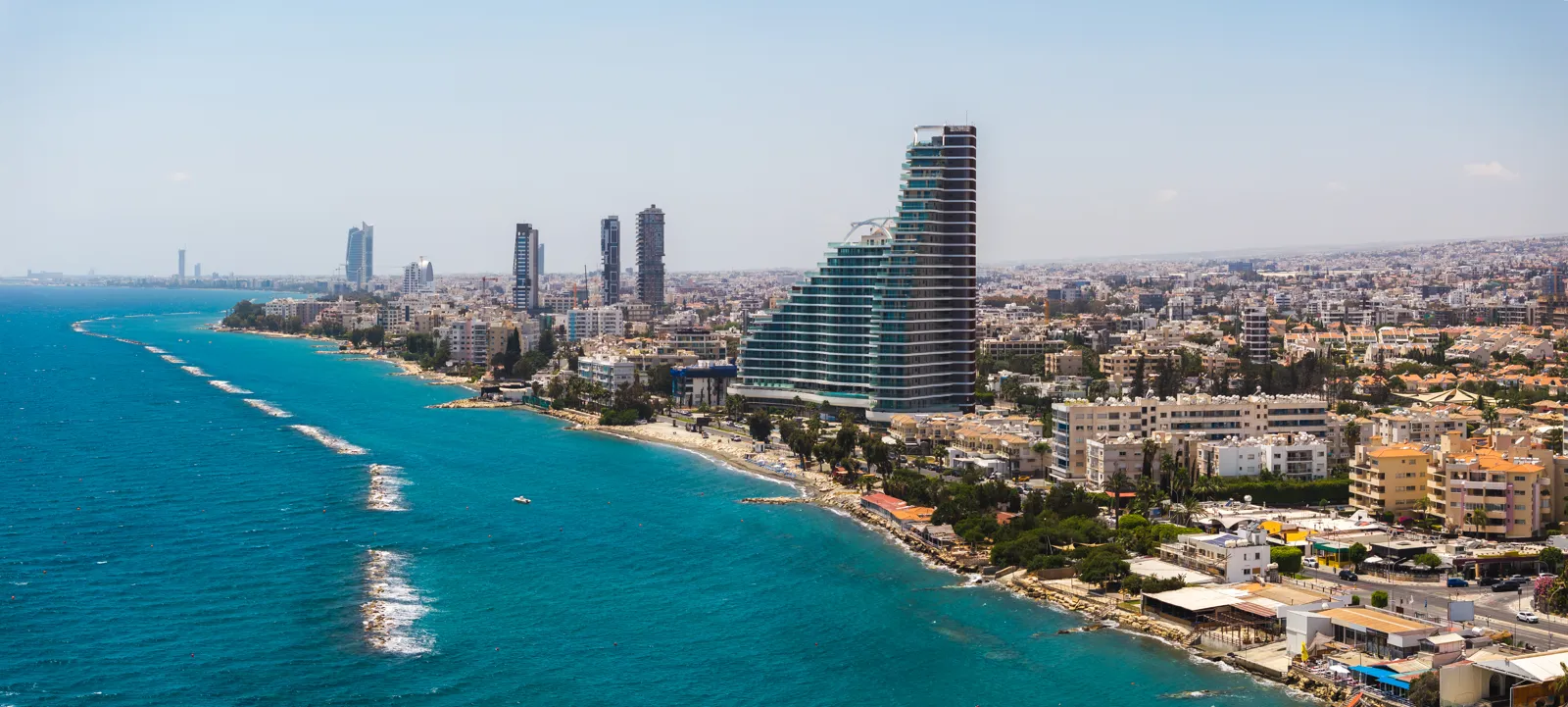
Larnaca, on the south-east coast of Cyprus, is the city of the island’s main airport, but it deserves more than a transit night: a palm-lined seafront promenade, a 9th-century Byzantine church, an Ottoman fort and a salt lake where thousands of flamingos spend the winter. Built on the ruins of ancient Kition, home town of the philosopher Zeno, it can be visited on foot in one or two days. This Larnaca travel guide covers what to see, when to come according to official climate normals, how to get from the airport to the centre and what the US and UK governments say about entry and safety.
Time zoneUTC+2 (Eastern European Time; UTC+3 in summer): 2 hours ahead of London and 7 hours ahead of New York in standard time
Best periodsApril to June and September to October; July and August average more than 33 °C (91 °F) at the daily maximum
Entryno visa for stays of up to 90 days for US and UK citizens; UK citizens need a passport issued less than 10 years before arrival (U.S. Department of State, last updated August 13, 2026; UK FCDO, updated 14 August 2026)
Arrivalboth governments say to enter the Republic of Cyprus through its own airports and ports, such as Larnaca or Paphos, not through Ercan in the north
Main sightsChurch of Saint Lazarus, Finikoudes promenade, fort, salt lake and Hala Sultan Tekke, Kition, Kamares aqueduct
What to see in Larnaca: the highlights
The Church of Saint Lazarus
In the heart of the old town, the Church of Saint Lazarus was built in the late 9th or early 10th century over the presumed tomb of Lazarus of Bethany. According to Orthodox tradition, Lazarus, raised from the dead by Christ, came to Cyprus and became the first bishop of Kition. A tomb inscribed “Lazarus, friend of Christ” was found there in 890; the Byzantine emperor Leo VI had his relics moved to Constantinople and the church built in compensation. The building, 31.5 m (103 ft) long, is among the island’s major Byzantine monuments.
The Finikoudes promenade and the fort
The Finikoudes seafront, on Athinon Avenue, takes its name from the palm trees (“finikoudes” in Greek) that line it on both sides. An urban beach, cafés and busts of Kimon and Zeno punctuate the promenade. At its southern end, Larnaca Fort guards the old Ottoman harbour. Just south of the fort lies Skala, the former merchant-port district of Ottoman times, now a quarter of potters and restaurants.
The salt lake and Hala Sultan Tekke
West of the city, on the road to the airport, Larnaca Salt Lake brings together four lakes over 2.2 km² (0.8 sq mi). It is one of the most important wetlands in Cyprus, a Ramsar and Natura 2000 site: 85 species of waterbirds have been recorded there, including 2,000 to 12,000 flamingos that spend the winter feeding on small brine shrimp (Artemia salina). On its western shore, the Hala Sultan Tekke mosque holds the tomb of Umm Haram, linked to the family of the Prophet Muhammad: it is one of the most important holy places of Ottoman Islam. A Bronze Age archaeological site lies nearby.
Kition, the Kamares aqueduct and the museums
The remains of Kition, a city-kingdom founded in the 13th century BC and later a Phoenician centre, include Cyclopean walls, a group of temples and a military harbour; the Kition-Pervolia site can be visited in town. To the north-west, the Ottoman Kamares aqueduct (or Bekir Pasha aqueduct) supplied the city. Among the museums, the Larnaca District Archaeological Museum and the Pierides Museum, founded on the collection of Demetrios Pierides (1811–1895), trace the island’s history. Check opening hours and prices on the official sites before you go.
The beaches
Besides Finikoudes beach, Mackenzie beach, to the south near the airport, is popular for its promenade of restaurants and its windsurfing centre; Larnaca attracts windsurfers, especially in autumn. Farther east, the beaches of Ayia Napa and Protaras and Cape Greco can be reached on a day trip.
Around Larnaca
Larnaca is one end of the E4 European long-distance footpath, which finishes in Portugal. Inland, the Neolithic site of Choirokoitia (a World Heritage Site) and the village of Lefkara, known for its lace, are common excursions, as are Nicosia, the divided capital, and the beaches of the east. Our guide to visiting Nicosia explains how to cross the Green Line.
Larnaca in 1 or 2 days
Day 1: Church of Saint Lazarus, Skala and the fort, lunch on Finikoudes, then the salt lake and Hala Sultan Tekke in the late afternoon.
Day 2: Kition and the Pierides Museum in the morning, Mackenzie beach in the afternoon; or an excursion to Lefkara and Choirokoitia, Nicosia or Cape Greco.
Where to stay in Larnaca
To do everything on foot, stay near Finikoudes and the Church of Saint Lazarus. The Mackenzie area, to the south, is closest to the airport and its beach. The seaside hotels along the Dhekelia road, to the east, suit a beach holiday. Larnaca is also a practical base for trips to the east of the island and to Nicosia.
Getting to Larnaca and getting around
Larnaca International Airport, the island’s main one, lies about 4 km (2 mi) south-west of the city, according to its Wikipedia entry. The U.S. Department of State (travel.state.gov, last updated August 13, 2026) tells US citizens to enter and exit the Republic of Cyprus only at Larnaca and Paphos airports and at the seaports of Limassol, Larnaca and Paphos, and says the Republic does not consider entry at Ercan Airport in the north a legal entry. The UK FCDO (GOV.UK, updated 14 August 2026) warns that entering through the north is treated as illegal entry and can lead to fines or refusal of entry or exit. Check current flights on the airport’s website and with the airlines.
Public transport on the island is limited: the U.S. State Department says there are few public buses and no rail lines, and that taxis are widely available.
Airport transfer and car rental
To reach the centre, a taxi or a pre-booked transfer are the usual options; a transfer booked in advance avoids waiting after a late arrival. To explore the island (Troodos, Akamas, villages), a rental car is the most flexible solution. Traffic drives on the left in Cyprus, and the State Department notes that secondary roads, especially in mountain areas, tend to be narrow, winding and less well maintained, and that speeding and tailgating are common. Before booking, compare the official rental company and resellers: excess, insurance, and whether you may cross to the north. The UK FCDO says cars hired in the Republic often have no insurance cover in the north, and that you cannot go through a crossing without the right insurance documents. Our guide to car rental in Cyprus details driving on the left and the Green Line.
When to go to Larnaca: climate month by month
Larnaca has a hot Mediterranean climate: a long, very hot and almost rainless summer, and a mild winter in which most of the rain falls. The table combines official normals with our calculations.
Month
Avg. max
Avg. min
Rain
Day/night gap
Sunrise / sunset (15th)
Daylight
January
17.1 °C (63 °F)
7.8 °C (46 °F)
83 mm (3.3 in)
9.3 °C (17 °F)
6:52 am / 4:56 pm
10 h 04 min
February
17.5 °C (64 °F)
7.6 °C (46 °F)
47 mm (1.9 in)
9.9 °C (18 °F)
6:31 am / 5:27 pm
10 h 56 min
March
19.9 °C (68 °F)
9.1 °C (48 °F)
30 mm (1.2 in)
10.8 °C (19 °F)
5:56 am / 5:52 pm
11 h 56 min
April
23.0 °C (73 °F)
12.1 °C (54 °F)
16 mm (0.6 in)
10.9 °C (20 °F)
6:14 am / 7:17 pm
13 h 03 min
May
27.0 °C (81 °F)
16.4 °C (62 °F)
12 mm (0.5 in)
10.6 °C (19 °F)
5:42 am / 7:41 pm
13 h 59 min
June
30.6 °C (87 °F)
20.1 °C (68 °F)
2 mm (0.1 in)
10.5 °C (19 °F)
5:31 am / 8:00 pm
14 h 29 min
July
33.0 °C (91 °F)
22.6 °C (73 °F)
1 mm (0.0 in)
10.4 °C (19 °F)
5:42 am / 7:59 pm
14 h 17 min
August
33.3 °C (92 °F)
23.0 °C (73 °F)
0 mm (0.0 in)
10.3 °C (19 °F)
6:05 am / 7:34 pm
13 h 29 min
September
31.4 °C (89 °F)
20.6 °C (69 °F)
5 mm (0.2 in)
10.8 °C (19 °F)
6:28 am / 6:53 pm
12 h 25 min
October
28.3 °C (83 °F)
17.5 °C (64 °F)
16 mm (0.6 in)
10.8 °C (19 °F)
6:50 am / 6:11 pm
11 h 20 min
November
23.3 °C (74 °F)
13.2 °C (56 °F)
42 mm (1.7 in)
10.1 °C (18 °F)
6:19 am / 4:40 pm
10 h 21 min
December
18.9 °C (66 °F)
9.7 °C (49 °F)
95 mm (3.7 in)
9.2 °C (17 °F)
6:45 am / 4:35 pm
9 h 50 min
Temperatures and rainfall: 1991–2020 normals for the Larnaca airport station (17609), Cyprus Department of Meteorology, published by the World Meteorological Organization (NOAA/NCEI archive). Our page on when to go to Cyprus uses normals from the same service for an unspecified period, slightly lower (January 16.8 °C / 62 °F, July 32.4 °C / 90 °F). Day/night gap, sunrise, sunset and day length: Destination de Voyage calculations (NOAA solar algorithm, 15th of each month, local time).
Reading the table: from May to September only 20 mm (0.8 in) of rain falls in total: summer is dry. July and August reach about 33 °C (91 °F) at the average maximum (33.3 °C / 92 °F in August) and nights stay above 22 °C (72 °F). Winter is mild by day (17 to 19 °C / 63 to 66 °F from December to February) but December (95 mm / 3.7 in) and January (83 mm / 3.3 in) are the wettest months. The gap between day and night exceeds 10 °C (18 °F) from April to October: in spring, evenings stay cool (12.1 °C / 54 °F minimum in April), so pack a jacket. For a trip mixing sightseeing and swimming, May, June, September and October are the best compromises.
Rules checked in the official sources read on 26 October 2026. Rules can change: confirm with the Cyprus embassy or high commission before you travel.
US citizens
According to the U.S. Department of State (travel.state.gov, last updated August 13, 2026), US citizens may enter the Republic of Cyprus for up to 90 days for tourism or business without a visa; a temporary residency visa is needed for longer stays. The page points to the Embassy of the Republic of Cyprus for current visa information and notes that Cyprus is in the EU but not in the Schengen area. If you travel on through Schengen countries, it says your passport should be valid for at least three months beyond your stay and that you need proof of funds and a return ticket.
UK citizens
According to the UK FCDO (GOV.UK, updated 14 August 2026), you can travel to Cyprus without a visa for up to 90 days. Your passport must have been issued less than 10 years before arrival, must expire at least 3 months after the day you plan to leave, and must have at least one blank page. You may be asked to show a return or onward ticket and proof of enough money. Cyprus is not in the Schengen area, so your time there does not count towards your Schengen 90 days and the EU Entry/Exit System does not apply. Make sure your passport is stamped on entry and exit.
Crossing to the north
The U.S. State Department says you can cross the UN buffer zone into the Turkish Cypriot-administered area by showing a valid US passport at a recognised checkpoint and that you can stay there for less than 90 days; the UK FCDO says you can use any crossing point and that time in the north counts towards your 90 days. Both warn against entering the buffer zone anywhere other than a designated crossing point. The UK FCDO says it can provide only limited consular support in the north, and the UK government does not recognise the self-declared “Turkish Republic of Northern Cyprus”. See also our guide to entry requirements.
Safety
Terrorism: the UK FCDO says terrorist attacks in Cyprus cannot be ruled out and could be indiscriminate, including in places visited by foreign nationals.
Wildfires: the UK FCDO reports a high risk of wildfires from April to October and advises registering your phone for emergency alerts; the emergency number is 112.
Crime and drugs: the UK FCDO says crime against tourists is not common, but advises sensible precautions, keeping an eye on your drinks, and notes a zero-tolerance policy on illegal drugs, including cannabis.
Demonstrations: the UK FCDO advises avoiding protests, which can disrupt local transport.
Staying connected
Mobile roaming conditions for US and UK plans depend on your operator, and they may differ in the north of the island: check with your carrier before using data there. Our travel eSIM guide details the options.
If you… then…
If you…
Then…
Want to see the flamingos
Come in winter: they overwinter on the salt lake (2,000 to 12,000 depending on the year)
Want a beach without extreme heat
Aim for June or September–October
Have a layover of a few hours
Salt lake and Hala Sultan Tekke, on the airport road, then Finikoudes
Want to cross to the north
Carry a valid passport and cross at designated points only
Rent a car
Drive on the left; check the contract for rules on the north of the island
Like history
Saint Lazarus, Kition and the Pierides Museum, then Choirokoitia
Frequently asked questions
What can you see in Larnaca in one day?
The Church of Saint Lazarus, Skala and the fort, the Finikoudes promenade, then the salt lake and the Hala Sultan Tekke mosque late in the day.
When can you see the flamingos in Larnaca?
In winter: the salt lake hosts 2,000 to 12,000 flamingos that spend the cold season there.
What is the hottest month in Larnaca?
August, with an average maximum of 33.3 °C (92 °F) (WMO 1991–2020 normals for Larnaca airport).
Do you need a visa for Larnaca?
Not for stays of up to 90 days, for US citizens (U.S. Department of State, last updated August 13, 2026) or UK citizens (UK FCDO, updated 14 August 2026). UK citizens need a passport issued less than 10 years before arrival and valid for 3 months after departure.
How do you get from the airport to the centre of Larnaca?
By taxi or pre-booked transfer; public transport on the island is limited, so check current options with the airport and local operators.
Can you go to the north of Cyprus from Larnaca?
Yes, by crossing the buffer zone at a designated crossing point with a valid passport. Entering the buffer zone anywhere else is forbidden.
Our sources
UK FCDO, Cyprus foreign travel advice (GOV.UK, updated 14 August 2026): entry requirements, safety and security, regional risks; read 26 October 2026
U.S. Department of State, Cyprus country information (travel.state.gov, last updated August 13, 2026): entry and exit requirements, safety and security, transportation; read 26 October 2026
World Meteorological Organization, 1991–2020 climate normals, Larnaka Airport station (17609), Cyprus Department of Meteorology (NOAA/NCEI archive)
Wikipedia articles “Larnaca” (FR and EN), “Larnaca Salt Lake”, “Hala Sultan Tekke”, “Church of Saint Lazarus, Larnaca”, “Larnaca International Airport”
Astronomical calculations: NOAA solar algorithm, applied by Destination de Voyage to the coordinates of Larnaca (15th of each month, year 2027)


 FlightsKiwi.comCompare flights and airline combinations to Larnaca.Compare flights