
Choose Malta for a short, easy trip: a compact archipelago where Valletta, Mdina, the megalithic temples, Gozo and diving fit into one week. Choose Cyprus for more sun, warmer sea and a longer swimming season, with ancient sites, sandy beaches and the Troodos mountains, accepting a bigger island that is best explored by car, and a northern part where consular support is limited (UK FCDO).
Malta or Cyprus? Both Mediterranean islands are members of the European Union, use the euro, drive on the left and have British-style plugs. They differ in size, distance and climate. To compare sunshine and sea temperature on the same basis, we used the Klimatafeln of the German weather service (DWD) for Luqa, Malta’s airport, and Larnaca, Cyprus’s main airport, in addition to the national weather service normals published in our guides to Malta and Cyprus.
Malta or Cyprus: the essentials
- Short stay, extended weekend: Malta (compact archipelago, no car needed)
- Sun: Cyprus, about 3,310 hours a year in Larnaca against 2,950 in Luqa (our calculation from DWD data)
- Swimming: Cyprus, sea at 22 °C (72 °F) or more from June to October in Larnaca, against July to October in Malta
- Heritage: a tie; Knights of St John and megalithic temples in Malta, Paphos mosaics, Kourion and the painted churches of the Troodos in Cyprus
- Cyprus, a divided island: enter through Larnaca or Paphos; consular support is limited in the north (UK FCDO and U.S. State Department)
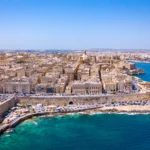
Malta or Cyprus: criteria compared
| Criterion | Malta | Cyprus | Advantage |
|---|---|---|---|
| Best time | April to June, September-October | April to June, September-October | Tie |
| July high | 30.7 °C (87 °F) (Luqa) | 32.4 °C (90 °F) (Larnaca), over 37 °C (99 °F) in Nicosia | Malta if you dislike heat |
| January high | 15.2 °C (59 °F) | 16.8 °C (62 °F) | Cyprus |
| October to January rain | 80 to 112 mm (3.1-4.4 in) a month | 14 to 95 mm (0.6-3.7 in) a month | Cyprus |
| Annual sunshine | About 2,950 h | About 3,310 h | Cyprus |
| Sea in October | 22 °C (72 °F) | 24 °C (75 °F) | Cyprus |
| Size and getting around | Compact archipelago; buses and ferries are enough | Larger island; a car is strongly recommended | Malta |
| Beaches | Little sand; Golden Bay, Mellieħa, Ramla (Gozo), Comino | Pale sand at Ayia Napa and Protaras, coves at Cape Greco and the Akamas | Cyprus |
| Diving | Very clear water, wrecks and drop-offs, Dwejra (Gozo) | Possible from June to October (Larnaca, Protaras, Paphos) | Malta |
| Entry (UK citizens) | Passport issued less than 10 years before arrival and valid 3 months after departure from the Schengen area; visa-free up to 90 days in any 180 | Passport issued less than 10 years before arrival, valid 3 months after departure, with a blank page; visa-free up to 90 days; official crossing points for the north | Tie |
Sun and sea: the edge goes to Cyprus
Destination de Voyage calculation from the DWD Klimatafeln: multiplying average daily sunshine by the number of days in each month, Larnaca totals about 3,310 hours of sun a year, against about 2,950 in Luqa, nearly 360 hours more. The gap is clearest from June to October (up to 1.8 hours more a day in September). The sea follows the same logic: according to the DWD, it reaches at least 22 °C (72 °F) for 5 months of the year in Larnaca (June to October) against 4 in Malta (July to October), and 27 °C (81 °F) in August in Larnaca against 25 °C (77 °F) in Malta. Cyprus is also drier in autumn: 14 mm (0.6 in) of rain in October in Larnaca against 90 mm (3.5 in) in Luqa, where autumn thunderstorms are common.
| Month | Malta (Luqa): high · rain | Cyprus (Larnaca): high · rain | Sun per day (Malta / Cyprus) | Sea (Malta / Cyprus) |
|---|---|---|---|---|
| January | 15.2 °C (59 °F) · 89 mm (3.5 in) | 16.8 °C (62 °F) · 78 mm (3.1 in) | 5.1 / 5.8 h | 15 °C (59 °F) / 17 °C (63 °F) |
| February | 15.5 °C (60 °F) · 61 mm (2.4 in) | 16.8 °C (62 °F) · 41 mm (1.6 in) | 6.0 / 6.5 h | 14 °C (57 °F) / 16 °C (61 °F) |
| March | 16.7 °C (62 °F) · 41 mm (1.6 in) | 19.1 °C (66 °F) · 34 mm (1.3 in) | 7.4 / 7.4 h | 15 °C (59 °F) / 17 °C (63 °F) |
| April | 19.1 °C (66 °F) · 23 mm (0.9 in) | 22.5 °C (72 °F) · 18 mm (0.7 in) | 8.2 / 9.0 h | 15 °C (59 °F) / 18 °C (64 °F) |
| May | 23.3 °C (74 °F) · 7 mm (0.3 in) | 26.5 °C (80 °F) · 9 mm (0.4 in) | 9.7 / 10.7 h | 18 °C (64 °F) / 19 °C (66 °F) |
| June | 27.5 °C (82 °F) · 3 mm (0.1 in) | 30.3 °C (87 °F) · 3 mm (0.1 in) | 10.9 / 12.3 h | 21 °C (70 °F) / 22 °C (72 °F) |
| July | 30.7 °C (87 °F) · <1 mm (<0.04 in) | 32.4 °C (90 °F) · <1 mm (<0.04 in) | 11.8 / 12.5 h | 24 °C (75 °F) / 25 °C (77 °F) |
| August | 30.7 °C (87 °F) · 7 mm (0.3 in) | 32.7 °C (91 °F) · <1 mm (<0.04 in) | 10.9 / 11.9 h | 25 °C (77 °F) / 27 °C (81 °F) |
| September | 28.0 °C (82 °F) · 40 mm (1.6 in) | 30.9 °C (88 °F) · 7 mm (0.3 in) | 8.7 / 10.5 h | 24 °C (75 °F) / 26 °C (79 °F) |
| October | 24.2 °C (76 °F) · 90 mm (3.5 in) | 28.1 °C (83 °F) · 14 mm (0.6 in) | 7.1 / 8.7 h | 22 °C (72 °F) / 24 °C (75 °F) |
| November | 20.1 °C (68 °F) · 80 mm (3.1 in) | 22.6 °C (73 °F) · 53 mm (2.1 in) | 6.1 / 7.4 h | 19 °C (66 °F) / 21 °C (70 °F) |
| December | 16.7 °C (62 °F) · 112 mm (4.4 in) | 18.3 °C (65 °F) · 95 mm (3.7 in) | 5.0 / 6.0 h | 17 °C (63 °F) / 18 °C (64 °F) |
The flip side: Cyprus is hotter in high summer, especially inland (over 37 °C / 99 °F in the afternoon in Nicosia in July). In Malta, summer heat is humid and shade is scarce at the sites. For detail: when to go to Malta and when to go to Cyprus.
What to see: a concentrate of history or an island to explore
Malta
Malta is the smallest country in the European Union: three inhabited islands, Malta, Gozo and Comino. Valletta, built by the Knights of St John and UNESCO-listed, is visited on foot (St John’s Co-Cathedral and its Caravaggios, the Grand Master’s Palace, the Upper Barrakka). The Three Cities, Mdina, the listed megalithic temples (Ħaġar Qim, Mnajdra, Tarxien, Ġgantija) and the Ħal Saflieni Hypogeum, to be booked long in advance, complete the visit. Gozo is greener and quieter; Comino draws visitors for its Blue Lagoon. See our Malta guide.
Cyprus
Cyprus, the third-largest island in the Mediterranean by area, needs more time: a week for Paphos, Kourion, the Troodos and part of the coast, two weeks to add the Akamas, Nicosia and the east. Paphos is listed in its entirety by UNESCO for its mosaics and Tombs of the Kings; ten painted churches of the Troodos are also listed. The pale sandy beaches of Ayia Napa and Protaras, Cape Greco and the Akamas peninsula are its seaside strengths. See our Cyprus guide.
Malta or Cyprus by traveler profile
| Profile | Verdict | Why |
|---|---|---|
| Weekend or 4-5 day stay | Malta | Compact archipelago |
| Beach and swimming | Cyprus | Pale sandy beaches, warmer sea for longer |
| Culture and history | Tie | Knights and megalithic temples in Malta; mosaics, Kourion and painted churches in Cyprus |
| Diving | Malta | Very clear water, wrecks and drop-offs around Malta and Gozo |
| Hiking | Cyprus | Akamas and Troodos; Gozo and the Dingli cliffs in Malta |
| Families | Tie | Compact archipelago in Malta; sandy beaches on the east coast of Cyprus |
| Without a car | Malta | Buses and ferries; in Cyprus, the Troodos and the Akamas are poorly served |
| Late-season sun (October-November) | Cyprus | Less rain and warmer sea than in Malta |
Budget, entry requirements and getting there
In Cyprus, car rental weighs more in the budget because the island is larger. For flights, check current routes from your departure city for both islands.
UK citizens. According to the UK FCDO (GOV.UK for Malta and GOV.UK for Cyprus, checked 12 November 2026), you can visit both countries without a visa for up to 90 days (Malta: in any 180-day period, Schengen area). For Malta, the passport must have been issued less than 10 years before arrival and expire at least 3 months after the day you plan to leave the Schengen area; the EES biometric registration may apply on first entry. For Cyprus, the passport must also have been issued less than 10 years before arrival, expire at least 3 months after the day you plan to leave and have at least one blank page. In Cyprus, the FCDO says that entering the Republic through the north (for example through Ercan Airport) is treated as illegal entry.
US citizens. For Cyprus, the U.S. State Department (travel.state.gov, last updated August 13, 2026, read 26 October 2026) says you may enter for up to 90 days for tourism or business without a visa and that you need proof of funds and a return ticket; it advises entering and exiting the Republic of Cyprus only at Larnaca and Paphos airports and the seaports of Limassol, Larnaca and Paphos. For Malta, check the U.S. State Department page (travel.state.gov) before booking: it could not be read on 12 November 2026.
Safety: one point to check for Cyprus
Malta. According to the UK FCDO (GOV.UK, checked 12 November 2026), crime against tourists is rare, but criminals have drugged people in some bars and clubs in Paceville, so keep your drinks in sight and check your bill; pickpocketing has been reported on the Valletta to St Julian’s bus routes in summer. People drown every year in the sea and in pools in Malta, and some beaches have strong undercurrents: red flags mean dangerous conditions.
Cyprus. The FCDO says crime against tourists is not common but advises sensible precautions, and notes that it can only provide limited consular support in the north, whose authorities do not share information with the British High Commission. The U.S. State Department says the buffer zone patrolled by the UN must be crossed only at designated crossing points. Car insurance bought in the south is not valid in the north: separate insurance can be bought at the crossing points. Check the current advice just before departure.
Why not both?
There is no obvious link between the two islands: it is better to treat them as two separate trips. Malta combines more naturally with nearby Sicily; Cyprus with Crete or Greece. For other Mediterranean contests, see Crete or Sicily.
Frequently asked questions
Malta or Cyprus for a week?
Malta works very well for a week, Gozo included. In Cyprus, a week lets you see Paphos, Kourion, the Troodos and part of the coast; two weeks are more comfortable.
Where is the sea warmest?
In Cyprus: according to the DWD, 27 °C (81 °F) in August and 24 °C (75 °F) in October in Larnaca, against 25 °C (77 °F) and 22 °C (72 °F) in Malta. The sea there exceeds 22 °C (72 °F) from June to October.
Which island is sunnier?
Cyprus: about 3,310 hours of sun a year in Larnaca against about 2,950 in Luqa, from our calculation on DWD data.
Is Cyprus safe?
According to the UK FCDO (GOV.UK, checked 12 November 2026), crime against tourists is not common, but consular support is limited in the north of the island, and the U.S. State Department says the UN buffer zone must be crossed only at designated crossing points. Check the advice before departure.
Do I need a passport?
Yes, for US and UK citizens. The UK FCDO says British passports must have been issued less than 10 years before arrival and be valid at least 3 months after departure (Cyprus also needs a blank page); see the entry section above for the details by nationality.
Our sources
- Deutscher Wetterdienst (DWD), Klimatafeln for Luqa (Malta), Larnaka and Paphos (Cyprus): sunshine and water temperature, consulted on 23 October 2026
- Malta Meteorological Office (1961-1990 normals for Luqa, via the WMO) and Cyprus Meteorological Service (Larnaca normals), taken from our pages when to go to Malta and when to go to Cyprus
- UK FCDO, foreign travel advice: Malta (entry requirements and safety and security pages, checked 12 November 2026) and Cyprus (GOV.UK, updated 14 August 2026)
- U.S. Department of State, Cyprus country information (travel.state.gov, last updated August 13, 2026)
- Our published guides: Malta, Cyprus
- Our methodology
More contests await in our destination comparisons.
Updated November 2026.