
Planning an Ibiza travel guide trip starts with choosing your Ibiza. The clubbing island exists, around Sant Antoni and Platja d’en Bossa, but it covers only a small part of the territory. The rest is a fortified old town on the UNESCO World Heritage list, clear-water coves, white inland villages, hippie markets and, thirty minutes away by boat, Formentera. What to do in Ibiza, when to go, where to stay and what budget to plan: this guide covers the essentials, with official AEMET climate normals. For a quieter island in the archipelago, away from the parties, our Menorca travel guide covers the coves, Ciutadella and the Camí de Cavalls.

Our travel deals for Ibiza
Affiliate links: we earn a commission, at no extra cost to you.
 FlightsKiwi.comCompare flights and airline combinations to Ibiza.Compare flights
- Airport transferKiwitaxiPrivate driver booked in advance at a fixed price.Book a transfer


Ibiza at a glance
- Main town Ibiza Town (Eivissa in Catalan)
- Languages Catalan and Spanish; English is widely used in tourism
- Currency the euro (€) · currencies
- Time zone UTC+1, UTC+2 in summer: 1 hour ahead of London, 6 hours ahead of New York · detailsLocal time now: –:–
- Airports Ibiza (IBZ) · details
- Entry Schengen area: no visa for UK citizens for up to 90 days in any 180-day period; US citizens need a passport valid 3 months beyond their stay · travel.state.gov · GOV.UK
- Electricity check voltage and plug types before you go · plugs
- Budget see our budget section
- Tax a Balearic tourist tax(sustainable tourism tax) is charged per night, depending on the accommodation and season
When to go to Ibiza
The best time to go to Ibiza is June and September: 27 to 28 °C (81 to 82 °F) in the afternoon, very little rain, a pleasant sea and slightly fewer visitors than in July-August. May is ideal for exploring the island in peace, before the high season. July and August are the hottest, driest and most expensive months. From October to April, the island returns to its local rhythm: it is mild, but many hotels and restaurants and all the big clubs are closed.
When to go to Ibiza: the essentials
- Best periods: late May, June and September
- Beach: June to September
- Clubs: generally from late April or May to early October, depending on the venue
- Hiking, villages, peace: March to May, October
- Hottest month: August, average high 30.4 °C (87 °F) at the airport
- Wettest months: September to November, about 57 to 63 mm (2.2 to 2.5 in)
| Month | High °C (°F) | Low °C (°F) | Rain mm (in) | Rain days | Crowds | Prices | Verdict |
|---|---|---|---|---|---|---|---|
| January | 15.8 (60) | 7.9 (46) | 40 (1.6) | 5 | Low | Low | ⚠️ Mild but off-season, many closures |
| February | 16.0 (61) | 7.9 (46) | 30 (1.2) | 4 | Low | Low | ⚠️ Almond blossom in some years, very quiet island |
| March | 17.8 (64) | 9.5 (49) | 22 (0.9) | 4 | Low | Low | ⚠️ Cool spring, ideal for walking |
| April | 20.0 (68) | 11.6 (53) | 27 (1.1) | 4 | Medium (Easter) | Medium | ✅ Villages and trails, places gradually reopen |
| May | 23.1 (74) | 14.5 (58) | 22 (0.9) | 3 | Medium | Medium | ✅ Very good month, season opens |
| June | 27.1 (81) | 18.5 (65) | 8 (0.3) | 1 | High | High | ✅ Hot, dry, sea warming up |
| July | 29.8 (86) | 21.5 (71) | 3 (0.1) | 0 | Very high | Very high | ⚠️ Ideal for the beach, crowds and prices at their peak |
| August | 30.4 (87) | 22.4 (72) | 18 (0.7) | 2 | Very high | Very high | ⚠️ Hottest and most expensive |
| September | 27.7 (82) | 19.7 (67) | 63 (2.5) | 4 | High | High → medium | ✅ Warm sea, first storms |
| October | 24.0 (75) | 16.3 (61) | 57 (2.2) | 6 | Medium | Medium | ✅ Mild, clubs close |
| November | 19.5 (67) | 11.9 (53) | 60 (2.4) | 6 | Low | Low | ⚠️ Quiet, autumn rain |
| December | 16.8 (62) | 9.0 (48) | 52 (2.0) | 6 | Low | Low | ⚠️ Mild, off-season island |
Ibiza is one of the driest and sunniest of the Balearic Islands: more than 300 hours of sunshine a month from June to August at the airport, according to AEMET. Autumn is the rainy season, often with short but intense storms, sometimes causing local flooding. In summer, heatwaves are possible, and the wildfire risk is high in the pine forests.
The seasons in Ibiza
- Spring (March to May): 18 to 23 °C (64 to 73 °F) in the afternoon, green countryside, trails in good condition. The sea stays cool until May. Businesses reopen gradually from Easter, and the clubs open their season around late April or in May.
- Summer (June to August): 27 to 30 °C (81 to 86 °F), almost no rain, warm sea, nights of 19-22 °C (66-72 °F). It is high season: packed coves, saturated roads and car parks, very expensive accommodation. Head to the beaches early in the morning.
- Autumn (September-October): September keeps summer weather with the sea at its warmest; storms return. In October, the clubs hold their closing parties and then the island empties.
- Winter (November to February): 16 to 20 °C (61 to 68 °F) in the afternoon, 8 to 12 °C (46 to 54 °F) at night. Ibiza Town stays lively, but many hotels and beach restaurants are closed and there are fewer connections. Almond trees blossom in January-February in some years, notably around Santa Agnès.
Ibiza month by month
- January: 16 °C (61 °F), quiet island; ideal for Dalt Vila and hiking, not for the beach.
- February: almond blossom in some years in the north-west; many businesses closed.
- March: 18 °C (64 °F), little rain (22 mm / 0.9 in), cold sea.
- April: 20 °C (68 °F), Holy Week; the island wakes up.
- May: 23 °C (73 °F), dry, season opens: one of the best months to visit.
- June: 27 °C (81 °F), almost no rain, the sea warms up; Saint John’s Day is celebrated on the 24th.
- July: 30 °C (86 °F), the driest month (3 mm / 0.1 in); peak season.
- August: the hottest (30.4 °C / 87 °F) and busiest month; Ibiza Town’s patron saint festival on 5 August.
- September: 28 °C (82 °F), warm sea, first storms; crowds drop at the end of the month.
- October: 24 °C (75 °F), clubs close, more local atmosphere.
- November: 20 °C (68 °F), autumn rain, many closures.
- December: 17 °C (63 °F), off-season island, festive atmosphere in Ibiza Town.
To compare with Mallorca and Menorca, see our page when to go to the Balearic Islands, or our destination ideas for where to go in June.
Things to do in Ibiza: the highlights
Dalt Vila, Ibiza’s old town
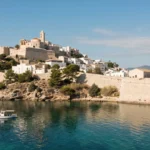
Perched above the port, Dalt Vila is surrounded by 16th-century ramparts. You enter through the Portal de ses Taules, then climb through white lanes to the cathedral and the castle, with views over the port and Formentera. The upper town is part of the UNESCO World Heritage property “Ibiza, Biodiversity and Culture”, together with the nearby Phoenician-Punic necropolis of Puig des Molins, the Phoenician site of Sa Caleta and the Posidonia seagrass meadows around the island. Below, the Marina quarter and the port are packed with bars, restaurants and shops. Go up preferably late in the day, when the heat eases.
Ses Salines natural park
In the south of the island, this natural park extends to the north of Formentera. It protects the old salt pans, still in use, dunes, pine forests and seabeds covered with Posidonia. Flamingos stop here in some seasons. The long sandy beaches of Ses Salines and Es Cavallet are among the busiest on the island in summer. The Ses Portes tower, at the southern tip, offers a fine view toward Formentera.
Cala d’Hort and Es Vedrà
On the south-west coast, the cove of Cala d’Hort faces the rock of Es Vedrà, a steep islet rising nearly 400 m (1,312 ft) above the sea. The viewpoint above the cove is one of the most popular sunset spots. The islet is a nature reserve: landing is not allowed. Nearby, the old Sa Pedrera quarry, nicknamed “Atlantis”, draws many visitors; access is via a steep, unmaintained path, not recommended in hot weather or with children.
The coves of the west and north
Cala Comte, north-west of Sant Antoni, is known for its turquoise water and sunsets. Cala Salada and Cala Saladeta, at the end of a pine-fringed bay, have limited road access in summer: check shuttles or parking. In the north, Benirràs is known for its drummers at sunset, especially on Sundays, and Cala Xarraca or Portinatx for their calm waters. Near Port de Sant Miquel, the Can Marçà caves can be visited with a sound and light show.
Sant Antoni and the sunset
On the west coast, Sant Antoni de Portmany is the island’s liveliest resort, with many of its bars and clubs around the “West End”. Its seafront promenade, on the Caló des Moro side, is one of the best-known spots for watching the sunset. If you are looking for peace, stay elsewhere: it is very lively in summer. GOV.UK notes that local laws restrict alcohol sales in parts of San Antonio (see the safety section).
Santa Eulària and the inland villages
On the east coast, Santa Eulària des Riu is a small family-friendly town with a promenade, a fortified church on the Puig de Missa and a Roman bridge. Inland, the island has kept white villages built around their church, such as Santa Gertrudis, Sant Joan de Labritja, Sant Carles de Peralta or Santa Agnès de Corona, known for its almond groves. These villages are the best way to discover rural Ibiza, with its fincas, dry-stone walls and red earth.
The hippie markets
A legacy of the hippie communities that settled here in the 1960s and 1970s, several craft markets punctuate the week. The best known, Las Dalias, in Sant Carles, is held on Saturdays; the Punta Arabí market, in Es Canar, takes place on Wednesdays in season. Days and times change with the season: check them before you go.
The clubs
Ibiza is one of the world capitals of electronic music. The big clubs are concentrated between Ibiza Town, Platja d’en Bossa and Sant Antoni, and generally open from late April or May to early October. Entry is expensive, and so are drinks: buy your tickets in advance on the official websites and plan your way back (night buses in season, taxis scarce at peak times).
Formentera
About 30 minutes to an hour by boat from Ibiza port, depending on the vessel, Formentera is a flat, narrow island known for its white-sand beaches, notably Ses Illetes, in Ses Salines natural park. It can be visited as a day trip by renting a bike, scooter or car on arrival. In summer, car access to some protected areas is charged or limited, and accommodation is scarce and expensive.
Itinerary: suggested routes in Ibiza
5 days: the essentials
- Day 1: Ibiza Town, Dalt Vila, the Marina
- Day 2: Ses Salines and Es Cavallet, the Ses Portes tower
- Day 3: Cala d’Hort, Es Vedrà, Cala Comte and sunset in Sant Antoni
- Day 4: day trip to Formentera
- Day 5: Santa Gertrudis, Sant Carles and the Las Dalias market (Saturdays), departure
7 to 10 days: the whole island
- Days 1-2: Ibiza Town, Dalt Vila and Puig des Molins
- Day 3: Ses Salines park
- Days 4-5: the west (Cala d’Hort, Es Vedrà, Cala Comte, Cala Salada, Sant Antoni)
- Days 6-7: the north (Benirràs, Portinatx, Can Marçà, Sant Joan, Santa Agnès)
- Day 8: the east (Santa Eulària, Sant Carles, Es Canar)
- Days 9-10: Formentera, as a day trip or with a night there
To combine with Mallorca, see our Mallorca guide and our Balearic Islands guide. Ibiza is also a port of call on some Mediterranean cruises. And to choose between the two, our comparison Ibiza or Mallorca sets climate and sea side by side.
Budget for a trip to Ibiza
Ibiza is, with Formentera, the most expensive of the Balearic Islands, especially for accommodation in July-August. Indicative amounts per person per day, excluding flights:
| Item | Budget | Comfort |
|---|---|---|
| Accommodation (shared double room) | roughly €40 to €70 | roughly €100 to €220 |
| Meals | roughly €25 to €35 | roughly €50 to €90 |
| Transport (bus, shared car hire, parking) | roughly €10 to €20 | roughly €20 to €40 |
| Sights and activities (excluding clubs) | roughly €5 to €15 | roughly €20 to €60 |
| Total per day | roughly €80 to €140 | roughly €190 to €410 |
For a week, that means roughly €550 to €1,000 per person on a budget and €1,300 to €2,900 for comfort, excluding flights. Club nights are a separate item: budget generously if that is the purpose of your trip. To cut costs, travel in May, June or late September, and compare accommodation in Santa Eulària or inland, often cheaper than on the south coast.
Who is Ibiza for?
Our verdicts by profile, based on the places, conditions and budget ranges in this guide:
- Partying: ideal: the big clubs, between Ibiza Town, Platja d’en Bossa and Sant Antoni, generally open from late April or May to early October. Budget separately for entry and late-night journeys back.
- Beach: a very good choice: Ses Salines, Es Cavallet, Cala Comte, Cala d’Hort and, 30 minutes to an hour away by boat, Ses Illetes on Formentera. June and September avoid the peak crowds.
- Families: yes, if you choose your base: Santa Eulària, Es Canar, Portinatx or Cala Llonga have sheltered beaches. Avoid Sant Antoni and Platja d’en Bossa in summer, and the Sa Pedrera path with children.
- Couples: yes: sunsets at Cala d’Hort facing Es Vedrà, inland fincas with pools, a day on Formentera.
- Culture and nature: a good choice in spring and autumn: Dalt Vila and Puig des Molins, on the UNESCO list, Ses Salines natural park, white villages and the almond trees of Santa Agnès.
- Budget travel: difficult: Ibiza is, with Formentera, the most expensive of the Balearics; allow roughly €80 to €140 per day on a budget. May, June or late September and a base in Santa Eulària or inland keep costs down.
Getting around Ibiza
- Bus: the bus network links the airport, Ibiza Town, Sant Antoni, Santa Eulària and many beaches; night buses run in season to the club areas.
- Car or scooter: the most practical for coves and villages. Distances are short (the island is about forty kilometers / 25 mi long), but beach car parks fill up quickly in summer and some access roads are regulated. UK photocard licences can be used in Spain (GOV.UK); US drivers should check the Transportation section of travel.state.gov.
- Boat: shuttles link Ibiza Town and Sant Antoni with several beaches in season; ferries leave Ibiza port for Formentera several times a day, as well as for Mallorca and the mainland (Barcelona, Valencia, Dénia).
- Taxi: handy but sometimes hard to find when the clubs close; book ahead if possible.
- Bike: pleasant inland in spring, less so in summer because of the heat.
Ibiza airport transfer: AERO buses, taxi and private transfer
Ibiza airport is served by AERO bus lines to Ibiza Town and the main resort areas, and by taxis waiting at the terminal rank. Here is how to choose. Lines, timetables and fares change with the season: check them on the official Aena (Ibiza airport) and bus operator websites before you travel, especially out of season.
AERO bus lines
The airport bus lines serve Ibiza Town (including an express service), Sant Antoni and Sant Josep, Santa Eulària and Es Canar, and Platja d’en Bossa. Some lines only run in season.
Taxi
Taxis wait at the signposted rank outside the terminal and charge the official metered fares set by the island authorities, with supplements for the airport and for night journeys. Always take a taxi from the official rank and ask for a receipt if you need to make a complaint.
Booking a private transfer in Ibiza
A private transfer (a driver waiting for you on arrival, price agreed at booking) makes most sense if you arrive late in the evening, as a family or group, with lots of luggage, or if your accommodation is poorly served by public transport. In high season, demand for taxis can be heavy when many flights land: booking avoids the wait. Before booking, check what the price includes (luggage, child seats, tolls, night supplements), the free waiting time if your flight is late, flight tracking, the exact meeting point in the terminal and the cancellation terms.
Where to stay in Ibiza
| Base | Best for | Good to know |
|---|---|---|
| Ibiza Town and the Marina | Culture, restaurants, boat to Formentera | Practical without a car, lively in the evening |
| Platja d’en Bossa | Beach, clubs | Very lively in summer |
| Sant Antoni | Partying, sunsets, budget | Noisy in season; Cala de Bou a little quieter |
| Santa Eulària des Riu | Families, couples, peace | Good base for the east and north |
| North (Portinatx, Sant Joan, Sant Miquel) | Nature, quiet coves | Car recommended |
| Inland fincas | Rest, pool, countryside | Car essential, often expensive |
In July-August, book several months ahead: availability runs out and prices rise sharply. Out of season, check that the property is open on your dates.
Entry requirements, health and safety
- US citizens (travel.state.gov, last updated August 11, 2025): Schengen rules apply. Your passport should be valid for at least 3 months beyond your stay, and you need sufficient proof of funds and a return ticket.
- UK citizens (GOV.UK, updated 12 August 2026): no visa for up to 90 days in any 180-day period as a tourist. Your passport must have been issued less than 10 years before the day you arrive and be valid for at least 3 months after the day you plan to leave the Schengen area. The EU Entry/Exit System (EES) means fingerprints and a photo may be taken at your first entry, free of charge.
- Lost passport: according to GOV.UK, you cannot use a police report to leave Spain: you need a new passport or an emergency travel document.
- Health: UK travellers can use a GHIC or EHIC for medically necessary state healthcare, which does not replace travel insurance; whatever your nationality, take out insurance covering medical costs. Emergency number: 112.
- Safety: the U.S. Department of State notes that pickpocketing and theft are very common at tourist spots, airports, train stations and beach destinations. GOV.UK warns of extreme heat in summer, wildfires and flash floods (follow AEMET warnings), and of strong undercurrents on some beaches: never swim when the red flag is flying.
- Balearic alcohol rules: according to GOV.UK, local laws limit alcohol sales in parts of some resorts, including Magaluf (Calvià) and Playa de Palma in Mallorca and San Antonio (Sant Antoni de Portmany) in Ibiza: no happy hours, open bars, vending-machine sales, pub crawls or party boat trips, and no off-licence sales between 9:30 pm and 8 am. Drinking in the street is illegal in some areas and can bring an on-the-spot fine.
- Balconies: GOV.UK reports serious, sometimes fatal falls from balconies; hotels can evict you and you may be fined for dangerous behavior, and travel insurance may not cover such incidents. It also notes serious accidents at illegal commercially promoted parties in villas on Ibiza and Mallorca.
To compare policies, see our travel insurance guide.
Practical tips for Ibiza
- Money: cards are accepted almost everywhere; keep some cash for markets and small beach bars.
- Mobile data: check your roaming charges before you go, or use a travel eSIM.
- Hours: dinner is late, and the clubs often only fill up after 1 am.
- Coves: arrive before 10 am in summer, or late in the day; bring water and shoes for the rocks.
- Respect the environment: the Posidonia meadows are protected: boats must not anchor on them.
- Food: try bullit de peix (fish stew served with rice), sofrit pagès (a country dish of mixed meats) and flaó, a cheese and mint cake.
Further reading
To compare Ibiza with Mallorca and Menorca before fixing your dates, see when to go to the Balearic Islands and our Balearic Islands guide. For a two-island trip, our Mallorca travel guide covers the neighboring island, linked by ferry. And if you are still unsure about the timing, our selections where to go in June and where to go in September compare Ibiza with other Mediterranean destinations.
Frequently asked questions
What is the best time to go to Ibiza?
Late May, June and September: 23 to 28 °C (73 to 82 °F) in the afternoon according to AEMET normals, very little rain and slightly fewer visitors than in July-August. For peace, hiking and villages, aim for April-May or October.
How many days do you need to visit Ibiza?
Five days let you see Dalt Vila, Ses Salines, Cala d’Hort and Es Vedrà, the west-coast coves and Formentera. With a week to ten days, you can add the north, the inland villages and beach days.
Can you visit Ibiza without partying?
Yes. The clubs are concentrated around Ibiza Town, Platja d’en Bossa and Sant Antoni. Santa Eulària, the north of the island and the inland villages are quiet, and many visitors come for the coves, Dalt Vila and nature.
Is Ibiza good for families?
Yes, if you choose your base: Santa Eulària, Es Canar, Portinatx or Cala Llonga have sheltered beaches and a family atmosphere. Avoid Sant Antoni and Platja d’en Bossa in summer if you want peace and quiet.
How much does a week in Ibiza cost?
Excluding flights, roughly €550 to €1,000 per person on a budget and €1,300 to €2,900 for comfort, not counting club nights or the tourist tax. July and August are much more expensive.
Do you need to rent a car in Ibiza?
Not if you stay in Ibiza Town, Sant Antoni or Santa Eulària, which are well served by buses. For the northern coves and the inland villages, a car or scooter is more practical.
Our sources
- Entry requirements, health and safety read on 26 October 2026: U.S. Department of State, Spain country information (travel.state.gov, last updated August 11, 2025), and UK FCDO, foreign travel advice for Spain (GOV.UK, updated 12 August 2026)
- Agencia Estatal de Meteorología (AEMET): normals for the Ibiza airport station
- Our methodology
Updated October 2026.
To continue, see our Balearic Islands guide, our Mallorca guide, our Spain guide and when to go to Spain.