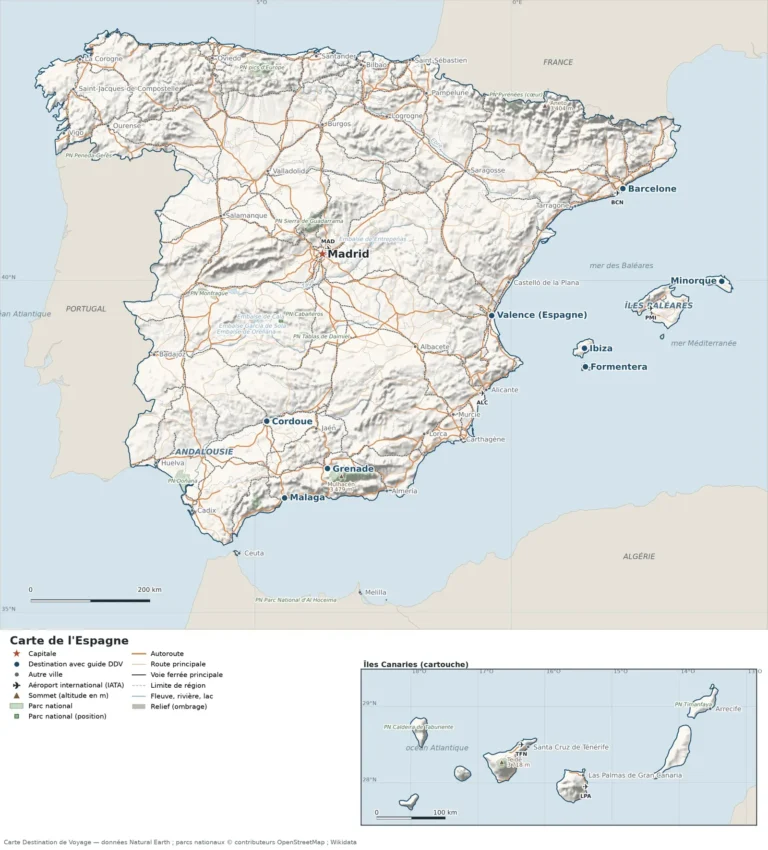
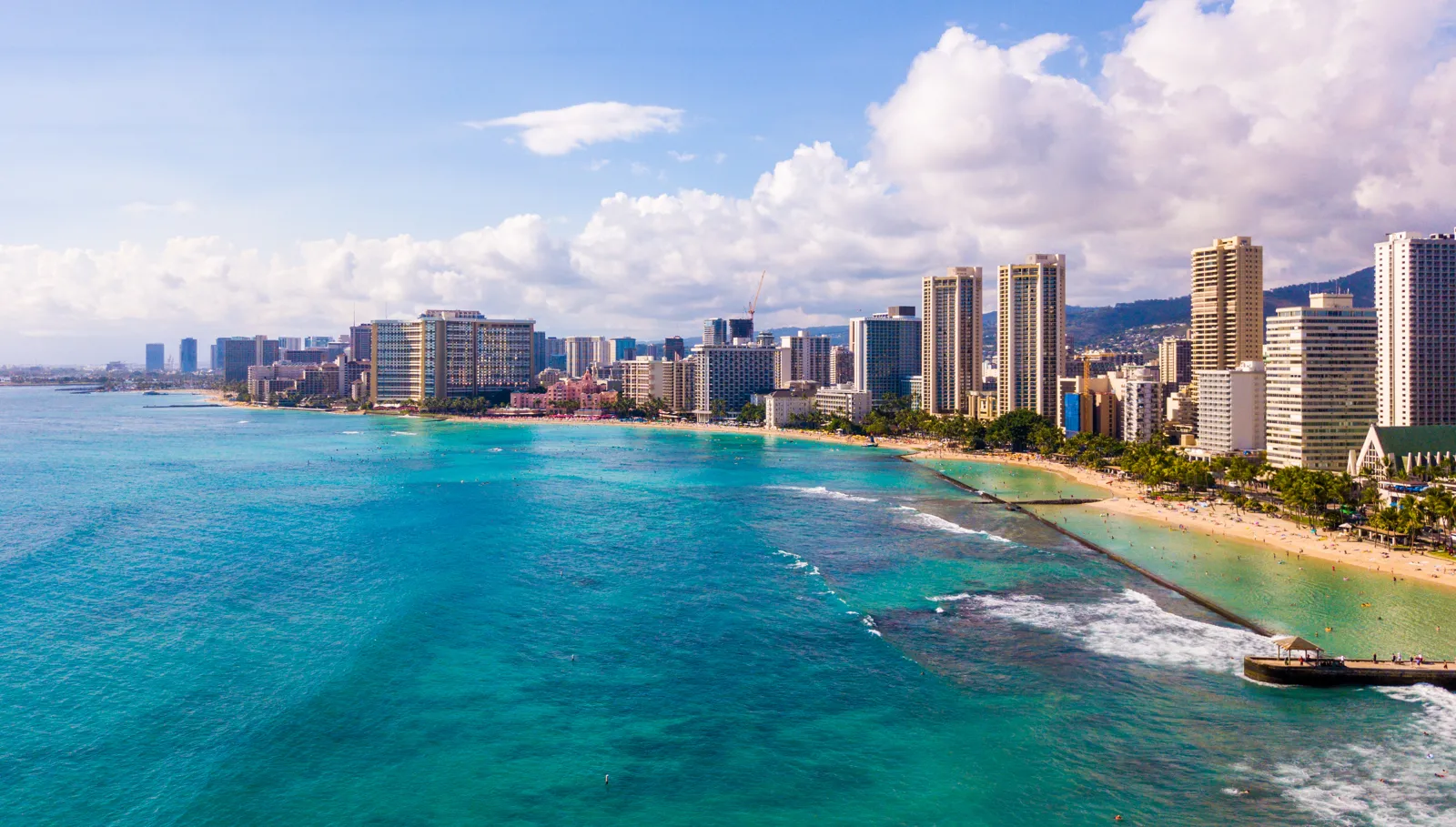
This Balearic Islands travel guide answers two questions: what to do, and which island to choose? Off the coast of Barcelona and Valencia, the Balearic archipelago has four main islands with very different personalities: Mallorca, the largest, with mountains, stone villages and coves; Menorca, more unspoiled and a biosphere reserve; Ibiza, known for its parties but also for its fortified old town; and Formentera, the smallest, famous for its beaches. This guide helps you choose your island, your stops and your accommodation.

Our travel deals for Balearic Islands
Affiliate links: we earn a commission, at no extra cost to you.
 Learn the languageTargumiLearn a few words of Spanish before you go — 30% off via our link.See the course
- FlightsKiwi.comCompare flights and airline combinations to Balearic Islands.Compare flights


Balearic Islands essentials
- Main islands: Mallorca (capital Palma), Menorca, Ibiza, Formentera
- Airports: Palma de Mallorca, Menorca (Mahón) and Ibiza; Formentera has no airport and is reached by boat from Ibiza
- Languages: Catalan and Spanish (Castilian); English and German are widely spoken in tourist areas. To learn a few words before you go, try Targumi’s online Spanish lessons with native teachers (30% off via our link).
- Ideal length: a week per island, 10 days to 2 weeks to combine two
- Best time: May-June and September to early October
- Time zone: UTC+1 (UTC+2 in summer), one hour ahead of London
- Entry: Schengen rules for US and UK citizens (see entry requirements below)
- Currency: the euro
- Budget: roughly €80 to €120 per person per day on a budget, €170 to €300 for comfort (much more in July-August)
Things to do in the Balearic Islands: the highlights
Palma de Mallorca
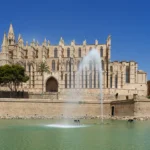
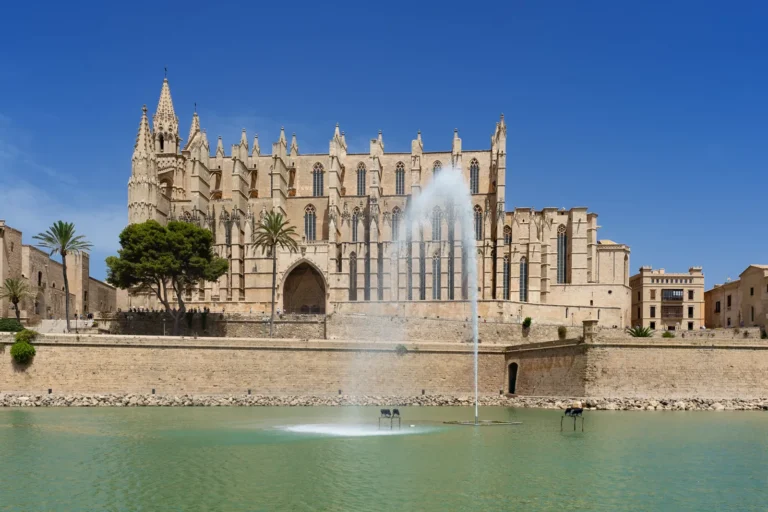
The capital of the archipelago, Palma is easy to explore on foot. Its Gothic cathedral, La Seu, dominates the seafront; next to it, the Almudaina Palace, a royal residence, occupies a former Moorish fortress. The old town is lined with patio palaces, the Arab baths and lively shopping streets. Circular Bellver Castle offers a view over the whole bay. The Santa Catalina district, with its market, and the harbor promenade round off the visit. Palma stays lively all year, making it a good base out of season.
The Serra de Tramuntana, Valldemossa and Sóller
This mountain range runs along Mallorca’s entire north-west coast; its cultural landscape of farming terraces, paved paths and stone villages is a UNESCO World Heritage Site. Valldemossa and its charterhouse, Deià, Fornalutx and Sóller are the best-known stops. A historic wooden train links Palma with Sóller, then a tram runs down to the port. The mountain road to Sa Calobra and the Torrent de Pareis is spectacular but very busy in summer. It is also the island’s great hiking area, with a long-distance trail (GR 221).
The north and east of Mallorca
In the north, the Formentor peninsula ends in a cape of sheer cliffs above crystal-clear coves; in summer, car access to the lighthouse is regulated. Pollença and Alcúdia have kept their old centers, and the Bay of Alcúdia offers long, family-friendly beaches. In the east, the Caves of Drach near Porto Cristo, Mondragó natural park and the many coves (calas) between Cala Rajada and Cala d’Or draw big crowds in season. In the south, Es Trenc beach and its dunes contrast with the big resorts near Palma.
Menorca: Mahón, Ciutadella and the coves
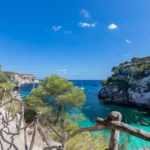
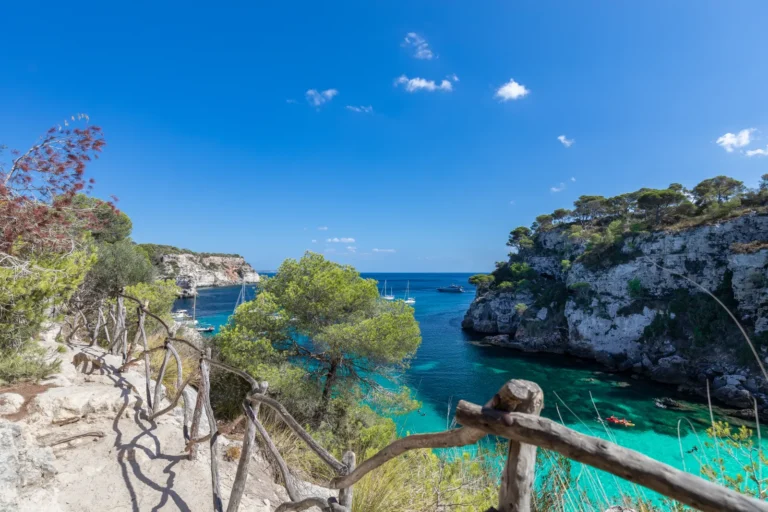
Entirely designated a UNESCO biosphere reserve, Menorca is less built-up than its neighbors. Mahón (Maó), the capital, stretches above a very deep natural harbor that you can explore by boat. At the other end of the island, Ciutadella, the former capital, has kept a center of medieval lanes and a lively little port. The island is known for its southern coves (Macarella, Turqueta, Mitjana), reached on foot and sometimes subject to limited parking in summer, and for its prehistoric Talayotic monuments. The Camí de Cavalls, a coastal path, goes all the way round the island. Coves, the Camí de Cavalls and Talayotic sites: our Menorca travel guide details these visits and the best time to go.
Ibiza: Dalt Vila and the coast
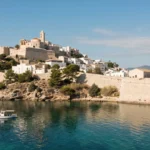
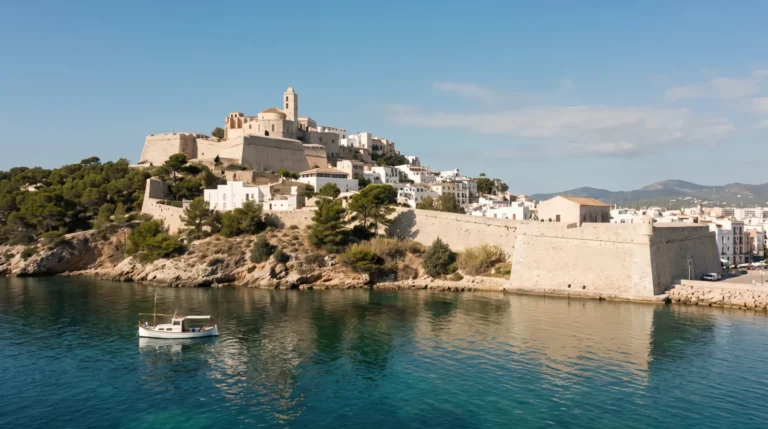
Beyond its party reputation, Ibiza has a fortified old town, Dalt Vila, a UNESCO World Heritage Site together with the Posidonia seagrass meadows around the island and Phoenician sites. You climb up to the cathedral through white lanes. The coast alternates coves (Cala Comte, Cala d’Hort facing the rock of Es Vedrà, Cala Salada) with quieter inland villages such as Santa Gertrudis or Sant Joan. The big clubs are concentrated around Ibiza Town, Platja d’en Bossa and Sant Antoni, from roughly May-June to early October. Between Dalt Vila and the coves, our Ibiza travel guide explains which area to choose depending on whether you want parties or peace.
Formentera
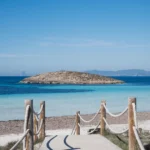
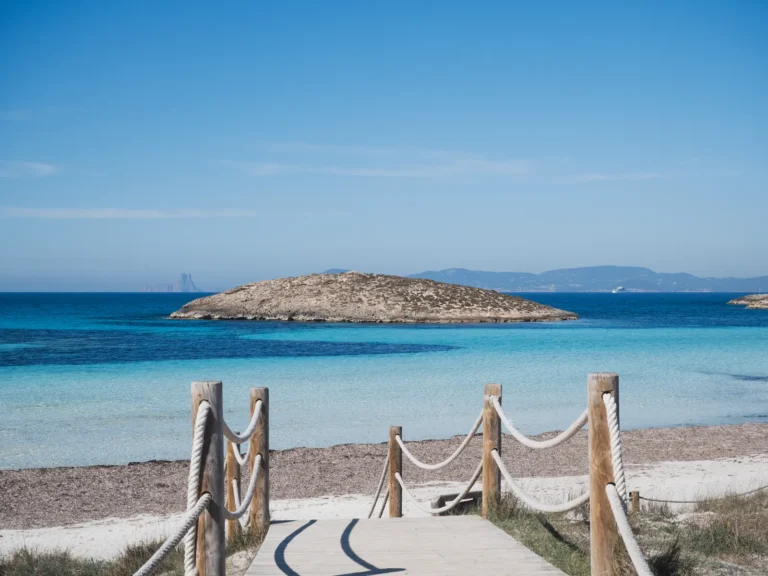
Thirty minutes to an hour by boat from Ibiza depending on the vessel, Formentera is a flat, narrow island with no big resort. Its white-sand beaches, notably Ses Illetes and Llevant in Ses Salines natural park, have very clear water. People get around by bike, scooter or rental car. Accommodation is scarce and expensive in summer: many visitors come for the day from Ibiza. Out of season, the island is very quiet and many businesses close.
Cabrera and the smaller islands
South of Mallorca, the Cabrera archipelago forms a maritime-terrestrial national park. Boat trips leave in season from Colònia de Sant Jordi; the number of visitors and boats allowed is limited, and mooring requires a permit. Ask local operators for details.
Which Balearic island should you choose?
| Island | Best for | Highlights |
|---|---|---|
| Mallorca | First trip, families, hikers, cyclists | The most varied: Palma, mountains, villages, coves, long beaches |
| Menorca | Couples, families, lovers of nature and peace | Unspoiled coves, coastal path, human-scale towns |
| Ibiza | Party-goers, but also lovers of coves and villages | Dalt Vila, west-coast coves, nightlife |
| Formentera | Beach and relaxation | Very clear water, laid-back atmosphere, no big resort |
Itinerary: visiting the Balearic Islands
7 to 10 days in Mallorca
- Days 1 to 2: Palma (cathedral, old town, Bellver Castle, Santa Catalina)
- Days 3 to 5: Serra de Tramuntana (Valldemossa, Deià, Sóller by historic train, Fornalutx, Sa Calobra), with one or two hikes
- Days 6 and 7: the north (Pollença, Formentor, Alcúdia)
- Days 8 to 10: the east and south (Caves of Drach, Mondragó coves, Es Trenc), then back to Palma
2 weeks: Mallorca and Menorca, or Ibiza and Formentera
- Option 1 – Days 1 to 9: Mallorca as above; days 10 to 14: Menorca (Ciutadella, southern coves, Mahón and its harbor), by ferry or plane depending on available connections
- Option 2 – Days 1 to 9: Ibiza (Dalt Vila, west-coast coves, inland villages); days 10 to 14: Formentera by boat from Ibiza port
A rental car is almost essential in Mallorca and Menorca (see our pages on car rental in Mallorca and car rental in Menorca) to reach coves and villages; in Formentera, a bike or scooter is enough. Inter-island ferries are more frequent in summer: check timetables before building your itinerary. These summer connections are easier to plan once you know how to plan your trip to Mallorca, the largest of the Balearics.
When to go to the Balearic Islands
✅ Best months: April, may, June, September, October
The best periods are May to June and September to early October: 23 to 27 °C (73 to 81 °F) in the afternoon in Palma according to AEMET normals, little rain and reasonable crowds. July and August are the hottest (around 30 °C / 86 °F) and driest months, but also the most expensive and crowded. Winter is mild, ideal for Palma and hiking, but many hotels close. Month-by-month climate, an island comparison and festivals: see our article when to go to the Balearic Islands.
Budget for a trip to the Balearic Islands
The Balearics are one of the most expensive regions of Spain for accommodation, especially in July-August, and even more so in Ibiza and Formentera. Prices can double between May and August. Meals stay affordable if you avoid the most touristy seafronts. Indicative amounts per person per day, excluding flights:
| Item | Budget | Comfort |
|---|---|---|
| Accommodation (shared double room) | roughly €35 to €60 | roughly €90 to €180 |
| Meals | roughly €25 to €35 | roughly €45 to €70 |
| Transport (bus, shared car hire, ferry) | roughly €10 to €15 | roughly €20 to €35 |
| Activities | roughly €10 to €15 | roughly €20 to €40 |
| Total per day | roughly €80 to €120 | roughly €170 to €300 |
To cut costs: go in May, June or September, compare self-catering apartments, have a “menú del día” lunch in inland villages and book your rental car early.
Getting around the Balearic Islands
- Car: the most practical option in Mallorca and Menorca. In summer, parking is difficult near the coves and some roads (Formentor, access to certain Menorca beaches) are restricted: check locally. UK photocard licences can be used in Spain (GOV.UK); US drivers should check the Transportation section of travel.state.gov.
- Bus: each island has its own bus network, useful for linking towns and the main beaches, less so for remote coves. In Mallorca, trains also link Palma with some inland towns.
- Sóller train: the historic Palma – Sóller train is an excursion in itself; book in summer.
- Boat: ferries link the islands with each other (notably Ibiza – Formentera, several times a day, and Mallorca – Menorca) and with the mainland (Barcelona, Valencia, Dénia).
- Bike and scooter: ideal in Formentera; Mallorca is a popular road-cycling destination, especially in spring.
Where to stay in the Balearic Islands
In Mallorca, Palma is the best base for a short first stay and out of season; Sóller or Pollença suit the mountains and the north, Alcúdia a family looking for beaches. The big resorts near Palma (such as Magaluf or s’Arenal) are very party-oriented. In Menorca, Ciutadella is the liveliest, Mahón the most practical for the east of the island; the small southern villages are quieter. In Ibiza, Ibiza Town and Santa Eulària are calmer than Sant Antoni; inland fincas suit those looking for rest. In Formentera, the choice is limited and expensive.
Options range from resort hotels to apartments, as well as “agroturismos”, converted farms and country houses in the islands’ interior. Out of season, check that your accommodation is open.
Entry requirements, health and safety
- US citizens (travel.state.gov, last updated August 11, 2025): Schengen rules apply. Your passport should be valid for at least 3 months beyond your stay, and you need sufficient proof of funds and a return ticket.
- UK citizens (GOV.UK, updated 12 August 2026): no visa for up to 90 days in any 180-day period as a tourist. Your passport must have been issued less than 10 years before the day you arrive and be valid for at least 3 months after the day you plan to leave the Schengen area. The EU Entry/Exit System (EES) means fingerprints and a photo may be taken at your first entry, free of charge.
- Lost passport: according to GOV.UK, you cannot use a police report to leave Spain: you need a new passport or an emergency travel document.
- Health: UK travellers can use a GHIC or EHIC for medically necessary state healthcare, which does not replace travel insurance; whatever your nationality, take out insurance covering medical costs. Emergency number: 112.
- Safety: the U.S. Department of State notes that pickpocketing and theft are very common at tourist spots, airports, train stations and beach destinations. GOV.UK warns of extreme heat in summer, wildfires and flash floods (follow AEMET warnings), and of strong undercurrents on some beaches: never swim when the red flag is flying.
- Balearic alcohol rules: according to GOV.UK, local laws limit alcohol sales in parts of some resorts, including Magaluf (Calvià) and Playa de Palma in Mallorca and San Antonio (Sant Antoni de Portmany) in Ibiza: no happy hours, open bars, vending-machine sales, pub crawls or party boat trips, and no off-licence sales between 9:30 pm and 8 am. Drinking in the street is illegal in some areas and can bring an on-the-spot fine.
- Balconies: GOV.UK reports serious, sometimes fatal falls from balconies; hotels can evict you and you may be fined for dangerous behavior, and travel insurance may not cover such incidents. It also notes serious accidents at illegal commercially promoted parties in villas on Ibiza and Mallorca.
- Assistance: some Spanish cities offer a Foreign Tourist Assistance Service (SATE) where you can report crimes in English (GOV.UK).
Practical tips for the Balearic Islands
- Language: Catalan is the islands’ own language, with local variants; signs are often in Catalan (Maó for Mahón, Eivissa for Ibiza). Spanish is understood everywhere.
- Coves: arrive early in summer, bring water and suitable shoes: many coves can only be reached on foot and have no facilities.
- Environment: the Posidonia seagrass meadows are protected; boaters must follow anchoring rules.
- Meal times: lunch is around 1:30-3 pm and dinner is late. In low season, many beach restaurants are closed.
- Mobile data: check your roaming charges before you go, or use a travel eSIM.
- Money: cards are accepted almost everywhere; keep some cash for small shops and markets.
Frequently asked questions
Which is the most beautiful Balearic island?
It depends on your plans. Mallorca is the most varied (city, mountains, beaches), Menorca the most unspoiled, Ibiza the liveliest but also rich in coves, and Formentera the most beach-focused. For a first trip, Mallorca is the easiest.
How many days do you need to visit Mallorca?
One week lets you see Palma, the Serra de Tramuntana and a few coves. Allow 10 days to add the north (Formentor, Pollença) and the east of the island without rushing.
Can you visit several Balearic islands on one trip?
Yes. The simplest combinations are Ibiza and Formentera, linked several times a day by boat, and Mallorca and Menorca, linked by ferry. There are fewer crossings out of season.
Do you need to rent a car in the Balearic Islands?
In Mallorca and Menorca, it is strongly recommended for reaching coves and villages. In Ibiza it is handy; in Formentera, a bike or scooter is enough. Book early for summer.
What are the Balearic Islands?
The archipelago has four main islands: Mallorca, the largest, Menorca, Ibiza and Formentera, the smallest. There are also smaller islands, including Cabrera, south of Mallorca.
Which Balearic island should you choose for a first trip?
Mallorca, the most varied: Palma, the Serra de Tramuntana, villages, coves and long beaches. Menorca is better for peace and nature, Formentera for the beach.
Are the Balearic Islands safe?
Generally yes, but the U.S. Department of State notes that pickpocketing and theft are very common at tourist spots and beach destinations. GOV.UK highlights alcohol restrictions in some resorts and the risk of falls from balconies. Watch your belongings, especially at night and on beaches, and follow beach flag warnings.
Our sources
- Entry requirements, health and safety read on 26 October 2026: U.S. Department of State, Spain country information (travel.state.gov, last updated August 11, 2025), and UK FCDO, foreign travel advice for Spain (GOV.UK, updated 12 August 2026)
- Agencia Estatal de Meteorología (AEMET): normals for Palma port (provisional 1991-2020) and Menorca and Ibiza airports (1981-2010)
- Our methodology
Updated October 2026.
To extend your trip, see our Spain travel guide, when to go to Spain, our guides to Madrid, Barcelona (with ferries to the islands) and Andalusia, or our ideas for a Mediterranean cruise. Find all our destinations in Europe.