To visit Alicante is to enjoy a Costa Blanca port city overlooked by Santa Bárbara Castle, with a palm-lined promenade, a hilly old town and beaches you can reach by tram. What to do in Alicante, which beach to choose, how to get to Tabarca island and when to go based on AEMET climate normals: here are the essentials, backed by official sources.
Alicante has around 366,000 inhabitants and gets more than 3,000 hours of sunshine a year, according to the normals of the Spanish State Meteorological Agency (AEMET). Its airport, one of the busiest in the country, also makes it a gateway to the whole Costa Blanca.

Our travel deals for Alicante
Affiliate links: we earn a commission, at no extra cost to you.
 FlightsKiwi.comCompare flights and airline combinations to Alicante.Compare flights
- Airport transferKiwitaxiPrivate driver booked in advance at a fixed price.Book a transfer
- Tickets and toursTiqetsEntry tickets and guided tours to book online; compare with the official price.See tickets
- Audio guidesWeGoTripSelf-guided audio tours on your phone.See audio tours




Alicante essentials
- Region: Valencian Community, south-east Spain, on the Costa Blanca
- Airport: Alicante-Elche, about 9 km (6 mi) south-west of the city
- Languages: Spanish and Valencian
- Entry: Schengen rules for US and UK citizens (see entry requirements below)
- Currency: euro; time zone UTC+1 (UTC+2 in summer), one hour ahead of London
- Ideal length of stay: 2 to 3 days, 4 with Tabarca
Things to do in Alicante: the highlights
Santa Bárbara Castle
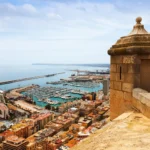
Mount Benacantil, 169 m (554 ft) high, towers over the city and is topped by Santa Bárbara Castle, Alicante’s best-known landmark. Seen from the sea, the rock forms a profile nicknamed “the Moor’s face”. The view takes in the port, the beaches and the old town. You can walk up from the old quarter; check the tourist office website for other ways up, opening hours and visiting conditions.
The Explanada de España
Known simply as “the Explanada”, this palm-lined promenade runs along the harbor. It is the locals’ favorite place for a stroll, especially in the evening. It continues into Canalejas park and its century-old fig trees, some 20 m (66 ft) tall.
The old town and the Santa Cruz quarter
At the foot of Benacantil, the old town gathers the co-cathedral of San Nicolás, the basilica of Santa María and the town hall. Higher up, the lanes of the Santa Cruz quarter climb toward the castle. Next to Santa María, the Museum of Contemporary Art (MACA) occupies the Casa de la Asegurada, built in 1685.
The beaches
San Juan beach, a long stretch of fine sand lined with bars and restaurants, is one of the most popular. It can be reached by tram from the center. Other, smaller beaches lie close to the center and further north along the coast. In summer, arrive early to find a spot.
Tabarca island
Tabarca is the largest island in the Valencian Community and the only inhabited one. It lies about 5 km (3 mi) off the coast and some 20 km (12 mi) from Alicante. Before 1700 it was a refuge for Barbary pirates; today you can visit a small fortified village and its coves. Crossings leave from the port depending on the season: check timetables with the boat companies.
The Fogueres de Sant Joan
The Midsummer bonfires are Alicante’s biggest popular festival. According to Wikipedia, the festivities take place every year from 20 to 24 June and end with the burning of large figures built for the occasion. Check the year’s program on the city website; accommodation is in high demand at this time.
Itinerary: Alicante in 2 or 3 days
| Day | Morning | Afternoon | Evening |
|---|---|---|---|
| 1 | Santa Bárbara Castle | Old town, co-cathedral, Santa María basilica, MACA | Explanada de España |
| 2 | San Juan beach by tram | Beach or walk along the coast | Santa Cruz quarter |
| 3 | Crossing to Tabarca | Fortified village and the island’s coves | Back to the port |
For a wider tour, combine Alicante with Valencia, further north, or continue to Andalusia.
When to go to Alicante
May-June and September-October are the best times to visit Alicante: 24.5 to 28.3 °C (76 to 83 °F) in the afternoon in May-June, 28.5 °C (83 °F) in September, and very dry weather. July and August are the hottest months (30.7 and 31.1 °C / 87 and 88 °F) with nights above 21 °C (70 °F). Winter is mild (17.2 °C / 63 °F in January) and sunny, making it a year-round destination. One thing to watch: September is the wettest month (51.1 mm / 2.0 in) with only 3.4 rain days on average, a sign of short but intense downpours.
| Month | High °C (°F) | Low °C (°F) | Rain mm (in) | Rain days | Sun / day | Verdict |
|---|---|---|---|---|---|---|
| January | 17.2 (63) | 6.7 (44) | 23.9 (0.9) | 3.1 | 6.2 h | ✅ Mild, sunny |
| February | 17.7 (64) | 7.2 (45) | 17.3 (0.7) | 2.6 | 6.9 h | ✅ Mild, driest winter month |
| March | 19.6 (67) | 9.1 (48) | 28.7 (1.1) | 3.8 | 7.6 h | ✅ Mild |
| April | 21.6 (71) | 11.4 (53) | 28.6 (1.1) | 3.8 | 8.6 h | ✅ Pleasant |
| May | 24.5 (76) | 14.6 (58) | 18.9 (0.7) | 2.9 | 9.7 h | ✅ Ideal |
| June | 28.3 (83) | 18.5 (65) | 8.4 (0.3) | 1.4 | 10.7 h | ✅ Hot, dry |
| July | 30.7 (87) | 21.3 (70) | 3.2 (0.1) | 0.4 | 11.1 h | ⚠️ Very hot, busy |
| August | 31.1 (88) | 21.8 (71) | 13.4 (0.5) | 1.5 | 10.3 h | ⚠️ Hottest month |
| September | 28.5 (83) | 18.8 (66) | 51.1 (2.0) | 3.4 | 8.7 h | ⚠️ Warm sea, storms possible |
| October | 25.0 (77) | 14.8 (59) | 33.1 (1.3) | 4.2 | 7.4 h | ✅ Mild, sea still warm |
| November | 20.5 (69) | 10.3 (51) | 32.8 (1.3) | 4.0 | 6.2 h | ✅ Mild, sunny |
| December | 17.9 (64) | 7.5 (46) | 25.1 (1.0) | 3.6 | 5.6 h | ✅ Mild, quiet |
Sunshine and downpours: what the figures say
Alicante gets 3,014 hours of sunshine a year, according to AEMET, from 5.6 hours a day in December to 11.1 hours in July. As for rain, September brings the heaviest downpours (15.0 mm / 0.6 in per rain day on average): a late-summer stay may see a violent storm, even if most days stay dry. Destination de Voyage calculation based on AEMET (Alicante, 1991-2020).
| Month | Sun / day | Rain per rain day |
|---|---|---|
| January | 6.2 h | 7.7 mm (0.3 in) |
| February | 6.9 h | 6.7 mm (0.3 in) |
| March | 7.6 h | 7.6 mm (0.3 in) |
| April | 8.6 h | 7.5 mm (0.3 in) |
| May | 9.7 h | 6.5 mm (0.3 in) |
| June | 10.7 h | 6.0 mm (0.2 in) |
| July | 11.1 h | 8.0 mm (0.3 in) |
| August | 10.3 h | 8.9 mm (0.4 in) |
| September | 8.7 h | 15.0 mm (0.6 in) |
| October | 7.4 h | 7.9 mm (0.3 in) |
| November | 6.2 h | 8.2 mm (0.3 in) |
| December | 5.6 h | 7.0 mm (0.3 in) |
To compare with the rest of the country, see when to go to Spain.
Getting there and getting around
- By air: Alicante-Elche airport is about 9 km (6 mi) south-west of the city. According to Wikipedia, it handled more than 18 million passengers in 2024, making it the fifth-busiest airport in Spain.
- Tram: from the city center, tram lines run to the university, Sant Vicent del Raspeig and, along the coast, El Campello, Sant Joan, La Vila Joiosa and Benidorm.
- Bus: a network of city buses complements the tram.
- On foot: the old town, the Explanada and the port are easily walkable; the climb to the castle calls for good shoes.
Where to stay
The center, between the Explanada and the old town, puts the main sights and the port within walking distance. The San Juan beach area suits a beach stay and is linked to the center by tram. For the Fogueres de Sant Joan and in summer, book early.
Entry requirements, health and safety
- US citizens (travel.state.gov, last updated August 11, 2025): Schengen rules apply. Your passport should be valid for at least 3 months beyond your stay, and you need sufficient proof of funds and a return ticket.
- UK citizens (GOV.UK, updated 12 August 2026): no visa for up to 90 days in any 180-day period as a tourist. Your passport must have been issued less than 10 years before the day you arrive and be valid for at least 3 months after the day you plan to leave the Schengen area. The EU Entry/Exit System (EES) means fingerprints and a photo may be taken at your first entry, free of charge.
- Lost passport: according to GOV.UK, you cannot use a police report to leave Spain: you need a new passport or an emergency travel document.
- Health: UK travellers can use a GHIC or EHIC for medically necessary state healthcare, which does not replace travel insurance; whatever your nationality, take out insurance covering medical costs. Emergency number: 112.
- Safety: the U.S. Department of State notes that pickpocketing and theft are very common at tourist spots, airports, train stations and beach destinations. GOV.UK warns of extreme heat in summer, wildfires and flash floods (follow AEMET warnings), and of strong undercurrents on some beaches: never swim when the red flag is flying.
Frequently asked questions
How many days do you need to visit Alicante?
Two days for the castle, the old town, the Explanada and a beach; three or four with Tabarca island.
What is the best time to visit Alicante?
May-June and September-October. Winter stays mild (17.2 °C / 63 °F in January) and sunny; September is the wettest month (51.1 mm / 2.0 in), according to AEMET.
What is the best beach in Alicante?
San Juan beach is one of the most popular, with fine sand, and can be reached by tram from the center.
How do you get to Tabarca island?
Boats leave from Alicante port depending on the season; the island is about 20 km (12 mi) from the city. Check timetables with the boat companies.
What documents do I need to visit Alicante?
US citizens follow Schengen rules with a passport valid at least 3 months beyond their stay (travel.state.gov, last updated August 11, 2025). UK citizens can stay up to 90 days in any 180-day period without a visa, with a passport issued less than 10 years before arrival and valid 3 months after leaving the Schengen area (GOV.UK, updated 12 August 2026).
Our sources
- Agencia Estatal de Meteorología (AEMET), 1991-2020 normals for the Alicante station, via the Wikipedia climate box (article “Alicante”), checked 23 October 2026
- Entry requirements, health and safety read on 26 October 2026: U.S. Department of State, Spain country information (travel.state.gov, last updated August 11, 2025), and UK FCDO, foreign travel advice for Spain (GOV.UK, updated 12 August 2026)
- Wikipedia: “Alicante”, “Tabarca”, “Alicante-Elche Airport”, checked 23 October 2026
- Destination de Voyage calculations: sun per day, rain per rain day
- Our methodology
Updated October 2026.
To go further, see our Spain travel guide, Barcelona, the Balearic Islands and our other destinations in Europe.