
Stirling, in the heart of Scotland, grew up at the foot of a volcanic rock crowned by one of the country’s largest castles, where the River Forth could be crossed before it widens towards the sea. A former royal capital and Scotland’s smallest “city” (38,587 inhabitants at the 2022 census), it packs the history of the wars of independence into a few streets: the bridge of 1297, the William Wallace monument, the Bannockburn battlefield. This Stirling travel guide covers what to do, how to get there, how long to stay and what US visitors need before they go.
To place the town in a circuit, see our Scotland travel guide, the map of Scotland and the calendar for when to go to Scotland.

Our travel deals for Stirling
Affiliate links: we earn a commission, at no extra cost to you.
 FlightsKiwi.comCompare flights and airline combinations to Stirling.Compare flights
- eSIMAiraloData plan to install before you leave (eSIM-compatible phone).See plans


Stirling at a glance
- Time zone UTC+0 (GMT), UTC+1 in summer: same as London and 5 hours ahead of New York in standard time
- Entry US citizens need a valid passport and a UK Electronic Travel Authorisation (ETA); UK citizens travelling within the UK need no entry formalities (U.S. Department of State, last updated August 11, 2025)
- Light more than 17 h 30 min of daylight in mid-June, less than 7 hours in mid-December (calculated)
- Sights castle, old town and Church of the Holy Rude, Old Town Jail, Wallace Monument, Old Bridge, Bannockburn
- Access railway station served by lines to Edinburgh, Glasgow, Perth, Dundee, Aberdeen and Inverness
Things to do in Stirling: the highlights
Stirling Castle
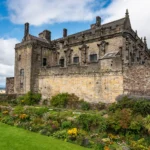
The castle sits on top of a rock with cliffs on three sides: a position that guarded the lowest crossing of the Forth until the 1890s. Most of its main buildings date from the 15th and 16th centuries; a few elements go back to the 14th and the outer defences facing the town to the early 18th. A royal residence as much as a fortress, it saw the coronation of Mary, Queen of Scots in 1542 and at least eight sieges, the last in 1746, when Charles Edward Stuart (Bonnie Prince Charlie) tried unsuccessfully to take it.
The castle is now run by Historic Environment Scotland, which publishes opening hours and tickets on its official site: check it before you come, especially as several guides advise booking online in high season. Allow half a day if you want to see the interiors and the regimental museum of the Argyll and Sutherland Highlanders.
The old town, the Holy Rude and the Old Town Jail
Between the station and the castle, the old town climbs along cobbled streets: the upper town, from Broad Street, is known for its cobbles and views over the valley. This is the classic climb for visitors, who stop at the Old Town Jail, a former prison turned visitor attraction, at Mar’s Wark and at Argyll’s Lodging before reaching the castle. Just below the castle, the Church of the Holy Rude, a medieval parish church, is where the future James VI was crowned King of Scots on 29 July 1567, still a child, at a service ending with a sermon by John Knox.
The National Wallace Monument
On Abbey Craig, a hill overlooking the town to the north-east, this Gothic Revival tower pays tribute to William Wallace. The site is said to be where Wallace watched the English army before the Battle of Stirling Bridge. Its foundation stone was laid in 1861. You walk up from the foot of the hill, then 246 steps lead to the viewing platform, with three exhibition rooms in the tower. Note that, according to its description, the tower is not accessible to people with reduced mobility.
Stirling Bridge and Bannockburn: the two battles
On 11 September 1297, the troops of Andrew Moray and William Wallace defeated the English army near Stirling, on the Forth: the Battle of Stirling Bridge, a founding episode of the First War of Scottish Independence. The Old Bridge, the town’s old bridge, recalls the importance of this crossing. On 23 June 1314, at Bannockburn, a neighbouring village to the south, Robert Bruce’s troops defeated the army of Edward II, which had come to relieve the English garrison of the castle, within sight of its walls. The saying “he who holds Stirling holds Scotland”, sometimes attributed to Robert Bruce, sums up this strategic position.
Museum and cultural outings
The Smith Art Gallery and Museum is free to enter, a good option in wet weather. The Tolbooth and the Albert Halls host many events, and the Macrobert Arts Centre offers exhibitions and shows. Check programmes on their websites.
Stirling in 1 or 2 days
- Day 1: castle in the morning, down through the old town (Holy Rude, Argyll’s Lodging, Mar’s Wark, Old Town Jail), Old Bridge late in the day.
- Day 2: Wallace Monument and Abbey Craig, then Bannockburn; or head for the Trossachs and the Highlands.
Stirling combines naturally with Edinburgh and Glasgow, both linked by train, and serves as a gateway to the Highlands: it is nicknamed the “Gateway to the Highlands”.
When to go to Stirling
We have no published official normals for Stirling on our climate page: for temperatures and rain, refer to the Met Office normals detailed in when to go to Scotland. What changes your visit most is the light: at Stirling’s latitude, the day lasts 17 h 37 min in mid-June, against 6 h 58 min in mid-December.
| Month | Sunrise (15th) | Sunset (15th) | Daylight |
|---|---|---|---|
| January | 8:37 am | 4:12 pm | 7 h 35 min |
| February | 7:41 am | 5:18 pm | 9 h 37 min |
| March | 6:31 am | 6:18 pm | 11 h 47 min |
| April | 6:10 am | 8:22 pm | 14 h 12 min |
| May | 5:02 am | 9:22 pm | 16 h 20 min |
| June | 4:28 am | 10:04 pm | 17 h 37 min |
| July | 4:49 am | 9:53 pm | 17 h 04 min |
| August | 5:45 am | 8:53 pm | 15 h 08 min |
| September | 6:46 am | 7:34 pm | 12 h 48 min |
| October | 7:46 am | 6:15 pm | 10 h 29 min |
| November | 7:52 am | 4:07 pm | 8 h 15 min |
| December | 8:41 am | 3:39 pm | 6 h 58 min |
Reading the table: in December, the sun sets around 3:39 pm: start at the castle as soon as it opens to make the most of the light. From May to August, evenings stay light well after 9 pm, ideal for climbing Abbey Craig late in the day.
Getting to Stirling and getting around
Stirling has no airport: visitors generally arrive via Edinburgh or Glasgow, then by train or road. Stirling station is served by trains to Edinburgh Waverley, Glasgow Queen Street, Perth, Dundee, Aberdeen, Inverness and London King’s Cross, as well as by regional lines to Alloa, Bridge of Allan, Falkirk and Dunblane. Scottish Citylink and Ember coaches link many Scottish towns. By car, the M9 motorway comes from Edinburgh and the M80 from Glasgow. Check timetables and journey times with ScotRail and the coach operators.
In town, the centre and the old town are walkable, but the climb to the castle is steep. Local buses link the districts and two park-and-ride sites serve the centre.
Train, transfers or car?
The train is the simplest way to include a stop in Stirling. A car becomes useful if you continue to the Trossachs or the Highlands. Remember that traffic drives on the left in the UK, and that the U.S. State Department notes Scotland’s drink-driving limit (roughly 0.05 blood alcohol) is lower than in the rest of the UK (0.08). Before booking, compare the operator’s site and resellers: cancellation terms, excess and insurance for a rental.
Where to stay in Stirling
The old town, between the station and the castle, lets you do everything on foot. Streets near the station are practical if you are travelling on by train. Bridge of Allan, to the north, is another base, served by train. For major event dates, book early.
Entry requirements, health and safety
Rules checked in the official sources read in October and November 2026. Rules can change: confirm before you travel.
US citizens
According to the U.S. Department of State (travel.state.gov, last updated August 11, 2025), your passport must be valid for the entire length of your stay in the United Kingdom, and all US citizens travelling to the UK for tourism, family visits, business meetings, conferences or short-term study of 6 months or less must have an Electronic Travel Authorisation (ETA) before travel. According to GOV.UK (GOV.UK, read 12 November 2026), an ETA costs £20 and lets you travel to the UK for up to 6 months; apply only through the official GOV.UK site or app, as other websites may charge more.
UK citizens
Scotland is part of the United Kingdom, so there are no entry formalities for UK citizens travelling from elsewhere in the UK. Carry photo ID for airlines and trains that ask for it.
Safety and local rules
- Crime: the U.S. State Department says violent crime and crime against property are rare and advises the usual precautions, including awareness of pickpocketing and “snatch and grab” theft of phones and valuables.
- Emergencies: dial 999 for police, fire and ambulance; the U.S. Consulate in Edinburgh can be reached on +44 (0) 131-556-8315.
- Driving: traffic drives on the left, which the State Department notes is a common source of injuries to US pedestrians; it also says Scotland’s drink-driving limit (roughly 0.05 blood alcohol) is lower than in the rest of the UK (0.08).
Staying connected
Roaming charges depend on your plan; an eSIM installed before departure solves the question. Mobile coverage can be patchy in mountains and glens, so download offline maps. See our travel eSIM guide.
If you… then…
| If you… | Then… |
|---|---|
| Have only one day | Castle in the morning, old town in the afternoon, Old Bridge on the way back |
| Like the history of the wars of independence | Add the Wallace Monument and Bannockburn |
| Travel in winter | Be at the castle when it opens: less than 7 hours of daylight in December (calculated) |
| Travel without a car | Stay near the station: trains to Edinburgh, Glasgow, Perth and Inverness |
| Head north to the Highlands | Make Stirling your first stop |
| Have reduced mobility | Skip the Wallace Monument tower, not accessible according to its description |
| Travel from the US | Get your UK ETA before you fly |
Frequently asked questions
What can you do in Stirling in one day?
The castle, the old town with the Church of the Holy Rude, Argyll’s Lodging and the Old Town Jail, then the Old Bridge. With a little more time, add the Wallace Monument.
Is Stirling Castle worth visiting?
Yes: it is one of the largest and most important castles in Scotland, a former royal residence where Mary, Queen of Scots was crowned in 1542. It is run by Historic Environment Scotland.
How many steps are there up the Wallace Monument?
246 steps lead to the viewing platform of this tower, which is not accessible to people with reduced mobility.
How do you get to Stirling from Edinburgh or Glasgow?
By train from Edinburgh Waverley or Glasgow Queen Street, or by coach (Scottish Citylink, Ember). By car, take the M9 from Edinburgh or the M80 from Glasgow.
Do you need a visa for Stirling?
US citizens do not need a visa for a tourist stay of up to 6 months, but they need a UK Electronic Travel Authorisation (ETA) and a passport valid for the whole stay (U.S. Department of State, last updated August 11, 2025; GOV.UK, read 12 November 2026). UK citizens need nothing.
Is Stirling in the Highlands?
No, it lies at the hinge between the Lowlands and the Highlands, hence its nickname “Gateway to the Highlands”.
Our sources
- U.S. Department of State, United Kingdom country information (travel.state.gov, last updated August 11, 2025): entry and exit requirements, safety and security, transportation; read 26 October 2026
- GOV.UK, Apply for an electronic travel authorisation (ETA): fee and validity; read 12 November 2026
- Met Office climate normals (for Scotland generally): see our page on when to go to Scotland
- Wikipedia (EN) articles “Stirling”, “Stirling Castle”, “National Wallace Monument” and “Battle of Stirling Bridge”
- Astronomical calculations: NOAA solar algorithm, applied by Destination de Voyage to the coordinates of Stirling (15th of each month, year 2027)
- Our methodology
Updated November 2026.
