
Pamukkale, « cotton castle » in Turkish, is a hillside covered in dazzling white travertine terraces, deposited by limestone-rich hot springs. Above them lie the ruins of Hierapolis, a Greco-Roman spa town. The whole site has been a UNESCO World Heritage Site since 1988. This guide on how to visit Pamukkale explains what to see, the rules to know (barefoot on the pools), how to get there, the best time to go based on official normals, and how to combine it with Cappadocia or Antalya.
Safety: according to the UK FCDO (GOV.UK, updated 19 October 2026), terrorists are likely to try to carry out attacks in Turkey, mostly in the southeast, Ankara and Istanbul. Pamukkale and Denizli province, in the west of the country, are far from the southeastern provinces where the U.S. Department of State restricts travel by its staff (travel.state.gov, last updated June 11, 2026). Check the latest advice before you leave.

Our travel deals for Pamukkale
Affiliate links: we earn a commission, at no extra cost to you.
 FlightsKiwi.comCompare flights and airline combinations to Pamukkale.Compare flights
- eSIMAiraloData plan to install before you leave (eSIM-compatible phone).See plans


Pamukkale at a glance
- Location Denizli provinceIn western Turkey, about 20 km (12 mi) north of the city of Denizli
- Language Turkish; English is common in the village and on the site
- Currency the Turkish lira (TRY); see our currency exchange guide · currencies
- Time zone UTC+3, no daylight saving · details3 h ahead of London and 8 h ahead of New York in winterLocal time now: –:–
- Airports no international airport at Pamukkale; nearest: Denizli-Çardak (domestic), Izmir, Antalya · details
- Entry US and UK: visa-free up to 90 days in any 180 days · travel.state.gov · GOV.UK
- Electricity check the plug type with your adapter supplier · plugs
- Visit length half a day minimum · detailsA full day with Hierapolis
- Best time April-May and late September-October
- Budget see our budget section
What to see in Pamukkale
The travertine terraces
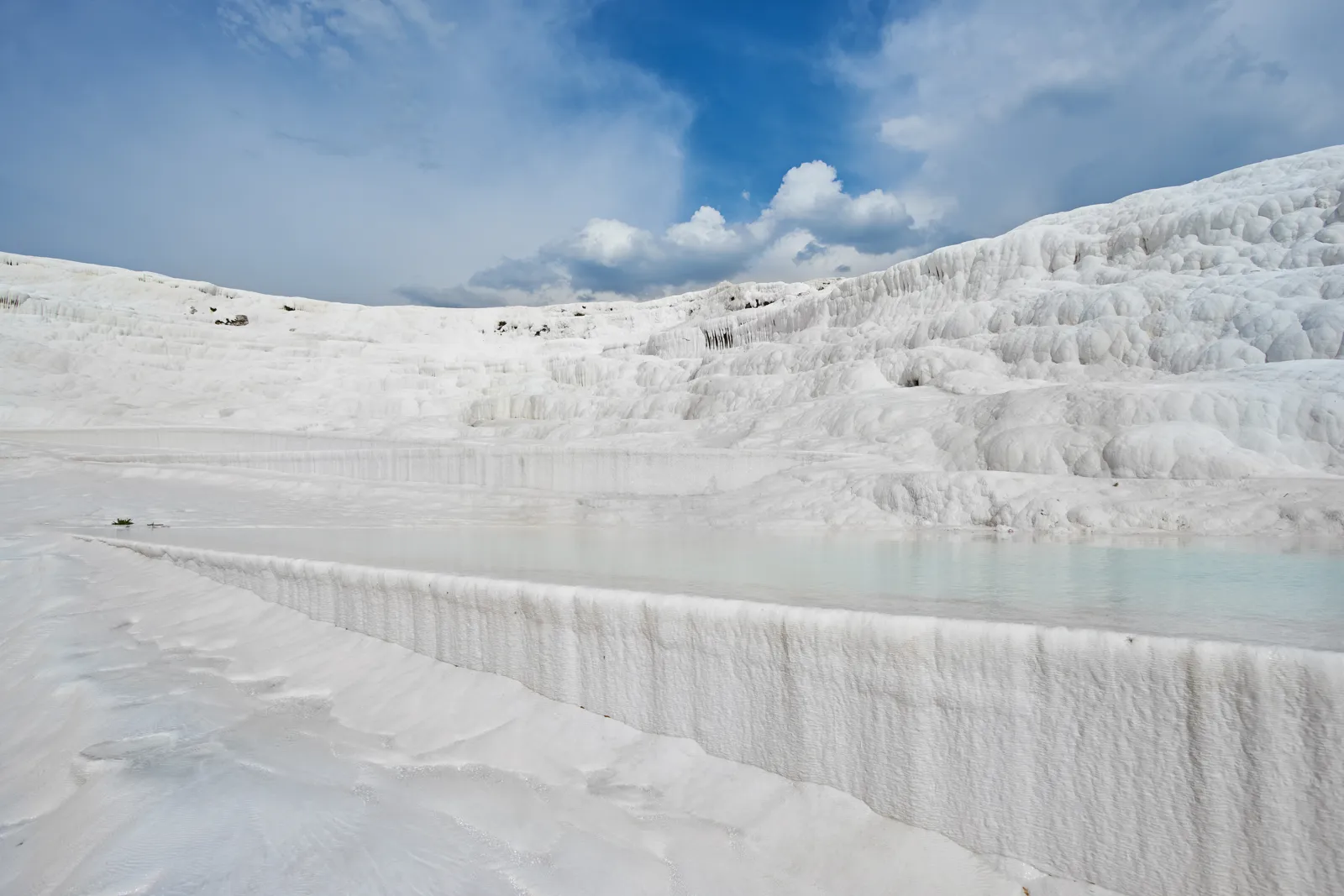
According to Wikipedia, the water of 17 springs, at about 36 °C (97 °F) (over 45 °C / 113 °F for some), is rich in carbon dioxide and limestone. As it flows in the open air, it loses its gas and deposits layers of calcium carbonate that form pools and petrified cascades. 20th-century development (hotels on the edge of the terraces, a road) damaged the site: the road was closed and artificial stepped pools were created. You may only walk in authorised areas, barefoot, to protect the rock.
Hierapolis, the ancient spa town
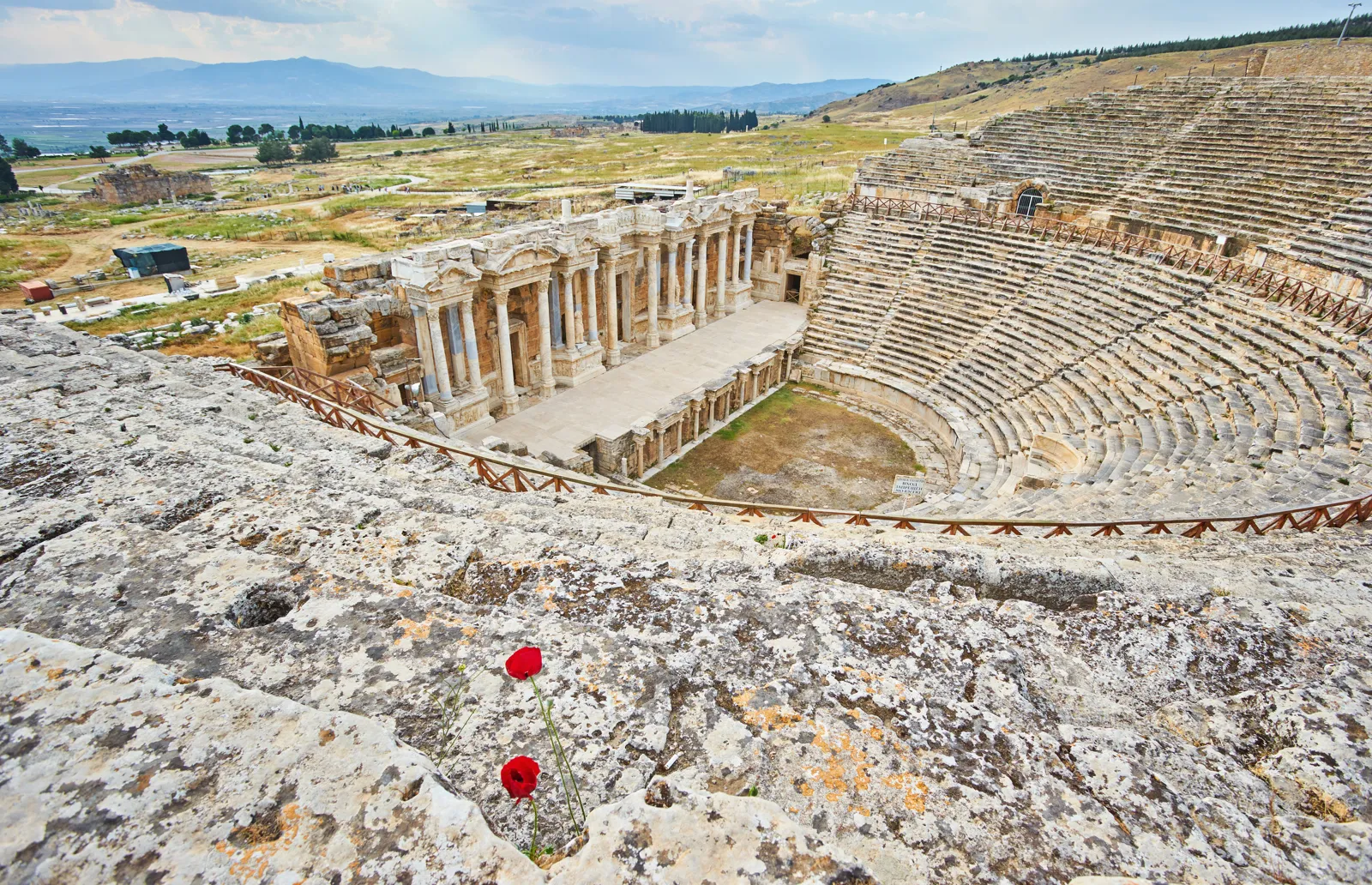
Founded in the 2nd century BC, Hierapolis prospered thanks to its springs. Rebuilt after a major earthquake in AD 60, it has a vast Roman theatre on the hillside, a colonnaded main street, the Gate of Domitian, baths and one of the largest ancient necropolises in Anatolia, with hundreds of tombs. The site is large: allow at least two to three hours.
The Antique Pool (« Cleopatra’s Pool »)
You bathe in warm thermal water among ancient columns that have fallen to the bottom of the pool. Entry is charged on top of the site ticket, and the pool is very busy in the middle of the day: come early or late in the afternoon.
Hierapolis Archaeological Museum
Housed in former Roman baths, it displays sarcophagi, statues and reliefs found at Hierapolis and in neighbouring cities.
The Martyrium of St Philip
On the hill above the theatre, this octagonal shrine is associated with the apostle Philip, who according to tradition died in Hierapolis. The climb offers a fine view over the whole site.
Around Pamukkale
- Karahayıt: a neighbouring spa village with reddish, iron-rich springs.
- Laodicea: the ruins of a large ancient city a few kilometres away, often less crowded.
- Aphrodisias: one of Turkey’s finest ancient cities, about 1 hour 30 minutes’ drive away; can be combined in a day.
- Kaklık: a cave with travertine formations, on the road to Afyon.
- Hot-air balloons: sunrise flights over the terraces are offered; compare operators and check that your travel insurance covers the activity.
Rules and checklist for the visit
- Shoes off on the travertines: bring a bag to carry them. The ground is rough in places, slippery elsewhere.
- Swimsuit under your clothes if you plan to bathe in the pools or the Antique Pool.
- Sunglasses: the glare from the white rock is very strong.
- Sunscreen, hat and water: there is almost no shade on the terraces or in Hierapolis.
- Two entrances: the south entrance (top of the site, near Hierapolis) lets you walk down the terraces; the village entrance (bottom of the site) means walking up barefoot.
- Opening times and prices: they change often with inflation; check them on the official Turkish museums website before you go.
- Drones: check the rules before flying yours.
Pamukkale: when is it too hot? A comparison with Cappadocia
Pamukkale lies in an inland valley: summer is much hotter than on the Aegean coast or in Cappadocia, on the Anatolian plateau. According to the MGM, the average high reaches 35.7 °C (96 °F) in July and August in Denizli, and 4 months out of 12 exceed 30 °C (86 °F). As most tours link Pamukkale and Cappadocia, we compared the two stations month by month.
| Month | Max Pamukkale/Denizli | Max Cappadocia/Nevşehir | Difference in max | Min Denizli | Min Nevşehir | Heat in Pamukkale |
|---|---|---|---|---|---|---|
| January | 10.7 °C (51 °F) | 4.1 °C (39 °F) | +6.6 °C (12 °F) | 2.7 °C (37 °F) | -3.5 °C (26 °F) | — |
| February | 12.7 °C (55 °F) | 6.0 °C (43 °F) | +6.7 °C (12 °F) | 3.6 °C (38 °F) | -2.6 °C (27 °F) | — |
| March | 16.5 °C (62 °F) | 10.9 °C (52 °F) | +5.6 °C (10 °F) | 6.0 °C (43 °F) | 1.0 °C (34 °F) | — |
| April | 21.3 °C (70 °F) | 16.3 °C (61 °F) | +5.0 °C (9 °F) | 9.7 °C (49 °F) | 5.2 °C (41 °F) | — |
| May | 27.0 °C (81 °F) | 21.2 °C (70 °F) | +5.8 °C (10 °F) | 14.2 °C (58 °F) | 9.3 °C (49 °F) | — |
| June | 32.3 °C (90 °F) | 25.6 °C (78 °F) | +6.7 °C (12 °F) | 18.6 °C (65 °F) | 12.3 °C (54 °F) | 🔥 very hot |
| July | 35.7 °C (96 °F) | 29.3 °C (85 °F) | +6.4 °C (12 °F) | 21.6 °C (71 °F) | 14.6 °C (58 °F) | 🔥 very hot |
| August | 35.7 °C (96 °F) | 29.4 °C (85 °F) | +6.3 °C (11 °F) | 21.5 °C (71 °F) | 14.5 °C (58 °F) | 🔥 very hot |
| September | 31.0 °C (88 °F) | 25.3 °C (78 °F) | +5.7 °C (10 °F) | 17.2 °C (63 °F) | 11.3 °C (52 °F) | hot |
| October | 24.7 °C (76 °F) | 19.1 °C (66 °F) | +5.6 °C (10 °F) | 12.5 °C (54 °F) | 7.4 °C (45 °F) | — |
| November | 17.8 °C (64 °F) | 11.6 °C (53 °F) | +6.2 °C (11 °F) | 7.5 °C (46 °F) | 2.1 °C (36 °F) | — |
| December | 12.2 °C (54 °F) | 6.2 °C (43 °F) | +6.0 °C (11 °F) | 4.4 °C (40 °F) | -1.4 °C (29 °F) | — |
Pamukkale is 5 to 7 °C (9 to 13 °F) warmer than Cappadocia all year round. The best months to combine the two are May (27 °C / 81 °F in Pamukkale, 21 °C / 70 °F in Cappadocia) and late September-October. In winter, Cappadocia freezes at night (-3.5 °C / 26 °F minimum in January) while Denizli stays above 0 °C (32 °F). For Cappadocia, see also the best time to visit Cappadocia.
What time to arrive? Sunrise and sunset in Pamukkale
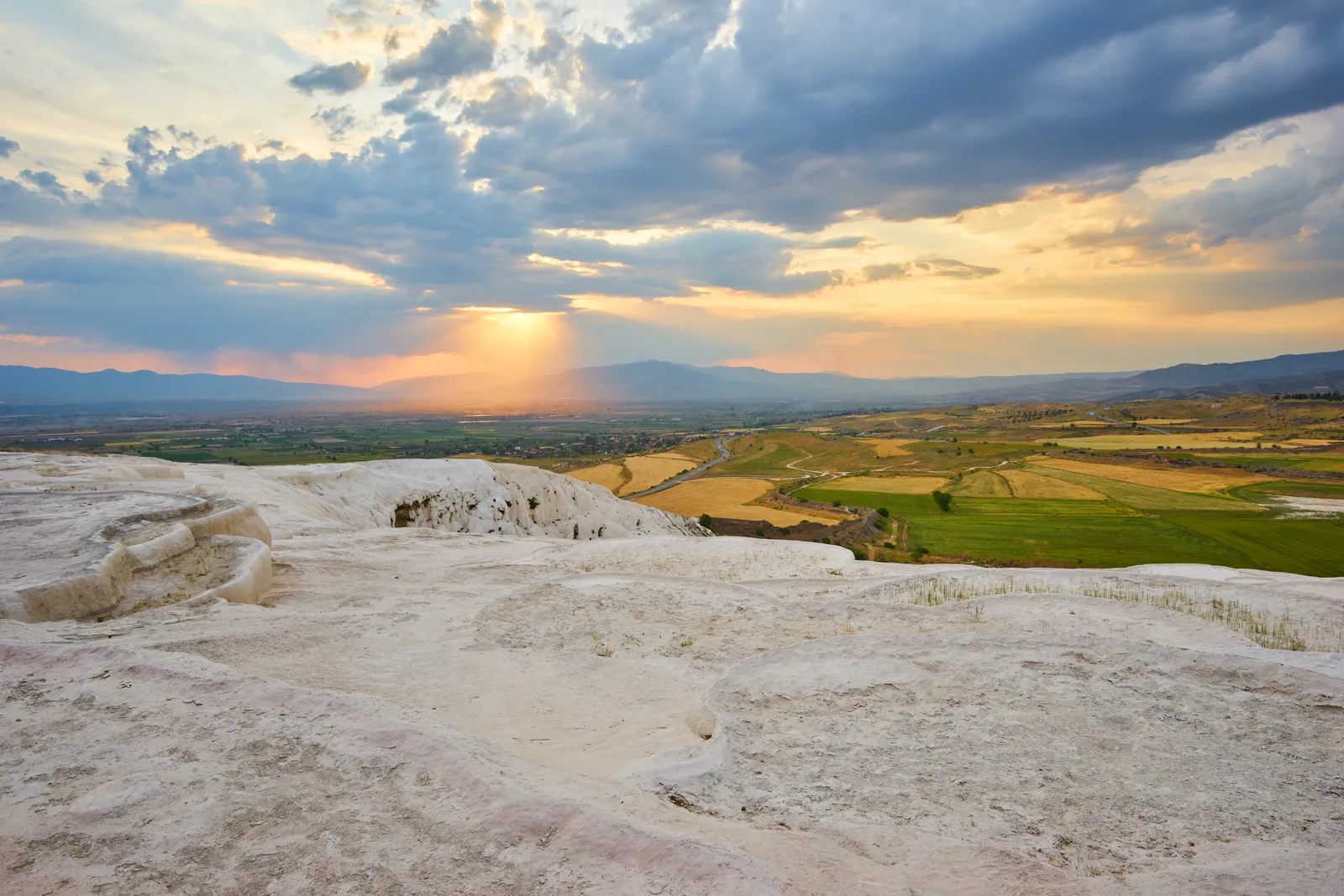
The terraces are at their most beautiful, and least crowded, in the low light of morning and evening. Here are the calculated times on the 15th of each month.
| Month | Sunrise | Sunset | Day length | Monthly sunshine (MGM) |
|---|---|---|---|---|
| January | 08:18 | 18:07 | 9h49 | 111 h |
| February | 07:53 | 18:41 | 10h48 | 128 h |
| March | 07:15 | 19:10 | 11h55 | 173 h |
| April | 06:28 | 19:39 | 13h10 | 208 h |
| May | 05:53 | 20:06 | 14h13 | 274 h |
| June | 05:40 | 20:27 | 14h47 | 322 h |
| July | 05:52 | 20:25 | 14h33 | 358 h |
| August | 06:18 | 19:57 | 13h39 | 324 h |
| September | 06:44 | 19:12 | 12h27 | 264 h |
| October | 07:11 | 18:26 | 11h15 | 205 h |
| November | 07:43 | 17:52 | 10h09 | 143 h |
| December | 08:11 | 17:45 | 9h33 | 102 h |
As Turkey stays on UTC+3 all year, the sun rises very late in winter (after 08:00 in December and January) and very early in summer (around 05:40 in June). In summer, aim for opening time or late afternoon, and keep the middle of the day for the Antique Pool or the museum.
How to get to Pamukkale
- From Izmir: about 250 km (155 mi), around 3 hours 30 minutes by road, or by train or bus to Denizli. Izmir airport has international flights: check current routes with the airlines.
- From Antalya: about 240 km (149 mi), 3 hours 30 minutes to 4 hours by road across the Taurus. Pamukkale is possible as a day trip, but the day is long: better to spend a night there.
- From Istanbul: a domestic flight to Denizli-Çardak airport, about an hour’s drive away, or a night bus.
- From Cappadocia: about 600 to 650 km (370 to 400 mi): a long day’s drive or a night bus; by air, you have to go back via Istanbul.
- Locally: dolmuş (minibuses) link Denizli bus station with Pamukkale village in 20 to 30 minutes.
Itineraries with Pamukkale
Pamukkale in 2 days
- Day 1: arrive in the afternoon, the terraces and sunset, night in the village
- Day 2: enter at opening time, Hierapolis, the theatre, the necropolis, the museum, the Antique Pool; leave at the end of the day or take a trip to Aphrodisias
10-day tour: Istanbul, Cappadocia, Pamukkale, the coast
- Days 1-3: Istanbul
- Days 4-6: Cappadocia (domestic flight)
- Day 7: road or night bus to Pamukkale
- Day 8: Pamukkale and Hierapolis
- Day 9: Aphrodisias then Selçuk (Ephesus), or the road to Antalya
- Day 10: Ephesus and flight home from Izmir, or the beach in Antalya
For the whole country, see our Turkey travel guide.
When to go to Pamukkale: climate and best time
The best time to visit Pamukkale is April to May and late September to October: 21 to 31 °C (70 to 88 °F) in the afternoon, little rain and dazzling terraces in the sun. June to August are very hot (over 35 °C / 95 °F in July and August) and very busy. Winter is cool and wet, but the site is quiet and the light soft. The table uses the official MGM normals for Denizli.
| Month | Avg max | Avg min | Rain | Rain days | Crowds | Prices | Verdict |
|---|---|---|---|---|---|---|---|
| January | 10.7 °C (51 °F) | 2.7 °C (37 °F) | 85.7 mm (3.4 in) | 12 | Low | Low | ⚠️ Cool and wet, very quiet |
| February | 12.7 °C (55 °F) | 3.6 °C (38 °F) | 69.7 mm (2.7 in) | 11 | Low | Low | ⚠️ Cool, some rain |
| March | 16.5 °C (62 °F) | 6.0 °C (43 °F) | 63.8 mm (2.5 in) | 11 | Low | Low | ⚠️ Mild, showers |
| April | 21.3 °C (70 °F) | 9.7 °C (49 °F) | 54.8 mm (2.2 in) | 10 | Moderate | Medium | ✅ Mild, ideal for Hierapolis |
| May | 27.0 °C (81 °F) | 14.2 °C (58 °F) | 47.9 mm (1.9 in) | 9 | High | Medium | ✅ One of the best months |
| June | 32.3 °C (90 °F) | 18.6 °C (65 °F) | 31.8 mm (1.3 in) | 5 | High | High | ⚠️ Hot, visit early |
| July | 35.7 °C (96 °F) | 21.6 °C (71 °F) | 16.3 mm (0.6 in) | 2 | Very high | High | ❌ Very hot (35.7 °C) |
| August | 35.7 °C (96 °F) | 21.5 °C (71 °F) | 12.1 mm (0.5 in) | 3 | Very high | High | ❌ Very hot, crowds |
| September | 31.0 °C (88 °F) | 17.2 °C (63 °F) | 15.7 mm (0.6 in) | 3 | High | Medium | ✅ Still hot early in the month |
| October | 24.7 °C (76 °F) | 12.5 °C (54 °F) | 37.1 mm (1.5 in) | 6 | Moderate | Medium | ✅ Ideal, soft light |
| November | 17.8 °C (64 °F) | 7.5 °C (46 °F) | 57.8 mm (2.3 in) | 7 | Low | Low | ⚠️ Cool, rain returns |
| December | 12.2 °C (54 °F) | 4.4 °C (40 °F) | 81.1 mm (3.2 in) | 12 | Low | Low | ⚠️ Wettest with January |
Spring (March to May)
The ideal season: from 16 °C (61 °F) in March to 27 °C (81 °F) in May, green hills, less rain. The water in the pools, about 36 °C (97 °F) at the source, is pleasant even in cool weather.
Summer (June to August)
Very hot and dry: 32 to 36 °C (90 to 97 °F) in the afternoon, barely two or three rainy days a month. The white rock reflects heat and light: come at opening time or late in the day. Wildfires happen frequently in Turkey in summer; follow the instructions of the local authorities and call 112 if you see one (GOV.UK).
Autumn (September to November)
September is still hot (31 °C / 88 °F), October is mild (25 °C / 77 °F) and bright: one of the best periods. Rain returns in November.
Winter (December to February)
Cool (11 to 13 °C / 52 to 55 °F in the afternoon), wet (about twelve rainy days in December and January), few people. Days are short: under 10 hours, with sunrise after 08:00.
Pamukkale month by month
January: 10.7 °C (51 °F), the wettest month (85.7 mm / 3.4 in), deserted site.
February: 12.7 °C (55 °F), still cool and damp.
March: 16.5 °C (62 °F), early spring.
April: 21.3 °C (70 °F): a very good month for Hierapolis.
May: 27 °C (81 °F), little rain: the best compromise.
June: 32.3 °C (90 °F): visit early.
July: 35.7 °C (96 °F), the hottest, almost no rain.
August: 35.7 °C (96 °F), holiday crowds.
September: 31 °C (88 °F), quieter after mid-September.
October: 24.7 °C (76 °F), soft light: excellent.
November: 17.8 °C (64 °F), rain returns.
December: 12.2 °C (54 °F), twelve rainy days on average.
For the rest of the country, see the best time to visit Turkey, and for other ideas, where to go in April or where to go in October.
Budget for visiting Pamukkale
Prices change quickly with inflation and the lira exchange rate: the amounts below are rough estimates per person per day, excluding flights, converted at the European Central Bank rate of 23 October 2026.
| Item | Tight budget | Comfort |
|---|---|---|
| Accommodation (shared double room) | roughly TRY 850 to 1,700 | roughly TRY 2,800 to 5,600 |
| Meals | roughly TRY 650 to 1,100 | roughly TRY 1,400 to 2,500 |
| Transport (dolmuş, bus / car) | roughly TRY 150 to 550 | roughly TRY 1,100 to 2,200 |
| Site entry, Antique Pool, museum | roughly TRY 850 to 1,400 | roughly TRY 1,400 to 2,200 |
| Total per day | roughly TRY 2,500 to 4,200 | roughly TRY 5,600 to 10,000 |
Where to stay in Pamukkale
- Pamukkale village: guesthouses and small hotels at the foot of the terraces, often with a pool; the most practical for being on the site early in the morning and at sunset.
- Karahayıt: larger spa hotels a few kilometres to the north.
- Denizli: a medium-sized city with more choice and the bus station, about twenty minutes away.
Entry requirements, health and safety
US citizens
According to the U.S. Department of State (travel.state.gov, last updated June 11, 2026), ordinary passport holders are exempt from visas for up to 90 days in any 180-day period. Your passport must be valid for six months beyond your entry date, with enough space for entry and exit stamps; make sure you get both stamps.
UK citizens
According to the UK FCDO (GOV.UK foreign travel advice, updated 19 October 2026), British citizen passport holders can visit without a visa for up to 90 days in any 180-day period for tourism or business. Your passport must be valid for at least 150 days after the date you arrive and have at least 1 blank page. The US and UK sources give different validity rules: if in doubt, check with the Turkish embassy.
- Health: check vaccine recommendations at least 8 weeks before travel; the GHIC and EHIC are not valid in Turkey, so take out insurance covering medical costs and evacuation (GOV.UK, updated 19 October 2026). In summer, protect yourself from heat and sun.
- Security: terrorists are likely to try to carry out attacks in Turkey; avoid gatherings and demonstrations (GOV.UK). Insulting the Turkish state, its flag or Atatürk is illegal, including on social media (U.S. Department of State).
- Natural risks: earthquakes, flooding after severe rainstorms and summer wildfires; follow AFAD, the Disaster and Emergency Management Authority (GOV.UK).
- Emergencies: dial 112.
See our travel insurance guide.
Practical tips for Pamukkale
- Money: cards are accepted on the site and in hotels; keep Turkish lira for dolmuş and small restaurants.
- What to pack: a light towel, a waterproof bag for your phone, sandals that are easy to take off.
- Photos: reflections in the pools are best under a blue sky and low light.
- Food: try gözleme (stuffed flatbread) and Aegean dishes cooked in olive oil.
- Mobile data: check your home carrier’s roaming charges; an eSIM is often cheaper (see our eSIM guide).
Frequently asked questions
Can you swim at Pamukkale?
Yes, in the terrace pools open to the public, barefoot, and in the Antique Pool of Hierapolis, for an extra fee. The spring water is about 36 °C (97 °F).
When is the best time to visit Pamukkale?
April-May and late September-October. In July and August the average high reaches 35.7 °C (96 °F) in Denizli according to the MGM, and the white rock reflects the heat.
How long does it take to visit Pamukkale?
Half a day for the terraces, a full day with Hierapolis, the museum and the Antique Pool. A night on site lets you see sunset and sunrise.
Do you have to take your shoes off at Pamukkale?
Yes, on the travertine terraces, to protect the rock. Bring a bag for your shoes.
Can you visit Pamukkale from Antalya in a day?
It is possible, with about 3 hours 30 minutes to 4 hours of driving each way, but it makes a long day. Staying in the village is more comfortable.
Pamukkale or Cappadocia: which to visit in summer?
Cappadocia, at higher altitude, is 5 to 7 °C cooler: 29 °C (84 °F) in July against 35.7 °C (96 °F) in Denizli according to the MGM normals. In Pamukkale in summer, visit early in the morning.
Our sources
- Climate normals: 1991-2020 normals for the Denizli (about 20 km from Pamukkale) and Nevşehir (Cappadocia) stations, published by the Turkish State Meteorological Service (Meteoroloji Genel Müdürlüğü, MGM), as reported by Wikipedia (articles « Denizli » and « Nevşehir »)
- Entry, health and safety information read on 26 October 2026: U.S. Department of State, Turkey country information (travel.state.gov, last updated June 11, 2026), and UK FCDO, foreign travel advice for Turkey (GOV.UK, updated 19 October 2026)
- Wikipedia, article « Pamukkale » (formation of the travertines, UNESCO listing, protection measures), accessed October 2026
- Destination de Voyage calculations: Denizli / Nevşehir comparison, sunrise and sunset (NOAA solar algorithm)
- European Central Bank, euro reference rates of 23 October 2026 (budget conversion)
- Our methodology
Updated October 2026.