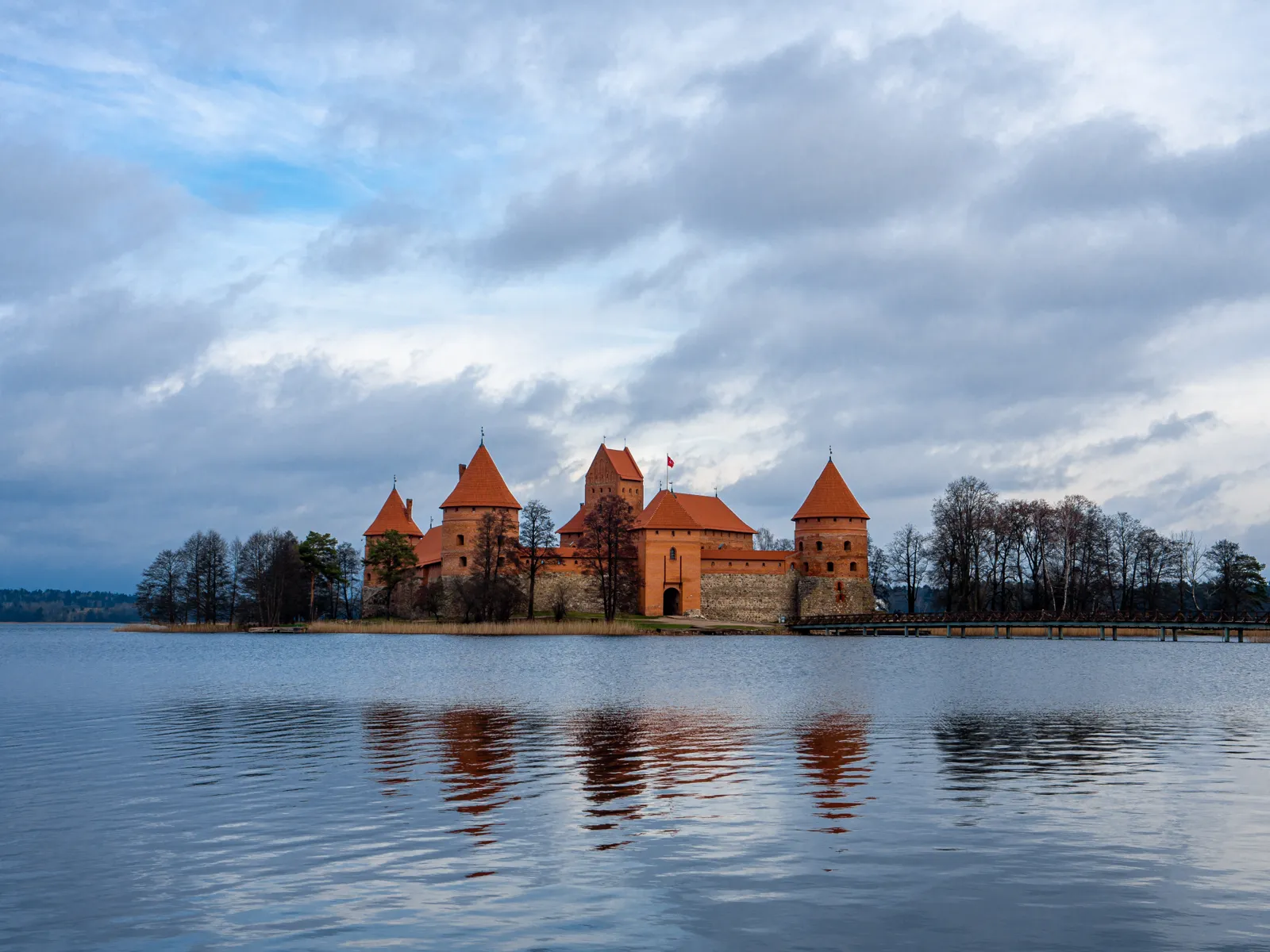
Paraguay is a landlocked country in the heart of South America, between Argentina, Brazil and Bolivia, where people come for the UNESCO-listed Jesuit missions, the capital Asunción on the Paraguay River, the wide open spaces of the Chaco and a culture where Guarani is spoken as much as Spanish. This Paraguay travel guide gathers what you need to know before you go: areas of caution according to the UK and US governments, the best time to visit based on official climate normals, the highlights, itineraries, getting around and entry requirements.

Our travel deals for Paraguay
Affiliate links: we earn a commission, at no extra cost to you.
 FlightsKiwi.comCompare flights and airline combinations to Paraguay.Compare flights
- eSIMSailyAnother eSIM plan to compare: data, validity, network.See Saily plans


Paraguay in figures (Destination de Voyage calculation)
- Time difference: UTC−3 all year since October 2024: 3 h behind London in winter and 4 h behind in summer; 2 h ahead of New York in winter and 1 h ahead in summer.
- Driest month in Asunción: August (38.7 mm / 1.5 in); wettest: November (195 mm / 7.7 in).
- Warmest month: January (34.0 °C / 93 °F average high); coolest: July (12.9 °C / 55 °F average low).
- Day–night gap: from 9.3 °C in June to 11.6 °C in August.
- Day length: from 10 h 34 min (15 June) to 13 h 42 min (15 December).
- Destination de Voyage calculation using the 1991–2020 normals of the Dirección de Meteorología e Hidrología (WMO) and the NOAA solar algorithm. Method: driest and warmest months read from the official Asunción airport station normals shown below; day–night gap = average high minus average low.
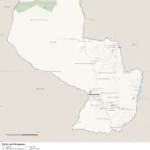
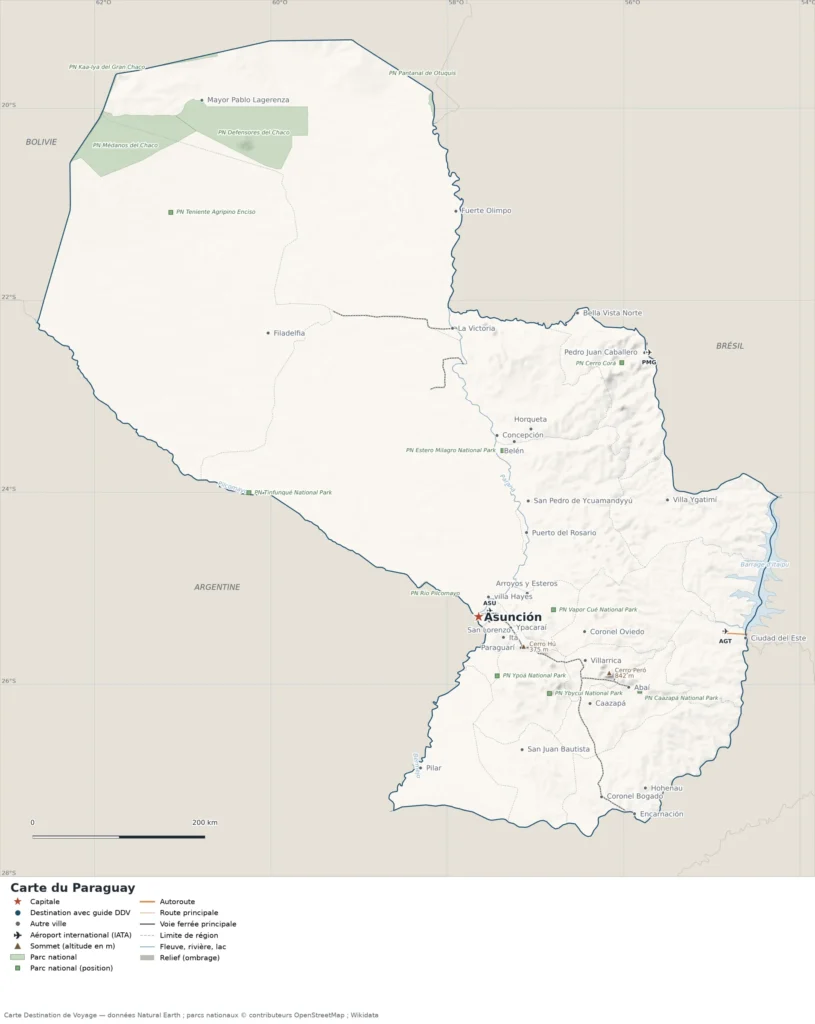
To locate cities, regions, terrain, national parks and airports, see our map of Paraguay.
⚠️ Areas of caution: what the UK and US governments say
- U.S. Department of State: Level 1, Exercise Normal Precautions (travel advisory dated August 18, 2026): Paraguay is generally a safe destination, but crime is a concern, and the advisory says to exercise increased caution in the departments of Alto Paraná, Amambay, Canindeyú, Concepción and San Pedro because of crime.
- UK FCDO (GOV.UK, updated 3 November 2026): reports that transnational criminal organizations run drug and arms trafficking along the border with Brazil, mostly from Pedro Juan Caballero south to Ciudad del Este and the Tri-Border Area, and that violent crime is increasing there. It names the departments bordering Brazil (Amambay, Concepción, Alto Paraná, San Pedro, Canindeyú and Salto del Guairá) as ones to take particular care in. It also reports that a small guerrilla-style group, the Ejército del Pueblo Paraguayo (EPP), operates in the north of San Pedro and the south of Concepción, typically targeting police and the military.
- Our choice: this guide recommends no visit to Pedro Juan Caballero, Laguna Blanca (San Pedro department) or the city of Concepción.
- Sources: FCDO, Paraguay and the U.S. Department of State, Paraguay country information (last updated September 17, 2026), read on 12 November 2026. Check the latest advice before you leave.
Paraguay at a glance
- Capital Asunción
- Language Spanish (castellano) and Guarani, official languages under Article 140 of the 1992 Constitution
- Currency the Paraguayan guaraní (PYG) · currency converter
- Time zone UTC−3 all year since October 2024 · details3 h behind London in winter, 4 h in summer; 2 h ahead of New York in winter, 1 h in summerLocal time now: –:–
- Airports Silvio Pettirossi International Airport, near AsunciónCheck current routes with the airlines
- Entry US and UK: no visa for stays of up to 90 days; get your passport stamped on arrival · travel.state.gov · GOV.UK
- Electricity we could not check plug types and voltage against an official source: check before you travel and bring a universal adapter
- Health dengue and chikungunya are health risks (FCDO and State Department); according to the Institut Pasteur, no malaria transmission
- Safety extra caution in the departments bordering Brazil and in San Pedro and Concepción (box above)
When to go to Paraguay
Paraguay has a subtropical climate: a long, very hot southern summer and a mild, drier winter. The most pleasant period runs from May to September: in Asunción, average highs stay between 23.5 and 27.9 °C (74 and 82 °F) and July and August are the driest months of the year (48.2 mm / 1.9 in and 38.7 mm / 1.5 in). From November to February, highs average above 31 °C (88 °F) and thunderstorms are frequent: November is the wettest month (195 mm / 7.7 in). Nights in June and July can be cool (average lows around 13–14 °C / 55–57 °F): bring a sweater.
| Month | High °C (°F) | Low °C (°F) | Rain mm (in) | Verdict |
|---|---|---|---|---|
| January | 34.0 (93) | 23.1 (74) | 132.6 (5.2) | ⚠️ Very hot, thunderstorms |
| February | 33.0 (91) | 22.5 (72) | 146.4 (5.8) | ⚠️ Very hot, thunderstorms |
| March | 31.9 (89) | 21.5 (71) | 131.3 (5.2) | ⚠️ Hot and humid |
| April | 29.2 (85) | 18.9 (66) | 151.7 (6.0) | ⚠️ Milder, still rainy |
| May | 24.9 (77) | 15.5 (60) | 134.1 (5.3) | ✅ Mild |
| June | 23.5 (74) | 14.2 (58) | 70.7 (2.8) | ✅ Mild, cool nights |
| July | 23.6 (74) | 12.9 (55) | 48.2 (1.9) | ✅ Driest, cool nights |
| August | 26.2 (79) | 14.6 (58) | 38.7 (1.5) | ✅ Very dry, mild |
| September | 27.9 (82) | 16.5 (62) | 79.2 (3.1) | ✅ Mild, warming up |
| October | 30.1 (86) | 19.5 (67) | 157.9 (6.2) | ⚠️ Hot, thunderstorms |
| November | 31.2 (88) | 20.3 (69) | 195.0 (7.7) | ⚠️ Hot, wettest month |
| December | 32.8 (91) | 22.2 (72) | 176.5 (6.9) | ⚠️ Very hot, thunderstorms |
Key points (Destination de Voyage calculation from these normals): in Asunción, 6 months out of 12 have an average high of at least 30 °C (86 °F), from October to March. The average day–night gap is largest in August (11.6 °C): that is the month when you need both a T-shirt in the afternoon and a jacket in the evening. These figures apply to the capital and the southeast; the Chaco, in the west, is drier and its temperatures can be more extreme.
| Month (15th) | Sunrise | Sunset | Day length |
|---|---|---|---|
| January | 06:13 | 19:45 | 13 h 33 min |
| February | 06:36 | 19:33 | 12 h 57 min |
| March | 06:52 | 19:08 | 12 h 17 min |
| April | 07:05 | 18:36 | 11 h 31 min |
| May | 07:19 | 18:14 | 10 h 54 min |
| June | 07:33 | 18:08 | 10 h 34 min |
| July | 07:35 | 18:17 | 10 h 42 min |
| August | 07:19 | 18:31 | 11 h 12 min |
| September | 06:48 | 18:43 | 11 h 55 min |
| October | 06:17 | 18:55 | 12 h 39 min |
| November | 05:55 | 19:15 | 13 h 20 min |
| December | 05:55 | 19:36 | 13 h 42 min |
Where to go in Paraguay: the highlights
In short: in Paraguay you visit Asunción, the Cordillera and Lake Ypacaraí, the Jesuit missions of Trinidad and Jesús (UNESCO) near Encarnación, Itaipú and, with a guide, the Chaco.
Asunción, the capital
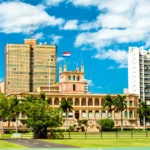
Founded in 1537 on the Paraguay River, Asunción is one of the oldest cities in South America. The historic center holds the López Palace, seat of the presidency, the National Pantheon of Heroes, the cathedral and the House of Independence, a small museum devoted to 1811. The Costanera, a promenade along the river, is best walked in the late afternoon. The UK FCDO says that bag-snatching and pickpocketing are a problem on public transport, that many foreigners use taxis rather than buses, and that you should keep away from isolated or poorly lit areas at night, including downtown areas of major cities. All the details are in our guide what to do in Asunción.
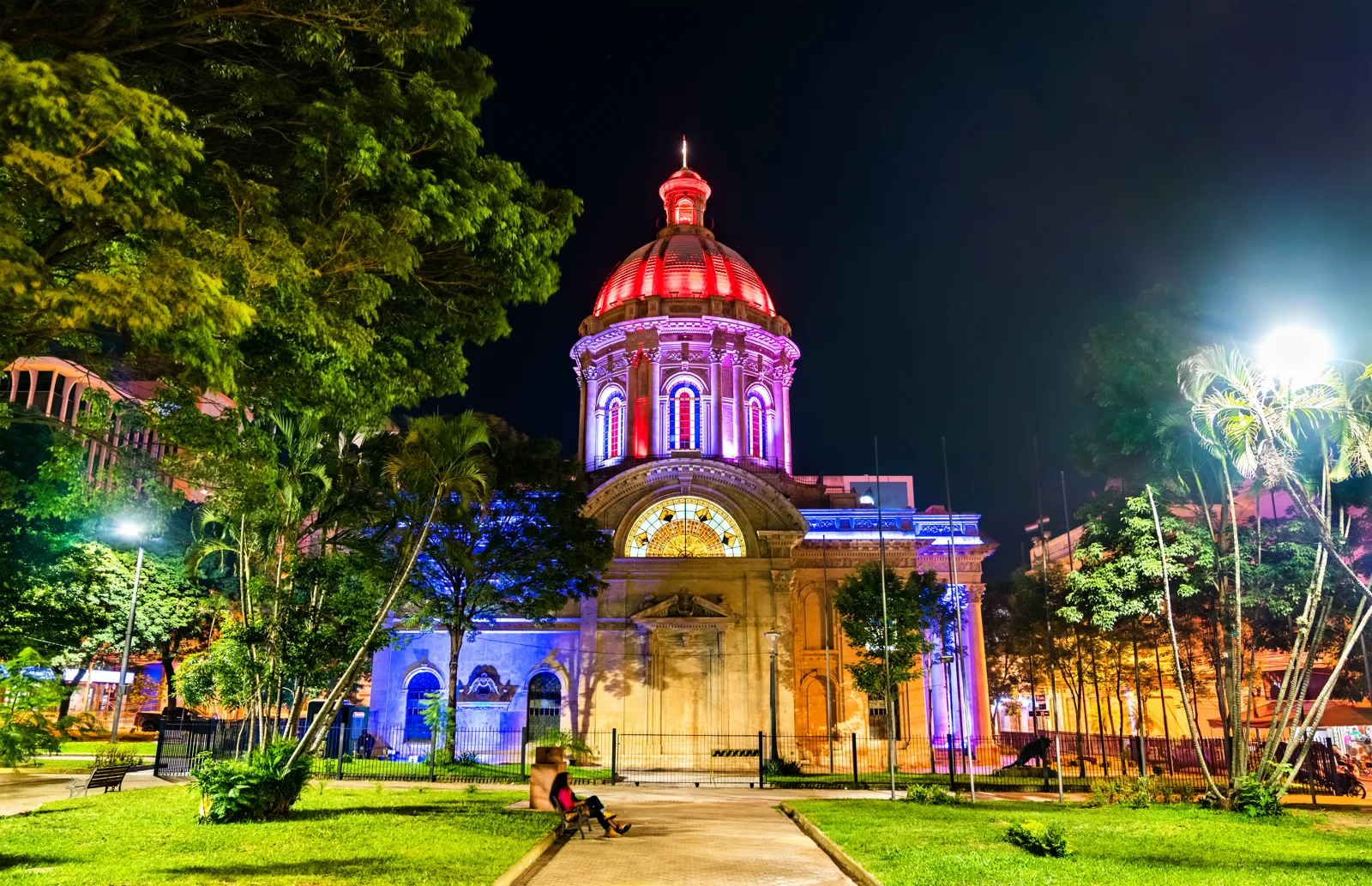
Areguá, Lake Ypacaraí and the Cordillera
East of the capital, Areguá is a town known for its ceramics workshops and its view of Lake Ypacaraí. Further on, San Bernardino is the traditional getaway for Asunción families, and Caacupé has the basilica of the Virgin, the country’s main pilgrimage site. This region, the Cordillera, is easily visited in a day from the capital, by day, avoiding the drive back after dark. The FCDO says to check the latest official advice before swimming in Lake Ypacaraí.
The Jesuit missions of Trinidad and Jesús
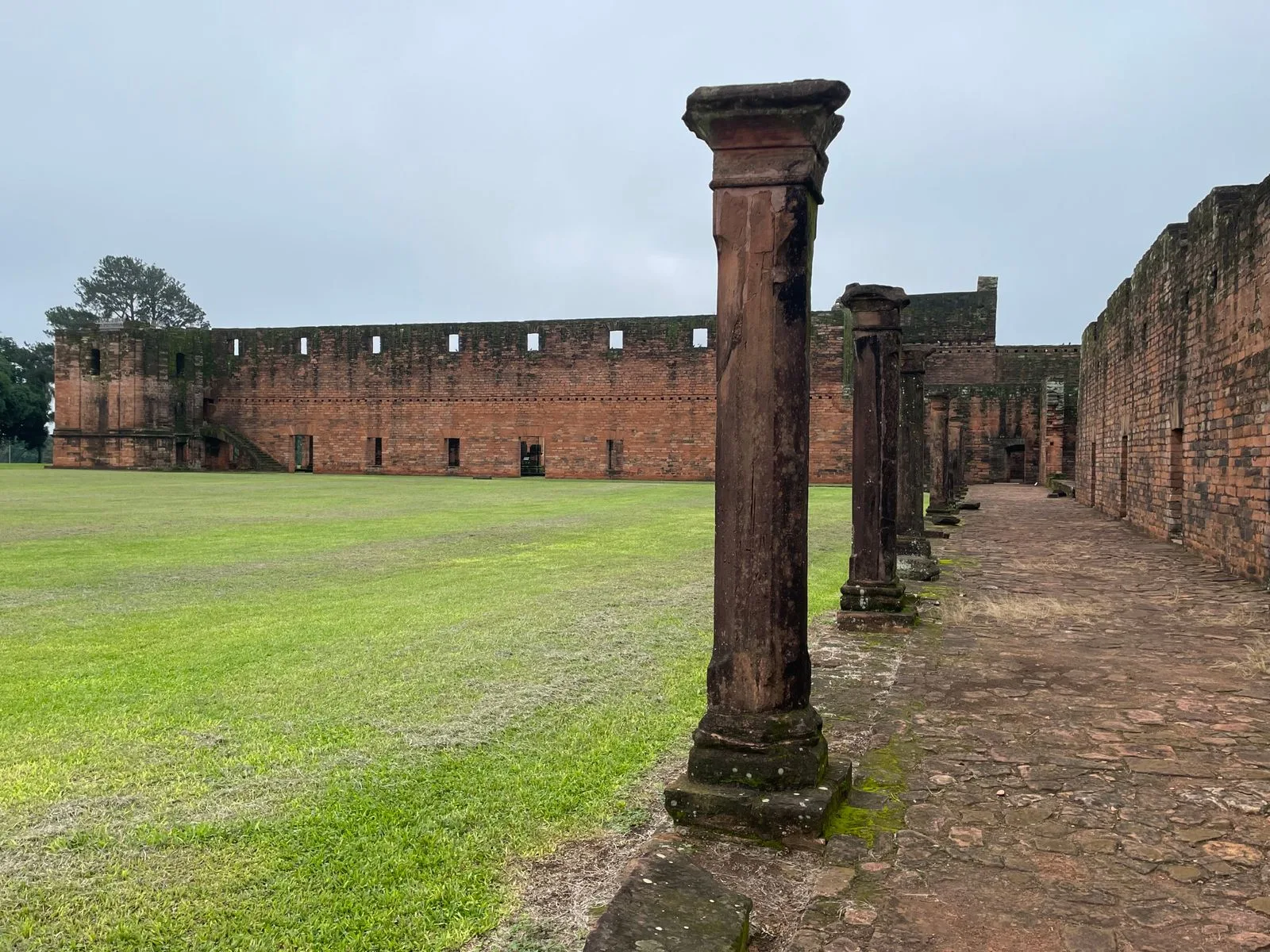
In Itapúa department, in the southeast, the ruins of the Jesuit missions of La Santísima Trinidad de Paraná and Jesús de Tavarangüe are inscribed on the UNESCO World Heritage List. These 17th- and 18th-century « reductions » housed Guarani communities organized by the Jesuits: church, workshops, living quarters, red sandstone carvings. They are visited from Encarnación, the nearest city, and combine with the Argentine missions across the Paraná River.
Encarnación and the Paraná River
Encarnación, on the Paraná, faces the Argentine city of Posadas, to which it is linked by a bridge. It is the practical base for the Jesuit missions and a natural stop on a trip continuing to Argentina. In the southern summer, its river beaches attract Paraguayan families.
Ciudad del Este, Itaipú and Iguaçu Falls
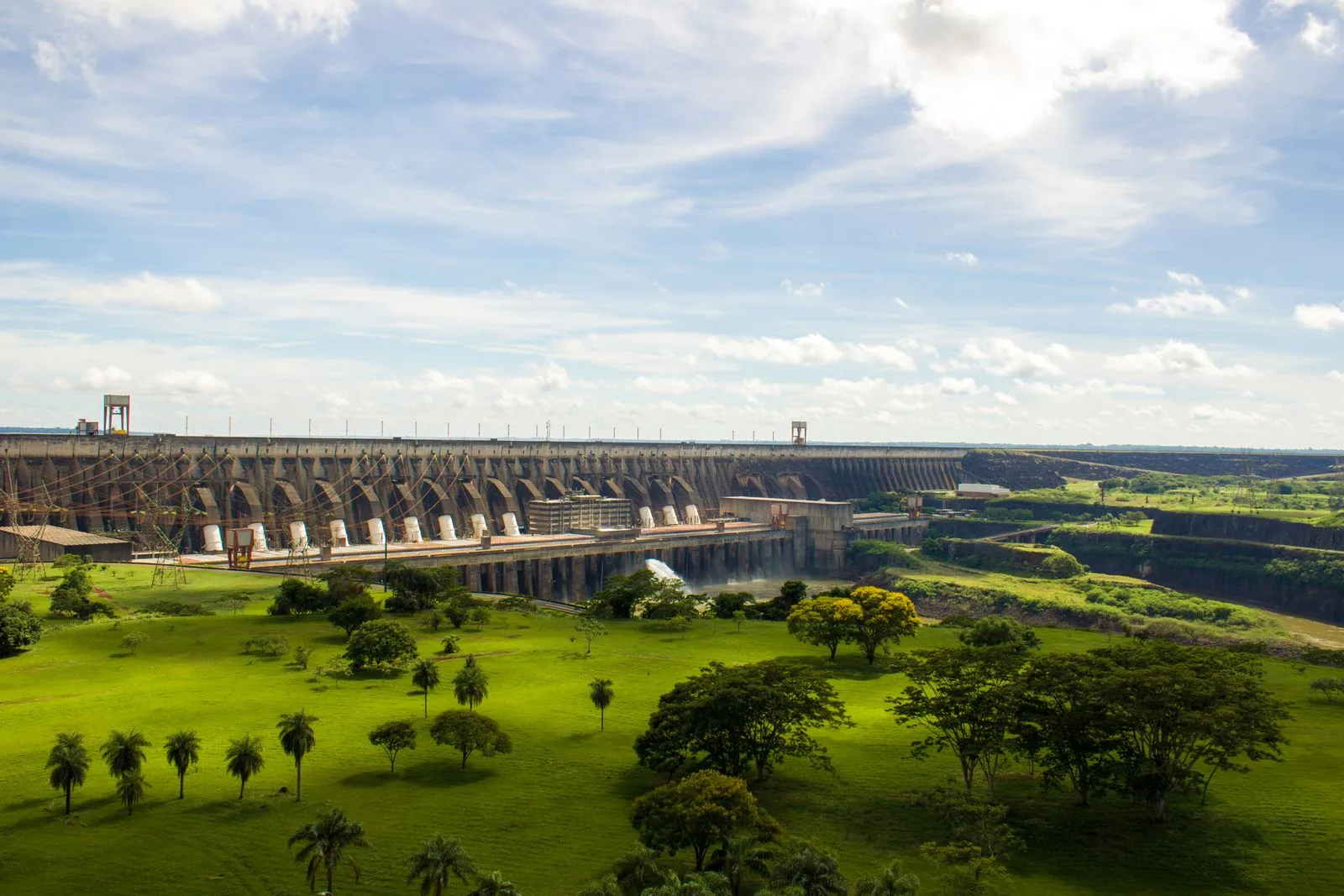
On the border with Brazil and Argentina, Ciudad del Este is mainly a trading town. Close by, the Itaipú Dam, a binational project built with Brazil on the Paraná, can be visited. The famous Iguaçu Falls are across the border, on the Brazilian or Argentine side: see our guide to Iguazú Falls on the Argentine side. Crossing the border on foot or by bus means getting your passport stamped on entry and exit: the UK FCDO warns that long-distance bus drivers sometimes wrongly tell foreigners they can complete immigration formalities in Asunción, and that without an entry stamp you will be fined when you leave. The FCDO also notes that this area, from Pedro Juan Caballero south to Ciudad del Este and the Tri-Border Area, is where drug and arms trafficking is concentrated and violent crime is increasing.
The Chaco
The west of the country, the Chaco, covers a large part of the territory for a very small population. The Mennonite colonies of the central Chaco, around Filadelfia, and the nature reserves attract travelers looking for wide open spaces and wildlife. We found no official UK or US advice specific to the Chaco: use a local operator or an estancia stay, and bring water, food and fuel. The US State Department says nearly all rural roads are unpaved and may be impassable in rainy periods and that driving at night outside Asunción is not advisable.
Jesuit missions and Guarani bilingualism
In Paraguay, an Indigenous language, Guarani, is an official language alongside Spanish and is spoken by most of the population, a unique case among Indigenous American languages. Article 140 of the 1992 Constitution makes Spanish and Guarani the two official languages of the country, and half of the rural population speaks only Guarani. A few words (mba’éichapa, aguyje) are therefore very much appreciated outside the cities.
The Jesuit missions of La Santísima Trinidad de Paraná and Jesús de Tavarangüe, in Itapúa department, have been on the UNESCO World Heritage List since 1993. These « reductions » brought Guarani communities together around a church, workshops and housing: this is where the shared history of the country and the Guarani language is best read.
| Landmark | What to know | Source |
|---|---|---|
| Official languages | Spanish and Guarani (Art. 140) | Constitution of Paraguay (1992), Constitute Project |
| Guarani | Spoken by most of the population; half of the rural population is monolingual | Wikipedia (EN), « Guarani language » |
| Trinidad and Jesús missions | World Heritage since 1993, Itapúa department | UNESCO World Heritage Centre |
Which region to choose? Our decision tree
- You have 2 or 3 days: Asunción, then Areguá and Lake Ypacaraí as an excursion.
- You like history: head south to Encarnación for the Trinidad and Jesús missions.
- You are coming from Argentina or Brazil: enter via Encarnación or Ciudad del Este, getting your passport stamped at the border.
- You want wide open spaces: the Chaco, with a local guide or agency, traveling by day.
- You were thinking of the northeast (Concepción, Pedro Juan Caballero, Canindeyú): the FCDO and the State Department both flag crime and organized crime there; choose another region.
Map: Paraguay
Itinerary ideas for Paraguay
7 to 10 days: Asunción and the south
- Days 1 to 3: Asunción (historic center, Costanera, museums)
- Day 4: Areguá, Lake Ypacaraí and San Bernardino
- Days 5 to 7: Encarnación and the Trinidad and Jesús missions
- Days 8 to 10: Ciudad del Este, Itaipú, then Iguaçu Falls on the Brazilian or Argentine side
2 weeks: from the Chaco to the missions
- Days 1 to 3: Asunción and the Cordillera
- Days 4 to 7: central Chaco (Filadelfia and the Mennonite colonies), with a local provider, driving by day
- Day 8: return to Asunción
- Days 9 to 11: Encarnación and the Jesuit missions
- Days 12 to 14: Ciudad del Este, Itaipú and Iguaçu, or crossing into Argentina
Paraguay combines well with its neighbors: Argentina (Posadas, Iguazú, Buenos Aires), Brazil via Foz do Iguaçu, or Bolivia through the Chaco for experienced travelers.
Budget: what to plan for
We do not show a daily amount: no official source publishes a travel budget for Paraguay, and prices change quickly. The biggest items are international flights, accommodation in Asunción and, if you go to the Chaco, the vehicle and guide. Long-distance buses remain the cheapest way to get between cities. Prices are shown in guaraníes: our currency converter helps translate them into dollars or pounds.
Getting around Paraguay
In short: in Paraguay you travel by long-distance bus or by car, always by day; the US State Department says driving or traveling at night is not advisable outside Asunción.
- Bus: long-distance buses link Asunción to the main cities (Encarnación, Ciudad del Este, Filadelfia). The Terminal de Omnibus Asunción is the main bus terminal for long-distance journeys (FCDO). Many buses and taxis do not meet European standards and rarely have working seat belts (FCDO).
- Night driving: driving standards are poor, some vehicles drive with no lights at night, and country roads at night can be particularly dangerous (FCDO). Plan daytime journeys.
- Car: possible for the Cordillera and the south if you do not drive at night. The FCDO says you can use a UK photocard licence; carry your licence and your passport showing the entry stamp. There are regular police checks, and the legal blood alcohol limit is 0.00%. Heavy rain can flood even major paved roads, including in Asunción, and minor roads are often impassable in the rainy season. The State Department adds that no vehicle insurance is required and many drivers have none.
- Taxis and ride-hailing: practical in Asunción, especially in the evening to avoid walking; the FCDO advises calling a licensed taxi from a landline or a hotel rather than hailing one in the street.
- Land borders: always stop at the border post to have your passport stamped, on entry and on exit.
Where to stay in Paraguay
In Asunción, most travelers choose the historic center, convenient for sightseeing on foot by day, or newer residential districts such as Villa Morra and Carmelitas, which have more restaurants. Outside the capital, Encarnación offers hotels for reaching the missions, and the Chaco has estancia stays or lodgings in the Mennonite towns. In every case, keep your valuables and passport in a safe place and carry a copy of your passport photo page and entry stamp (FCDO).
Entry requirements for Paraguay
US citizens
- According to the U.S. Department of State (travel.state.gov, last updated September 17, 2026), you need a valid passport; with an expired or damaged passport you may be refused entry. US citizens do not need a visa for stays of up to 90 days for tourism or business.
- Some minor children need a special notarized authorization to enter and exit when not accompanied by both legal parents or guardians. To leave Paraguay by air you must pay an airport departure tax, which some airlines include in the ticket: check with your airline. The page refers you to the Embassy of Paraguay for the most current visa information.
UK citizens
- According to the UK FCDO (GOV.UK foreign travel advice, updated 3 November 2026), your passport should be valid for the duration of your stay, and you do not need a visa to visit: you will normally get permission to stay for 90 days on arrival (check with the Paraguayan Immigration Department about staying a further 90 days).
- Make sure an immigration official stamps, dates and signs your passport when you arrive; without an entry stamp you will be fined when you leave. This matters especially at land borders, such as the crossing between Ciudad del Este and Foz do Iguaçu.
- Declare any cash or travellers cheques worth 10,000 US dollars or more; you can make an online declaration in advance.
Both governments agree on 90 days visa-free. For yellow fever, the FCDO says you must have a vaccination certificate if you are coming from a country listed as a transmission risk. Check with the Paraguayan embassy before you travel. Entry requirements checked on 12 November 2026. See also our entry requirements guide.
Health and safety
- Health: the FCDO lists dengue, chikungunya and poor air quality among the health risks, and the State Department lists dengue and chikungunya; check the latest vaccine recommendations at least 8 weeks before your trip on TravelHealthPro. The Institut Pasteur recommends the yellow fever vaccine except for a stay limited to the city of Asunción, and reports no malaria transmission.
- Care: there are some good private medical facilities, but only in the major cities, and hospitals expect immediate payment (FCDO). Emergency numbers: 141 for an ambulance (FCDO); 911 for the police (State Department).
- Crime: muggers are occasionally violent and can be armed; use ATMs inside buildings, keep phones and wallets out of sight and carry photo ID safely (FCDO). Kidnappings have been rare but high-profile, and foreigners are not routinely targeted.
- Demonstrations: there is often social conflict in Paraguay, with demonstrations and blockades at short notice, including in downtown Asunción and Ciudad del Este (FCDO): avoid large gatherings.
- Laws: penalties for drug trafficking and possession are severe, without bail (FCDO). Same-sex sexual activity is not illegal, but same-sex marriages are not recognized (FCDO).
Practical tips for Paraguay
- Money: the currency is the guaraní (PYG). Many ATMs accept bank cards: use ATMs inside buildings, banks or shopping centers, by day. Change money only at registered banks or bureaux de change, not on the street or on arrival at the airport, because false banknotes are common (FCDO).
- Internet: check your carrier’s roaming rates before you go. A local SIM or an eSIM is the simplest solution; see our eSIM guide.
- Language: Spanish is enough in the cities, but Guarani is the everyday language for a large part of Paraguayans, especially in the countryside. A few words are appreciated: mba’éichapa (hello, how are you?) and aguyje (thank you).
- Tereré: you will see thermoses and cups of tereré everywhere, an iced yerba mate infusion, often shared.
- Time: the country no longer changes its clocks: Paraguay stays on UTC−3 all year. Our time difference page gives the live time.
Verified practical information
| Topic | Information | Source (consulted 11–12 November 2026) |
|---|---|---|
| Currency | Paraguayan guaraní (PYG), issued by the Banco Central del Paraguay | Banco Central del Paraguay |
| Electricity | Not verified against an official source: check plug types and voltage before you travel | n/a |
| Languages | Spanish and Guarani, official languages (1992 Constitution, Art. 140) | Constitute Project |
| Health | Yellow fever vaccine recommended « except for the city of Asunción »; no malaria transmission; dengue and chikungunya present | Institut Pasteur, Paraguay sheet; UK FCDO; U.S. Department of State |
| Safety | US Level 1 with increased caution in five departments (August 18, 2026); FCDO: particular care in departments bordering Brazil, EPP active in north San Pedro and south Concepción | U.S. Department of State; UK FCDO (GOV.UK, 3 November 2026) |
| Time | UTC−3 all year | IANA tzdb 2026f |
Frequently asked questions
Is Paraguay dangerous for tourists?
The US State Department rates Paraguay Level 1, Exercise Normal Precautions, but advises increased caution in five departments, including Amambay, Concepción and San Pedro. The UK FCDO warns of organized crime and rising violent crime along the Brazilian border. Elsewhere: be discreet, avoid night road travel and take care in some Asunción areas.
Do you need a visa for Paraguay?
No for US and UK citizens for stays of up to 90 days, according to the State Department and the FCDO. You need a valid passport and an entry stamp, and a yellow fever certificate if you come from a country listed as a transmission risk (FCDO).
What is the best time to visit Paraguay?
May to September: in Asunción, average highs stay between 23.5 and 27.9 °C (74 and 82 °F) and July–August are the driest months, according to the 1991–2020 WMO normals.
What is the time difference with Paraguay?
Paraguay is on UTC−3 all year since October 2024: 3 h behind London in winter and 4 h in summer; 2 h ahead of New York in winter and 1 h in summer.
What languages are spoken in Paraguay?
Spanish and Guarani, both official languages under the 1992 Constitution.
Where is Paraguay?
In the heart of South America, landlocked, between Argentina, Brazil and Bolivia.
What is the capital of Paraguay?
Asunción, founded in 1537 on the Paraguay River.
What is there to do in Paraguay?
Visit Asunción, the Cordillera and Lake Ypacaraí, the UNESCO-listed Jesuit missions of Trinidad and Jesús, the Itaipú Dam and, with a guide, the Chaco.
What time is it in Paraguay?
Paraguay is on UTC−3 all year, so the offset from London and New York changes with their daylight saving time.
Do you need a yellow fever vaccine for Paraguay?
The Institut Pasteur recommends it except for a stay limited to the city of Asunción. A certificate is required if you come from a country listed as a transmission risk (UK FCDO).
Is there malaria in Paraguay?
No: the Institut Pasteur reports no malaria transmission. Dengue and chikungunya are present (FCDO and State Department).
What are people from Paraguay called?
Paraguayans.
Our sources
- UK FCDO, foreign travel advice for Paraguay (GOV.UK, updated 3 November 2026), read on 12 November 2026
- U.S. Department of State, Paraguay country information (travel.state.gov, last updated September 17, 2026) and Travel Advisory (Level 1, August 18, 2026), read on 12 November 2026
- 1991–2020 normals for Asunción airport station Silvio Pettirossi (WMO 86218), Dirección de Meteorología e Hidrología of Paraguay, published by the World Meteorological Organization (NOAA NCEI archive), file read on 11 November 2026
- IANA Time Zone Database, version 2026f, consulted 11 November 2026 (America/Asuncion, UTC−3 since 15 October 2024)
- Constitution of the Republic of Paraguay (1992), Article 140, text published by Constitute Project
- Destination de Voyage calculations: months above 30 °C and day–night gap, from the normals above
- Institut Pasteur, Paraguay country sheet (in French), consulted 11 November 2026
- Banco Central del Paraguay (bcp.gov.py), issuer of the guaraní
- Wikipedia (EN), « Guarani language », consulted 11 November 2026
- UNESCO World Heritage Centre: « Jesuit Missions of La Santísima Trinidad de Paraná and Jesús de Tavarangué » (1993)
- Our methodology
Updated November 2026.
Discover our other destinations in Latin America.