Armenia is a small country of high plateaus in the South Caucasus, where people come for its medieval monasteries, the ancient temple of Garni, Lake Sevan and its capital, Yerevan, facing Mount Ararat. This Armenia travel guide gathers what you need to know before you go: areas to avoid according to the UK and US governments, the best time to visit based on official climate normals, the highlights, itineraries, getting around and entry requirements.
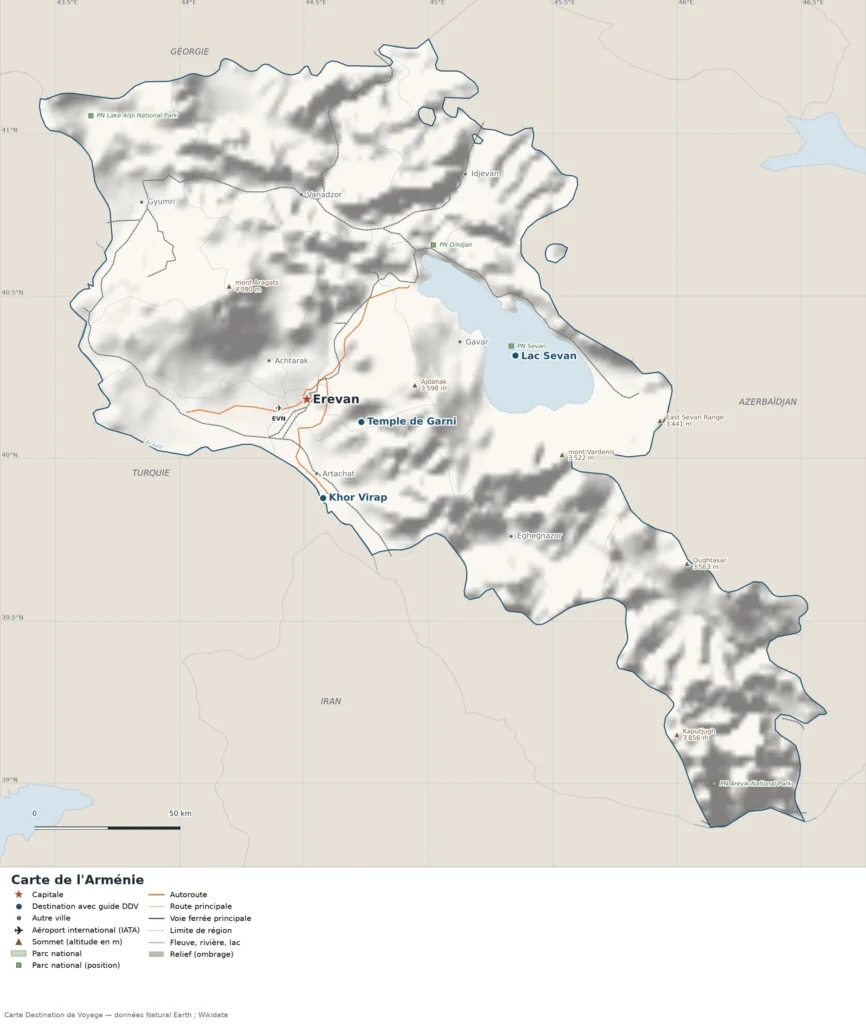
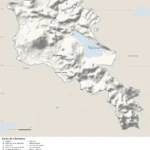
To locate cities, regions, terrain, national parks and airports, see our map of Armenia.
Our travel deals for Armenia
Affiliate links: we earn a commission, at no extra cost to you.
FlightsKiwi.comCompare flights and airline combinations to Armenia.
Areas to avoid: what the UK and US governments say
UK FCDO (GOV.UK, updated 1 March 2026): advises against all travel to within 5 km of the entire eastern border between Armenia and Azerbaijan, which remains closed, and against all travel along the M16/H26 road between the towns of Ijevan and Noyemberyan, because of tensions between the two countries. Consular support is severely limited in the border area.
U.S. Department of State: Level 2, Exercise Increased Caution (travel advisory dated September 4, 2025), because of areas of potential armed conflict. The advisory says Do Not Travel to the border region with Azerbaijan, and says US Embassy employees and their families cannot travel for non-essential reasons to the Gegharkunik region east of Vardenis, the Syunik region east of Goris and the Syunik region south of Kapan; travel through Yeraskh village in the Ararat region is allowed, stopping is not.
Our choice: this guide recommends no visit to these areas, and does not cover Syunik province (Tatev, Goris, Sisian, Meghri), much of which lies near the Azerbaijani border.
Time zoneUTC+4 all year, no daylight saving · time difference4 h ahead of London and 9 h ahead of New York in winter; 3 h and 8 h in summerLocal time now: –:–
AirportsZvartnots International Airport, YerevanCheck current routes with the airlines
EntryUS and UK: visa-free for up to 180 days (per year); passport valid for the stay · travel.state.gov · GOV.UK
Land bordersthe borders with Turkey and Azerbaijan are closed; the Iran border is open to foreign nationals coming from Iran, subject to change at short notice (FCDO)
Emergencies112 (US State Department); the FCDO gives 911 for an ambulance with an English speaker
Central bankthe dram is issued by the Central Bank of Armenia, which publishes reference rates (consulted 11 November 2026)
Electricitywe could not check plug types and voltage against an official source: check before you travel and bring a universal adapter
Healththe Institut Pasteur recommends bringing vaccinations up to date and hepatitis A, and reports no malaria transmission (sheet consulted 11 November 2026)
Armenia: key figures calculated by Destination de Voyage
Time difference: UTC+4 all year (IANA tz database, Asia/Yerevan): 4 h ahead of London and 9 h ahead of New York in winter, 3 h and 8 h in summer.
Day length in Yerevan: from 9 h 20 min on 15 December to 15 h 01 min on 15 June, a difference of 5 h 41 min (Destination de Voyage calculation using the NOAA solar algorithm, 2027, clear horizon).
Warmest and coldest months: August (25.7 °C / 78 °F average) and January (−2.4 °C / 28 °F), a gap of 28.1 °C between summer and winter (Destination de Voyage calculation from the 1991–2020 WMO normals of Yerevan-Arabkir station).
Driest month: August (8 mm / 0.3 in, 1.9 rainy days); wettest: April (54 mm / 2.1 in) (same source).
When to go to Armenia
When is the best time to visit Armenia? May to June and September to October. According to the 1991–2020 WMO normals for Yerevan, the average is 17.0 °C (63 °F) in May and 21.2 °C (70 °F) in September, while July and August together have more than 26 days at 30 °C (86 °F) or above. Summer remains the best season for Lake Sevan, which is cooler, and winter is cold (−2.4 °C / 28 °F average in January in Yerevan).
Armenia has a continental climate shaped by altitude: most sites lie between 900 and 2,000 m (2,953 and 6,562 ft). Winters are cold, summers hot and dry on the Ararat plain, cooler around Lake Sevan. In Yerevan the average temperature rises from −2.4 °C (28 °F) in January to 25.6 °C (78 °F) in July, with an average of 26.9 days at 30 °C or above in July and 26.4 in August (1991–2020 WMO normals). In Yerevan, April and May are the wettest months (54 and 52 mm / 2.1 and 2.0 in) and August the driest (8 mm / 0.3 in); at Lake Sevan, 93 mm (3.7 in) falls in May.
May–June and September–October: the most balanced periods for combining Yerevan, the monasteries and Lake Sevan (17.0 °C average in May, 21.2 °C in September in Yerevan).
July–August: strong heat on the plain (more than 26 days at 30 °C or above per month in Yerevan), but the most pleasant season at Lake Sevan (16.8 °C and 17.1 °C / 62 and 63 °F average).
November to March: cold (−4.9 °C / 23 °F average in January at Lake Sevan, −7.8 °C / 18 °F in Gyumri); mountain roads sometimes snowy; Yerevan remains visitable.
The climate of Yerevan month by month
Month
Average temp. °C (°F)
Rain mm (in)
Rain days (≥ 1 mm)
Days at 30 °C or above
Sunrise / sunset on the 15th
January
-2.4 (28)
28 (1.1)
5.5
0.0
08:22 / 18:00
February
0.5 (33)
27 (1.1)
4.8
0.0
07:55 / 18:37
March
6.6 (44)
35 (1.4)
6.3
0.0
07:14 / 19:08
April
12.3 (54)
54 (2.1)
8.7
0.2
06:24 / 19:40
May
17.0 (63)
52 (2.0)
8.8
1.5
05:46 / 20:10
June
22.2 (72)
23 (0.9)
4.9
15.0
05:31 / 20:32
July
25.6 (78)
19 (0.7)
2.8
26.9
05:44 / 20:30
August
25.7 (78)
8 (0.3)
1.9
26.4
06:12 / 19:59
September
21.2 (70)
14 (0.6)
2.4
11.6
06:42 / 19:11
October
14.5 (58)
27 (1.1)
4.5
0.1
07:12 / 18:22
November
6.7 (44)
29 (1.1)
4.7
0.0
07:46 / 17:45
December
0.2 (32)
26 (1.0)
6.0
0.0
08:16 / 17:36
Yerevan-Arabkir station (1,113 m / 3,652 ft). 1991–2020 WMO normals (NOAA NCEI archive), Armenian hydrometeorological service: daily mean temperature, precipitation, days with at least 1 mm of rain, days when the maximum reaches 30 °C. Sunrise and sunset: astronomical calculations using the NOAA solar algorithm applied by Destination de Voyage to the coordinates of Yerevan (15th of each month, 2027, local time UTC+4, clear horizon).
Yerevan, Sevan, Gyumri, Dilijan: the effect of altitude
Destination de Voyage calculation from the 1991–2020 WMO normals of four stations: the gap in average temperature from Yerevan, month by month, shows what to pack when leaving the capital.
Month
Yerevan (1,113 m / 3,652 ft)
Lake Sevan (1,917 m / 6,289 ft)
Gyumri (1,513 m / 4,964 ft)
Dilijan (1,256 m / 4,121 ft)
January
−2.4
−4.9 (−2.5)
−7.8 (−5.4)
−0.9 (1.5)
April
12.3
4.6 (−7.7)
7.2 (−5.1)
8.1 (−4.2)
May
17.0
9.4 (−7.6)
12.0 (−5.0)
12.4 (−4.6)
June
22.2
13.9 (−8.3)
16.7 (−5.5)
16.5 (−5.7)
July
25.6
16.8 (−8.8)
20.3 (−5.3)
19.2 (−6.4)
August
25.7
17.1 (−8.6)
20.6 (−5.1)
19.1 (−6.6)
September
21.2
13.5 (−7.7)
16.1 (−5.1)
15.1 (−6.1)
October
14.5
8.8 (−5.7)
9.8 (−4.7)
10.1 (−4.4)
Average temperature (°C) and, in brackets, the gap from Yerevan. 1991–2020 WMO normals (NOAA NCEI archive); gaps calculated by Destination de Voyage.
Key point: in July, it is on average 8.8 °C (16 °F) cooler on the shore of Lake Sevan than in Yerevan. Dilijan, in the forest, is the wettest of the four stations (647 mm / 25.5 in a year, against 341 mm / 13.4 in in Yerevan).
Best time by activity
Activity
Recommended period
Based on
Yerevan and the plain monasteries (Khor Virap, Etchmiadzin, Garni)
May–June, September–October
WMO normals: 17.0 °C in May, 21.2 °C in September in Yerevan
Lake Sevan
July–August
WMO normals: 16.8 °C and 17.1 °C average at Lake Sevan
Dilijan forests
May to October
the wettest station in our comparison (647 mm / 25.5 in a year)
Hiking toward Mount Aragats
summer, with a local guide
altitude sickness is a risk on Mount Aragats (4,090 m / 13,419 ft) and the Aragats lakes (about 3,000 m / 9,843 ft) (FCDO)
Yerevan in winter
November to March
the city is visitable; mountain roads sometimes snowy
Destination de Voyage summary based on the 1991–2020 WMO normals (NOAA NCEI archive) and UK FCDO, read on 12 November 2026.
Where to go in Armenia: the highlights
What is there to see in Armenia? Yerevan, the temple of Garni and Geghard Monastery, Khor Virap facing Ararat, Etchmiadzin, Lake Sevan, Dilijan, the monasteries of Haghpat and Sanahin, and Gyumri. Three of these sites are part of UNESCO World Heritage properties, and all lie outside the areas the UK FCDO advises against.
The sites below cover the center, west and north of the country, away from the Azerbaijani border zone and Syunik.
Yerevan, the capital
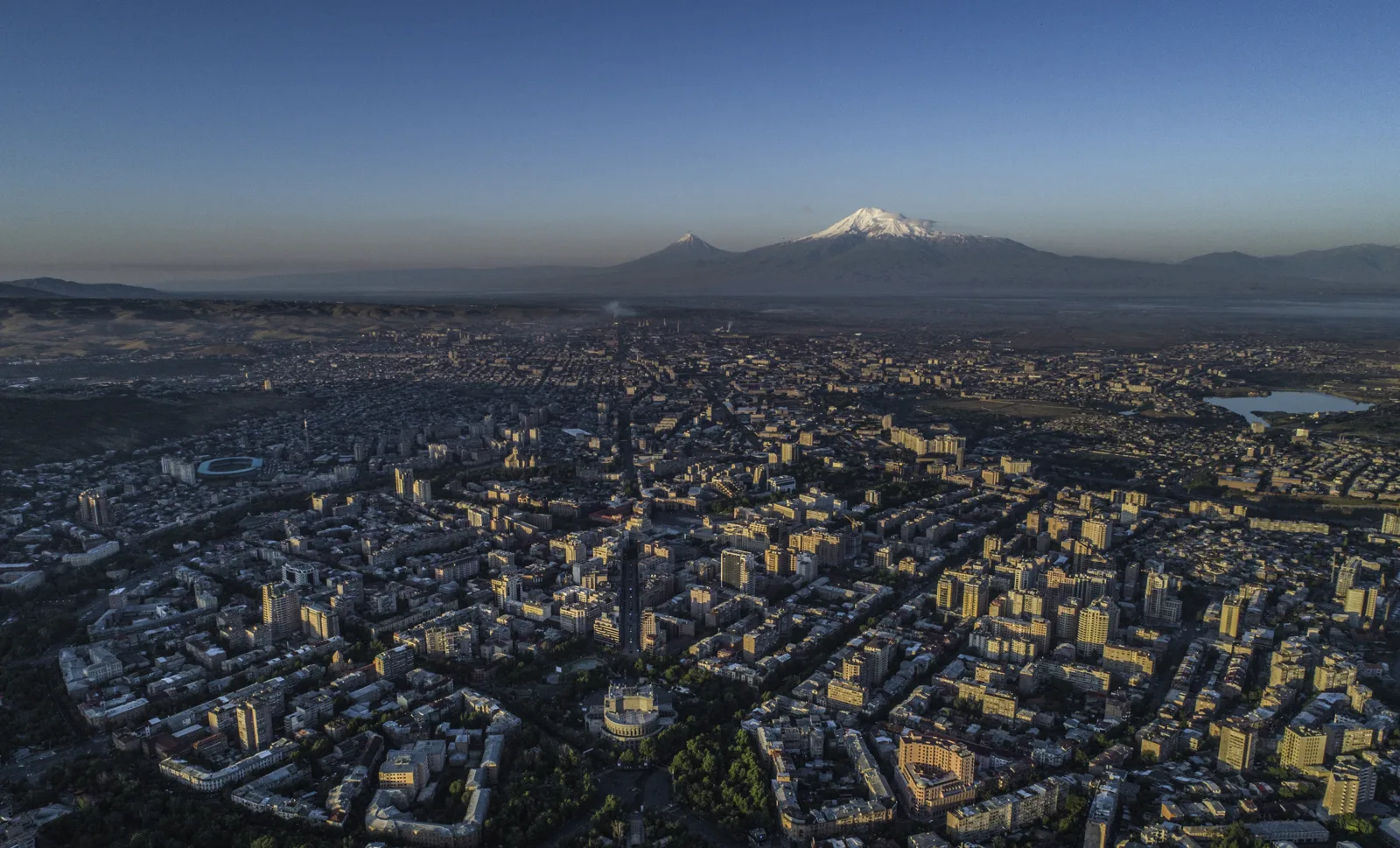
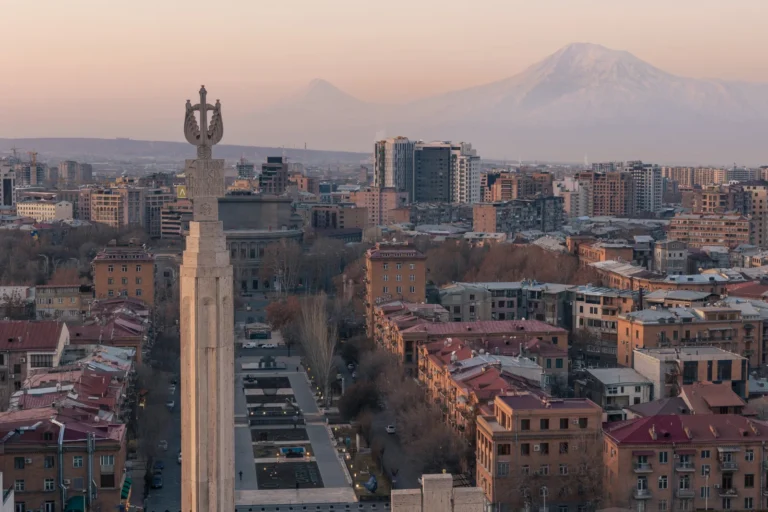
Yerevan has museums, cafés and a lively cultural life. The Matenadaran, the institute of ancient manuscripts, the Cascade, Republic Square, the Vernissage market and the Tsitsernakaberd Armenian Genocide Memorial are the landmarks. The city takes its name from the Urartian fortress of Erebuni, whose ruins stand next to the modern center. The FCDO says crime levels are low, with occasional pickpocketing, bag-snatching and theft from cars; the State Department adds that police say a criminal group in Yerevan targets foreigners and burglarizes rented apartments when the occupants are away. Our guide what to see in Yerevan details visits and official opening hours.
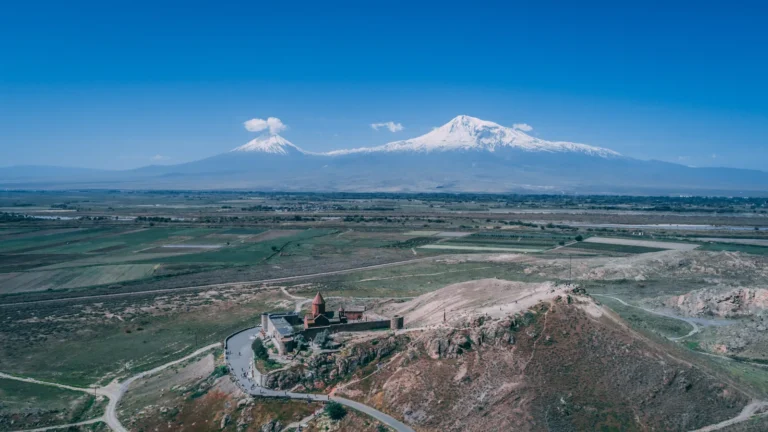
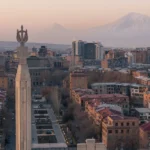
Yerevan with Ararat on the horizon.
The temple of Garni and Geghard Monastery
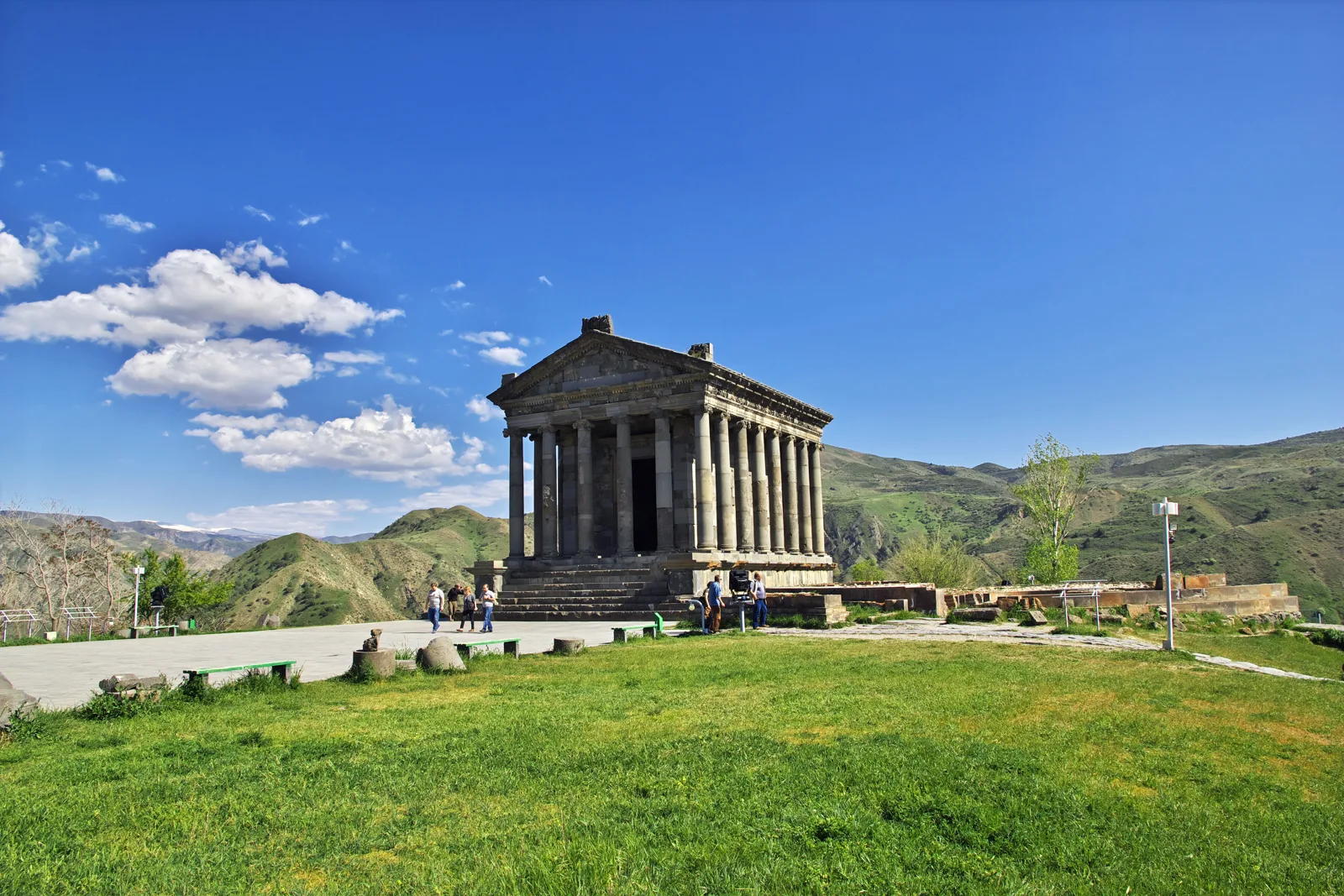
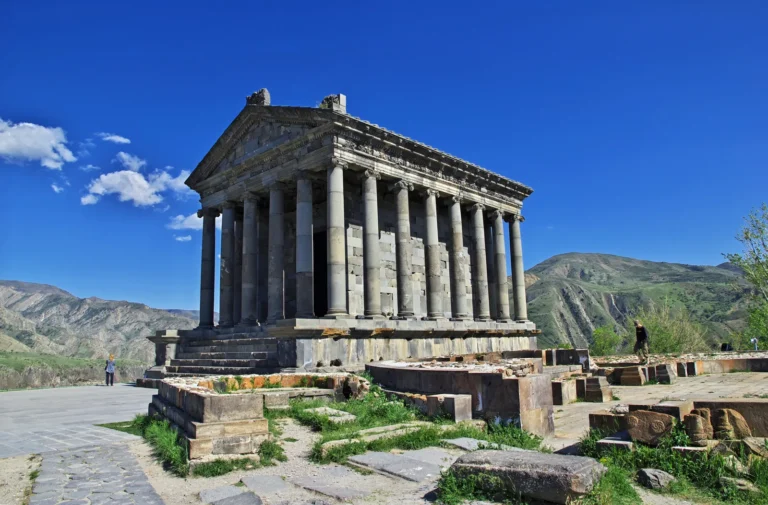
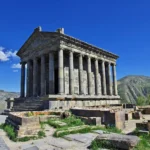
East of Yerevan, in Kotayk province, the temple of Garni is a basalt-columned temple in Greco-Roman style, standing at the edge of a gorge. Higher up the Azat valley, Geghard Monastery is partly carved into the rock; the Armenia Tourism Committee notes that it is a UNESCO World Heritage Site and that it took its present form in the 13th century. Opening hours and tickets: our page on the temple of Garni.
The temple of Garni.
Khor Virap, facing Ararat
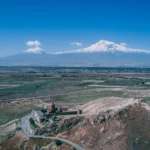
On the Ararat plain, Khor Virap Monastery houses the pit where, according to tradition, Gregory the Illuminator was held for 13 years before Armenia’s conversion to Christianity. It is one of the best-known viewpoints on Mount Ararat, which lies in Turkey. See our Khor Virap page.
Lake Sevan
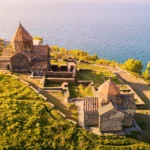
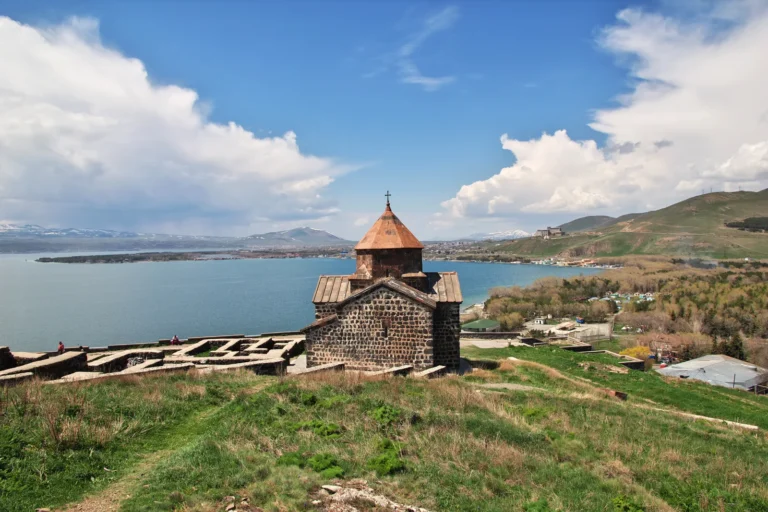
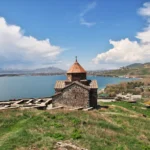
At nearly 1,900 m (6,234 ft), Lake Sevan is the largest lake in the country. Sevanavank Monastery, founded in 874 on a peninsula, overlooks the northwest shore. The east of Gegharkunik province runs along the Azerbaijani border, and the State Department restricts embassy staff from the part east of Vardenis: stay on the north and west shores. Details on our Lake Sevan page.
Etchmiadzin
West of Yerevan, Etchmiadzin is the seat of the Armenian Apostolic Church. The Armenia Tourism Committee presents its cathedral, frescoes and the Treasury museum, which holds relics. It is often combined with Khor Virap, as the tourism committee suggests.
Dilijan and the north
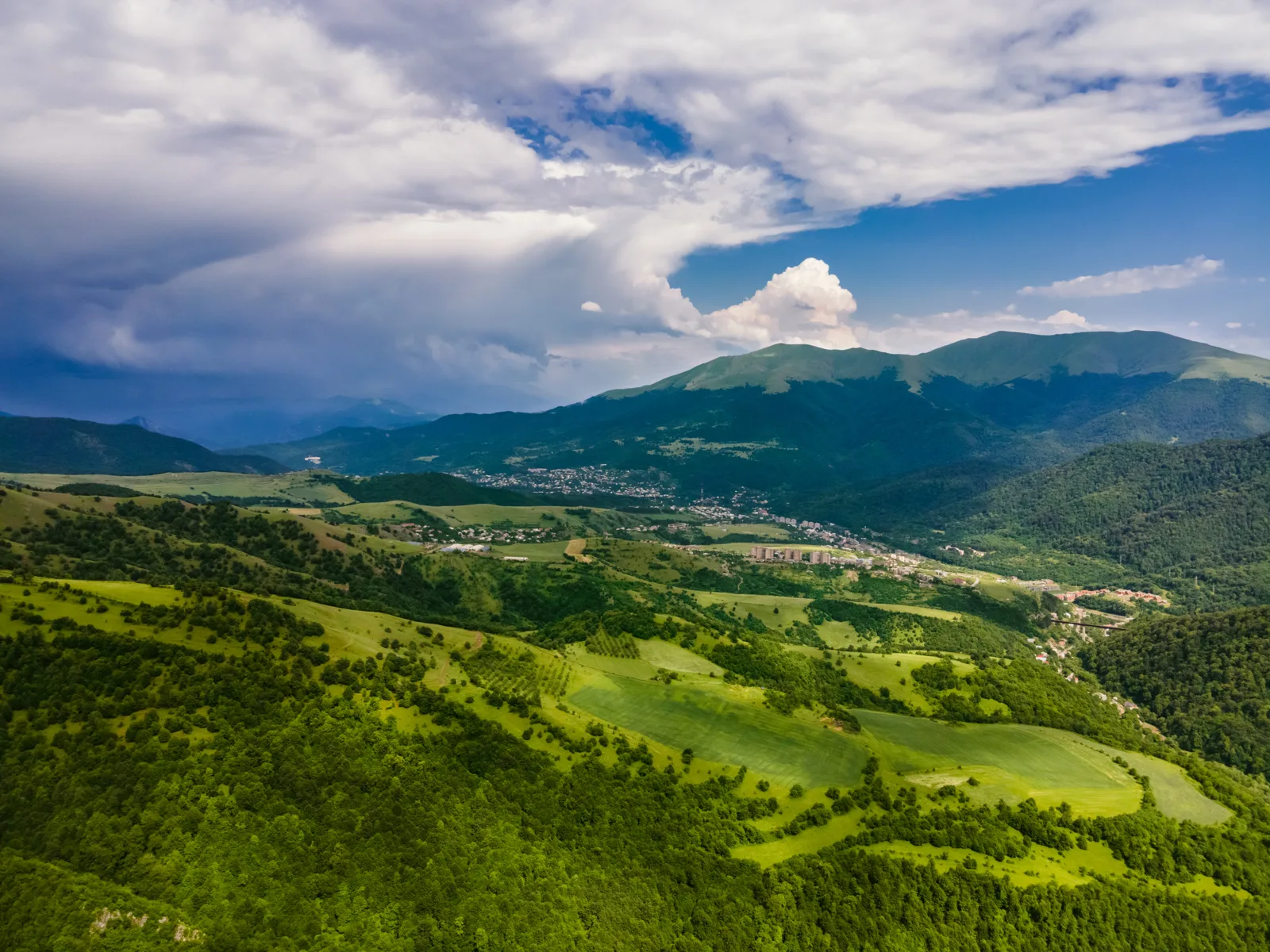
In Tavush province, Dilijan is surrounded by forests: it is the wettest station in our comparison, green from May to October. Further north, in Lori province, the monasteries of Haghpat and Sanahin combine, according to the tourism committee, religious and civil buildings and remarkable khachkars (carved stone crosses). Note: the FCDO advises against all travel along the M16/H26 road between Ijevan and Noyemberyan, which is on the road to Georgia from this area.
The wooded hills of Dilijan.
Gyumri and Mount Aragats
Gyumri, in Shirak province in the northwest, is known for its historic streets and arts scene, according to the tourism committee. On the way, the slopes of Mount Aragats and Amberd fortress attract hikers in summer. Gyumri is the coldest station in our comparison: −7.8 °C (18 °F) average in January.
museums (Matenadaran), Cascade, Tsitsernakaberd memorial
no FCDO warning; low crime levels
Kotayk (east of Yerevan)
temple of Garni, Geghard Monastery (UNESCO, 2000)
no FCDO warning
Ararat plain
Khor Virap and the view of Mount Ararat
State Department: travel through Yeraskh village is allowed, stopping is not
West of Yerevan
Etchmiadzin and the Zvartnots archaeological site (UNESCO, 2000)
no FCDO warning
Gegharkunik
Lake Sevan, Sevanavank (north and west shores)
east of Vardenis: State Department restricts embassy staff; FCDO: nothing within 5 km of the Azerbaijani border
Tavush and Lori (north)
Dilijan forests, Haghpat and Sanahin monasteries (UNESCO, 1996 and 2000)
FCDO advises against all travel on the M16/H26 road between Ijevan and Noyemberyan
Shirak and Aragats (northwest)
Gyumri, Amberd fortress, hiking
altitude sickness risk on Aragats (FCDO)
Eastern border zone and Syunik
not covered in this guide
FCDO: against all travel within 5 km of the Azerbaijani border; State Department: Do Not Travel to the border region, embassy staff restricted in parts of Syunik
Destination de Voyage summary based on UK FCDO (GOV.UK, updated 1 March 2026), U.S. Department of State (advisory dated September 4, 2025), the Armenia Tourism Committee and the UNESCO World Heritage List, read on 12 November 2026.
Armenian monasteries on the World Heritage List
UNESCO lists three properties in Armenia, all linked to Armenian Christianity and all outside the areas to avoid: the monasteries of Haghpat and Sanahin (inscribed in 1996, extended in 2000), Geghard Monastery and the upper Azat valley (2000), and the cathedral and churches of Etchmiadzin with the Zvartnots archaeological site (2000). The well-known Tatev Monastery is not on this list and lies in Syunik province, which this guide does not cover; check the latest FCDO and State Department advice if you consider going.
These itineraries avoid Syunik and the Azerbaijani border zone. Journey times depend on road conditions and the season: the US State Department says primary roads are frequently in poor condition and secondary roads are often unpaved, and the FCDO says roads are in a poor state, particularly from November to February.
7 days: Yerevan and around
Days 1 and 2: Yerevan (Matenadaran, Cascade, Tsitsernakaberd, Vernissage market)
Day 3: Etchmiadzin and Zvartnots
Day 4: Khor Virap early in the morning for the view of Ararat, back to Yerevan
Day 5: Garni and Geghard
Day 6: Lake Sevan (Sevanavank) then Dilijan
Day 7: back to Yerevan
10 to 12 days: center, north and west
Days 1 to 3: Yerevan, Etchmiadzin, Khor Virap
Day 4: Garni and Geghard
Days 5 and 6: Lake Sevan, north and west shore
Days 7 and 8: Dilijan and its forests
Days 9 and 10: Lori, Haghpat and Sanahin monasteries
Days 11 and 12: Gyumri, then back to Yerevan via the slopes of Mount Aragats
Decision tree: which Armenia is for you?
If you…
Then…
want the best weather to see everything
go in May–June or September–October
travel in July–August
visit Yerevan and the plain early in the morning, and spend more time at cooler Lake Sevan or Dilijan
want to photograph Ararat
go to Khor Virap in the morning, when the light comes from the east
were planning Tatev or Goris
check the latest FCDO and State Department advice for Syunik before you decide; this guide does not cover it
are heading to Georgia by road
avoid the Ijevan–Noyemberyan section of the M16/H26, as the FCDO advises
plan to hike
go with a local guide and check altitude sickness risks on Aragats
Getting around Armenia
Minibuses (marshrutkas) and buses: they link Yerevan to the towns and main sites. The Armenia Tourism Committee mentions, for example, a bus to Artashat or Pokr Vedi for Khor Virap. The FCDO says public transport is often overcrowded, particularly in Yerevan, and that local buses in the regions may be old and poorly maintained.
Taxis and drivers: practical for combining several monasteries in a day. The FCDO and State Department warn that hailing taxis on the street risks scams and that there are occasional reports of taxi drivers sexually harassing single female passengers; the FCDO suggests the GG taxi app.
Car rental: possible, but the FCDO says the standard of driving is poor and roads are in a poor state, and advises avoiding driving outside towns in the dark; you need both a 1968 International Driving Permit and your UK driving licence (FCDO). The State Department says US driver’s licenses are not valid for driving in Armenia.
Train: the FCDO mentions the cross-border train between Armenia and Georgia, advising you to secure your valuables and lock the compartment door from the inside.
Where to stay in Armenia
Yerevan has the largest choice of hotels, apartments and hostels: it is the simplest base for excursions to Garni, Geghard, Etchmiadzin and Khor Virap. On Lake Sevan there are hotels and seasonal guesthouses, mostly around the town of Sevan. Dilijan and Gyumri have guesthouses and small hotels. In villages, guesthouses dominate.
Entry requirements for Armenia
US citizens
According to the U.S. Department of State (travel.state.gov, last updated September 10, 2026), you need a valid passport, and US citizens are allowed visa-free entry for up to 180 days per year. For longer stays, you must apply for a residency permit through the Armenian Ministry of Foreign Affairs.
The State Department warns that Armenia routinely shares information about foreign visitors with Russian law enforcement and security services, and that US citizens may be detained on entry or exit based on that information. It also notes that Armenian citizens, including dual nationals, must enter and leave on Armenian passports.
UK citizens
According to the UK FCDO (GOV.UK foreign travel advice, updated 1 March 2026), your passport must be valid for the duration of your stay, and you can visit Armenia without a visa for up to 180 days in a year for tourism or business.
To extend your stay, contact the Administration Department for Passports and Visas (OVIR) in Yerevan. To work or study, check the requirements with the Armenian Embassy in the UK.
Both governments agree on 180 days visa-free. Land borders: those with Turkey and Azerbaijan are closed; the Iran border is open to foreign nationals coming from Iran but may change at short notice, and the State Department warns US citizens against all travel to Iran. Check the Armenian embassy before you travel. Entry requirements checked on 12 November 2026. See also our entry requirements guide.
Health and safety
Health: check vaccine recommendations at least 8 weeks before your trip (FCDO; TravelHealthPro). The Institut Pasteur recommends bringing your vaccinations up to date and hepatitis A. The State Department says the risk of diarrheal disease is high and food and water precautions are recommended, and that cases of brucellosis from unpasteurized dairy products have been reported.
Care: public medical facilities in Yerevan are generally sufficient for minor ailments, public healthcare outside Yerevan is likely to be basic, and private hospitals are of a good standard but can be expensive (FCDO). Make sure your insurance covers treatment and repatriation.
Safety: crime levels are low (FCDO). Protests sometimes take place in central Yerevan: avoid large crowds and demonstrations. The FCDO says terrorist attacks cannot be ruled out. Photographing military bases and installations is illegal.
Laws: penalties for drug offenses are severe, and it is illegal to use, possess or trade marijuana, CBD or THC products, even when prescribed (FCDO). Same-sex sexual activity is legal, but many Armenians disapprove of same-sex couples (FCDO).
Natural hazards: there is a risk of earthquakes; the last serious one was in 1988 in the Lori region (FCDO).
Women travelers: informal taxis pose risks, especially to women traveling alone (State Department).
Practical tips for Armenia
Money: the currency is the dram (AMD). Official site prices, such as the Garni temple ticket, are displayed in drams. When using ATMs, check no one is watching or following you, and take particular care after dark (FCDO).
Documents: carry a copy of your passport photo page rather than the original, and leave spare cash, passports and valuables in a safe place (FCDO).
Internet: an eSIM or a local SIM card avoids roaming charges: our eSIM guide explains phone compatibility.
Language: Armenian has its own alphabet. Learning to read it, even a little, helps with signs and menus.
At religious sites: Armenia has many active churches; dress appropriately and stay quiet during services.
Behavior: Armenian society does not tolerate drinking to excess, and British nationals have been arrested for drunken behavior (FCDO).
Frequently asked questions
Do you need a visa for Armenia?
No, for stays of up to 180 days: the US State Department says US citizens can enter visa-free for up to 180 days per year, and the UK FCDO says the same for British citizens (180 days in a year). Your passport must be valid for your stay.
Is Armenia a safe country?
Crime levels are low according to the UK FCDO, but the FCDO advises against all travel within 5 km of the Azerbaijani border and on the M16/H26 road between Ijevan and Noyemberyan, and the US State Department rates Armenia Level 2, Exercise Increased Caution, with Do Not Travel for the Azerbaijani border region.
Can you visit Tatev Monastery?
Tatev is in Syunik province, which this guide does not cover. The State Department restricts embassy staff from parts of Syunik; check the latest FCDO and State Department advice before deciding.
What is the best time to visit Armenia?
May–June and September–October. In July and August, Yerevan averages more than 26 days at 30 °C (86 °F) or above per month (1991–2020 WMO normals), but Lake Sevan stays cool.
What language is spoken in Armenia?
Armenian, the state language under Article 20 of the Constitution, written with its own alphabet.
What is the time difference with Armenia?
Armenia is on UTC+4 all year: 4 h ahead of London and 9 h ahead of New York in winter, 3 h and 8 h in summer.
Where is Armenia?
In the South Caucasus, on high plateaus. Its land borders with Turkey and Azerbaijan are closed; the border with Georgia is open, and the Iran border is open to foreign nationals coming from Iran, subject to change (FCDO).
What is there to see in Armenia?
Yerevan, the temple of Garni, Geghard Monastery, Khor Virap, Etchmiadzin, Lake Sevan, Dilijan, the monasteries of Haghpat and Sanahin and Gyumri.
Is Mount Ararat in Turkey or Armenia?
Mount Ararat is in Turkey. It can be seen from Armenia, notably from Khor Virap Monastery on the Ararat plain.
Do you need a passport or an ID card for Armenia?
A valid passport, valid for your stay: US and UK citizens are visa-free for up to 180 days (State Department and FCDO, checked 12 November 2026).
What plug is used in Armenia?
We could not check plug types and voltage against an official source: check before you travel and bring a universal adapter.
Can you cross from Armenia to Azerbaijan or Turkey?
No: the land borders with Azerbaijan and Turkey are closed (FCDO and State Department). There are scheduled direct flights between Yerevan and Istanbul (FCDO).
U.S. Department of State, Armenia country information (travel.state.gov, last updated September 10, 2026) and Travel Advisory (Level 2, September 4, 2025), read on 12 November 2026
World Meteorological Organization, 1991–2020 climate normals (NOAA NCEI archive), stations Yerevan-Arabkir (37789), Lake Sevan (37717), Gyumri (37686) and Dilijan (37706), data from the Armenian hydrometeorological service
Constitution of the Republic of Armenia, Article 20 (state language), text published on the official legal portal ARLIS (arlis.am), consulted 11 November 2026
IANA Time Zone Database (tz database), version 2026f, zone Asia/Yerevan, consulted 11 November 2026
Armenia Tourism Committee, armenia.travel (Khor Virap and Geghard pages), consulted 11 November 2026
Astronomical calculations: NOAA solar algorithm applied by Destination de Voyage to the coordinates of Yerevan (15th of each month, 2027, local time UTC+4, clear horizon)
UNESCO World Heritage Centre, Armenia page, consulted 11 November 2026


 FlightsKiwi.comCompare flights and airline combinations to Armenia.Compare flights