Yerevan, the capital of Armenia, is a city of wide avenues and parks, surrounded by hills from which you can see Mount Ararat on a clear day. This Yerevan travel guide covers what to see, easy excursions from the city, what the UK and US governments advise and the climate month by month, based on the official normals of the World Meteorological Organization.
SafetyYerevan is far from the areas where the UK FCDO advises against travel (within 5 km of the Azerbaijan border and the M16/H26 road between Ijevan and Noyemberyan); the U.S. Department of State rates Armenia Level 2, « Exercise Increased Caution » (advisory updated September 4, 2025). Both read on 12 November 2026: GOV.UK, travel.state.gov
LanguageArmenian, the state language (Constitution, article 20)
CurrencyArmenian dram (AMD)
Time zoneUTC+4 all year: London is 4 hours behind in winter and 3 in summer, New York 9 hours behind in winter and 8 in summer
Climate25.6 °C (78 °F) average in July, −2.4 °C (28 °F) in January; 341 mm (13.4 in) of rain a year (WMO 1991–2020 normals)
Entryno visa for tourism or business for up to 180 days in a year for US and UK citizens, passport valid for the whole stay
What to see in Yerevan: the highlights
The Matenadaran
The Mesrop Mashtots Institute of Ancient Manuscripts, known as the Matenadaran, preserves and displays Armenian manuscripts. Its official website says the museum is open Tuesday to Saturday, from 10 am to 5:50 pm; Sundays, Mondays, public holidays and days of commemoration are closing days (checked 11 November 2026 on matenadaran.am). Ticket prices are on the same official page. It is the ideal visit for understanding the Armenian alphabet before touring the country.
The Cascade and the Republic–Opera axis
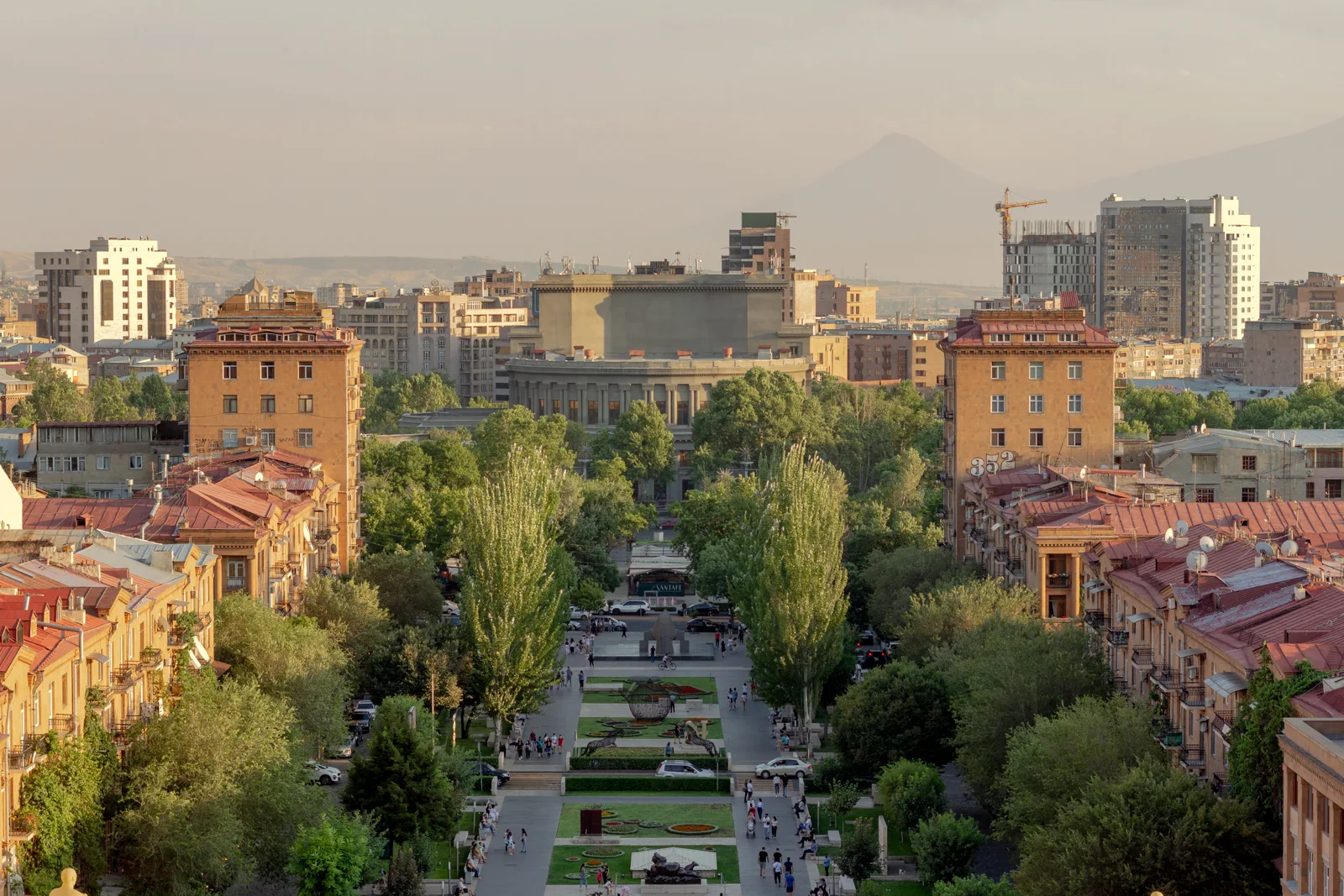
Conceived in the 1970s, the Cascade is an immense monumental staircase that ends the axis linking Republic Square to the Opera. You climb it for the view over the city and, when the sky is clear, of Ararat. At the bottom, the Opera houses the Aram Khachaturian concert hall and the national opera and ballet theater.
From the Cascade, the view toward the Opera
Republic Square
The central square of Yerevan and a gathering place during festivals, it is lined with government buildings and the National Gallery. It is a good starting point for a first walk in Kentron, the central district with its tree-lined avenues.
The Tsitsernakaberd memorial
On Tsitsernakaberd hill, above the Hrazdan gorge, the Armenian Genocide memorial was built from 1966 to 1968. It is the most important place of remembrance in the country. Allow time and dress respectfully.
Erebuni, the original fortress
The name of Yerevan comes from the Urartian fortress of Erebuni, whose ruins remain near today’s center. A cuneiform inscription there mentions its construction by King Argishti, son of Menua: the city considers it its « birth certificate ».
The Vernissage
This open-air flea market brings together crafts, antiques and souvenirs. Be careful with purchases: check your home country’s customs allowances (for example CBP in the US and HMRC in the UK) and Armenian export rules for cultural objects before taking anything old out of the country.
Excursions from Yerevan
Yerevan is a base for several sites:
The Garni temple, an ancient basalt-column temple, and Geghard monastery, a UNESCO World Heritage Site according to the Armenia Tourism Committee
Khor Virap monastery, facing Ararat: the Tourism Committee puts the drive at around 40 minutes from Yerevan, depending on traffic
Etchmiadzin, seat of the Armenian Apostolic Church, with its cathedral and treasury museum
Lake Sevan and Sevanavank monastery, on the northwest shore
Avoid the border areas with Azerbaijan: the FCDO advises against all travel to within 5 km (3 mi) of the entire eastern border and along the M16/H26 road between Ijevan and Noyemberyan, and the State Department says not to travel to the border region with Azerbaijan and bars its embassy staff from non-essential travel to parts of Gegharkunik and Syunik (Gegharkunik east of Vardenis, Syunik east of Goris and south of Kapan). Check both advisories before heading to Syunik.
Climate in Yerevan: when to go
Yerevan has a dry continental climate. Summer is hot: the maximum reaches 30 °C (86 °F) or more on average 26.9 days in July and 26.4 days in August. Winter is cold, with 26.5 frost days in January on average. Rainfall is low and concentrated in spring: 54 mm (2.1 in) in April and 52 mm (2.0 in) in May, against 8 mm (0.3 in) in August.
Month
Avg. temperature
Rain
Rainy days (≥ 1 mm)
Days at 30 °C (86 °F) or more
Sunrise / sunset on the 15th
January
-2.4 °C (28 °F)
28 mm (1.1 in)
5.5
0.0
8:22 am / 6:00 pm
February
0.5 °C (33 °F)
27 mm (1.1 in)
4.8
0.0
7:55 am / 6:37 pm
March
6.6 °C (44 °F)
35 mm (1.4 in)
6.3
0.0
7:14 am / 7:08 pm
April
12.3 °C (54 °F)
54 mm (2.1 in)
8.7
0.2
6:24 am / 7:40 pm
May
17.0 °C (63 °F)
52 mm (2.0 in)
8.8
1.5
5:46 am / 8:10 pm
June
22.2 °C (72 °F)
23 mm (0.9 in)
4.9
15.0
5:31 am / 8:32 pm
July
25.6 °C (78 °F)
19 mm (0.7 in)
2.8
26.9
5:44 am / 8:30 pm
August
25.7 °C (78 °F)
8 mm (0.3 in)
1.9
26.4
6:12 am / 7:59 pm
September
21.2 °C (70 °F)
14 mm (0.6 in)
2.4
11.6
6:42 am / 7:11 pm
October
14.5 °C (58 °F)
27 mm (1.1 in)
4.5
0.1
7:12 am / 6:22 pm
November
6.7 °C (44 °F)
29 mm (1.1 in)
4.7
0.0
7:46 am / 5:45 pm
December
0.2 °C (32 °F)
26 mm (1.0 in)
6.0
0.0
8:16 am / 5:36 pm
Yerevan-Arabkir station (1,113 m / 3,652 ft). WMO 1991–2020 normals (NOAA NCEI archive), Armenian hydrometeorological service, the same data as our Armenia guide. Frost days are not shown here, they are cited in the text. Sunrise and sunset: Destination de Voyage astronomical calculations (NOAA solar algorithm, applied to Yerevan’s coordinates, 15th of each month, year 2027, local time UTC+4, clear horizon).
If you come…
What to know
in April–May
the wettest spring (8.7 and 8.8 rainy days), but mild temperatures (12.3 and 17.0 °C (54 and 63 °F) average)
in June
already 15.0 days at 30 °C (86 °F) or more: sightsee in the morning
in July–August
strong heat and little rain: follow up with cooler Lake Sevan
in September–October
21.2 then 14.5 °C (70 then 58 °F) average, little rain: the best compromise
from December to February
cold (−2.4 °C (28 °F) average in January) and short days: sunset around 5:36 pm in mid-December
Destination de Voyage calculation based on the WMO 1991–2020 normals and the NOAA solar algorithm.
Getting to Yerevan and getting around
International flights arrive at Zvartnots International Airport. We could not verify nonstop flights from the US or UK on the airport’s page: compare itineraries, with or without a stopover depending on the airline and the season. The FCDO notes that the land border with Turkey is closed, although there are scheduled direct flights between Yerevan and Istanbul.
Transfer from the airport
To reach the center, you choose between a taxi, a ride-hailing app, a hotel shuttle or a transfer booked in advance. Things to check: the total price quoted before departure, the meeting point and what happens if your flight is delayed. If you arrive late, a booked transfer avoids negotiating on arrival. The FCDO says that if you hail taxis on the street you risk being scammed for high fares, and recommends the GG taxi app, considered reputable in Armenia.
In town and to the excursions
The center is easily explored on foot. For excursions, minibuses and buses leave for the neighboring towns; the Tourism Committee describes, for example, bus access to Khor Virap via Artashat or Pokr Vedi. If you drive, the FCDO says you need both a 1968 International Driving Permit and your UK licence, that driving standards are poor and that roads are in a poor state, particularly from November to February; it advises avoiding driving outside towns in the dark. The State Department adds that reckless driving is common.
Where to stay in Yerevan
Kentron, around Republic Square and the Opera, is the most convenient district for sightseeing on foot. The higher districts to the north and east, such as Arabkir, are more residential. Yerevan has hotels, apartments and hostels, and serves as a base for day excursions.
Safety, health and entry requirements in Yerevan
US citizens: according to the U.S. Department of State (travel.state.gov, Armenia page last updated September 10, 2026), you need a valid passport and are allowed visa-free entry for up to 180 days per year. The page warns that Armenia routinely shares information about foreign visitors with Russian law enforcement and security services, so US citizens may be detained on entry or exit based on that information; former and current US government and military personnel with prior travel to Russia may face increased scrutiny.
UK citizens: according to the FCDO (GOV.UK, updated 1 March 2026), you can visit without a visa for up to 180 days in a year for tourism or business; your passport must be valid for the duration of your stay. To extend your stay, contact the Administration Department for Passports and Visas (OVIR).
Land borders: the borders with Azerbaijan and Turkey are closed (FCDO, State Department); the FCDO has separate advice on entering from Iran, and the State Department continues to warn against all travel to Iran.
Demonstrations: the FCDO says protests sometimes take place in central Yerevan and other major cities and are usually peaceful; avoid large crowds.
Emergencies: the FCDO gives 911 for emergency services and ambulance; the State Department says to dial 112.
Earthquakes: there is a risk of earthquakes; the last serious one was in 1988 in the Lori region in the north (FCDO). Read the instructions given in your accommodation.
Health: altitude sickness is a risk in parts of Armenia such as Mount Aragats (FCDO); travel insurance covering medical costs and repatriation is essential: see our travel insurance guide.
The Matenadaran (Tuesday to Saturday), the Cascade, Republic Square, the Opera and the Tsitsernakaberd memorial.
When should you visit Yerevan?
May to June and September to October. In July and August there are on average more than 26 days a month at 30 °C (86 °F) or more (WMO 1991–2020 normals).
Is Yerevan safe?
Yerevan is far from the border areas that the UK FCDO advises against, and the U.S. Department of State rates Armenia Level 2, « Exercise Increased Caution ». Avoid large demonstrations and use reputable taxi apps.
What are the Matenadaran’s opening hours?
Tuesday to Saturday, from 10 am to 5:50 pm, according to the official website checked on 11 November 2026; closed on Sundays, Mondays, public holidays and days of commemoration.
What excursions can you make from Yerevan?
Garni and Geghard, Khor Virap, Etchmiadzin and Lake Sevan. Avoid the Azerbaijan border areas and check the advisories before going to Syunik.
Do US and UK citizens need a visa for Armenia?
No: both the U.S. Department of State and the UK FCDO say you can enter visa-free for up to 180 days in a year for tourism or business.
Our sources
Entry, health and safety information: U.S. Department of State, Armenia country information (travel.state.gov, last updated September 10, 2026) and travel advisory (updated September 4, 2025); UK FCDO, foreign travel advice for Armenia (GOV.UK, updated 1 March 2026), both read on 12 November 2026
Matenadaran, Mesrop Mashtots Institute of Ancient Manuscripts, « Working hours and tickets » page (matenadaran.am), checked on 11 November 2026
Armenia Tourism Committee, armenia.travel (Khor Virap and Geghard pages), checked on 11 November 2026
World Meteorological Organization, 1991–2020 climate normals, Yerevan-Arabkir station (37789), NOAA NCEI archive
Astronomical calculations: NOAA solar algorithm, applied by Destination de Voyage to Yerevan’s coordinates (15th of each month, year 2027, local time UTC+4, clear horizon)
Constitution of the Republic of Armenia, article 20 (ARLIS), checked on 11 November 2026
Wikipedia article « Yerevan » (history, Erebuni, Tsitsernakaberd, Cascade), checked on 11 November 2026


 FlightsKiwi.comCompare flights and airline combinations to Yerevan.Compare flights