
To visit Rabat, the capital of Morocco, is to discover a city listed as a UNESCO World Heritage Site since 2012: the Kasbah of the Udayas above the ocean, the Hassan Tower and the Mausoleum of Mohammed V, the Chellah necropolis, a medina and a new town from the early 20th century. What to see in Rabat, when to go and how to fit it into a circuit: here are the essentials, based on official sources.
Rabat lies on the Atlantic coast, 87 km (54 mi) northeast of Casablanca, facing Salé across the mouth of the Bou Regreg. Founded in the 12th century by the Almohads as a ribat, a fortress, it became the seat of the French protectorate in 1912 and remained the capital at independence in 1956. Today it is the seat of the government and the royal palace.

Our travel deals for Rabat
Affiliate links: we earn a commission, at no extra cost to you.
 Learn the languageTargumiLearn a few words of Moroccan Darija before you go — 30% off via our link.See the course
- FlightsKiwi.comCompare flights and airline combinations to Rabat.Compare flights
- Airport transferKiwitaxiPrivate driver booked in advance at a fixed price.Book a transfer
- Audio guidesWeGoTripSelf-guided audio tours on your phone.See audio tours
- eSIMAiraloData plan to install before you leave (eSIM-compatible phone).See plans





Rabat at a glance
- Location Atlantic coast, northwestern Morocco, at the mouth of the Bou Regreg
- Airport Rabat-Salé (RBA)
- Stations Rabat-Agdal (Al Boraq high-speed train, Tangier-Casablanca) and Rabat-Ville
- Entry US and UK citizens can visit without a visa for up to 90 days (travel.state.gov, GOV.UK)
- Safety petty crime is common in tourist areas, as in other large cities (UK FCDO)
- Currency Moroccan dirham (MAD)
- Ideal length 1 to 2 days
What to see in Rabat: the highlights
The Kasbah of the Udayas
A fortified military camp built in the 12th century by the Almohads, the Kasbah of the Udayas overlooks the mouth of the Bou Regreg and the ocean. It takes its name from a tribe moved from Fez to Rabat, and was a stronghold of the Salé corsairs. You enter through a monumental Almohad gate decorated with interlacing. Inside, the former palace houses the Udayas Museum, devoted to jewelry. The lanes and garden are explored on foot.
The Hassan Tower and the Mausoleum of Mohammed V
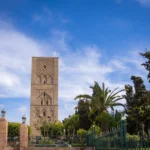
The Hassan Tower is the minaret of an unfinished mosque intended in the 12th century by the Almohad sultan Yacoub El Mansour to be the largest in the Muslim world. The mosque was ruined by the 1755 earthquake; the minaret and a forest of columns remain. Opposite stands the Mausoleum of Mohammed V, where King Mohammed V and his two sons, King Hassan II and Prince Moulay Abdallah, are buried. Respectful dress is expected.
The Chellah
About 200 meters from the Almohad rampart, the Chellah brings together the remains of the ancient city of Sala, with its main street, forum and triumphal arch, and a 14th-century Marinid necropolis. After major restoration work, the site reopened to the public on 20 May 2024 with a new audio-guided route. It hosts the Jazz au Chellah festival every year.
The medina
Built in the 17th century to house refugees from Andalusia, the medina is bordered to the north by the Bou Regreg and to the south by the Andalusian wall. It includes the mellah, the former Jewish quarter, and the covered souk of Rue des Consuls.
The ramparts and Bab Er-Rouah
The late-12th-century Almohad wall stretches for more than five kilometers (3 mi). Its most famous gate, Bab Er-Rouah (« gate of the winds »), stands out for its rich carved decoration. It now houses an exhibition gallery.
The new town and Avenue Mohammed V
The new town, built at the start of the protectorate, is part of the UNESCO-listed sites. Avenue Mohammed V crosses it from the Sunna Mosque, passing the Parliament, the State Bank of Morocco and colonial-era buildings. The botanical test garden (Jardin d’Essais) lies in the middle of the city.
Museums
The Mohammed VI Museum of Modern and Contemporary Art, opened in 2014, was the country’s first contemporary art museum; its permanent collection includes more than three hundred works by Moroccan artists. The Museum of History and Civilizations opened in 2017. Check opening hours and closing days before your visit.
Itinerary: Rabat in 1 or 2 days
| Time | Day 1 | Day 2 |
|---|---|---|
| Morning | The Kasbah of the Udayas and the Udayas Museum | The Chellah (audio-guided route) |
| Midday | The medina, Rue des Consuls | Bab Er-Rouah and the ramparts |
| Afternoon | The Hassan Tower and the Mausoleum of Mohammed V | The Mohammed VI Museum or the Museum of History and Civilizations |
| Evening | The banks of the Bou Regreg, view of Salé | Avenue Mohammed V |
Rabat in a circuit: where next?
Rabat is well connected by train to the rest of the country. Here is a decision grid based on your plans.
| If you want… | Then continue to… | How |
|---|---|---|
| A big city and the Hassan II Mosque | Casablanca | Train (Al Boraq, Al Atlas or fast shuttles) |
| The north and the Mediterranean | Tangier, then Chefchaouen | Al Boraq high-speed train to Tangier |
| An imperial city | Fez | Train or the Rabat-Fez highway |
| The souks and the south | Marrakech | Train via Casablanca |
When to go to Rabat
April to June and September-October, with 21.2 to 25.6 °C (70 to 78 °F) in the afternoon in spring and 26.6 °C (80 °F) in September, and very little rain. Summer is tempered by the ocean: the average high does not exceed 27.8 °C (82 °F) in August, and July-August are almost rainless. The rain is concentrated from November to January, peaking in November (94 mm / 3.7 in). Winter stays mild by day (17.4 °C / 63 °F in January) but cool at night (7.2 °C / 45 °F).
| Month | High °C (°F) | Low °C (°F) | Rain mm (in) | Rainy days | Sun per day | Verdict |
|---|---|---|---|---|---|---|
| January | 17.4 (63 °F) | 7.2 (45 °F) | 80.9 (3.2 in) | 7.6 | 6,2 h | ⚠️ Mild, rainy |
| February | 18.2 (65 °F) | 7.8 (46 °F) | 60.5 (2.4 in) | 6.4 | 6,9 h | ⚠️ Mild, showers |
| March | 20.2 (68 °F) | 9.5 (49 °F) | 62.6 (2.5 in) | 6.4 | 8,0 h | ✅ Mild |
| April | 21.2 (70 °F) | 10.9 (52 °F) | 42.3 (1.7 in) | 5.3 | 9,0 h | ✅ Pleasant |
| May | 23.6 (74 °F) | 13.3 (56 °F) | 17.9 (0.7 in) | 2.7 | 10,0 h | ✅ Ideal, dry |
| June | 25.6 (78 °F) | 15.9 (61 °F) | 3.6 (0.1 in) | 0.8 | 10,4 h | ✅ Warm, dry |
| July | 27.2 (81 °F) | 17.9 (64 °F) | 0.4 (0.0 in) | 0.2 | 10,9 h | ✅ Warm, no rain |
| August | 27.8 (82 °F) | 18.3 (65 °F) | 0.6 (0.0 in) | 0.3 | 10,6 h | ⚠️ The warmest |
| September | 26.6 (80 °F) | 16.8 (62 °F) | 13.7 (0.5 in) | 1.9 | 9,3 h | ✅ Warm, sunny |
| October | 24.8 (77 °F) | 14.4 (58 °F) | 54.9 (2.2 in) | 5.2 | 8,1 h | ✅ Mild, sunny |
| November | 21.1 (70 °F) | 10.8 (51 °F) | 94.3 (3.7 in) | 7.4 | 6,8 h | ⚠️ The wettest |
| December | 18.6 (65 °F) | 8.8 (48 °F) | 90.2 (3.6 in) | 7.6 | 6,3 h | ⚠️ Mild, rainy |
How many rainy days in a week?
Over a seven-day stay, you can expect an average of 1.7 rainy days in November, against almost none from June to August. From May to October, rain is rarely an obstacle. Destination de Voyage calculation based on the WMO 1991-2020 normals (rainy days).
| Month | Rainy days expected over 7 days | Rain in the month mm (in) |
|---|---|---|
| January | 1.7 | 81 (3.2 in) |
| February | 1.6 | 60 (2.4 in) |
| March | 1.4 | 63 (2.5 in) |
| April | 1.2 | 42 (1.7 in) |
| May | 0.6 | 18 (0.7 in) |
| June | 0.2 | 4 (0.2 in) |
| July | 0.0 | 0 (0.0 in) |
| August | 0.1 | 1 (0.0 in) |
| September | 0.4 | 14 (0.6 in) |
| October | 1.2 | 55 (2.2 in) |
| November | 1.7 | 94 (3.7 in) |
| December | 1.7 | 90 (3.5 in) |
To compare with the rest of the country, see the best time to visit Morocco.
Getting there and getting around Rabat
- By plane: Rabat-Salé Airport has international routes that vary by season: check with the airlines. A shuttle links Rabat-Agdal station to the airport.
- By train: Rabat-Agdal station is served by Al Boraq, the high-speed train linking Tangier to Casablanca via Kenitra; Rabat-Agdal and Rabat-Ville are served by Al Atlas trains to Tangier, Marrakech, Fez or Casablanca. Timetables on the ONCF website. The U.S. Department of State notes that the train system has a good safety record.
- In the city: two tram lines, opened in May 2011, link Rabat and Salé via the Hassan II bridge. The U.S. Department of State recommends petit taxis (blue in Rabat) at night and in unfamiliar areas, and considers city buses unsafe.
- Time: Morocco is on UTC+1, UTC+0 during Ramadan: see our page on the time difference in Morocco.
Where to stay
The center, around Avenue Mohammed V and the new town, is served by the tram and close to the medina. The medina and the area around the kasbah suit traditional accommodation, closer to the ocean. The Agdal district is convenient for the high-speed train station. Keep your documents in a safe. Locals appreciate the effort: learn a few words of Moroccan Darija before you go with Targumi, with 30% off via our link.
Entry requirements, health and safety
- US citizens: according to the U.S. Department of State (travel.state.gov, last updated July 30, 2026), you need a valid passport with at least one blank page; no visa is required for visits of less than 90 days. If you stay beyond 90 days without requesting an extension, you will have to appear before a judge before leaving. Carry a copy of your passport at all times.
- UK citizens: according to the UK FCDO (GOV.UK, updated 19 August 2026), you can visit without a visa for up to 90 days for tourism. Your passport must be valid for at least 3 months after the date you arrive and must not be damaged; make sure it is stamped on entry. A polio vaccination certificate is required if you come from a polio-affected country.
- Visa: details and special cases in our Morocco visa guide.
- Health: adequate medical care is available in the largest cities, particularly Rabat and Casablanca (U.S. Department of State), but most providers only accept cash. Check vaccine recommendations with TravelHealthPro (UK) or the CDC (US).
- Crime: petty crime is common in tourist areas, especially in medinas and on beaches (pickpocketing, bag-snatching, theft by motorcyclists), and criminals have used knives in street attacks in major cities and along beaches (UK FCDO, updated 19 August 2026). People posing as official guides commonly harass tourists: use a guide with an official badge.
- Terrorism: the UK FCDO considers that terrorists are likely to try to carry out attacks in Morocco, including in places popular with tourists and in crowded places; stay aware of your surroundings and follow the advice of the local authorities. Protests can occur without warning in large cities.
- Swimming: many beaches in Morocco have limited or no lifeguard cover; strong currents and unexpected waves can occur, so avoid swimming in isolated areas (UK FCDO).
- Local laws: drinking alcohol anywhere other than a licensed restaurant or bar is illegal; possession of any drugs, including cannabis, carries severe penalties; same-sex relations are illegal (UK FCDO). There have been deaths caused by alcoholic drinks containing methanol.
- Emergencies: police 190, gendarmerie 177, ambulance and fire 150 according to the UK FCDO; the U.S. Department of State gives 15 for emergency services and 190 for police from a mobile phone. Check locally on arrival.
Frequently asked questions
How many days do you need to visit Rabat?
One day for the Kasbah of the Udayas, the medina, the Hassan Tower and the Mausoleum of Mohammed V; two days to add the Chellah, the ramparts and a museum.
Is it safe to travel to Rabat?
Rabat is not in an area the UK FCDO advises against. The FCDO considers that terrorists are likely to try to carry out attacks in Morocco and reports common petty crime in tourist areas: stay alert in large cities.
What is the best time to visit Rabat?
April to June and September-October. November is the wettest month (94 mm / 3.7 in) according to the WMO 1991-2020 normals; summer is dry and tempered by the ocean.
Do I need a visa for Rabat?
No, not for US or UK citizens visiting for less than 90 days. You need a valid passport (with at least one blank page for US citizens, valid at least 3 months after arrival for UK citizens).
Is the Chellah open?
According to the sources consulted, the site reopened to the public on 20 May 2024 after restoration, with an audio-guided route. Check opening hours before you go.
Our sources
- NOAA, World Meteorological Organization 1991-2020 normals for Rabat-Salé (sunshine 1961-1990), via the Wikipedia climate box (article « Rabat »), consulted on 23 October 2026
- Entry, health and safety information read on 26 October 2026: U.S. Department of State, Morocco country information (travel.state.gov, last updated July 30, 2026), and UK FCDO, foreign travel advice for Morocco (GOV.UK, updated 19 August 2026)
- Wikipedia: « Rabat », « Kasbah of the Udayas », « Hassan Tower », « Chellah », « Rabat–Salé Airport », consulted on 23 October 2026
- Destination de Voyage calculations and summaries: sun per day, rainy days over a week, circuit grid
- Our methodology
Updated October 2026.
To go further, see our Morocco guide, Casablanca and our other destinations in Africa.
