This Fez travel guide starts with Fès el-Bali, the oldest of Morocco’s imperial cities: a pedestrian medina listed as a UNESCO World Heritage Site, where mules still carry goods through thousands of lanes. What is there to do in Fez? Visit the Marinid madrasas, see the Chouara tanneries from the terraces, browse the artisans’ souks, then head to Meknes and Volubilis. This guide brings together the highlights, the best time to go based on official normals, the budget and practical tips for visiting Fez. From Fez, the north continues to the strait: our Tangier travel guide helps you add that city to your itinerary.
Our travel deals for Fez
Affiliate links: we earn a commission, at no extra cost to you.
FlightsKiwi.comCompare flights and airline combinations to Fez.
Morocco in general: the UK FCDO (GOV.UK, updated 19 August 2026) considers that terrorists are likely to try to carry out attacks in Morocco, including in crowded places and places popular with tourists.
Medinas: petty crime is common in historical districts (medina quarters), and people posing as official guides commonly harass tourists: use a guide with an official badge (UK FCDO).
Rif (road to Chefchaouen): the U.S. Department of State describes roads through the Rif and Atlas Mountains as steep, narrow, winding and dangerous; stay on the main roads and avoid driving at night.
Read the GOV.UK and travel.state.gov pages for Morocco before you leave.
When to go to Fez
The best times to go to Fez are spring (April-May) and autumn (late September-October): 22 to 30 °C (72 to 86 °F) in the afternoon, cool nights and often clear skies. Summer is dry but very hot, with an average high of 35 °C (95 °F) in July and August. Winter is mild by day (16 to 17 °C / 61 to 63 °F) but cold at night (4 to 5 °C / 39 to 41 °F) and is the rainy season, with about 55 to 66 mm (2.2 to 2.6 in) a month from November to April.
Fez is wetter and more continental than Marrakech: its altitude and the nearby Middle Atlas explain cool nights for much of the year. The riads of the medina, built to keep cool, are often cold and damp in winter: check for heating before booking.
When to go to Fez: the essentials
Best periods: April-May and late September-October
Avoid if you dislike heat: July and August, 35 °C (95 °F) in the afternoon on average
Wettest month: November (66 mm / 2.6 in), then December (62 mm / 2.4 in)
Coldest months: January and February, about 4 °C (39 °F) at night
Driest month: July (1 mm)
Key event: the Fes Festival of World Sacred Music, usually in late May or June (check dates on the official website)
Fez climate month by month
Month
High °C (°F)
Low °C (°F)
Rain mm (in)
Crowds
Prices
Verdict
January
16 (61 °F)
3.7 (39 °F)
60.1 (2.4 in)
Low
Low
⚠️ Mild by day, cold nights, rain
February
17.3 (63 °F)
4.4 (40 °F)
54.3 (2.1 in)
Medium (winter vacations)
Medium
⚠️ Cool and rainy
March
19.9 (68 °F)
6.6 (44 °F)
59.2 (2.3 in)
Medium
Medium
⚠️ Mild, still showery
April
22 (72 °F)
8.3 (47 °F)
54.7 (2.2 in)
High (Easter)
High
✅ Pleasant, a few showers
May
26.4 (80 °F)
11.5 (53 °F)
38.2 (1.5 in)
Medium
Medium
✅ Ideal for sightseeing
June
31.2 (88 °F)
14.9 (59 °F)
11.1 (0.4 in)
Medium
Medium
⚠️ Hot, dry
July
35.1 (95 °F)
17.9 (64 °F)
1.1 (0.0 in)
High
Medium
❌ Very hot (35 °C / 95 °F)
August
35.1 (95 °F)
18.3 (65 °F)
4.9 (0.2 in)
High
High
❌ Very hot, crowds
September
30.3 (87 °F)
15.6 (60 °F)
22.1 (0.9 in)
Medium
Medium
✅ Heat easing
October
26.1 (79 °F)
12.6 (55 °F)
53.9 (2.1 in)
High (autumn vacations)
High
✅ Mild, one of the best months
November
20.2 (68 °F)
8.1 (47 °F)
66.1 (2.6 in)
Low
Low
⚠️ Rains return
December
17.2 (63 °F)
5.2 (41 °F)
62 (2.4 in)
Medium (holidays)
Medium
⚠️ Cool and rainy
Temperatures and rainfall: 1991-2020 normals for the Fès-Saïss station, Direction générale de la Météorologie du Maroc, published by the World Meteorological Organization (NOAA archive). Crowds and prices: estimates based on European and Moroccan school vacations.
Fez season by season
Spring (March to May): 20 to 26 °C (68 to 79 °F) in the afternoon, green countryside around the city. March and April are still rainy (about 55 to 60 mm / 2.2 to 2.4 in), May is drier. The best season for walking for hours in the medina and for day trips to Meknes, Volubilis or the Middle Atlas.
Summer (June to August): 31 to 35 °C (88 to 95 °F) by day, almost no rain. Sightsee early in the morning and late in the day; the covered lanes of the medina keep some shade. This is when Moroccans living abroad return home: flights are more expensive.
Autumn (September to November): 30 °C (87 °F) in September, 26 °C (79 °F) in October, then 20 °C (68 °F) in November. The rains return in October (54 mm / 2.1 in). Late September and October are a very good compromise.
Winter (December to February): 16 to 17 °C (61 to 63 °F) in the afternoon, 4 to 5 °C (39 to 41 °F) at night, regular rain. Few visitors and low prices outside the holidays, but bring warm clothes; it can snow in the nearby Middle Atlas (Ifrane).
Fez month by month
January: 16 °C (61 °F) by day, 4 °C (39 °F) at night, 60 mm (2.4 in) of rain. Quiet, with low prices; choose a heated riad.
February: 17 °C (63 °F), cold nights, still rainy. European winter vacations slightly increase demand.
March: 20 °C (68 °F), frequent showers. Pleasant light, few tourists.
April: 22 °C (72 °F), the countryside is green. A very good month, but high demand during the Easter vacations.
May: 26 °C (80 °F), less rain (38 mm / 1.5 in). One of the best months to visit Fez and its surroundings.
June: 31 °C (88 °F), almost dry. The Festival of World Sacred Music often takes place at this time: check the dates and book early.
July: 35 °C (95 °F), the driest month. Sightsee early in the morning and rest during the hottest hours.
August: also 35 °C (95 °F), nights at 18 °C (65 °F). High demand linked to the vacations.
September: 30 °C (87 °F) and little rain (22 mm / 0.9 in). The heat eases as the month goes on.
October: 26 °C (79 °F), first rains. A very good month, outside the autumn school vacations.
November: 20 °C (68 °F), the wettest month (66 mm / 2.6 in). Quiet, with low prices.
December: 17 °C (63 °F) by day, 5 °C (41 °F) at night, rainy. A calm atmosphere, except around the holidays.
Founded from the late 8th century under the Idrisids, Fès el-Bali (« old Fez ») has been a UNESCO World Heritage Site since 1981. It is one of the largest pedestrian medinas in the world: cars do not enter, and the lanes, sometimes one meter wide, constantly climb and descend. You often enter through Bab Boujloud, the gate with blue tiles on the outside and green on the medina side. The two main streets, Talaa Kebira and Talaa Seghira, lead to the heart of the city. For a first visit, an official guide (with a badge issued by the authorities) saves you from getting lost and from the approaches of fake guides.
The Bou Inania and al-Attarine madrasas
The madrasas, former Koranic schools with student lodgings, are the religious monuments in Fez open to non-Muslims. Bou Inania, built in the 14th century by the Marinids near Bab Boujloud, stands out for its cedar woodwork, stucco and minaret. Al-Attarine, smaller, lies at the edge of the spice souk near the Qarawiyyin, with very fine zellige decoration. Wear covering clothing and check opening times, which are shorter on Fridays.
The Qarawiyyin Mosque
Founded in the 9th century by Fatima al-Fihriya, the Qarawiyyin is one of the oldest educational institutions in the world still in operation. Like other working mosques in Morocco, it is not open to non-Muslims: you can glimpse its courtyard and fountains from the doors. The neighboring library, restored, is reserved for researchers.
The Chouara tanneries
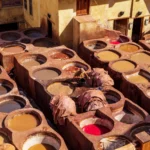
In the tanners’ quarter, the stone vats where hides are dyed form a checkerboard of colors. You watch from the terraces of the leather shops around the tannery: access is free in principle, but you will be invited into the shop. Activity is busiest and the light best in the morning. The smell is strong: the sprig of mint offered at the entrance is not a gimmick.
Souks, fondouks and Seffarine square
The medina is organized by trade: the coppersmiths of Seffarine square, hammering copper and brass, dyers, weavers, slipper makers, potters. The fondouks, former caravanserais, housed merchants and their goods; the Nejjarine fondouk now houses a museum of wooden arts and crafts. The mausoleum of Moulay Idriss II, the city’s patron saint, is a place of pilgrimage whose surroundings only are accessible to non-Muslims.
Fès el-Jdid, the Mellah and the royal palace
Southwest of the old city, Fès el-Jdid (« new Fez ») was founded by the Marinids in the 13th century. Admire the monumental brass doors of the royal palace (Dar el-Makhzen), which cannot be visited. Next door, the Mellah, the former Jewish quarter, keeps houses with balconies opening onto the street, a restored synagogue and a vast cemetery. The Jnan Sbil gardens offer a quiet break between the two medinas.
The Marinid Tombs and Borj Nord
On the hill north of the medina, the ruins of the Marinid Tombs offer the best overall view of Fès el-Bali, especially late in the day. Right next to them, Borj Nord, a 16th-century fortress, houses an arms museum. Avoid going up alone after dark: the U.S. Department of State advises avoiding traveling alone at night and in unfamiliar areas.
The Dar Batha Museum and crafts
Housed in a late-19th-century palace with an Andalusian garden, the Dar Batha Museum presents the crafts of Fez: blue ceramics, embroidery, carved wood, carpets. It is a good introduction before shopping. Fez pottery and zellige can also be seen in the workshops of the potters’ quarter, east of the city.
Day trips: Meknes, Volubilis, Moulay Idriss, Middle Atlas
About an hour away by road, Meknes, the former capital of Moulay Ismail, is quieter, with the monumental Bab Mansour gate. The Roman site of Volubilis, a UNESCO World Heritage Site, has fine mosaics, and the holy town of Moulay Idriss Zerhoun spreads over a neighboring hill: the three can be combined in a day. To the south, Ifrane and the cedar forests of the Middle Atlas, home to Barbary macaques, are about an hour away. Further north, Chefchaouen, the blue town, is about four hours by road.
Suggested itineraries
Fez in 3 days
Day 1: Bab Boujloud, the Bou Inania madrasa, Talaa Kebira, the souks, the Nejjarine fondouk and Seffarine square; sunset at the Marinid Tombs
Day 2: the Chouara tanneries in the morning, the Qarawiyyin (outside) and the al-Attarine madrasa, the Dar Batha Museum; in the afternoon, Fès el-Jdid, the Mellah and Jnan Sbil
Day 3: a day trip to Meknes, Volubilis and Moulay Idriss
A week in northern Morocco
Days 1 to 3: Fez and its medina
Day 4: Meknes and Volubilis
Days 5 and 6: Chefchaouen and the Rif (on the main roads)
Fez is one of the most affordable cities in Morocco, with a very wide choice of riads in the medina. Indicative amounts per person per day, excluding flights:
Item
Tight budget
Comfort
Accommodation (shared double room)
about US$17 to 35
about US$55 to 110
Meals
about US$9 to 17
about US$30 to 45
Local transportation
about US$2 to 6
about US$11 to 20
Activities (guide, madrasas, museums, hammam)
about US$6 to 17
about US$20 to 45
Total per day
roughly US$40 to 65
roughly US$100 to 190
Indicative estimates, varying with the season and the exchange rate, converted from euros at the European Central Bank rate of 23 October 2026 and rounded.
To cut costs: go in November, January or March, eat in the small eateries of the medina, share an official guide and take the train to Meknes rather than a car with driver. On the Atlantic coast, Rabat and its Kasbah of the Udayas are also easy to reach by train.
Who is Fez for?
Our verdict by travel style, based on the information in this guide:
Culture and heritage: ideal: the UNESCO-listed medina of Fès el-Bali, the Bou Inania and al-Attarine madrasas, the Mellah, the Dar Batha Museum and the artisans’ souks.
Tight budget: very suitable: Fez is one of the most affordable cities in Morocco, with roughly US$40 to 65 per person per day in a simple riad and small eateries.
Couples: yes: large restored mansions in the quiet heart of the medina, a view over the city from the Marinid Tombs late in the day (without going up alone after dark).
Families: possible: the sloping lanes, accessible only on foot, and the smell of the tanneries require some planning; hotels in the new town, with parking, are more practical for families.
Nature: as day trips: Ifrane and the cedar forests of the Middle Atlas, about an hour away, or Volubilis and Moulay Idriss on the way to Meknes.
Beach: no: Fez is an inland city at the foot of the Middle Atlas.
Getting to and around Fez
By plane: Fès-Saïss Airport is about fifteen kilometers (9 mi) south of the city. Check current routes with the airlines. Fixed-fare grands taxis or a transfer arranged by your riad.
By train: the ONCF station in Fez, in the new town, is linked to Meknes, Rabat, Casablanca, Tangier and Marrakech (a long journey to Marrakech, about 7 hours). The U.S. Department of State notes that the train system has a good safety record.
By bus: CTM and Supratours serve the major cities and Chefchaouen.
In the medina: everything is on foot. Porters with carts or donkeys carry luggage to your riad for a tip.
Petit taxis: red in Fez, handy between the new town, Fès el-Jdid and the medina gates; ask for the meter.
Car: useful for the Middle Atlas. The U.S. Department of State describes traffic accidents as a significant hazard and notes that modern freeways link Tangier, Rabat, Fez, Casablanca and Marrakech; mountain roads are steep, narrow and dangerous. Avoid driving at night.
Where to stay in Fez
Fès el-Bali, near Bab Boujloud: riads and guesthouses with easy access to taxis and the two main streets; ideal for a first stay
Heart of the medina (Qarawiyyin, Batha): large restored mansions in quiet surroundings, but access on foot only; ask to be met at the nearest gate
New town: modern hotels with parking, convenient by car and for families, 10 minutes by taxi from the medina
Surroundings (palm groves, hills): a few guesthouses with pools, useful in summer
Entry requirements, health and safety
US citizens: according to the U.S. Department of State (travel.state.gov, last updated July 30, 2026), you need a valid passport with at least one blank page; no visa is required for visits of less than 90 days. If you stay beyond 90 days without requesting an extension, you will have to appear before a judge before leaving. Carry a copy of your passport at all times.
UK citizens: according to the UK FCDO (GOV.UK, updated 19 August 2026), you can visit without a visa for up to 90 days for tourism. Your passport must be valid for at least 3 months after the date you arrive and must not be damaged; make sure it is stamped on entry. A polio vaccination certificate is required if you come from a polio-affected country.
Health: check vaccine recommendations at least 8 weeks before your trip (TravelHealthPro for UK travelers, the CDC for US travelers). Rabies is present and stray dogs are common: do not approach them and seek medical advice immediately after a bite or scratch (UK FCDO). In many areas tap water is not drinkable and ice may be made with tap water (U.S. Department of State).
Crime: petty crime is common in tourist areas, especially in medinas and on beaches (pickpocketing, bag-snatching, theft by motorcyclists), and criminals have used knives in street attacks in major cities and along beaches (UK FCDO, updated 19 August 2026). People posing as official guides commonly harass tourists: use a guide with an official badge.
Terrorism: the UK FCDO considers that terrorists are likely to try to carry out attacks in Morocco, including in places popular with tourists and in crowded places; stay aware of your surroundings and follow the advice of the local authorities. Protests can occur without warning in large cities.
Women travelers: women may receive unwanted attention, especially when traveling alone (UK FCDO); the U.S. Department of State advises traveling with a companion or in a group where possible.
Local laws: drinking alcohol anywhere other than a licensed restaurant or bar is illegal; possession of any drugs, including cannabis, carries severe penalties; same-sex relations are illegal (UK FCDO). There have been deaths caused by alcoholic drinks containing methanol.
Emergencies: police 190, gendarmerie 177, ambulance and fire 150 according to the UK FCDO; the U.S. Department of State gives 15 for emergency services and 190 for police from a mobile phone. Check locally on arrival.
Money: the dirham is a closed currency that cannot easily be exchanged outside Morocco (UK FCDO); keep your exchange receipts, as dirhams can be changed back into US dollars only with proof that you exchanged them in Morocco (U.S. Department of State). Be alert at ATMs. Our currency converter helps you estimate your spending. There are ATMs at the medina gates and in the new town; keep cash for the souks, guides and petit taxis.
Finding your way: mapping apps work poorly in the lanes; use the main gates (Bab Boujloud, Bab Rcif, Bab Guissa) as landmarks.
Bargaining: expected in the souks; set your maximum price before you start and do not feel obliged to buy after a workshop visit.
Dress: shoulders and knees covered in the medina, out of respect and to limit unwanted attention.
Ramadan: eating or drinking in public in the daytime may cause offense (UK FCDO); opening hours of sites and shops change.
Internet: a local SIM card or an eSIM is practical; riad Wi-Fi is patchy behind the thick walls.
April-May and late September-October: 22 to 30 °C (72 to 86 °F) in the afternoon and moderate rain. July and August are very hot (35 °C / 95 °F on average); winter is mild by day but cold at night and rainy.
How many days do you need to visit Fez?
Two full days for the medina, the madrasas, the tanneries and Fès el-Jdid; three days with the day trip to Meknes and Volubilis.
Do you need a guide to visit the medina of Fez?
It is not compulsory, but an official guide is very useful on the first day: the medina is a maze and the UK FCDO notes that people posing as official guides commonly harass tourists. Book one through your riad or the tourist office.
Can you visit the Qarawiyyin Mosque?
No, it is reserved for Muslims, like other working mosques in Morocco. You can glimpse its courtyard from the doors; the Bou Inania and al-Attarine madrasas, however, are open to visitors.
How do you get from Fez to Chefchaouen?
By road, in about four hours: CTM bus, grand taxi or car with driver. The U.S. Department of State describes roads through the Rif as steep, narrow and dangerous: stay on the main roads and travel by day.
Is Fez a safe city?
The UK FCDO considers that terrorists are likely to try to carry out attacks in Morocco and reports common petty crime in medinas, as well as harassment by fake guides. Avoid isolated places at night.
Our sources
Entry, health and safety information read on 26 October 2026: U.S. Department of State, Morocco country information (travel.state.gov, last updated July 30, 2026), and UK FCDO, foreign travel advice for Morocco (GOV.UK, updated 19 August 2026)
Climate data: 1991-2020 normals for the Fès-Saïss station, Direction générale de la Météorologie du Maroc, published by the World Meteorological Organization (NOAA archive)
European Central Bank, euro reference exchange rates of 23 October 2026 (budget conversion)


 FlightsKiwi.comCompare flights and airline combinations to Fez.Compare flights