A Chefchaouen travel guide starts with a small town in the Rif whose medina is painted in every shade of blue. Founded in 1471 and set against the mountain at about 600 m (1,970 ft), the « blue pearl » of northern Morocco is explored on foot, between stepped lanes, Outa el Hammam square and the kasbah. What is there to do in Chefchaouen? Wander the medina, climb to the Spanish Mosque at sunset, hike to the Akchour waterfalls. This guide brings together the highlights, the best time to go, access from Tangier or Fez, the budget and safety. The approach from Tangier can become a stop in its own right: see things to do in Tangier before heading up to Chefchaouen.
Our travel deals for Chefchaouen
Affiliate links: we earn a commission, at no extra cost to you.
FlightsKiwi.comCompare flights and airline combinations to Chefchaouen.
Morocco in general: the UK FCDO (GOV.UK, updated 19 August 2026) considers that terrorists are likely to try to carry out attacks in Morocco, including in places popular with tourists.
Drugs: the Rif is known for cannabis, but Morocco has a zero-tolerance approach: possessing, using or trafficking any drugs, including cannabis, carries severe penalties (UK FCDO). Turn down any offers.
Roads: the U.S. Department of State (travel.state.gov, last updated July 30, 2026) describes roads through the Rif and Atlas Mountains as steep, narrow, winding and dangerous, and secondary rural routes as often poorly paved.
Flooding: heavy rain can cause flash flooding, particularly in the mountains and near rivers during the winter months (UK FCDO).
Read the GOV.UK and travel.state.gov pages for Morocco before you leave.
When to go to Chefchaouen
The best times to go to Chefchaouen are spring (April-May) and autumn (September-October): mild days, green mountains in spring and ideal conditions for hiking to Akchour. Summer is dry and hot by day, but the town stays cooler in the evening than the plains. Winter is the rainy season, with abundant rain in the Rif and cold nights.
Set in the mountains and exposed to weather systems from the Atlantic, the western Rif is one of the wettest regions of Morocco. According to the Chefchaouen station records cited by Wikipedia, annual rainfall ranged from about 500 mm (20 in) to nearly 1,900 mm (75 in) between 2000 and 2020: the variation from one year to the next is considerable. We found no official published climate normals for Chefchaouen, which is why the table below gives no temperatures, only an assessment by month.
When to go to Chefchaouen: the essentials
Best periods: April-May and September-October
For hiking: spring, when the waterfalls and rivers are full
For swimming in the Akchour pools: summer, with many Moroccan visitors
To avoid crowds: weekdays, outside vacations and long weekends
Rainy season: from autumn to spring, especially in winter; bring warm clothes
Combine with: Tangier, Tetouan, Fez or Andalusia, across the strait
Chefchaouen month by month: our assessment
Month
Climate (trend)
Crowds
Prices
Verdict
January
Cool, rainy, cold nights
Low
Low
❌ Cold and damp
February
Cool, rainy
Low
Low
⚠️ Cool, few people
March
Mild, showers
Medium
Medium
⚠️ Mild, showers possible
April
Mild, green
High (Easter)
High
✅ Ideal for hiking
May
Mild to warm, drier
Medium
Medium
✅ One of the best months
June
Hot and dry
Medium
Medium
✅ Hot, good for Akchour
July
Hot and dry
Very high
High
⚠️ Hot, very busy
August
Hot and dry
Very high
High
⚠️ Very crowded
September
Warm, still dry
Medium
Medium
✅ A lovely late season
October
Mild, first rains
Medium
Medium
✅ Mild, fewer people
November
Cool, frequent rain
Low
Low
⚠️ Frequent rain
December
Cool, rainy, cold nights
Medium (holidays)
Medium
❌ Cold and rainy
Qualitative assessment by our editorial team: to our knowledge, no official climate normals are published for Chefchaouen. Crowds and prices: estimates based on European and Moroccan school vacations.
Chefchaouen season by season
Spring (March to May): the best season for walking in the Rif, with green hills and full waterfalls. Showers are still possible in March and sometimes April.
Summer (June to August): hot, dry days and evenings cooler than in Fez. This is the Moroccan high season: a very lively medina, accommodation to book early, and the Akchour sites very busy on weekends.
Autumn (September-October): the heat drops, and so do the crowds. The first rains usually arrive in October.
Winter (November to February): frequent rain, cold nights and poorly heated houses; snow can whiten the nearby peaks. The medina is quiet and prices are low, but the trails are muddy and rivers can be dangerous after heavy rain.
To compare with Marrakech, the coast or the desert, see our article on the best time to visit Morocco. If you are only interested in the Red City, see the best time to visit Marrakech, which does not follow the coastal calendar.
Things to do in Chefchaouen: the highlights
The blue medina
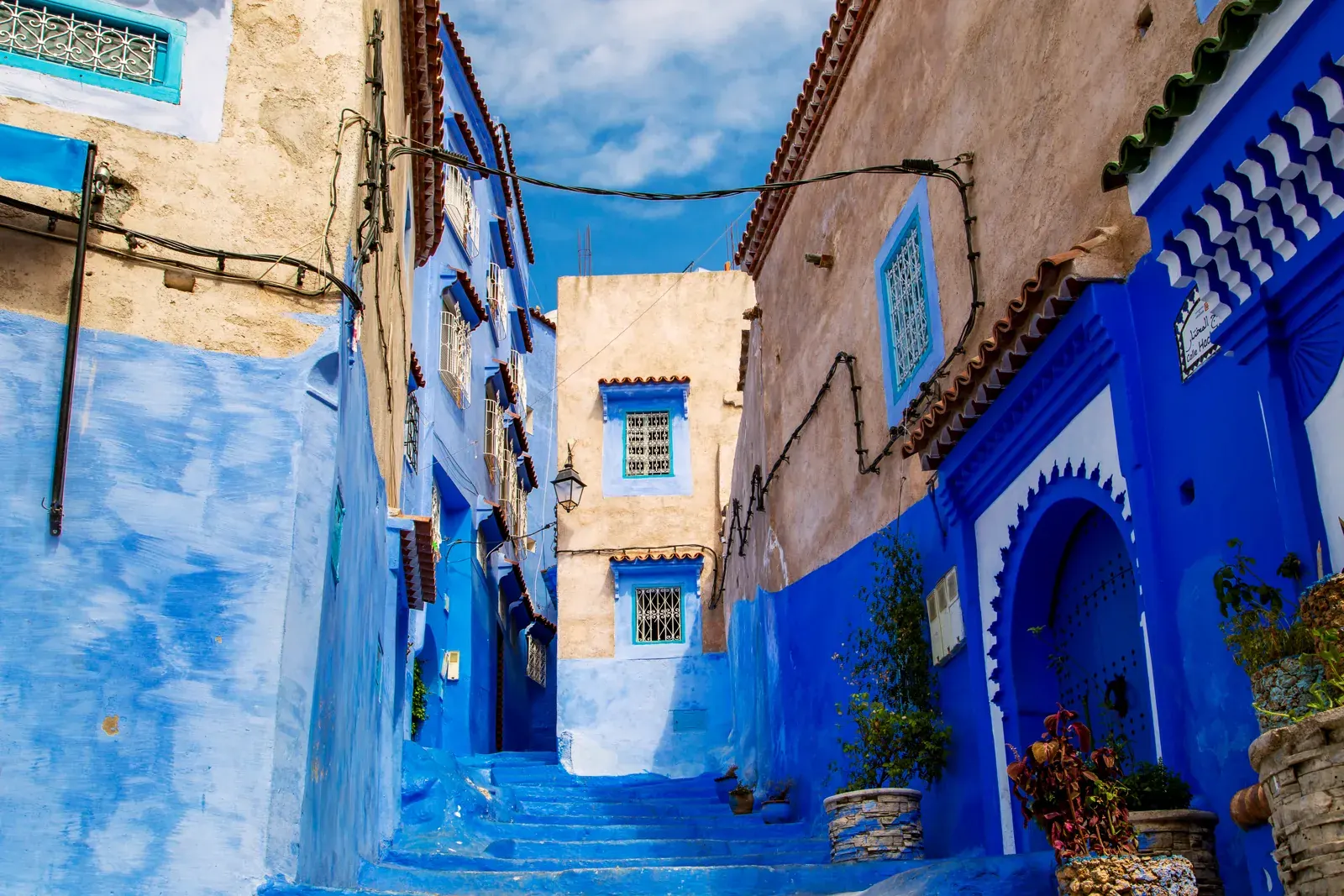
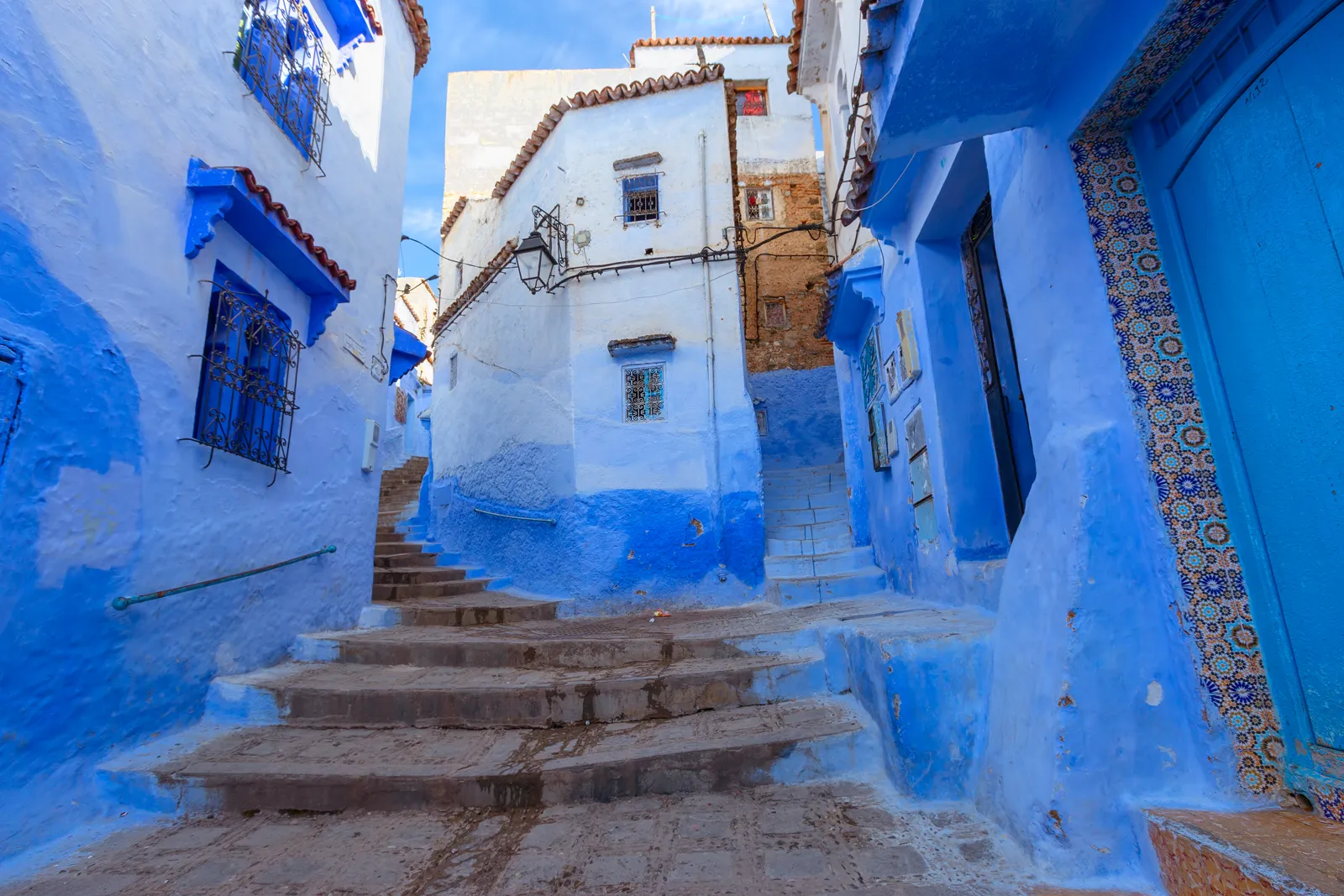
The blue facades of Chefchaouen.A stepped lane in the medina.
The medina is Chefchaouen’s main attraction. Its whitewashed, blue-washed houses, stairways, painted doors and fountains make up a much-photographed setting. There are several explanations for the color, none of them certain. The medina is small: it is easy to get lost, but you always end up back on the main square. Respect the residents: do not photograph people without their consent and do not sit on private steps.
Outa el Hammam square
The heart of the medina, Outa el Hammam square is lined with cafés and restaurants with terraces. It is the town’s meeting place, lively from morning until late at night, facing the kasbah and the Great Mosque.
The kasbah
Built when the town was founded, the ocher kasbah contrasts with the blue of the medina. Its walls enclose a tree-filled garden and a small ethnographic museum. From the top of the tower, the view takes in the rooftops of the medina and the mountain.
The Great Mosque
On Outa el Hammam square, the Great Mosque is recognizable by its octagonal minaret. As in most Moroccan mosques, entry is reserved for Muslims: admire it from outside.
Ras el Ma
At the eastern exit of the medina, through the Bab Onsar gate, the Ras el Ma spring supplies the town. Small cafés, wash houses and little cascades make it a pleasant place for a break, especially late in the day.
The Spanish Mosque and the sunset
From Ras el Ma, a path climbs in twenty to thirty minutes to the Bouzaafar Mosque, known as the « Spanish Mosque », built during the Spanish protectorate and never completed. The view over the medina is the most famous in town, especially at sunset. Take a flashlight for the way down.
Souks and crafts
The shops of the medina sell wool weavings, blankets, djellabas, leather goods, pottery and blue pigments. Prices are negotiable. The market in the new town, outside the medina, is frequented by people from the Rif villages.
The Akchour waterfalls and Talassemtane National Park
About an hour away by road, Akchour is the starting point of two well-known hikes in Talassemtane National Park: the waterfalls, with their pools, and « God’s Bridge », a natural arch over the river. Allow several hours of walking round trip depending on the route, good shoes and water. The site is very busy in summer and on weekends. After heavy rain, river crossings can become dangerous: ask locally or go with a local guide. The UK FCDO warns that swimming in rivers can be dangerous, with deep mud and steep underwater slopes.
Suggested itineraries
Chefchaouen in 2 days
Day 1: the medina, Outa el Hammam square, the kasbah, Ras el Ma and sunset at the Spanish Mosque
Day 2: a hike to the Akchour waterfalls or God’s Bridge, back in the late afternoon
A week in northern Morocco
Days 1 and 2: Tangier (medina, kasbah, Cape Spartel)
Day 3: Tetouan, whose medina is a World Heritage Site
Days 4 and 5: Chefchaouen and Akchour
Days 6 and 7: Fez, about 4 hours by road
For a wider circuit with Marrakech or the desert, see our Morocco travel guide and our Marrakech guide. From Tangier, ferries cross the strait to Spain: a combined trip with Andalusia is possible.
Budget for a stay in Chefchaouen
Chefchaouen is one of the cheapest stops on a trip to Morocco. Indicative amounts per person per day, excluding flights:
Item
Tight budget
Comfort
Accommodation (shared double room)
about US$11 to 30
about US$45 to 100
Meals
about US$8 to 13
about US$20 to 40
Local transportation
about US$2 to 6
about US$11 to 20
Activities (guide, trip to Akchour)
about US$6 to 11
about US$17 to 35
Total per day
roughly US$35 to 55
roughly US$90 to 170
Indicative estimates, varying with the season and the exchange rate, converted from euros at the European Central Bank rate of 23 October 2026 and rounded. Prices are higher in summer and during school vacations.
To cut costs: come on weekdays, outside July-August, eat in the small restaurants away from the main square and share a grand taxi to Akchour.
Getting to and around Chefchaouen
From Tangier: about 115 km (71 mi), 2.5 to 3 hours by road. CTM buses, grands taxis or a car with driver from the airport or the bus station.
From Tetouan: about 1.5 hours by bus or grand taxi.
From Fez: about 4 hours by road, by bus or car; Fez also has an international airport.
Train: there is no station in Chefchaouen. Trains link Casablanca, Rabat or Fez to Tangier, from where you continue by road.
On site: the medina can only be explored on foot, with many steps. Petit taxis serve the bus station, below the town.
Car: the U.S. Department of State describes roads through the Rif as steep, narrow, winding and dangerous; avoid driving at night and stay on the main roads.
Where to stay in Chefchaouen
Medina: riads, guesthouses and hostels, often with rooftop terraces; a unique atmosphere, but many stairs and no car access
Near Bab el Ain and the new town: more conventional hotels with parking, a few minutes’ walk from the medina
Surroundings and the Oued Laou valley: gîtes and guesthouses for quiet hiking
In winter: check for heating and blankets, as nights are cold
Entry requirements, health and safety
US citizens: according to the U.S. Department of State (travel.state.gov, last updated July 30, 2026), you need a valid passport with at least one blank page; no visa is required for visits of less than 90 days. If you stay beyond 90 days without requesting an extension, you will have to appear before a judge before leaving. Carry a copy of your passport at all times.
UK citizens: according to the UK FCDO (GOV.UK, updated 19 August 2026), you can visit without a visa for up to 90 days for tourism. Your passport must be valid for at least 3 months after the date you arrive and must not be damaged; make sure it is stamped on entry. A polio vaccination certificate is required if you come from a polio-affected country.
Health: check vaccine recommendations at least 8 weeks before your trip (TravelHealthPro for UK travelers, the CDC for US travelers). Rabies is present and stray dogs are common: do not approach them and seek medical advice immediately after a bite or scratch (UK FCDO). In many areas tap water is not drinkable and ice may be made with tap water (U.S. Department of State).
Crime: petty crime is common in tourist areas, especially in medinas and on beaches (pickpocketing, bag-snatching, theft by motorcyclists), and criminals have used knives in street attacks in major cities and along beaches (UK FCDO, updated 19 August 2026). People posing as official guides commonly harass tourists: use a guide with an official badge.
Terrorism: the UK FCDO considers that terrorists are likely to try to carry out attacks in Morocco, including in places popular with tourists and in crowded places; stay aware of your surroundings and follow the advice of the local authorities. Protests can occur without warning in large cities.
Local laws: drinking alcohol anywhere other than a licensed restaurant or bar is illegal; possession of any drugs, including cannabis, carries severe penalties; same-sex relations are illegal (UK FCDO). There have been deaths caused by alcoholic drinks containing methanol.
Hiking: take water and good shoes and, off the marked Akchour trails, a local guide. The UK FCDO advises checking safety standards with outdoor activity providers.
Emergencies: police 190, gendarmerie 177, ambulance and fire 150 according to the UK FCDO; the U.S. Department of State gives 15 for emergency services and 190 for police from a mobile phone. Check locally on arrival.
Money: the dirham is a closed currency that cannot easily be exchanged outside Morocco (UK FCDO); keep your exchange receipts, as dirhams can be changed back into US dollars only with proof that you exchanged them in Morocco (U.S. Department of State). Be alert at ATMs. Our currency converter helps you estimate your spending. There are a few ATMs in town near the medina; keep cash, as cards are rarely accepted in small shops.
Photos: always ask before photographing someone; some residents object.
Dress: cover shoulders and knees in the medina, a religious and conservative town.
Shoes: the lanes are steep and slippery in wet weather.
Ramadan: eating or drinking in public in the daytime may cause offense (UK FCDO); many restaurants close before the fast is broken.
Internet: a local SIM card or an eSIM is practical; coverage can be weak in the Rif valleys.
Who is Chefchaouen for?
Our verdict by traveler profile, based on the information in this guide:
Couples: yes: the blue medina, the terraces of Outa el Hammam square, sunset from the Spanish Mosque.
Families: yes, with children who are good walkers: the medina can only be explored on foot, with many steps.
Tight budget: yes: it is one of the cheapest stops in Morocco, roughly US$35 to 55 per person per day on a tight budget.
Hiking: yes, in spring: the Akchour waterfalls and God’s Bridge in Talassemtane National Park, with a local guide off the marked trails.
Culture: yes, on a small scale: the kasbah and its ethnographic museum, crafts in the souks; combine with Tetouan, Tangier or Fez.
Beach: no: Chefchaouen is in the mountains; swimming is limited to the Akchour pools in summer.
Read also
To place Chefchaouen in a wider circuit, our page on the best time to visit Morocco compares the north, the imperial cities, the coast and the desert. The shoulder seasons recommended for hiking are covered in our articles Morocco in April and Morocco in October. Finally, Morocco changes its clocks during Ramadan: check the time difference with Morocco before booking your transfers.
Frequently asked questions
What is the best month to visit Chefchaouen?
April, May, September and October are the most pleasant: mild days, little rain and reasonable crowds. Summer suits swimming at Akchour, but the town is very busy.
How many days should you stay in Chefchaouen?
One full day is enough for the medina and the Spanish Mosque. Allow two days with a hike to Akchour, three if you want to walk more in the Rif.
How do you get to Chefchaouen?
There is no airport in Chefchaouen. The simplest option is to fly to Tangier, then travel about 2.5 to 3 hours by bus, grand taxi or car. Fez is the other gateway, about 4 hours away.
Why is Chefchaouen blue?
Several explanations circulate, without historical certainty. Today the color is maintained by the residents and is part of the town’s identity.
Is Chefchaouen safe?
The UK FCDO considers that terrorists are likely to try to carry out attacks in Morocco and reports petty crime in tourist areas. In the Rif, turn down offers of cannabis (zero tolerance, severe penalties) and avoid mountain roads at night, which the U.S. Department of State describes as dangerous.
Our sources
Entry, health and safety information read on 26 October 2026: U.S. Department of State, Morocco country information (travel.state.gov, last updated July 30, 2026), and UK FCDO, foreign travel advice for Morocco (GOV.UK, updated 19 August 2026)
Climate: the Wikipedia article « Chefchaouen » (in English), Climate section, citing rainfall records from the Chefchaouen station (2000-2020); no official normals found
European Central Bank, euro reference exchange rates of 23 October 2026 (budget conversion)


 FlightsKiwi.comCompare flights and airline combinations to Chefchaouen.Compare flights