The best time to visit Senegal is from November to May: it is the dry season, with almost no rain across the country and mild temperatures on the coast (25 to 30 °C (77 to 86 °F) in the afternoon in Dakar). December to February is the best compromise if you want to combine the coast, the river and the hotter interior. By contrast, the hivernage, the rainy season, runs from June–July to October, with a peak in August–September, especially in Casamance. Further east along the Gulf of Guinea, the best time to visit Benin follows different seasons from the Senegalese hivernage.
⚠️ Safety: some areas call for particular care. The UK FCDO (GOV.UK, updated 15 October 2026) advises taking particular care in remote areas of Senegal near the borders with Mauritania and Mali, where terrorist groups active in neighboring Mali have carried out deadly attacks close to the Senegalese border. For Casamance, it says there have been decades of low-intensity separatist violence, that you should be alert for clashes particularly close to the Gambian and Guinea-Bissau borders, and that the risk of clashes is lower in the main tourist areas. The U.S. State Department (travel.state.gov, last updated December 4, 2025) reports sporadic armed banditry in Casamance and landmines from past conflicts in more remote areas off main roads. Check the latest official advice for your nationality before you go.
Senegal does not have a uniform climate. Dakar, cooled by the trade winds and a cold sea current, stays mild all year. The interior (Tambacounda, Kédougou) exceeds 40 °C (104 °F) in April–May. Casamance, in the south, receives five times more rain than Saint-Louis, in the north. Here is how to choose, based on the official 1991–2020 normals of the Senegalese weather service (ANACIM).

Our travel deals for Senegal
Affiliate links: we earn a commission, at no extra cost to you.
 FlightsKiwi.comCompare flights and airline combinations to Senegal.Compare flights
- eSIMAiraloData plan to install before you leave (eSIM-compatible phone).See plans


When to go to Senegal at a glance
- Best overall period November to May (dry season)
- The best compromise December to February, to combine Dakar, Saint-Louis, the Sine-Saloum and the interior without too much heat
- Beaches (Petite-Côte, Cap Skirring) November to May
- Birds in Djoudj National Park roughly November to April, when migratory birds from Europe overwinter
- Eastern Senegal (Niokolo-Koba, Bassari country) December to February; avoid March to May (more than 40 °C (104 °F) in Tambacounda in April–May)
- Hivernage (rainy season) July to October, with a peak in August; nearly 480 mm (18.9 in) on average in August in Ziguinchor
- Good to know the U.S. State Department (travel.state.gov, last updated December 4, 2025) lists malaria among the diseases present in Senegal, and recommends mosquito precautions
When to go to Senegal by priority
- Best weather: December, January and February for a full circuit; November to May for a coastal stay
- Cheapest: May–June and October; prices are at their highest over the year-end holidays
- Fewest crowds: May, June, September and October; September is rainy and muggy
- Events: Independence Day on April 4; Korité, Tabaski and the Grand Magal of Touba follow the lunar calendar, which moves forward by about 11 days each year
Senegal: the calendar at a glance
✅ Best months: January, February, March, April, may, November, December
❌ Period to avoid: August, September
Senegal climate month by month
The table below gives the normals for Dakar, the arrival point of almost every trip. Dakar has one of the mildest climates in the country: the other regions, hotter or wetter, are detailed below.
| Month | Avg. max | Avg. min | Rain | Crowds | Prices | Verdict |
|---|---|---|---|---|---|---|
| January | 25.9 °C (79 °F) | 18.6 °C (65 °F) | 1 mm (0.0 in) | High | High | Dry and mild, cool nights ✅ |
| February | 25.2 °C (77 °F) | 18.0 °C (64 °F) | 0.4 mm (0.0 in) | High (winter holidays) | High | Dry, the coolest month ✅ |
| March | 25.2 °C (77 °F) | 18.4 °C (65 °F) | 0.1 mm (0.0 in) | Moderate to high | Moderate to high | Dry, very pleasant on the coast ✅ |
| April | 25.0 °C (77 °F) | 19.1 °C (66 °F) | 0 mm (0.0 in) | Moderate (Easter) | Moderate | Dry, but very hot inland ✅ |
| May | 26.2 °C (79 °F) | 20.7 °C (69 °F) | 0 mm (0.0 in) | Low | Low | Dry, good value ✅ |
| June | 28.7 °C (84 °F) | 23.6 °C (74 °F) | 7 mm (0.3 in) | Low | Low | Humid heat, first rains in the south ⚠️ |
| July | 30.1 °C (86 °F) | 25.2 °C (77 °F) | 53 mm (2.1 in) | Moderate (summer holidays) | High for flights | Start of the rainy season, storms ⚠️ |
| August | 30.5 °C (87 °F) | 25.4 °C (78 °F) | 166 mm (6.5 in) | Moderate | High for flights | Heart of the rainy season, muggy heat ❌ |
| September | 30.9 °C (88 °F) | 25.2 °C (77 °F) | 138 mm (5.4 in) | Low | Low | Rainy and heavy, difficult roads ❌ |
| October | 31.3 °C (88 °F) | 25.5 °C (78 °F) | 26 mm (1.0 in) | Low | Low | End of the rains, still hot and humid ⚠️ |
| November | 30.1 °C (86 °F) | 23.5 °C (74 °F) | 0.3 mm (0.0 in) | Moderate | Moderate | Dry season returns, nature still green ✅ |
| December | 27.9 °C (82 °F) | 21.0 °C (70 °F) | 0.4 mm (0.0 in) | Very high (holidays) | Very high | Dry and pleasant, high prices over the holidays ✅ |
Note: from November to May, practically no rain falls in Dakar (less than 2 mm (0.1 in) a month on average). During the hivernage, rain comes mostly as thunderstorms, often violent but brief. The UK FCDO (GOV.UK, updated 15 October 2026) says that during the rainy season from June to September, torrential rains can cause floods and landslides which damage roads.
Sea temperature month by month
In Dakar, the sea drops to 20 to 21 °C (68 to 70 °F) from January to April, which often surprises visitors, then reaches 27 °C (81 °F) from July to November.
| Month | Dakar |
|---|---|
| January | 21 °C (70 °F) |
| February | 20 °C (68 °F) |
| March | 20 °C (68 °F) |
| April | 21 °C (70 °F) |
| May | 23 °C (73 °F) |
| June | 25 °C (77 °F) |
| July | 27 °C (81 °F) |
| August | 27 °C (81 °F) |
| September | 27 °C (81 °F) |
| October | 27 °C (81 °F) |
| November | 27 °C (81 °F) |
| December | 24 °C (75 °F) |
Senegal’s seasons: pros and cons
Senegal has two well-defined seasons: a long dry season, from November to May or June depending on the region, and a rainy season called the hivernage, linked to the West African monsoon. The rains arrive first in the south (from June) and withdraw in October.
The « cool » dry season (November to February): the high season
This is the most in-demand period. On the coast, days are sunny and nights cool: 18 °C (64 °F) average low in Dakar in February, 16 °C (61 °F) in Saint-Louis in January. The interior stays hot in the afternoon (35 °C (95 °F) in Tambacounda in January) but bearable. Early in the year, the harmattan, a dry wind from the Sahara, can fill the air with dust on some days; the U.S. State Department (travel.state.gov, last updated December 4, 2025) notes that air quality is typically at its worst during the Harmattan winds in January and February.
- Pros: no rain, moderate heat, good conditions for circuits, tracks and birdwatching at Djoudj
- Cons: prices at their highest over the year-end holidays and in February; in Dakar, the sea is cooler than you might imagine
- Our tip: January and March offer the same conditions, with fewer crowds
The hot dry season (March to June): pleasant coast, scorching interior
On the coast, nothing really changes: Dakar stays around 25 to 26 °C (77 to 79 °F) in the afternoon until May, with no rain. Inland, however, the heat becomes crushing: more than 40 °C (104 °F) average high in Tambacounda in April (41.4 °C (107 °F)) and May, and in Kédougou in April.
- Pros: falling prices after Easter, quieter beaches, weather still dry on the coast until May
- Cons: heat that makes visiting the interior and eastern Senegal difficult, end of the migratory bird season at Djoudj
- Who is it for? Travelers who stay on the coast: Dakar, the Petite-Côte, the Sine-Saloum, Cap Skirring
Hivernage (July to October): the green season
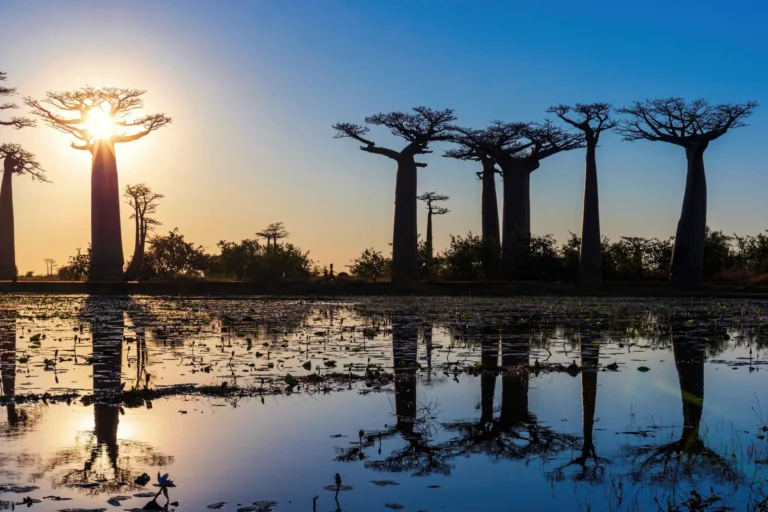
The hivernage transforms the landscapes: the bush and rice fields turn green, baobabs cover themselves in leaves. But it is hot and humid (25 °C (77 °F) at night, 30 to 31 °C (86 to 88 °F) by day in Dakar), and thunderstorms can be violent. Amounts vary greatly by region: about 270 mm (10.6 in) over the whole year in Saint-Louis, against more than 1,400 mm (55.1 in) in Ziguinchor, with nearly 480 mm (18.9 in) in August.
- Pros: lush nature, low prices on the ground, very few tourists
- Cons: tracks often impassable (the U.S. State Department notes that during the rainy season many roads are passable only with four-wheel-drive vehicles), more mosquitoes, some excursions and seaside accommodations dormant
- Who is it for? Flexible travelers who stay in Dakar or on the drier north coast
When to go to Senegal by region
From the Lompoul desert to the mangroves of Casamance, the differences are large. Comparison of the normals for four cities, from north to south and from the coast to the interior:
| Month | Dakar | Saint-Louis (north) | Ziguinchor (Casamance) | Tambacounda (east) |
|---|---|---|---|---|
| January | 25.9 °C (79 °F) / 1 mm (0.0 in) | 31.4 °C (89 °F) / 3 mm (0.1 in) | 34.1 °C (93 °F) / 5 mm (0.2 in) | 34.9 °C (95 °F) / 0 mm (0.0 in) |
| February | 25.2 °C (77 °F) / 0 mm (0.0 in) | 32.4 °C (90 °F) / 1 mm (0.0 in) | 36.7 °C (98 °F) / 0 mm (0.0 in) | 37.4 °C (99 °F) / 0 mm (0.0 in) |
| March | 25.2 °C (77 °F) / 0 mm (0.0 in) | 33.0 °C (91 °F) / 0 mm (0.0 in) | 38.4 °C (101 °F) / 0 mm (0.0 in) | 39.8 °C (104 °F) / 0 mm (0.0 in) |
| April | 25.0 °C (77 °F) / 0 mm (0.0 in) | 31.5 °C (89 °F) / 0 mm (0.0 in) | 38.4 °C (101 °F) / 0 mm (0.0 in) | 41.4 °C (107 °F) / 0 mm (0.0 in) |
| May | 26.2 °C (79 °F) / 0 mm (0.0 in) | 30.3 °C (87 °F) / 0 mm (0.0 in) | 37.2 °C (99 °F) / 3 mm (0.1 in) | 40.9 °C (106 °F) / 13 mm (0.5 in) |
| June | 28.7 °C (84 °F) / 7 mm (0.3 in) | 30.6 °C (87 °F) / 7 mm (0.3 in) | 35.5 °C (96 °F) / 93 mm (3.7 in) | 37.6 °C (100 °F) / 83 mm (3.3 in) |
| July | 30.1 °C (86 °F) / 53 mm (2.1 in) | 31.3 °C (88 °F) / 43 mm (1.7 in) | 33.1 °C (92 °F) / 341 mm (13.4 in) | 33.6 °C (92 °F) / 163 mm (6.4 in) |
| August | 30.5 °C (87 °F) / 166 mm (6.5 in) | 32.1 °C (90 °F) / 92 mm (3.6 in) | 32.3 °C (90 °F) / 481 mm (18.9 in) | 32.2 °C (90 °F) / 227 mm (8.9 in) |
| September | 30.9 °C (88 °F) / 138 mm (5.4 in) | 33.0 °C (91 °F) / 104 mm (4.1 in) | 33.0 °C (91 °F) / 359 mm (14.1 in) | 33.0 °C (91 °F) / 199 mm (7.8 in) |
| October | 31.3 °C (88 °F) / 26 mm (1.0 in) | 34.5 °C (94 °F) / 24 mm (0.9 in) | 34.4 °C (94 °F) / 114 mm (4.5 in) | 35.9 °C (97 °F) / 54 mm (2.1 in) |
| November | 30.1 °C (86 °F) / 0 mm (0.0 in) | 34.7 °C (94 °F) / 0 mm (0.0 in) | 34.6 °C (94 °F) / 6 mm (0.2 in) | 37.5 °C (100 °F) / 3 mm (0.1 in) |
| December | 27.9 °C (82 °F) / 0 mm (0.0 in) | 32.5 °C (91 °F) / 0 mm (0.0 in) | 33.7 °C (93 °F) / 0 mm (0.0 in) | 35.6 °C (96 °F) / 0 mm (0.0 in) |
In one table: the recommended period for each major region, month by month.
| Region | Jan | Feb | Mar | Apr | May | Jun | Jul | Aug | Sep | Oct | Nov | Dec |
|---|---|---|---|---|---|---|---|---|---|---|---|---|
| Dakar and Gorée | ✅ | ✅ | ✅ | ✅ | ✅ | ⚠️ | ⚠️ | ⚠️ | ⚠️ | ⚠️ | ✅ | ✅ |
| Saint-Louis and Djoudj | ✅ | ✅ | ✅ | ⚠️ | ⚠️ | ⚠️ | ⚠️ | ⚠️ | ⚠️ | ⚠️ | ✅ | ✅ |
| Petite-Côte and Sine-Saloum | ✅ | ✅ | ✅ | ✅ | ✅ | ⚠️ | ⚠️ | ⚠️ | ⚠️ | ⚠️ | ✅ | ✅ |
| Casamance | ✅ | ✅ | ✅ | ✅ | ✅ | ⚠️ | ❌ | ❌ | ❌ | ⚠️ | ✅ | ✅ |
| Eastern Senegal (Tambacounda, Kédougou) | ✅ | ✅ | ⚠️ | ⚠️ | ⚠️ | ⚠️ | ⚠️ | ⚠️ | ⚠️ | ⚠️ | ⚠️ | ✅ |
Dakar, Gorée Island and the Cap-Vert peninsula
The most temperate climate in the country: 25 to 26 °C (77 to 79 °F) in the afternoon from January to May, 30 to 31 °C (86 to 88 °F) during the hivernage. Dakar can be visited year-round, but the ideal period is November to May. Our guide to a stay in Dakar presents Gorée, the neighborhoods and the nearby beaches.
Saint-Louis, the river and Djoudj National Park
The north is the driest part of the country: about 270 mm (10.6 in) of rain a year in Saint-Louis, concentrated between July and September. Afternoons are hot all year (30 to 35 °C (86 to 95 °F)) but nights in December–January drop to about 16 to 17 °C (61 to 63 °F). The best window is November to March, which also matches the presence of migratory birds in Djoudj National Bird Sanctuary, about 60 km (37 mi) to the north. Saint-Louis, Djoudj and Dakar can be located on our map of Senegal.
The Petite-Côte and the Sine-Saloum
South of Dakar, the Petite-Côte (Saly, Somone, Mbour, Joal-Fadiouth) and the Saloum delta are hotter than the capital in the dry season: at the Mbour station, average highs exceed 34 °C (93 °F) from January to April. Aim for November to May for the beach and pirogue trips on the bolongs (mangrove-lined channels).
Casamance (Ziguinchor, Cap Skirring)
This is the wettest region: more than 1,400 mm (55.1 in) a year in Ziguinchor and about 1,200 mm (47.2 in) in Cap Skirring, with more than 300 mm (11.8 in) a month from July to September. In return, the dry season there is clear-cut, from November to May, with 30 to 33 °C (86 to 91 °F) in the afternoon in Cap Skirring, tempered by the sea. Reminder: the UK FCDO advises being alert for clashes in Casamance, particularly close to the Gambian and Guinea-Bissau borders, and advises avoiding night driving and sticking to main roads.
Eastern Senegal (Tambacounda, Niokolo-Koba, Kédougou)
The east has a pronounced continental climate. The best months are December and January, and possibly February: about 35 °C (95 °F) in the afternoon and 18 °C (64 °F) at night in Tambacounda. From March, heat exceeds 39 °C (102 °F), then 40 °C (104 °F) in April–May. Take particular care in remote areas near the Mali border, as advised by the UK FCDO.

When to go to Senegal by trip type
| Your trip | Best time | Where? |
|---|---|---|
| First trip (Dakar, Saint-Louis, Saloum) | November to March | Dakar, Gorée, Lake Retba, Saint-Louis, Sine-Saloum |
| Beach and relaxation | November to May | Saly, Somone, Popenguine, Cap Skirring |
| Birdwatching | November to March | Djoudj Park, Langue de Barbarie, Saloum delta |
| National park and hiking in the east | December to February | Niokolo-Koba, Bassari country (Kédougou) |
| Budget | May–June, October | Dakar and the coast |
| Green landscapes | End of the hivernage (October) and November | Casamance, Sine-Saloum |
| Family trip | Autumn, February and Easter school holidays | Petite-Côte, Sine-Saloum |
| Honeymoon | November, March–April | Sine-Saloum, Cap Skirring, Saint-Louis |
Major events to plan your trip around
| Period | Event | Location |
|---|---|---|
| Variable date (lunar calendar) | Korité, the festival marking the end of Ramadan | Nationwide |
| Variable date (lunar calendar) | Tabaski, the major Muslim festival: many family journeys, saturated transport | Nationwide |
| Variable date (lunar calendar) | Grand Magal of Touba, the great pilgrimage of the Mouride brotherhood | Touba |
| April 4 | Independence Day | Nationwide, parade in Dakar |
| Late December – early January | Year-end holidays (highest prices) | Dakar, Petite-Côte, Cap Skirring |
Senegal month by month: what to expect
January: Excellent everywhere: dry, 26 °C (79 °F) in Dakar, 34 to 35 °C (93 to 95 °F) in the interior. Ideal for Djoudj and Niokolo-Koba. The harmattan can haze the sky on some days.
February: The coolest month in Dakar (25 °C (77 °F) in the afternoon, 18 °C (64 °F) at night). A very good month for the whole country; crowds and prices are high during school holidays.
March: Still dry and pleasant on the coast. The heat rises in the interior (nearly 40 °C (104 °F) in Tambacounda).
April: Perfect on the coast (25 °C (77 °F) in Dakar), but the hottest month in the east (41 °C (106 °F) in Tambacounda). Independence Day on April 4. Crowds linked to the Easter holidays.
May: The last truly dry month across the country. Prices fall. Avoid the interior, still above 40 °C (104 °F).
June: Transition: humid heat, first rains in Casamance and the southeast (more than 80 mm (3.1 in) in Ziguinchor and Tambacounda). Dakar stays almost dry.
July: The hivernage sets in: about 50 mm (2.0 in) in Dakar but more than 340 mm (13.4 in) in Ziguinchor. High airfares for the summer holidays.
August: The heart of the rainy season: 166 mm (6.5 in) in Dakar, 481 mm (18.9 in) in Ziguinchor. Muggy heat. Difficult tracks.
September: Still very rainy (138 mm (5.4 in) in Dakar, 359 mm (14.1 in) in Ziguinchor), and mosquitoes are numerous: protect yourself well. Low prices on the ground, very few tourists.
October: The rains recede, especially in the second half of the month. Still hot and humid. The country is very green.
November: The dry season returns, nature still green, migratory birds arrive at Djoudj. A very good month, still spared the big crowds.
December: Dry and pleasant everywhere (28 °C (82 °F) in Dakar, 34 to 36 °C (93 to 97 °F) in the interior). Ideal for a full circuit, but book early for the holidays: it is the most expensive period.
When to book your trip to Senegal
For the year-end, February and Easter holidays, book your flights and accommodation 3 to 5 months ahead, especially on the Petite-Côte, in the Sine-Saloum and at Cap Skirring, where the best camps and hotels fill up quickly. In May, June, September or October, 1 to 2 months is generally enough. Blaise Diagne International Airport is the main gateway; compare flight options when you book.
Planning your trip to Senegal
- Entry requirements: see our page with the entry requirements for Senegal.
- Time difference: Senegal is on GMT (UTC+0) all year: the same time as London in winter and 1 hour behind in summer; usually 5 hours ahead of New York.
- Currency: the CFA franc (XOF), fixed to the euro (travel.state.gov). The U.S. State Department notes that Senegal’s economy operates primarily on a cash basis and credit cards are not widely accepted. Use our currency converter to estimate your budget.
- Health: the UK FCDO (GOV.UK, updated 15 October 2026) lists dengue, Zika and yellow fever among the health risks and says a yellow fever certificate is required if you are arriving from a country listed as a transmission risk; the U.S. State Department (travel.state.gov, last updated December 4, 2025) lists malaria and meningococcal meningitis among the diseases present. Check vaccine and malaria guidance with a travel health clinic before you go, and take out travel insurance covering your itinerary and emergency expenses.
To go further, see our complete Senegal travel guide. Looking for another sunny winter destination? See also when to go to Cape Verde, the neighboring archipelago, or our ideas for traveling in December.
To compare with other destinations at the same time of year, see our selections where to go in November, in January and in February, or the best time to visit Cape Verde.
Frequently asked questions
What is the best month to visit Senegal?
December, January and February are the best months for a full circuit: no rain, 25 to 28 °C (77 to 82 °F) in the afternoon in Dakar and heat that is still bearable in the interior. For a stay limited to the coast, the favorable season runs from November to May.
When is the rainy season in Senegal?
The hivernage lasts from June–July to October depending on the region, with a peak in August. It starts earlier and rains much more in the south: about 480 mm (18.9 in) in August in Ziguinchor, against 166 mm (6.5 in) in Dakar and 92 mm (3.6 in) in Saint-Louis, according to the official 1991–2020 normals.
Can you visit Senegal in July or August?
Yes, but it is the season of rain and humid heat. Storms are frequent, some tracks become impassable and mosquitoes are more numerous. Favor Dakar and the north, which are less rainy.
When is the cheapest time to visit Senegal?
May, June, September and October are generally the cheapest months on the ground. In July–August, accommodation is inexpensive, but flights often remain pricey.
Is Senegal hot in winter?
On the coast, it is mild rather than hot: about 25 to 26 °C (77 to 79 °F) in the afternoon in Dakar from January to April, 28 °C (82 °F) in December, with nights around 18 °C (64 °F). The interior is hotter (31 to 37 °C (88 to 99 °F)).
When should you go to Casamance?
From November to May, in the dry season. From July to September, more than 300 mm (11.8 in) of rain falls a month in Ziguinchor and Cap Skirring. Before you go, check the official advice for your nationality: the UK FCDO says the risk of clashes is lower in the main tourist areas of Casamance.
Is December a good time to visit Senegal?
Yes: it is dry and pleasant everywhere (28 °C (82 °F) in the afternoon in Dakar, 34 to 36 °C (93 to 97 °F) in the interior), ideal for a full circuit. Book early for the holidays, the most expensive period.
What is the weather like in Senegal in August?
It is the heart of the hivernage: 166 mm (6.5 in) of rain in Dakar and 481 mm (18.9 in) in Ziguinchor, muggy heat and difficult tracks.
Our sources
- Agence nationale de l’aviation civile et de la météorologie du Sénégal (ANACIM), via the World Meteorological Organization 1991–2020 climate normals (NOAA archive): Dakar, Saint-Louis, Ziguinchor, Tambacounda, Mbour, Cap Skirring and Kédougou stations
- Information read on 26 October 2026: UK FCDO, foreign travel advice for Senegal (GOV.UK, updated 15 October 2026), and U.S. Department of State, Senegal country information (travel.state.gov, last updated December 4, 2025)
- Deutscher Wetterdienst (DWD), Klimatafel for Dakar-Yoff: average sea temperature
- Our methodology
Updated November 2026.