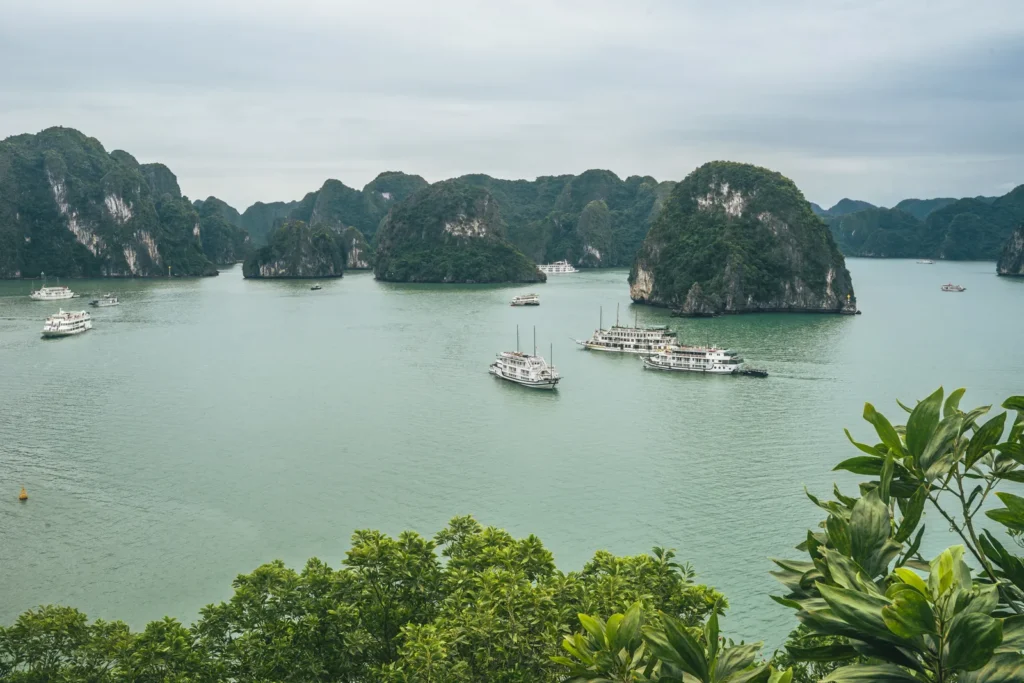
Ha Long Bay is the most visited sight in northern Vietnam: nearly 2,000 limestone islands and islets rising from the Gulf of Tonkin, a few hours’ drive from Hanoi. A UNESCO World Heritage Site, it is explored mainly on a cruise, from one day to three, with caves, kayaking and fishing villages. This guide helps you choose your Ha Long Bay cruise and departure point, pick the best time based on official normals, and discover the neighbouring Lan Ha and Bai Tu Long bays, often less crowded. For your starting point, our guide to visiting Hanoi helps you plan a day or two in the capital.

Our travel deals for Ha Long Bay
Affiliate links: we earn a commission, at no extra cost to you.
 FlightsKiwi.comCompare flights and airline combinations to Ha Long Bay.Compare flights
- eSIMAiraloData plan to install before you leave (eSIM-compatible phone).See plans


Ha Long Bay at a glance
- Location Quảng Ninh province, northeastern VietnamMain ports in Hạ Long (Bãi Cháy, Tuần Châu)
- From Hanoi about 2 h 30 to 3 h 30 by road depending on the departure point
- Airports Hanoi Noi Bai (HAN), then the road to the bayCheck current routes with the airlines
- Language Vietnamese; English is spoken on board cruises
- Currency the Vietnamese dong (VND) · currencies
- Time zone UTC+7, no daylight saving · details7 h ahead of London and 12 h ahead of New York in winterLocal time now: –:–
- Entry US: visa required (e-visa); UK: visa-free up to 45 days · travel.state.gov · GOV.UK
- Electricity check the plug type with your adapter supplier before you go · plugs
- Ideal length a 2-day, 1-night cruise · details
When to go to Ha Long Bay
The best time for Ha Long Bay is October-November, then April-May: 25 to 30 °C (77 to 86 °F) in the afternoon, little rain and, in autumn, often clearer skies. From December to March there is little rain but it is cool (14 to 22 °C / 57 to 72 °F), and drizzle and mist often veil the karsts. From June to September it is hot and very wet (up to 431 mm / 17.0 in in August), and tropical storms can lead to cruises being suspended.
When to go to Ha Long: the essentials
- Best periods: October-November, April-May
- Driest months: December (18 mm / 0.7 in) to February (25 mm / 1.0 in), but cool and often misty
- Wettest month: August, 431 mm (17.0 in) and 19 rainy days on average
- Hottest month: July, average high 31.7 °C (89 °F)
- Storm risk: the UK FCDO says the tropical storm season runs from May to November; the authorities then suspend sailings
- Swimming: mainly from May to October
| Month | Avg max | Avg min | Rain | Rain days | Crowds | Prices | Verdict |
|---|---|---|---|---|---|---|---|
| January | 19.3 °C (67 °F) | 14.0 °C (57 °F) | 28 mm (1.1 in) | 8 | Moderate | Medium | ⚠️ Cool, often grey and misty |
| February | 19.7 °C (67 °F) | 15.2 °C (59 °F) | 25 mm (1.0 in) | 10 | High (Tet) | High | ⚠️ Frequent drizzle; Tet in high demand |
| March | 22.0 °C (72 °F) | 17.8 °C (64 °F) | 43 mm (1.7 in) | 14 | Moderate | Medium | ⚠️ Mist and drizzle, reduced visibility |
| April | 26.1 °C (79 °F) | 21.5 °C (71 °F) | 86 mm (3.4 in) | 11 | Moderate | Medium | ✅ Mild, skies clearing |
| May | 30.1 °C (86 °F) | 24.6 °C (76 °F) | 183 mm (7.2 in) | 12 | Moderate | Medium | ✅ Warm, pleasant water, storms possible |
| June | 31.5 °C (89 °F) | 26.0 °C (79 °F) | 297 mm (11.7 in) | 16 | High | Medium | ⚠️ Hot and wet, storms possible |
| July | 31.7 °C (89 °F) | 26.2 °C (79 °F) | 364 mm (14.3 in) | 17 | High | High | ⚠️ Vietnamese holidays, storm risk |
| August | 31.3 °C (88 °F) | 25.4 °C (78 °F) | 431 mm (17.0 in) | 19 | High | High | ❌ Wettest month, cancellations possible |
| September | 30.7 °C (87 °F) | 24.4 °C (76 °F) | 276 mm (10.9 in) | 14 | Moderate | Medium | ⚠️ Still wet, storm risk |
| October | 28.8 °C (84 °F) | 22.2 °C (72 °F) | 143 mm (5.6 in) | 9 | High | High | ✅ One of the best months |
| November | 25.5 °C (78 °F) | 18.7 °C (66 °F) | 39 mm (1.5 in) | 6 | High | High | ✅ Dry, mild, often clear skies |
| December | 21.7 °C (71 °F) | 15.3 °C (60 °F) | 18 mm (0.7 in) | 5 | Moderate | Medium | ⚠️ Driest but cool |
Northern Vietnam has real seasons. Winter is dry in terms of rainfall, but not always sunny: from February to April, fine drizzle and mist are frequent, hence a high number of rainy days despite low totals. Summer is hot, humid and very wet. According to the UK FCDO (GOV.UK, updated 21 September 2026), tropical cyclones affect Vietnam’s eastern coast, normally from May to November, with strong winds, heavy rain and transport disruption; follow the advice of the local authorities. When there is a warning, departures are suspended: keep some slack in your itinerary and check your cruise’s cancellation terms.
The seasons in Ha Long Bay
- Autumn (October-November): pleasant temperatures, less rain, often clearer skies. It is the best season, and so also one of the most in demand.
- Winter (December to March): 19 to 22 °C (66 to 72 °F) in the afternoon, 14 to 18 °C (57 to 64 °F) at night, the sea too cold for swimming. The misty landscapes have their charm, but visibility can be poor. Bring a sweater, especially on board in the evening.
- Spring (April-May): the warmth returns, the sky clears and the water becomes pleasant for kayaking and swimming. Thunderstorms appear in May.
- Summer (June to September): 30 to 32 °C (86 to 90 °F), high humidity and heavy downpours. This is also the Vietnamese school holiday period and storm season: book a cruise with flexible cancellation terms.
Ha Long Bay month by month
- January: cool (19 °C / 66 °F), little rain, often grey skies.
- February: frequent drizzle; Tet (Lunar New Year, late January or February depending on the year) pushes prices up.
- March: drizzle and mist, visibility sometimes reduced.
- April: 26 °C (79 °F), the weather improves: a good month.
- May: 30 °C (86 °F), pleasant water, first thunderstorms.
- June: hot and wet, start of the storm season.
- July: the hottest (31.7 °C / 89 °F), many domestic tourists.
- August: the wettest (431 mm / 17.0 in), cancellations possible.
- September: still heavy rain, storm risk.
- October: 29 °C (84 °F), less rain: one of the best months.
- November: 25 °C (78 °F), dry (39 mm / 1.5 in): an excellent month for a cruise.
- December: the driest (18 mm / 0.7 in) but cool (22 °C / 71 °F).
To plan the whole trip, see the best time to visit Vietnam, or our ideas for October, November and April.
Things to do in Ha Long Bay: the highlights
Sailing among the limestone karsts
The bay covers about 1,500 km² (580 sq mi) and has nearly 2,000 islands and islets, most of them uninhabited. UNESCO listed it as a World Heritage Site in 1994 for its landscapes, then recognised its geological value: these karsts are an example of limestone relief shaped by erosion over millions of years. A local legend sees in them dragons that came down from the sky to protect the country, hence the name Hạ Long, « where the dragon descends ». Some rocks are known for their shape, such as Fighting Cocks Rock (Hòn Gà Chọi), often photographed from the boats.
The caves: Sung Sot, Thien Cung, Dau Go
Sửng Sốt cave (« Surprise Cave »), on Bồ Hòn island, is the most visited: you climb steps, then cross vast lit chambers of stalactites and stalagmites. The neighbouring Thiên Cung (Heavenly Palace) and Đầu Gỗ caves are close to the port. These sites are included in most cruise itineraries, but the order and choice depend on each boat’s authorised route. They are very crowded in the middle of the day.
Ti Top island
Ti Top has a small sandy beach and a staircase that climbs to a viewpoint over the bay. Its name honours the Soviet cosmonaut Gherman Titov, who visited in 1962. The climb is short but steep; the view rewards the effort, especially in the late afternoon. The beach is often packed when several boats stop at the same time.
Kayaking and fishing villages
Kayaking is the best way to approach the lagoons enclosed by cliffs and the small arches, such as around Luồn cave. Several floating villages still exist in the bay, such as Vung Vieng, but some of the inhabitants have been rehoused on land: life on the water has greatly declined. Some cruises offer a rowing-boat tour with local people; respect their privacy and ask before taking photos.

Lan Ha Bay and Cat Ba island
South of Ha Long Bay, Lan Ha Bay borders Cát Bà island, part of Hải Phòng. The landscape is the same, with karsts and lagoons, but you generally see fewer boats, and there are small beaches you can reach by kayak. Cát Bà, the largest island in the archipelago, has a national park with hiking trails and a fortress with a view over the bay. You can stay there and take a day or overnight cruise from the island. Many two- or three-day cruises from Hạ Long also pass through Lan Ha.
Bai Tu Long Bay
To the northeast, Bái Tử Long Bay extends Ha Long Bay with a comparable but less crowded landscape. Cruises there often leave from Hạ Long port; some visit lesser-known caves and fishing villages. It is a good choice for those seeking calm, at the cost of a smaller choice of boats.
On land: Hạ Long and around
The city of Hạ Long, split in two by a strait spanned by the Bãi Cháy bridge, serves mainly as a departure port. The Quảng Ninh Museum, on the Hòn Gai seafront, presents the history and nature of the province. The Bãi Cháy district has hotels, restaurants and an artificial beach, and the Sun World hill has a cable car and attractions. A night on land is useful if you arrive late or leave early.

Choosing your Ha Long Bay cruise
| Option | For whom? | Good to know |
|---|---|---|
| Day trip | Little time, tight budget | About 4 to 6 hours on the water, a return trip from Hanoi in one day: very long and tiring |
| 2-day, 1-night cruise | Most travellers | Sunset and sunrise over the bay, kayaking, a cave; the best compromise |
| 3-day, 2-night cruise | Peace and quiet, Lan Ha or Bai Tu Long | Lets you go further and escape the busiest sites |
| From Cát Bà | Budget, hiking | Boat trips in Lan Ha, an island to explore on land |
To choose, compare the sailing area (Ha Long, Lan Ha or Bai Tu Long), the number of cabins on the boat, what is included (meals, kayaking, entry fees, transfer from Hanoi) and the terms if the trip is cancelled because of the weather. The UK FCDO (GOV.UK, updated 21 September 2026) advises considering safety standards carefully before taking an overnight boat trip on Halong Bay: overcrowding and poor safety standards have led to accidents in past years, and some boats have sunk quickly and without warning. Check the boat’s registration and safety record, make sure you get a full safety briefing and a life jacket, and note the evacuation instructions on board.
Itineraries
2 to 3 days from Hanoi
- Day 1: morning transfer from Hanoi, boarding around midday, a cave and kayaking, night on board
- Day 2: sunrise, Ti Top or a fishing village, back at port around midday and the road to Hanoi
- Day 3 (optional): a second night on board in Lan Ha or Bai Tu Long, or a night on Cát Bà
As part of a 2-week tour of Vietnam
- Days 1-3: Hanoi
- Days 4-5: cruise in Ha Long or Lan Ha Bay
- Days 6-7: Ninh Bình and its rice fields among the karsts
- Days 8-14: flight to the centre (Huế, Hoi An) or the south (Ho Chi Minh City, Mekong Delta)
For the rest of the country, see our Vietnam guide; for a big regional tour, our guides to Laos and Cambodia and our tips for a multi-stop trip.
Budget for a Ha Long Bay cruise
The budget depends mainly on the standard of the cruise. Rough estimates per person, excluding flights, converted to US dollars at the European Central Bank rate of 23 October 2026:
| Item | Tight budget | Comfort |
|---|---|---|
| 2-day, 1-night cruise (meals and activities included) | roughly US$110 to US$200 | roughly US$220 to US$500 |
| Day trip from Hanoi | roughly US$45 to US$80 | roughly US$90 to US$170 |
| Hanoi – bay transfer (return) | often included or roughly US$15 to US$35 | roughly US$45 to US$110 in a private vehicle |
| Accommodation on land (per night, shared double room) | roughly US$10 to US$30 | roughly US$45 to US$110 |
| Meals on land (per day) | roughly US$10 to US$15 | roughly US$20 to US$45 |
Prices rise during Tet, the Vietnamese summer holidays and long weekends. To convert prices into dong, use our currency converter.
Getting to Ha Long Bay
- Cruise shuttle: most cruises offer a transfer from Hanoi’s Old Quarter; it is the simplest option.
- Buses and minibuses: regular buses and tourist minibuses link Hanoi with Hạ Long by expressway. The UK FCDO notes that bus and coach crashes are not uncommon, especially at night (GOV.UK).
- Car with driver: more comfortable and flexible, useful for combining with Ninh Bình.
- Air: Vân Đồn airport, northeast of the bay, receives domestic flights.
- Cát Bà: reached from Hải Phòng or Hạ Long with a boat crossing; combined bus and boat tickets are sold in Hanoi.
- Driving yourself: the U.S. Department of State says that international driving permits and US licences are not valid in Vietnam; the UK FCDO says British drivers need the 1968 international driving permit and their UK licence.
Where to stay
| Base | For whom? | Good to know |
|---|---|---|
| On board a cruise | Most travellers | The night on the water is the highlight of the stay |
| Bãi Cháy (Hạ Long) | Late arrival, families | Many hotels, close to the ports |
| Tuần Châu | Early cruise departure | Island linked by road, main port |
| Cát Bà | Budget, hiking, Lan Ha | More local atmosphere, boat needed |
| Hanoi | Day trip | Convenient, but long journeys |
Entry requirements, health and safety
US citizens
According to the U.S. Department of State (travel.state.gov, last updated July 2, 2026), you need a valid passport and a visa; you can apply online for a single- or multiple-entry e-visa on the Vietnam Immigration website. Your passport must be valid for six months beyond your planned stay, with at least one blank visa page. Check every detail: an error, even a typo in your name, can lead to refusal of entry.
UK citizens
According to the UK FCDO (GOV.UK foreign travel advice, updated 21 September 2026), you can visit without a visa for up to 45 days for tourism or business; for a longer stay, you can apply for an e-visa allowing 90 days and multiple entries. Your passport must be valid for at least 6 months after the date you arrive and be undamaged. Overstaying can lead to a fine and deportation.
- Health: mosquito-borne diseases include dengue, Zika, malaria and Japanese encephalitis; see a travel health clinic at least 8 weeks before you leave (GOV.UK). Hospitals expect immediate cash payment (U.S. Department of State): take out insurance covering medical costs and evacuation.
- Boats and weather: consider safety standards carefully before an overnight boat trip (see above), and follow the authorities’ instructions during tropical storms, normally from May to November (GOV.UK).
- On board: wear a life jacket for kayaking, do not dive from the boat without permission and watch out for slippery steps in the caves.
- Methanol and vapes: deaths have been caused by drinks containing methanol, including in licensed bars in tourist areas; vapes are banned and cannot be brought into the country (GOV.UK).
- Emergency numbers: police 113, fire 114, ambulance 115 (GOV.UK).
Insurance covering repatriation is strongly recommended: see our travel insurance guide.
Practical tips for Ha Long Bay
- Money: keep some dong for drinks and tips on board; cards are accepted on most cruises.
- Luggage: many cruises ask you to leave large bags in Hanoi or at the port: bring a small overnight bag.
- Clothing: a sweater and windbreaker from November to March; swimsuit, hat and sunscreen from April to October; closed shoes for the caves.
- Mobile data: coverage is reasonable near the coast, weaker offshore. A local eSIM avoids roaming charges.
- Environment: throw nothing into the water and prefer operators that limit single-use plastic.
Ha Long Bay: for which travellers?
Our view by traveller profile, based on the information in this guide (places, budget, seasons).
| Profile | Our view | Why |
|---|---|---|
| Couples | Very suitable | A night on board, sunset and sunrise over the bay, kayaking in the lagoons. |
| Families | Suitable | A 2-day, 1-night cruise, caves and kayaking; many hotels in Bãi Cháy. The day trip from Hanoi is long and tiring. |
| Tight budget | Suitable | Day trip from about US$45 to US$80, 2-day cruise from about US$110 to US$200, or a base on Cát Bà. |
| Nature and adventure | Very suitable | Kayaking, quieter Lan Ha Bay, hiking on Cát Bà. |
| Beach | Not very suitable | Only small beaches (Ti Top, Lan Ha); swimming mainly from May to October, cold water in winter. |
Frequently asked questions
When is the best time for Ha Long Bay?
October-November and April-May: 25 to 30 °C (77 to 86 °F), little rain and better visibility, according to the Bãi Cháy station normals. Winter is dry but cool and misty; summer is very wet, with a risk of storms.
Ha Long or Lan Ha: which bay should I choose?
The landscapes are similar. Ha Long Bay has the best-known caves and sites, but more boats. Lan Ha, around Cát Bà, is generally quieter and well suited to kayaking. Many two- or three-day cruises combine both.
Is one day enough to see Ha Long Bay?
It is possible from Hanoi, but with 5 to 7 hours of driving there and back for a few hours on the water. A 2-day, 1-night cruise lets you enjoy sunset and sunrise without rushing.
Are cruises cancelled in a typhoon?
Yes: in a storm, the authorities suspend sailings. According to the UK FCDO, the tropical storm season normally runs from May to November. Choose a cruise that refunds or reschedules in case of weather cancellation, and keep some slack in your itinerary.
Can you swim in Ha Long Bay?
Yes, on some beaches such as Ti Top or during stops planned by the cruises, mainly from May to October. In winter the water is cool. Only swim where the crew allows it.
Do I need a visa for Ha Long Bay?
US citizens need a visa (e-visa) according to the U.S. Department of State (last updated July 2, 2026). UK citizens can stay up to 45 days without a visa according to the UK FCDO (updated 21 September 2026). In both cases, the passport must be valid six months beyond arrival or stay.
Read also: the bay is almost always part of a wider tour: see the best time to visit Vietnam and our Vietnam travel guide. Before you leave, check the time in Vietnam. If you are still hesitating, our Thailand or Vietnam comparison helps you choose.
Our sources
- Entry, health and safety information read on 26 October 2026: U.S. Department of State, Vietnam country information (travel.state.gov, last updated July 2, 2026), and UK FCDO, foreign travel advice for Vietnam (GOV.UK, updated 21 September 2026)
- Vietnam Institute for Building Science and Technology (IBST): normals for the Bãi Cháy station (Hạ Long) published in standard QCVN 02:2022/BXD
- European Central Bank, euro reference rates of 23 October 2026 (budget conversion to US dollars)
- Our methodology
Updated October 2026.
To continue, see our Vietnam guide and the best time to visit Vietnam.