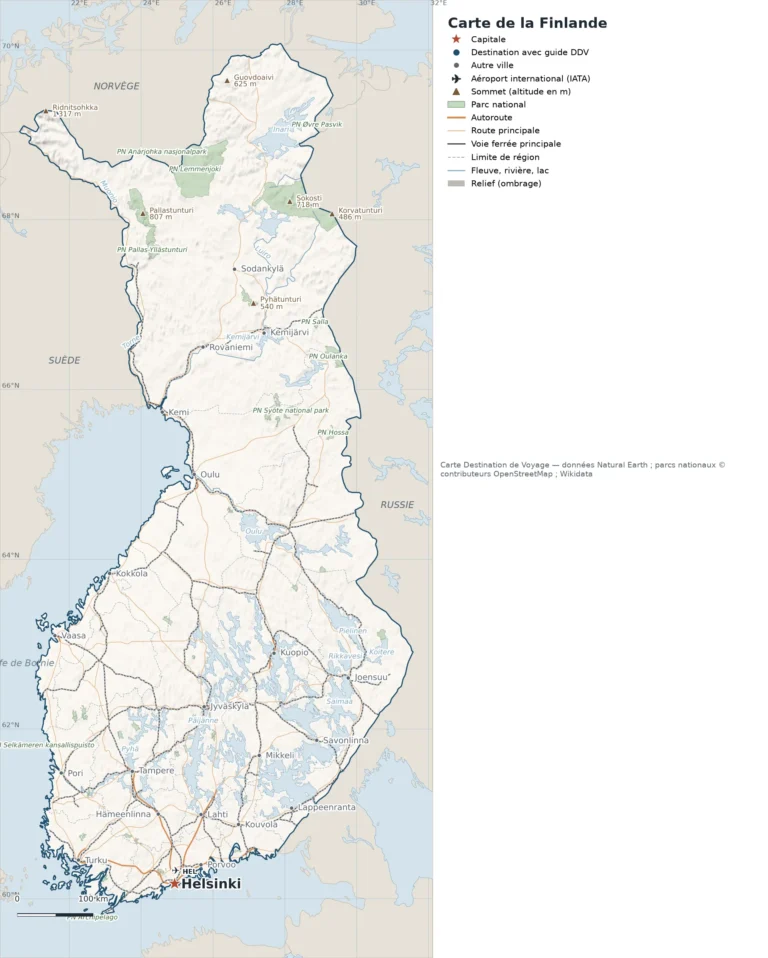
Finnish Lapland covers the whole north of Finland, beyond the Arctic Circle: conifer forests, rounded fells (tunturi), lakes and widely spaced villages. Most people come in winter for the snow, dog sledding, snowmobiling and the northern lights, but summer brings hiking under the midnight sun. This Lapland travel guide helps you choose your base (Rovaniemi, Levi, Saariselkä or Inari), decide what to do and set the length of your stay. Rovaniemi, Levi, Saariselkä and Inari are marked on our map of Finland.

Our travel deals for Lapland
Affiliate links: we earn a commission, at no extra cost to you.
 FlightsKiwi.comCompare flights and airline combinations to Lapland.Compare flights
- Tickets and toursTiqetsEntry tickets and guided tours to book online; compare with the official price.See tickets


Finnish Lapland at a glance
- Airports Rovaniemi, Kittilä (for Levi), Ivalo (for Saariselkä and Inari), Kuusamo, Kemi-Tornio
- Getting there flights from Helsinki, plus some seasonal winter routes (check with the airports); night train Helsinki – Rovaniemi
- Ideal length 4 to 7 days
- Best time December to March for winter (late February-March first), July to mid-September for hiking
- Time zone UTC+2 (UTC+3 in summer): 2 hours ahead of London
- Entry Schengen area: UK citizens need no visa for up to 90 days in any 180-day period; US citizens need a passport valid at least 3 months beyond their stay (travel.state.gov, GOV.UK)
- Budget high in winter, mainly because of guided activities and Christmas accommodation
What to see in Finnish Lapland: the highlights
Rovaniemi, capital of Lapland
Rovaniemi is the regional capital and main gateway, with an airport and a rail link to Helsinki. Destroyed during the Second World War, the town was rebuilt to a plan by the architect Alvar Aalto. It has no old-world charm, but it concentrates the tourist offer: hotels, restaurants, activity operators and museums. The center lies on the Kemijoki river, which freezes in winter.
- Arktikum: a museum and science center devoted to the Arctic, life in the far north and the history of Lapland
- Pilke: an information center on the northern forests, next to the Arktikum
- Jätkänkynttilä bridge: the town’s landmark bridge, lit up at night
- Ounasvaara hill: ski slopes, trails and views over the town, a few kilometers from the center
Santa Claus Village and the Arctic Circle
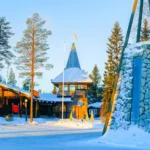
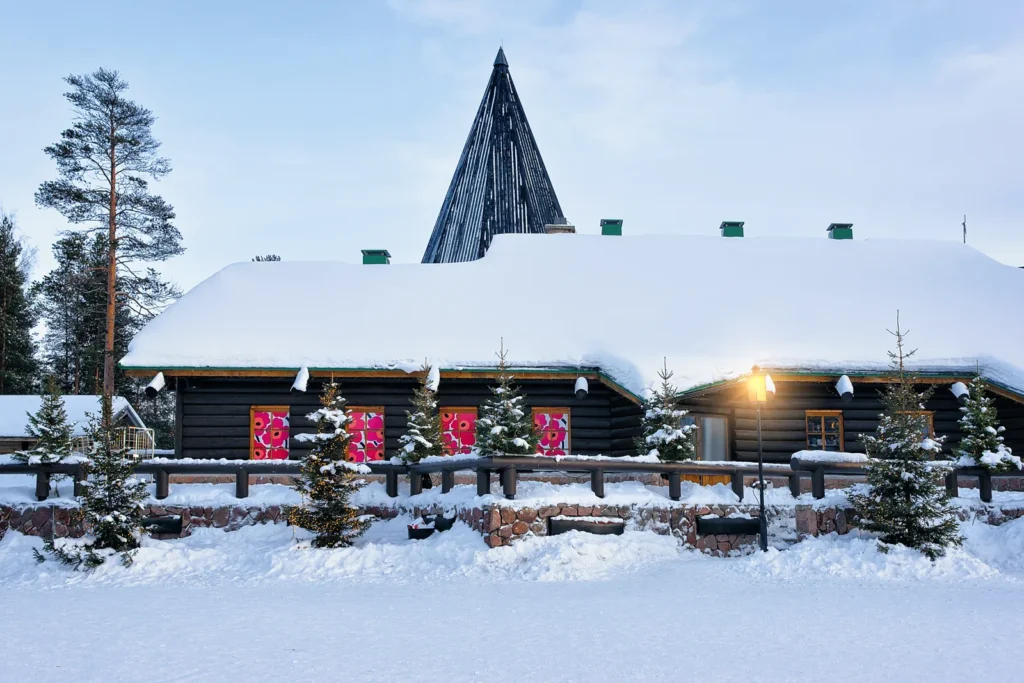
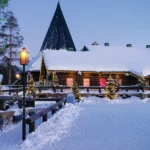
About 8 km (5 mi) north of central Rovaniemi, near the airport, Santa Claus Village sits on the Arctic Circle, marked on the ground. Here you will find the office where Santa receives visitors, Santa’s post office, which sends postmarked cards, shops and restaurants. According to Visit Rovaniemi and the village’s official site (checked 26 October 2026), the village is open every day of the year and entry is free, as is meeting Santa; photos, videos and activities are paid extras. It is busiest in December. A city bus links it to the town center.
Levi and Ylläs
In the municipality of Kittilä, about 15 km (9 mi) from the airport, Levi is Finland’s largest ski resort, with a pedestrian village, many cabins and nightlife. Further southwest, Ylläs is more spread out and quieter, known for its cross-country ski trails. Both resorts border Pallas-Yllästunturi National Park, popular for hiking in summer and cross-country skiing in winter.
Saariselkä and Urho Kekkonen National Park
Saariselkä is a holiday village about 30 km (19 mi) south of Ivalo airport, at the foot of rounded fells. It gives access to Urho Kekkonen National Park, one of the largest in Finland, crossed by cross-country ski trails in winter and hiking paths in summer. The village and its surroundings have several places to stay with glass-roofed rooms or igloos for watching the aurora from bed. Skies are dark and winter precipitation low, making it a good base for the northern lights.
Inari and Sámi culture
On the shore of Lake Inari, the largest lake in Lapland, the village of Inari is the cultural center of the Sámi, the only Indigenous people of the European Union. The Siida museum presents their culture and the nature of the far north, and the Sajos cultural center houses the Sámi Parliament of Finland. In summer, boats cruise the lake; in winter it freezes and is crossed by snowmobile or sled with a guide.
National parks and nature
Lapland has several national parks with marked trails, open wilderness huts and fire sites. The best known are Pallas-Yllästunturi, between Levi and Ylläs, Urho Kekkonen, near Saariselkä, and Oulanka, near Ruka and Kuusamo in the southeast of the region, known for its rapids and suspension bridges. Access to nature is open in Finland, within a few simple rules: do not disturb the reindeer, light fires only at designated sites and leave nothing behind.
Kemi and the Gulf of Bothnia coast
In southwestern Lapland, on the coast, Kemi is known for winter icebreaker cruises on the frozen sea and for its snow castle, rebuilt every winter. These activities depend on ice conditions and change from season to season: check opening dates before planning.
Things to do in Lapland: activities
Chasing the northern lights
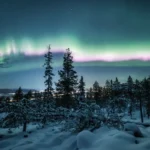
From late August to early April, it is often enough to get away from the lights on a clear night. Operators run trips by minibus, on foot, on snowshoes or by snowmobile to open spots. None is guaranteed: stay several nights to improve your chances. The best periods are detailed in our article on when to go to Lapland.
Husky sledding
Husky farms offer outings from a few kilometers to several days. In the most common formats, you sit in the sled or drive it yourself, two per team, after a short briefing. Before booking, ask about group size, actual time on the sled and how the dogs are kept.
Reindeer
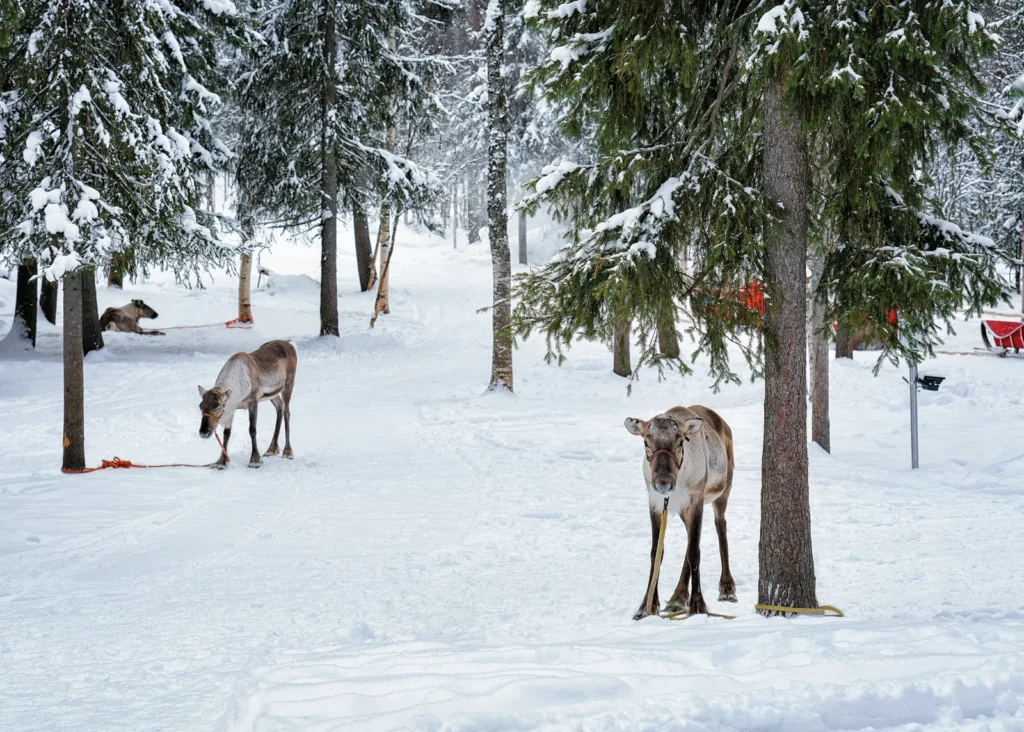
All reindeer in Lapland belong to herders. Farms offer visits and reindeer-drawn sleigh rides, slower and calmer than husky trips. On the road, slow down: reindeer often cross, day and night.
Snowmobiling
Snowmobile safaris cover long distances on marked trails and frozen lakes. Check the operator’s driver requirements when booking; passengers sit at the back. Keep to the speed and follow your guide’s instructions.
Skiing, snowshoeing and sauna
Levi, Ylläs, Saariselkä, Pyhä and Ruka offer downhill skiing on modest slopes, but above all hundreds of kilometers of cross-country trails, often lit. Snowshoes let you head into the forest with no experience. At the end of the day, the sauna is part of daily life in Finland: most hotels and cabins have one.
What to eat in Lapland
The best-known dish is poronkäristys, thinly sliced sautéed reindeer, served with mashed potatoes and lingonberries, often with pickles. Also try leipäjuusto, a grilled fresh cheese traditional in Lapland and Ostrobothnia, sometimes served with berry jam. Lake and river fish and wild berries complete restaurant menus.
Itinerary: 4 to 7 days in Lapland
4 days: Rovaniemi
- Day 1: arrival, town center, Arktikum, Jätkänkynttilä bridge lit up in the evening
- Day 2: Santa Claus Village and the Arctic Circle in the morning, a reindeer farm in the afternoon
- Day 3: husky or snowmobile safari, northern lights trip in the evening
- Day 4: snowshoeing or cross-country skiing on Ounasvaara hill, then departure
7 days: Rovaniemi and the north
- Days 1 to 3: Rovaniemi (the plan above, shortened)
- Day 4: road or bus to Saariselkä (about 3 h 30 to 4 h)
- Days 5 and 6: Saariselkä and Urho Kekkonen National Park, sledding, snowshoeing, aurora; trip to Inari and the Siida museum
- Day 7: departure from Ivalo airport
Ski variant: Levi
- Arrive at Kittilä, 4 to 5 days in Levi for downhill and cross-country skiing, a husky trip and an aurora trip, with a day in Ylläs or Pallas-Yllästunturi National Park
Distances are long and winter roads call for caution: two well-chosen bases beat daily moves.
Where to stay in Lapland
| Base | Best for | Good to know |
|---|---|---|
| Rovaniemi (center) | Short stay, mid-range budget, no car | Hotels, easy access to the airport, activities and Santa Claus Village |
| Rovaniemi (around Santa Claus Village) | Families at Christmas | Cabins and glass huts, very expensive in December |
| Levi | Skiers, lively stay | Full-service resort, cabins to rent |
| Saariselkä | Aurora, nature, peace and quiet | Igloos and glass-roofed rooms, small village |
| Inari | Sámi culture, the lake | Few places to stay, book early |
| Ylläs, Pyhä, Ruka | Cross-country skiing, hiking | Quieter than Levi |
The most sought-after places to stay are glass igloos and glass huts, designed for watching the sky from bed: they are expensive and booked very early for winter. Wooden cabins with a sauna suit families and groups. Check whether your accommodation lends or rents cold-weather clothing if you have none.
Getting around Lapland
- Plane: the fastest option from Helsinki to Rovaniemi, Kittilä, Ivalo or Kuusamo. Bus transfers usually link the airports to the resorts.
- Train: trains, including a night train, link Helsinki to Rovaniemi; another line serves Kolari, handy for Ylläs and Levi. There is no railway north of Rovaniemi.
- Bus: long-distance buses link Rovaniemi to Levi, Saariselkä, Ivalo and Inari. Services are infrequent: check schedules.
- Rental car: convenient for freedom, but driving on snow and ice, mostly in the dark in winter, takes experience. According to the State Department (travel.state.gov), vehicles must have snow tires from December through February and daylight hours are very short; GOV.UK notes that UK travellers can drive with a UK licence, though rental companies may have stricter requirements. Reindeer on the road are a real hazard.
- Activities: most operators pick clients up at their hotel, so you can stay without a car in Rovaniemi, Levi or Saariselkä.
When to go to Lapland
✅ Best months: January, February, March, August, September, December
❌ Period to avoid: may
For winter, aim for December to March, ideally late February to late March: deep snow, longer days and more bearable cold (-1.9 °C, or 29 °F, in the afternoon in March in Rovaniemi, against -7.3 °C, or 19 °F, in January, according to the FMI). December is Christmas month, but also the polar night and the highest prices. The aurora can be seen from late August to early April. Summer (July to mid-September) suits hiking. All the details are in our article on when to go to Lapland.
Budget for a trip to Lapland
Lapland is an expensive winter destination, mainly because of guided activities. Rough amounts per person per day, excluding flights:
| Item | Tight budget | Comfort |
|---|---|---|
| Accommodation (shared double room) | roughly €50 to 90 | roughly €150 to 400 (glass igloo, glass hut) |
| Meals | roughly €30 to 45 | roughly €60 to 100 |
| Local transport | roughly €10 to 20 | roughly €30 to 70 (car, transfers) |
| Activities (daily average) | roughly €30 to 80 | roughly €120 to 250 |
| Total per day | roughly €120 to 235 | roughly €360 to 820 |
To keep costs down: go in March or September rather than December, stay in Rovaniemi rather than in an igloo, pick one or two headline activities and enjoy the free ones (snowshoeing, cross-country skiing, aurora by a lake), and shop at the supermarket.
Entry requirements, health and safety
- US citizens: Finland is in the Schengen area; your passport should be valid for at least three months beyond your stay, and you need proof of sufficient funds and a return ticket (U.S. Department of State, travel.state.gov, last updated May 14, 2026).
- UK citizens: no visa for up to 90 days in any 180-day period as a tourist; your passport must have been issued less than 10 years before you arrive and be valid at least 3 months after you leave the Schengen area. The EU Entry/Exit System (EES) is being implemented: fingerprints and a photo may be taken at your first entry (GOV.UK, updated 11 August 2026).
- Russian border: the UK FCDO advises against all travel to Russia, and all land border crossings between Finland and Russia remain closed until further notice; areas close to the border require a permit from the Finnish Border Guard (GOV.UK).
- Arctic safety: parts of Finland are in the Arctic Circle, with very remote areas where emergency medical assistance and search and rescue are limited (GOV.UK). Check the weather before any outing, avoid hiking alone and leave your route with someone. Emergencies: 112.
- Insurance: take out travel insurance covering medical costs and rescue; UK travellers also need a GHIC or EHIC for state healthcare (GOV.UK).
Practical tips for Lapland
- Dressing for the cold: layer a thermal base (wool or synthetic), an insulating layer and a windproof shell. A hat, mittens and insulated boots with wool socks are essential. Operators often lend a thermal overall during activities.
- Gear: phone and camera batteries drain fast in the cold: keep them in an inside pocket and bring a spare.
- Coverage: the mobile signal is weak or absent far from the villages.
- Respect: reindeer have owners, and Sámi culture is not a backdrop: ask before photographing people and avoid Sámi costumes worn as fancy dress.
- Sauna: go in naked or in swimwear depending on the venue, after a shower; public saunas are usually separated by sex.
Lapland: who is it for?
Our view by traveler profile, based on the information in this guide (places, budget, seasons).
| Profile | Our view | Why |
|---|---|---|
| Couples | Very well suited | Glass igloos and glass huts, aurora, sauna. |
| Families | Very well suited | Santa Claus Village, reindeer, husky sledding; December is the most expensive time. |
| Tight budget | With reservations | Roughly €120 to 235 per person per day; go in March or September and stay in Rovaniemi. |
| Adventure and nature | Very well suited | Huskies, snowmobiles, snowshoes, hiking in the national parks in summer. |
| Culture | Suited | Sámi culture in Inari and at the Siida museum, the Arktikum in Rovaniemi. |
| Skiing | Suited | Levi, Ylläs, Saariselkä: modest slopes but a great many cross-country trails. |
Frequently asked questions
How many days do you need in Lapland?
Four days let you see Rovaniemi and Santa Claus Village and do two activities. With 6 to 7 days, you can add a second base further north, such as Saariselkä or Levi, and spend more nights looking for the aurora.
Rovaniemi, Levi or Saariselkä: where should you stay?
Rovaniemi is the most practical for a short first trip and for Santa. Levi suits skiers and those who want a lively resort. Saariselkä is quieter and further north, with very dark skies, good for the aurora.
Can you see the northern lights in Rovaniemi?
Yes, from late August to early April, under clear skies. You need to get a few kilometers away from the town lights, on foot along the river or on an organized trip. Several nights on site greatly improve your chances.
Do you need a car in Lapland?
It is not essential: activity operators pick clients up at their hotel, and buses link airports and resorts. A car gives more freedom, but driving on snow and ice takes experience.
Is Santa Claus Village free?
Yes: according to its official site and Visit Rovaniemi, entry to the village and meeting Santa are free, every day of the year. Souvenir photos and activities (reindeer, huskies, snowmobiles) are paid extras.
What can you do in Lapland in winter?
Watch the northern lights, take a husky or reindeer sled ride, a snowmobile safari, go cross-country skiing or snowshoeing, visit Santa Claus Village in Rovaniemi and the Siida museum in Inari, then end the day in the sauna.
What currency and documents do you need for Finnish Lapland?
Finnish Lapland is part of Finland: you pay in euros and cards are accepted almost everywhere. US and UK citizens need a passport; Finland is in the Schengen area (see travel.state.gov and GOV.UK for validity rules).
Further reading: to pick your dates, read when to go to Lapland and our Finland travel guide. For the aurora on the Norwegian side, see our Tromsø guide; neighboring Sweden has its own Lapland too.
Our sources
- Entry requirements, health, safety and driving checked on 26 October 2026: U.S. Department of State, Finland country information (last updated May 14, 2026) and UK FCDO, GOV.UK foreign travel advice for Finland (updated 11 August 2026).
- Climate normals: 1991-2020 normals from the Finnish Meteorological Institute (FMI): Rovaniemi (airport), Sodankylä (Tähtelä), Ivalo (airport), Kittilä (Pokka)
- Visit Rovaniemi, Santa Claus Village and Santa Claus Village official site, checked 26 October 2026
- Wikipedia (« Sautéed reindeer » and « Bread cheese » articles), checked 5 October 2026
- Our methodology
Updated October 2026.
To combine Lapland with Helsinki or the Lakeland region, see our Finland travel guide. The far north also continues into Sweden and Norway.