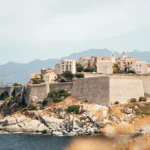
Things to do in Calvi include walking round the Genoese citadel and its ramparts, swimming off the long beach lined with pines, climbing to Notre-Dame de la Serra for the view, taking a boat to the Scandola nature reserve and riding the little Balagne train to L’Île-Rousse. Allow 2 to 4 days to visit Calvi; the best months are June and September, when the sea is warm and the summer crowds thinner. To compare with the island’s other big beach base, in the south, our Porto-Vecchio guide covers beaches, Bavella and budget.
Calvi sits at the head of a bay on the north-west coast of Corsica, in Haute-Corse, at the foot of the Balagne mountains. Its citadel, built by the Genoese on a rocky promontory, overlooks the harbour and a sandy beach lined with pines. The town is also a good base for the hilltop villages of Balagne, the Revellata peninsula and boat trips to Scandola and Girolata. This guide covers the sights, the beaches, 1- to 4-day itineraries, where to stay and the month-by-month climate according to Météo-France. For the whole island, see our Corsica travel guide.

Our travel deals for Calvi
Affiliate links: we earn a commission, at no extra cost to you.
 FlightsKiwi.comCompare flights and airline combinations to Calvi.Compare flights

Calvi at a glance
- Location north-west coast of Corsica, in BalagneAbout 25 km (16 mi) from L’Île-Rousse
- Airport Calvi-Sainte-Catherine, a few kilometres from the centre · details
- Train the Chemins de fer de la Corse link Calvi with L’Île-RousseAnd, via Ponte-Leccia, with Bastia, Corte and Ajaccio
- Ideal length 2 days for the town and the beach4 days with Balagne and Scandola
- Best time June and September; May and October for walking
- Entry Schengen rules: US and UK citizens visa-free up to 90 days · details
- Currency euro · currencies
- Electricity 220 V, 50 Hz, type E sockets; US plugs need an adapter (france.fr, checked 26 October 2026)
Things to do in Calvi: the highlights
Calvi citadel
Enclosed by Genoese ramparts, the citadel is Calvi’s main sight. You enter through a fortified gate, then follow the lanes to the cathedral of Saint-Jean-Baptiste and the Genoese governors’ palace. The wall walk looks over the bay, the harbour and the mountains, especially at the end of the day. A plaque recalls the local tradition that Christopher Columbus was born in Calvi, a claim historians do not accept. Allow one to two hours, avoiding the hottest hours in summer.
Quai Landry and the lower town
At the foot of the citadel, Quai Landry runs along the marina with its terraces and restaurants. The lower town, around Boulevard Wilson and the church of Sainte-Marie-Majeure, has the shops and the covered market. The Oratoire Saint-Antoine, a small confraternity chapel, is another example of the town’s religious heritage. This is the liveliest area in the evening.
Calvi beach and the pine forest
Just east of the harbour, Calvi beach stretches for several kilometres along a pine forest. The sand is fine, the water shallow near the shore, and the shade of the pines is welcome in summer. The further you go from the centre, the quieter the beach. Further on, towards L’Île-Rousse, the beaches of Sainte-Restitude, Algajola and Aregno offer other options.
Notre-Dame de la Serra
South-west of the town, the chapel of Notre-Dame de la Serra stands on a granite hill. The viewpoint is one of the best over Calvi, its citadel and the bay. You can drive up a small road or walk up from town.
The Revellata peninsula
West of Calvi, the Pointe de la Revellata juts out to sea as far as its lighthouse. Trails cross the maquis to coves with clear water. The ground is stony and without shade: take water and suitable shoes, and set off early in summer.
Scandola, Girolata and the Gulf of Porto by boat
Boat trips leave Calvi harbour for the Scandola nature reserve, red volcanic cliffs accessible only by sea, and the hamlet of Girolata, which no road reaches. Some trips go as far as the Calanques de Piana. The Gulf of Porto as a whole, with Scandola and Piana, is a UNESCO World Heritage site. The trip usually takes most of the day and depends on sea conditions.
The villages of Balagne
Inland, Balagne strings together hilltop villages among olive groves: Calenzana, the starting point of the GR20, Lumio, Sant’Antonino, Pigna, known for its craftspeople and music, and Aregno with its small Romanesque church. A loop road lets you visit several in a day; the roads are narrow and parking in the villages is limited.
L’Île-Rousse and the Balagne train
The Chemins de fer de la Corse line runs along the coast between Calvi and L’Île-Rousse, stopping at many beaches. The ride is slow but scenic, and saves you looking for a parking space. In L’Île-Rousse, see Place Paoli, the covered market and the Pietra peninsula with its lighthouse.
The Fango valley and the Agriates desert
To the south, the road to Galéria leads to the Fango valley, whose river forms pools for swimming in summer. To the east, the Agriates desert is a vast expanse of maquis without villages, edged by beaches reached by boat from Saint-Florent, by dirt track or on foot: plan it as a full-day trip.
How many days in Calvi? Itineraries
Calvi in 1 day
- Morning: the citadel, the cathedral and the wall walk
- Lunch: Quai Landry
- Afternoon: the pine-forest beach
- Late afternoon: Notre-Dame de la Serra for the sunset
Calvi in 2 days
- Day 1: as above
- Day 2: boat trip to Scandola and Girolata
Calvi in 4 days
- Days 1 and 2: as above
- Day 3: a loop through the Balagne villages (Calenzana, Lumio, Sant’Antonino, Pigna)
- Day 4: the train to L’Île-Rousse and the coastal beaches, or the Revellata peninsula in the morning and the Fango valley in the afternoon
To continue to Cap Corse, Corte or the south, our Corsica guide details one- and two-week itineraries; our road trip tips help you plan the stages.
When to go to Calvi: climate month by month
The best months are June and September. Calvi has a Mediterranean climate: hot, very dry summers, mild winters, and rain concentrated in autumn. According to Météo-France, the average high reaches 30.2 °C (86 °F) in July and August, and less than 8 mm (0.3 in) of rain falls in July. November is by far the wettest month.
| Month | High °C (°F) | Low °C (°F) | Rain mm (in) | Crowds | Prices | Verdict |
|---|---|---|---|---|---|---|
| January | 14.0 (57) | 5.0 (41) | 50.3 (2.0) | Very low | Low | ❌ Off season, cool nights |
| February | 14.2 (58) | 4.7 (40) | 53.5 (2.1) | Very low | Low | ❌ Quiet, cold sea |
| March | 16.4 (62) | 6.6 (44) | 58.9 (2.3) | Low | Low | ⚠️ Changeable weather, snow on the peaks |
| April | 19.1 (66) | 8.9 (48) | 55.8 (2.2) | Medium (Easter) | Medium | ⚠️ Mild for walking, sea still cold |
| May | 23.1 (74) | 12.5 (54) | 40.8 (1.6) | Medium | Medium | ✅ Ideal for Balagne and hiking |
| June | 27.2 (81) | 16.4 (62) | 32.2 (1.3) | High | High | ✅ Swimming, long days |
| July | 30.2 (86) | 19.0 (66) | 7.6 (0.3) | Very high | Very high | ⚠️ Hot, dry, festivals, crowds |
| August | 30.2 (86) | 19.2 (67) | 23.3 (0.9) | Very high | Very high | ⚠️ The busiest and most expensive |
| September | 26.4 (80) | 16.2 (61) | 59.1 (2.3) | High, then medium | High, then medium | ✅ Warm sea, fewer crowds |
| October | 22.4 (72) | 13.0 (55) | 79.2 (3.1) | Low | Medium to low | ⚠️ Mild, rain returns |
| November | 17.8 (64) | 9.3 (49) | 115.4 (4.5) | Very low | Low | ❌ The wettest month |
| December | 14.9 (59) | 6.2 (43) | 76.7 (3.0) | Very low | Low | ❌ Mild but damp, season closed |
- Spring (April-May): the maquis is in flower and temperatures are ideal for the Revellata and the villages; the sea stays cool before June.
- Summer (June-August): warm sea and near-guaranteed sun. July and August bring most of the visitors, the festivals and the highest prices; the wildfire risk is high.
- Autumn (September-October): September is still summery with fewer people; October is still mild but wetter, and boat trips run less often.
- Winter (November-March): mild on the coast, but many hotels and restaurants close, and there are fewer connections.
To compare with Ajaccio, Bastia and the interior, see our page on when to go to Corsica. More seasonal ideas: where to go in June and where to go in September.
Calvi hosts several festivals, notably of music and polyphonic singing; their dates change from year to year, so check with the tourist office before booking, as accommodation fills up quickly at those times.
Where to stay in Calvi
| Area | Best for | Strengths |
|---|---|---|
| Lower town and harbour | Without a car, first visit | Restaurants, station, citadel on foot; lively in the evening |
| Along the pine forest | Beach stay | Direct beach access, hotels and holiday residences |
| Revellata and Notre-Dame de la Serra road | Peace and views | Views over the bay; a car is useful |
| Balagne villages (Lumio, Calenzana) | A quieter stay | Often lower prices, village atmosphere |
Getting to and around Calvi
- By air: Calvi-Sainte-Catherine airport has flights to mainland France, with more routes in season; Corsica’s other airports are Bastia, Ajaccio and Figari.
- By ferry: Calvi and L’Île-Rousse have ports with links to the mainland, with a service that varies by season; check timetables with the ferry companies.
- By train: the Balagne line links Calvi with L’Île-Rousse and then Ponte-Leccia, for connections to Bastia, Corte and Ajaccio.
- By car: useful for the Balagne villages, the Fango valley and the more distant beaches. US and UK licence holders should read the driving sections of travel.state.gov and GOV.UK.
- On foot: the citadel, the harbour, the lower town and the beach can all be explored without a car.
Entry requirements, health and safety
- US citizens: France is in the Schengen area, which you may enter for up to 90 days for tourism or business without a visa. Immigration officers may ask for proof of sufficient funds and a return ticket, and France does not recognise the 12-page US emergency passport for visa-free entry (U.S. Department of State, travel.state.gov, last updated August 11, 2025).
- UK citizens: no visa for up to 90 days in any 180-day period as a tourist. Your passport must have been issued less than 10 years before the day you arrive and be valid at least 3 months after the day you plan to leave the Schengen area. The EU Entry/Exit System (EES) may require fingerprints and a photo at your first entry (UK FCDO, GOV.UK, updated 22 October 2026).
- ID: you must be able to prove your identity when asked by the police, or within 4 hours at a police station (GOV.UK, updated 22 October 2026).
- Health and emergencies: UK travellers need a GHIC or a valid EHIC for medically necessary state healthcare, which is not a substitute for travel insurance; the European emergency number is 112 (GOV.UK).
- Wildfires: the risk is highest in the south, particularly along the Mediterranean coast and in Corsica, in hot, dry weather; causing one, even by accident, is illegal. Call 18 (fire) or 112 (GOV.UK, updated 22 October 2026).
Practical tips for Calvi
- Heat: visit the citadel and the Revellata early in the morning or late in the day in summer.
- Wildfires: respect fire bans and any trail closures.
- Boat trips: they may be cancelled in windy weather; keep a back-up date.
- Packing: see our packing list.
Frequently asked questions
What to do in Calvi in 2 days?
On day one, the citadel, Quai Landry, the beach and Notre-Dame de la Serra at sunset; on day two, a boat trip to Scandola and Girolata.
What is there to do around Calvi?
The Balagne villages (Calenzana, Lumio, Sant’Antonino, Pigna), L’Île-Rousse by train, the Revellata peninsula, the Fango valley and, by boat, Scandola and Girolata.
When is the best time to go to Calvi?
June and September: 26 to 27 °C (79 to 81 °F) in the afternoon, a warm sea and fewer people than in July-August, according to Météo-France’s 1991-2020 normals for Calvi.
Can you visit Calvi without a car?
Yes for the town, the beach and the boat trips, and the train takes you to L’Île-Rousse and the coastal beaches. A car is still useful for the Balagne villages.
How do you get to Calvi?
By air to Calvi-Sainte-Catherine airport, by ferry to Calvi or L’Île-Rousse, or by train from elsewhere in Corsica via Ponte-Leccia. Timetables and frequencies vary by season.
What is the best beach in Calvi?
The pine-forest beach, below the town, is the most convenient. Further north-east, Sainte-Restitude and Algajola are quieter, and the coves of the Revellata appeal to snorkellers.
Our sources
- Météo-France: climate data sheet, 1991-2020 statistics, Calvi station (altitude 57 m, 187 ft)
- Train: Wikipedia, « Chemins de fer de la Corse » article (Ponte-Leccia to Calvi line), consulted in October 2026
- Entry requirements, health and safety checked on 26 October 2026: U.S. Department of State, France country information (last updated August 11, 2025) and UK FCDO, GOV.UK foreign travel advice for France (updated 22 October 2026)
- France tourism board (france.fr), electricity requirements, checked 26 October 2026
- Our methodology
Updated October 2026.
To go further, see our Corsica travel guide, our France travel guide and our French Riviera page, across the Mediterranean.