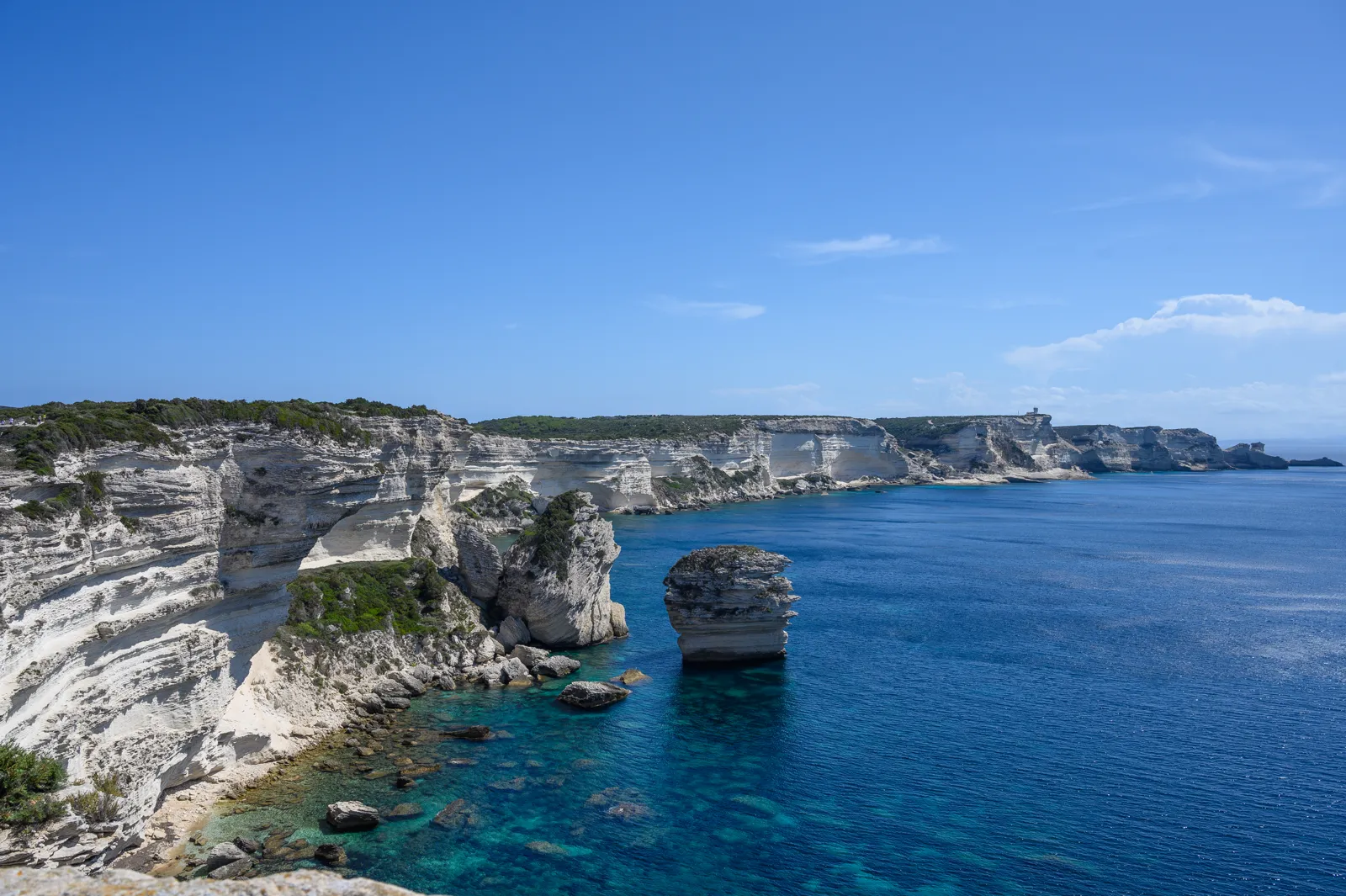
The best time to visit Corsica is June and September: it is 25 to 27 °C (77 to 81 °F) in the afternoon on the coast, there is very little rain, the sea is warm enough for swimming and the summer crowds have not yet arrived, or have already left. May and early October suit hiking and sightseeing well, if you accept a cooler sea and a few showers.
Corsica has a Mediterranean climate along the coast: hot, very dry summers, mild winters and rain concentrated in autumn. But the island is also a mountain in the sea: Monte Cinto rises above 2,700 m (8,858 ft), and the interior is much cooler, with snow on the summits in winter. The choice of period therefore depends as much on your plans (beach, hiking, villages, road trip) as on the weather. The other major factor is crowds: July and August concentrate most of the visitors, which pushes up the price of ferry crossings, rentals and hotels. Here is how to choose, based on the official normals of Météo-France.

Our travel deals for Corsica
Affiliate links: we earn a commission, at no extra cost to you.
 FlightsKiwi.comCompare flights and airline combinations to Corsica.Compare flights

When to go to Corsica at a glance
- Best months June and September; May and early October for hiking and sightseeing
- For the beach June to September
- Hottest month August, with an average high of 29 to 30 °C (84 to 86 °F) in Ajaccio, Bastia and Calvi
- Driest month July, with less than 15 mm (0.6 in) of rain on the coast
- Wettest months October and November (up to 134 mm (5.3 in) in Bastia in November)
- High season mid-July to late August, with a peak around August 15
- Cheapest period November to March, but many seaside hotels and restaurants are closed then
When to go to Corsica by priority
- Best weather: June and September; July is the driest month (9 mm (0.4 in) in Ajaccio)
- Cheapest: November to March, but many seaside businesses are closed; May and late September–October offer a better compromise
- Fewest crowds: May, June and the second half of September
- Events: Madonuccia on March 18 in Ajaccio, Holy Week processions including the Catenacciu in Sartène, August 15 celebrations in Ajaccio
Corsica: the calendar at a glance
🔎 Month by month: Corsica in April
✅ Best months: may, June, September, October
❌ Period to avoid: November
Climate in Corsica month by month
The table below uses the normals for the Ajaccio airport station, on the edge of the gulf on the west coast. They are representative of the coastline; Bastia and Calvi are compared further down. In the mountains, temperatures are much lower and summer thunderstorms are more frequent.
| Month | Avg. max | Avg. min | Rain | Crowds | Prices | Verdict |
|---|---|---|---|---|---|---|
| January | 14.0 °C (57 °F) | 4.7 °C (40 °F) | 54 mm (2.1 in) | Very low | Low | ⚠️ Mild by day, cool at night, many businesses closed |
| February | 14.2 °C (58 °F) | 4.3 °C (40 °F) | 48 mm (1.9 in) | Very low | Low | ⚠️ Quiet, snow in the mountains, cold sea |
| March | 16.0 °C (61 °F) | 5.9 °C (43 °F) | 50 mm (2.0 in) | Low | Low | ⚠️ Early spring, changeable weather |
| April | 18.5 °C (65 °F) | 8.4 °C (47 °F) | 53 mm (2.1 in) | Moderate (Easter) | Moderate | ⚠️ Maquis in bloom, sea still cold |
| May | 22.1 °C (72 °F) | 11.8 °C (53 °F) | 50 mm (2.0 in) | Moderate | Moderate | ✅ Ideal for coastal hiking and villages |
| June | 25.9 °C (79 °F) | 15.4 °C (60 °F) | 26 mm (1.0 in) | High | High | ✅ One of the best months, swimming possible |
| July | 28.6 °C (83 °F) | 17.7 °C (64 °F) | 9 mm (0.4 in) | Very high | Very high | ⚠️ Hot, dry, crowded beaches from mid-July |
| August | 29.2 °C (85 °F) | 18.1 °C (65 °F) | 16 mm (0.6 in) | Very high | Very high | ⚠️ Hottest, most expensive, busiest |
| September | 26.1 °C (79 °F) | 15.4 °C (60 °F) | 58 mm (2.3 in) | High, then moderate | High, then moderate | ✅ Warm sea, crowds thinning |
| October | 22.8 °C (73 °F) | 12.6 °C (55 °F) | 86 mm (3.4 in) | Low | Moderate → low | ✅ Mild early in the month, rains return |
| November | 18.3 °C (65 °F) | 9.0 °C (48 °F) | 112 mm (4.4 in) | Very low | Low | ❌ The wettest month |
| December | 15.1 °C (59 °F) | 5.8 °C (42 °F) | 74 mm (2.9 in) | Very low (holidays) | Low | ⚠️ Mild but damp, tourist season over |
Note: according to the same normals, Ajaccio averages barely more than one day of rain (at least 1 mm (0.04 in)) in July and August, compared with about 9 in November. Sunshine rises from about 125 hours per month in December to more than 370 hours in July.
Sea temperature in Corsica: when to swim?
The sea warms up slowly: about 16 °C (61 °F) in May, 20 °C (68 °F) in June, then 23 to 24 °C (73 to 75 °F) in July–August, its peak. It is still 22.5 °C (73 °F) in September and 20.5 °C (69 °F) in October, which makes the shoulder season a very good time for swimming. From January to April it stays around 13 to 14.5 °C (55 to 58 °F).
| Month | Sea | Sunshine (hours/day) |
|---|---|---|
| January | 13.8 °C (57 °F) | 4.3 |
| February | 13.4 °C (56 °F) | 5.0 |
| March | 13.6 °C (56 °F) | 6.1 |
| April | 14.5 °C (58 °F) | 7.5 |
| May | 16.4 °C (62 °F) | 9.1 |
| June | 20.1 °C (68 °F) | 10.7 |
| July | 22.7 °C (73 °F) | 11.8 |
| August | 23.8 °C (75 °F) | 10.7 |
| September | 22.5 °C (73 °F) | 8.8 |
| October | 20.5 °C (69 °F) | 6.8 |
| November | 17.7 °C (64 °F) | 5.0 |
| December | 15.4 °C (60 °F) | 4.1 |
The seasons in Corsica: pros and cons
Spring (April to May): the maquis in bloom
April is still mild (18.5 °C (65 °F) in the afternoon in Ajaccio) and May is already pleasant (22 °C (72 °F)), with nights still cool. The maquis is in bloom and the countryside is green. The sea stays cold for most swimmers before June. In the mountains, snow can linger on the high peaks in spring. This flowering maquis and the still-cold sea are covered in our page on the weather in Corsica in April, town by town.
- Pros: ideal temperatures for walking, quiet roads, prices still moderate outside Easter
- Cons: cold sea, some hotels and restaurants open only at Easter or in May, high mountains not yet accessible
- Our tip: May for coastal trails, the villages of Balagne and Cap Corse, and visits to Ajaccio, Bonifacio or Corte
Summer (June to August): beach season
It hardly rains any more (less than 30 mm (1.2 in) a month from June to August in Ajaccio) and highs exceed 28 °C (82 °F) in July–August. It is also the high-mountain hiking season, when the mountain huts are staffed. But from mid-July to late August the island receives most of its visitors: ferries full, busy roads, beach car parks saturated and prices at their peak.
- Pros: guaranteed sunshine, warm sea, long evenings, the whole tourist offer is open
- Cons: crowds and high prices in July–August, heat inland, high wildfire risk, possible afternoon thunderstorms in the mountains
- Our tip: June and the last week of August offer summer with slightly fewer people
Autumn (September to October): the shoulder season
September extends the summer: 26 °C (79 °F) in the afternoon, a sea that is still warm and crowds that drop markedly once the summer holiday period ends. The first rains return in the second half of the month, sometimes as violent thunderstorms. October stays mild (nearly 23 °C (73 °F)), but it is one of the wettest months, and the tourist offer begins to close at the end of the month.
- Pros: warm sea in September, falling prices, soft light, good hiking conditions
- Cons: stormy spells, shorter days, gradual closures from late October
- Our tip: the first half of September is the best compromise between beach and calm
Winter (November to March): Corsica without the crowds
Winter is mild on the coast (14 to 15 °C (57 to 59 °F) in the afternoon in December–January) but November is the wettest month. The mountains are snow-covered. Many hotels, campsites and seaside restaurants close, and sea and air connections are less frequent. The towns (Ajaccio, Bastia, Corte) remain lively.
- Pros: low prices, no crowds, lively towns, snowy mountain landscapes
- Cons: no swimming, reduced tourist offer, mountain roads sometimes difficult
- Who is it for? A cultural stay in the towns, coastal hiking in fine weather, small budgets
When to go to Corsica by region
Temperature differences are small between the large coastal towns; the difference is mostly in rainfall, which is heavier in Bastia, on the east coast, in autumn. The mountainous interior has a very different climate.
| Month | Ajaccio (west) | Bastia (northeast) | Calvi (Balagne) |
|---|---|---|---|
| January | 14.0 °C (57 °F) / 54 mm (2.1 in) | 13.8 °C (57 °F) / 67 mm (2.6 in) | 14.0 °C (57 °F) / 50 mm (2.0 in) |
| February | 14.2 °C (58 °F) / 48 mm (1.9 in) | 13.9 °C (57 °F) / 64 mm (2.5 in) | 14.2 °C (58 °F) / 54 mm (2.1 in) |
| March | 16.0 °C (61 °F) / 50 mm (2.0 in) | 15.8 °C (60 °F) / 64 mm (2.5 in) | 16.4 °C (62 °F) / 59 mm (2.3 in) |
| April | 18.5 °C (65 °F) / 53 mm (2.1 in) | 18.3 °C (65 °F) / 72 mm (2.8 in) | 19.1 °C (66 °F) / 56 mm (2.2 in) |
| May | 22.1 °C (72 °F) / 50 mm (2.0 in) | 22.4 °C (72 °F) / 54 mm (2.1 in) | 23.1 °C (74 °F) / 41 mm (1.6 in) |
| June | 25.9 °C (79 °F) / 26 mm (1.0 in) | 26.4 °C (80 °F) / 39 mm (1.5 in) | 27.2 °C (81 °F) / 32 mm (1.3 in) |
| July | 28.6 °C (83 °F) / 9 mm (0.4 in) | 29.4 °C (85 °F) / 14 mm (0.6 in) | 30.2 °C (86 °F) / 8 mm (0.3 in) |
| August | 29.2 °C (85 °F) / 16 mm (0.6 in) | 29.8 °C (86 °F) / 21 mm (0.8 in) | 30.2 °C (86 °F) / 23 mm (0.9 in) |
| September | 26.1 °C (79 °F) / 58 mm (2.3 in) | 26.0 °C (79 °F) / 75 mm (3.0 in) | 26.4 °C (80 °F) / 59 mm (2.3 in) |
| October | 22.8 °C (73 °F) / 86 mm (3.4 in) | 22.0 °C (72 °F) / 127 mm (5.0 in) | 22.4 °C (72 °F) / 79 mm (3.1 in) |
| November | 18.3 °C (65 °F) / 112 mm (4.4 in) | 17.7 °C (64 °F) / 134 mm (5.3 in) | 17.8 °C (64 °F) / 115 mm (4.5 in) |
| December | 15.1 °C (59 °F) / 74 mm (2.9 in) | 14.8 °C (59 °F) / 88 mm (3.5 in) | 14.9 °C (59 °F) / 77 mm (3.0 in) |
Ajaccio and the west coast (gulfs of Sagone and Porto)
The west coast is the sunniest part of the island, with a very dry summer (9 mm (0.4 in) of rain in July in Ajaccio). The Gulf of Porto, the Calanques de Piana and the Scandola reserve are best visited from May to June and in September, when boat trips run and the road through Piana is less congested.
Bastia and Cap Corse
Bastia has summers just as hot (nearly 30 °C (86 °F) in August) but a wetter autumn: 127 mm (5.0 in) in October and 134 mm (5.3 in) in November. For the Cap Corse loop, whose narrow road hugs the sea, aim for May–June and September.
Calvi and Balagne
Calvi has the hottest summers of the three stations (30 °C (86 °F) in July–August) and little rain from May to August. The hilltop villages of Balagne are pleasant in spring and in September, when the heat eases.
The south: Bonifacio and Porto-Vecchio
The south of the island has the busiest beaches (Palombaggia, Santa Giulia, Rondinara) and Bonifacio. This is where the July–August crowds are densest. June and September are the best months for swimming there. The wind can blow hard in the Strait of Bonifacio, in any season.
The mountains and the GR20
In the mountains the climate is much cooler and snow can cover the summits from autumn to spring. The GR20 and long-distance hiking season generally runs from June to September, when the mountain huts are staffed; early in the season, snow patches may remain at altitude. Afternoon thunderstorms are frequent in summer: start early. Check conditions and hut opening with the Parc naturel régional de Corse before you leave.
Summary by activity: the right month depending on what you come to Corsica for (sea temperatures: Deutscher Wetterdienst, cited above).
| Month | Beach and swimming (coast) | Coastal hiking and villages | High mountains and GR20 |
|---|---|---|---|
| January | ❌ Cold sea (13.8 °C (57 °F)) | ⚠️ Mild, reduced offer | ❌ Snow |
| February | ❌ Cold sea | ⚠️ Quiet, reduced offer | ❌ Snow |
| March | ❌ Cold sea | ⚠️ Changeable weather | ❌ Snow |
| April | ❌ Cold sea (14.5 °C (58 °F)) | ✅ Maquis in bloom | ❌ Snow at altitude |
| May | ⚠️ Cool sea (16.4 °C (62 °F)) | ✅ Ideal | ❌ Snow at altitude |
| June | ✅ Sea at 20 °C (68 °F) | ✅ Very good | ⚠️ Huts opening, snow patches possible |
| July | ⚠️ Warm sea, heavy crowds | ⚠️ Heat, wildfire risk | ✅ GR20 season, afternoon thunderstorms |
| August | ⚠️ The busiest | ⚠️ Heat, crowds | ✅ GR20 season, afternoon thunderstorms |
| September | ✅ Warm sea (22.5 °C (73 °F)) | ✅ Very good | ✅ End of season |
| October | ⚠️ Sea at 20.5 °C (69 °F), rain | ✅ Early in the month | ⚠️ After the staffed-hut season |
| November | ❌ No swimming | ❌ The wettest | ❌ Snow |
| December | ❌ No swimming | ⚠️ Mild but damp | ❌ Snow |
✅ favorable conditions, ⚠️ possible with reservations, ❌ to avoid. Summary based on the normals cited on this page and the regional advice above.
When to go to Corsica for your plans
| Plan | Best time | Where? |
|---|---|---|
| Beach and swimming | June to September; ideally June and the first half of September | Porto-Vecchio, Bonifacio, Balagne, Gulf of Ajaccio |
| GR20 and high mountains | June to September (staffed huts) | North–south traverse, from Calenzana to Conca |
| Coastal hiking and villages | April to June, September–October | Cap Corse, Balagne, the customs officers’ path, Piana |
| Road trip | May–June, September | Loop through Ajaccio, Porto, Calvi, Cap Corse, Corte, Bonifacio |
| Diving and boating | June to September | Scandola reserve, Lavezzi Islands, Gulf of Porto |
| Families | June and late August | Sandy beaches of the south and Balagne |
| Tight budget | May, late September–October | Everywhere, outside July–August |
Major events in Corsica
| Date | Event | Location |
|---|---|---|
| Holy Week (March or April) | Holy Week processions, including the Catenacciu on Good Friday | Sartène, and in many villages |
| March 18 | Feast of the Madonuccia, patron of the city | Ajaccio |
| Around August 15 | Assumption celebrations | Ajaccio and across the island |
| July–August | Music festivals and village festivals | Across the island |
Corsica month by month
Corsica in January: Mild on the coast (14 °C (57 °F) in Ajaccio) but cool at night. Snow in the mountains. Many seaside hotels closed; a stay in the towns is possible.
Corsica in February: The driest month of winter (48 mm (1.9 in) in Ajaccio). Total calm, lowest prices. No swimming.
Corsica in March: Days lengthen (16 °C (61 °F)). Changeable weather. Madonuccia festival in Ajaccio on March 18.
Corsica in April: Mild (18.5 °C (65 °F)) and the maquis in bloom. Holy Week and processions if Easter falls in April. The tourist offer gradually reopens.
Corsica in May: 22 °C (72 °F) in the afternoon, few visitors: a very good month for coastal hiking, villages and scenic roads. Sea still cool.
Corsica in June: One of the best months: nearly 26 °C (79 °F), 26 mm (1.0 in) of rain, an increasingly warm sea, long days. The GR20 season opens.
Corsica in July: The driest month (9 mm (0.4 in)). Hot (28.6 °C (83 °F)), with crowds rising sharply from mid-July. High wildfire risk.
Corsica in August: The hottest (29 to 30 °C (84 to 86 °F)) and the busiest, especially around August 15. Book everything very early. Thunderstorms possible in the mountains.
Corsica in September: Summer lingers (26 °C (79 °F)) with a warm sea and fewer people. First stormy showers in the second half of the month.
Corsica in October: Mild (23 °C (73 °F)) but wetter (86 mm (3.4 in) in Ajaccio, 127 mm (5.0 in) in Bastia). A good month for walking early on; closures from the end of the month.
Corsica in November: The wettest month (112 mm (4.4 in) in Ajaccio, 134 mm (5.3 in) in Bastia). Quiet, low prices, reduced offer.
Corsica in December: Mild (15 °C (59 °F)) and damp. Snow in the mountains, lights in the towns, tourist season over.
When to book your trip to Corsica
For July–August, book your ferry crossing (especially with a vehicle), your car rental and your accommodation 3 to 6 months ahead: places go early and prices rise as summer approaches. For June and September, two to three months is generally enough. The island’s four airports are Ajaccio, Bastia, Calvi and Figari (for the south), and ferries link the island with mainland France and Italy.
Planning your trip to Corsica
- Entry requirements: Corsica is part of France: see our entry requirements for France.
- Currency: the euro. Carry a little cash for villages and some small shops.
- Health: in summer, protect yourself from the sun and carry plenty of water when hiking.
- Wildfires: according to the UK FCDO (GOV.UK, updated 22 October 2026), wildfires can occur in France in summer, with the highest risk along the Mediterranean coast and in Corsica during hot, dry weather; authorities may evacuate areas and close roads, and causing a wildfire, even by accident, is illegal. Never light fires in the countryside.
To plan your itinerary, see our Corsica travel guide. For more ideas in France, see our France travel guide and the page on when to go to the French Riviera. For comparison, see also when to go to Sardinia and our destination ideas for May, June and September.
Frequently asked questions
What is the best month to visit Corsica?
June and September: 25 to 27 °C (77 to 81 °F) in the afternoon on the coast, little rain, a sea warm enough for swimming and far fewer people than in July–August. May is ideal if you prefer hiking and sightseeing.
When can you swim in Corsica?
From June to September. The sea is warmest in August and September. In May and October, swimming remains possible for those who do not mind the cold.
When should you hike the GR20?
From June to September, when the mountain huts are staffed. In June, snow patches may remain at altitude; in July–August, start early to avoid the heat and the afternoon thunderstorms. Check conditions with the Parc naturel régional de Corse.
What is the wettest month in Corsica?
November, with 112 mm (4.4 in) in Ajaccio and 134 mm (5.3 in) in Bastia according to Météo-France’s 1991–2020 normals. October is also very wet on the east coast.
When should you visit Corsica to avoid the crowds?
In May, in June before the summer holiday period, and from mid-September to mid-October. Avoid the period from mid-July to about August 20, the busiest.
Is Corsica pleasant in winter?
For a quiet stay in the towns and on the coastal trails, yes: it is 14 to 15 °C (57 to 59 °F) in the afternoon. But swimming is not possible, the mountains are snow-covered and many hotels and restaurants are closed.
What is the water temperature in Corsica?
According to the averages for the Ajaccio station published by the Deutscher Wetterdienst, the sea is about 13 to 14.5 °C (55 to 58 °F) from January to April, 16 °C (61 °F) in May, 20 °C (68 °F) in June, 23 to 24 °C (73 to 75 °F) in July–August, 22.5 °C (73 °F) in September and 20.5 °C (69 °F) in October.
When should you not go to Corsica?
Avoid the period from mid-July to about August 20 if you dislike crowds and high prices, and November if you are looking for sun: it is the wettest month. In winter, many seaside hotels and restaurants are closed.
What is the cheapest time to go to Corsica?
From November to March, but much of the tourist offer is closed then. For a good compromise between price, weather and openings, aim for May, June before the summer holiday period, or mid-September.
Our sources
- Deutscher Wetterdienst, Klimatafel von Ajaccio: sunshine (1961–1990) and average water temperature, consulted on 5 October 2026
- Météo-France: 1991–2020 normals for the Ajaccio (airport), Bastia and Calvi stations
- Wildfire information read on 26 October 2026: UK FCDO, foreign travel advice for France (GOV.UK, updated 22 October 2026). Event dates checked on 11 November 2026: Corsica tourism agency, Madonuccia and Catenacciu procession in Sartène
- Our methodology
Updated November 2026.