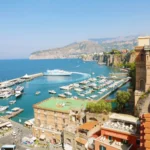
Sorrento is a town in the province of Naples, in Campania, that gave its name to the Sorrentine Peninsula. Built on cliffs facing the Bay of Naples, Vesuvius and the island of Capri, it is the terminus of the Circumvesuviana railway line and a port with boat links to Naples, Capri and the Amalfi Coast. Visiting Sorrento means strolling between Piazza Tasso, the cathedral and the Valley of the Mills, going down to Marina Grande, tasting limoncello, and then fanning out to Pompeii, Capri, Positano or Amalfi. This guide covers what to see, when to go according to the official climate normals, how to get there and why Sorrento is a practical base for the region.
To place Sorrento in a trip, see our guide to Naples, our pages on Pompeii, Herculaneum and Capri, our guide to the Amalfi Coast and the calendar when to go to Italy.

Our travel deals for Sorrento
Affiliate links: we earn a commission, at no extra cost to you.
 FlightsKiwi.comCompare flights and airline combinations to Sorrento.Compare flights

Sorrento at a glance
- Best time May–June and September to early October; July and August are the hottest and driest
- Time zone UTC+1 (UTC+2 in summer): 1 hour ahead of London, 6 hours ahead of New York
- Entry no visa for up to 90 days for US and UK citizens (Schengen rules); see travel.state.gov and GOV.UK
- Safety the main risks are pickpocketing and, in the Naples area, seismic and volcanic activity (UK FCDO; U.S. Department of State)
- Getting there Circumvesuviana train from Naples, boats from Naples and Capri, road
- Main sights Piazza Tasso, cathedral, St Francis cloister, Valley of the Mills, Correale Museum, Marina Grande
What to see in Sorrento: the highlights
Piazza Tasso and the historic centre
Piazza Tasso is the heart of Sorrento. It is named after the poet Torquato Tasso, author of “Jerusalem Delivered”, who was born in Sorrento in 1544. Around it, the lanes of the historic centre are lined with shops selling marquetry, lace and ceramics, the town’s craft specialities.
The cathedral and the Bishop’s Palace
Sorrento has many churches and a cathedral. The Bishop’s Palace was rebuilt in the 16th century after being destroyed in a Turkish raid in 1558: a reminder of the Barbary pirate incursions, which also left watchtowers all along the peninsula.
The Valley of the Mills
At the edge of the centre, the Vallone dei Mulini (Valley of the Mills) is a deep gorge where the overgrown ruins of old mills remain. You can look down on it from the parapet along the street, a few steps from Piazza Tasso.
The Correale di Terranova Museum
Housed in a former patrician residence, the Correale Museum holds one of the largest collections of Capodimonte porcelain in Italy, along with a small archaeological section. Check opening hours and prices on the museum’s official site before you go.
Marina Grande and Marina Piccola
Marina Piccola and Marina Grande are two waterfront hamlets of Sorrento, below the cliffs. Marina Grande has kept its fishing boats and fish restaurants; check on site which pier the scheduled boats leave from. You go down on foot by stairs and sloping streets, so bring good shoes.
The Bagni della Regina Giovanna
To the north-west, on Capo di Sorrento, the Bagni della Regina Giovanna are the remains of a Roman villa beside a small natural cove. Farther along the peninsula, the path that starts at Nerano leads to Punta Campanella and the Montalto tower, built in the 16th century against pirates, facing the Li Galli archipelago.
Limoncello and lemon groves
Sorrento is known around the world for limoncello, a liqueur made by steeping lemon peel in alcohol, with water and sugar. Terraced lemon groves are part of the peninsula’s landscape.
Sorrento as a base for the region
Many travelers choose Sorrento as a base: the town is served by the train to Pompeii, Herculaneum and Naples, and by boats to Capri and the Amalfi Coast. Here is how to combine them:
- Pompeii and Herculaneum: on the Circumvesuviana, the line that links Sorrento to Naples; see our pages on Pompeii and Herculaneum.
- Capri: by boat from Sorrento’s port; see our page on Capri.
- Positano and Amalfi: by boat, depending on the season, or along the narrow coastal road (the Amalfi Drive); see Positano and our guide to the Amalfi Coast.
- Naples: by train or by boat (Molo Beverello and Mergellina ports); see our guide to Naples.
Sorrento in 3 days
- Day 1: Piazza Tasso, cathedral, Valley of the Mills, Correale Museum; walk down to Marina Grande for dinner.
- Day 2: Pompeii by Circumvesuviana in the morning, Bagni della Regina Giovanna late in the day.
- Day 3: Capri by boat, or Positano and Amalfi by sea, depending on the season.
Where to stay in Sorrento
The centre, around Piazza Tasso and the station, is the most practical without a car: the train, buses and the stairs down to the port are all within walking distance. Cliff-top hotels offer views over the bay; neighbouring towns on the peninsula (Sant’Agnello, Piano di Sorrento) are an alternative, served by the same train. Book early in summer, and check the stairs and the lift if you have heavy luggage or difficulty walking.
Getting to Sorrento and getting around
From Naples airport, you reach Sorrento by road, or via Naples and then the Circumvesuviana, of which Sorrento is the terminus. Ferries and hydrofoils also connect the town to Naples, Capri, Ischia, Amalfi and Positano, with a wider service in the warmer months. For timetables and journey times, check the operator EAV (Circumvesuviana) and the shipping companies: we do not give a duration without an official source. On site, the centre is best explored on foot.
Transfer, boat or rental car?
A private transfer from Naples airport avoids changes with luggage. The train is the budget option; watch your belongings. A rental car is only useful for exploring the peninsula, and the Amalfi Coast road is narrow with little parking. Before booking, compare the pick-up point, what is included and the cancellation terms.
When to go to Sorrento: climate month by month
Sorrento has a Mediterranean climate: hot, dry summers and mild but rainy autumns and winters. There are no published official normals for Sorrento itself, so the table uses the Capri station, on the island just opposite, at 160 m (525 ft) above sea level. Our Naples guide uses the Naples-Capodichino airport station instead.
| Month | Avg. max | Avg. min | Rain | Rainy days | Day/night gap | Sunrise / sunset (15th) | Daylight |
|---|---|---|---|---|---|---|---|
| January | 13.7 °C (57 °F) | 8.7 °C (48 °F) | 71 mm (2.8 in) | 8.3 | 5.0 °C (9 °F) | 7:24 am / 4:59 pm | 9 h 35 min |
| February | 14.3 °C (58 °F) | 8.2 °C (47 °F) | 58 mm (2.3 in) | 6.8 | 6.1 °C (11 °F) | 6:56 am / 5:36 pm | 10 h 40 min |
| March | 16.8 °C (62 °F) | 9.8 °C (50 °F) | 53 mm (2.1 in) | 6.7 | 7.0 °C (13 °F) | 6:14 am / 6:08 pm | 11 h 54 min |
| April | 19.8 °C (68 °F) | 12.1 °C (54 °F) | 40 mm (1.6 in) | 5.5 | 7.7 °C (14 °F) | 6:24 am / 7:41 pm | 13 h 17 min |
| May | 24.4 °C (76 °F) | 15.8 °C (60 °F) | 26 mm (1.0 in) | 3.9 | 8.6 °C (15 °F) | 5:46 am / 8:12 pm | 14 h 26 min |
| June | 28.7 °C (84 °F) | 19.9 °C (68 °F) | 16 mm (0.6 in) | 2.3 | 8.8 °C (16 °F) | 5:30 am / 8:35 pm | 15 h 04 min |
| July | 31.7 °C (89 °F) | 22.3 °C (72 °F) | 11 mm (0.4 in) | 1.3 | 9.4 °C (17 °F) | 5:44 am / 8:32 pm | 14 h 48 min |
| August | 32.4 °C (90 °F) | 23.0 °C (73 °F) | 24 mm (0.9 in) | 1.7 | 9.4 °C (17 °F) | 6:12 am / 8:00 pm | 13 h 48 min |
| September | 28.3 °C (83 °F) | 19.9 °C (68 °F) | 58 mm (2.3 in) | 5.5 | 8.4 °C (15 °F) | 6:42 am / 7:12 pm | 12 h 29 min |
| October | 23.5 °C (74 °F) | 16.6 °C (62 °F) | 88 mm (3.5 in) | 6.7 | 6.9 °C (12 °F) | 7:13 am / 6:22 pm | 11 h 10 min |
| November | 18.3 °C (65 °F) | 12.9 °C (55 °F) | 96 mm (3.8 in) | 9.4 | 5.4 °C (10 °F) | 6:48 am / 4:44 pm | 9 h 56 min |
| December | 14.6 °C (58 °F) | 9.9 °C (50 °F) | 85 mm (3.3 in) | 8.9 | 4.7 °C (8 °F) | 7:18 am / 4:36 pm | 9 h 17 min |
Reading the table: from June to August it rains one to two days a month and afternoons exceed 28 °C (82 °F), reaching 32.4 °C (90 °F) in August. May and September have afternoons between 24 and 29 °C (75 and 84 °F). October and November are the wettest months (88 mm / 3.5 in and 96 mm / 3.8 in). Destination de Voyage calculation: the day/night gap stays small all year (roughly 5 to 9 °C, or 9 to 16 °F), an effect of the sea; on 15 June the sun sets at about 8:35 pm, against 4:36 pm on 15 December.
Entry requirements, health and safety
- US citizens: Italy follows Schengen rules. According to the U.S. Department of State (travel.state.gov, last updated August 11, 2025), you can enter for up to 90 days for tourism or business without a visa. Your passport must be valid for at least 3 months beyond your period of stay, and you need proof of sufficient funds and a return plane ticket.
- UK citizens: according to the UK FCDO (GOV.UK, updated 21 October 2026), you can travel without a visa for up to 90 days in any 180-day period as a tourist. Your passport must have been issued less than 10 years before the day you arrive and expire at least 3 months after the day you plan to leave the Schengen area. The EU Entry/Exit System (EES) is being implemented: you may need to register fingerprints and a photo, free of charge.
- Theft: crime levels are generally low, but bag-snatching and pickpocketing are more common in city centres and at major tourist attractions (UK FCDO). The State Department notes that pickpocketing is common in congested areas and on public transport, and that break-ins of rented vehicles are common.
- Earthquakes and volcanoes: the UK FCDO notes that minor tremors and earthquakes happen regularly in Italy, and that national emergency planning is in place for the Phlegraean Fields (Campi Flegrei), west of Naples, an area that remains active with regular tremors. The State Department adds that Italy has other areas of potential volcanic activity, especially near Naples, and that any visit to an active volcano is risky: stay on authorized trails and use well-known tour operators.
- Strikes: transport strikes are often called at short notice (UK FCDO); check with your carrier, for example before relying on the Circumvesuviana or a boat.
- Emergencies: 112 for all emergencies; 118 for an ambulance (UK FCDO).
Staying connected
Roaming charges in Italy depend on your home plan and provider, so check them before you leave. An eSIM can be useful if your plan has limited data. See our travel eSIM guide.
If you… then…
| If you… | Then… |
|---|---|
| Want a base without a car | Stay near the station and Piazza Tasso |
| Want to swim | Come from June to September: warm sea, little rain |
| Want to sightsee in cooler weather | Choose May or late September to early October |
| Are short of time | One day in Sorrento, one in Pompeii, one in Capri |
| Dislike crowded trains | Leave early in the morning or take the boat when it runs |
| Cannot choose between Sorrento and the Amalfi Coast | Sorrento has better train links; Positano and Amalfi are more spectacular but harder to reach |
Frequently asked questions
What is there to see in Sorrento?
Piazza Tasso, the cathedral, the Valley of the Mills, the Correale Museum, Marina Grande and the Bagni della Regina Giovanna.
How do you get from Naples to Sorrento?
By Circumvesuviana train, of which Sorrento is the terminus, or by boat from Naples port; check timetables with EAV and the shipping companies.
What is the best time to visit Sorrento?
May–June and September to early October for sightseeing; June to August for swimming (WMO 1991–2020 normals, Capri station).
Sorrento or Naples as a base?
Sorrento is quieter and close to Capri and the Amalfi Coast; Naples is more practical for the city, Herculaneum and the Phlegraean Fields.
Can you go to Capri from Sorrento?
Yes, by boat from Sorrento’s port: the island is just opposite.
Do US and UK citizens need a visa for Italy?
No, not for stays of up to 90 days in a 180-day period, according to the U.S. Department of State and the UK FCDO; your passport must meet Schengen validity rules.
Our sources
- UK FCDO, Italy foreign travel advice (GOV.UK, updated 21 October 2026): entry requirements, safety and security, natural disasters; read 26 October 2026
- U.S. Department of State, Italy country information (travel.state.gov, last updated August 11, 2025): entry and exit requirements, safety and security; read 26 October 2026
- World Meteorological Organization, 1991–2020 climate normals, Capri station (16294), Aeronautica Militare (NOAA/NCEI archive)
- Wikipedia articles “Sorrento” (French and English versions): transport, monuments, ports
- Astronomical calculations: NOAA solar algorithm, applied by Destination de Voyage to the coordinates of Sorrento (15th of each month, year 2027)
- Our methodology
Updated November 2026.