
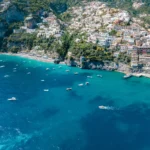
Things to do in Positano? Walk down the stepped lanes to the church of Santa Maria Assunta and its majolica dome, swim at Spiaggia Grande or Fornillo, visit the Roman archaeological museum (MAR) beneath the church, hike the Path of the Gods and take a boat to Capri or Amalfi. Positano is the most photographed village on the Amalfi Coast, clinging to the cliff above the sea.
When planning a visit to Positano, the real question is often elsewhere: should you stay in Positano or in Sorrento? This guide helps you decide with a decision tree, then covers the must-sees, a programme, getting there, budget, the climate based on official normals and the sunset time, calculated for each month.

Our travel deals for Positano
Affiliate links: we earn a commission, at no extra cost to you.
 FlightsKiwi.comCompare flights and airline combinations to Positano.Compare flights

Positano at a glance
- Location Amalfi Coast(Campania), about 15 km (9 mi) from Sorrento and 19 km (12 mi) from Amalfi on the SS163 road
- Currency euro (€); time zone: UTC+1, UTC+2 in summer (Europe/Rome) · currencies
- Airports fly into NaplesThen about 1 h 15 by road, or train to Sorrento then bus
- Getting around SITA buses on the coast roadBoats to Amalfi, Capri and Salerno in season
- Entry Schengen area: no visa for up to 90 days for US citizens (tourism or business) and UK citizens (in any 180-day period) · travel.state.gov · GOV.UKPassport valid at least 3 months beyond your stay (US) or after leaving the Schengen area (UK)
- Terrain a village built on stepsSome hotels are more than 200 steps from the road
- Electricity 220-volt system, according to the U.S. Department of State · plugsCheck that your devices accept it; you may need a plug adapter
- Budget see our budget section
Things to do in Positano: the must-sees
The church of Santa Maria Assunta
At the foot of the village, just behind the beach, the church and its dome covered in green, yellow and blue majolica tiles are Positano’s landmark. Entry is free during opening hours. The best view of the dome is from above, from the steps and the road overlooking the village, rather than from the churchyard.
The MAR, the Roman villa beneath the church
Beneath the church, the Museo Archeologico Romano displays the remains of a Roman villa buried by the eruption of Vesuvius in AD 79, with well-preserved frescoes. There is an admission charge; it is also a good option on a rainy day.
Spiaggia Grande
The large grey pebble beach stretches in front of the village. Much of it is taken up by private beach clubs with paid sunloungers; a free section lies on the western side. Come in the morning for the light on the façades, before the excursion boats arrive. The pebbles are large: beach sandals are useful.
Fornillo beach
A few minutes’ walk to the west along a cliffside path, Fornillo is quieter and smaller. The water is often clearer, as there is less boat traffic.
Arienzo beach
East of the village, Arienzo is reached by about 300 steps from the road, or by shuttle boat from Spiaggia Grande in season.
The lanes and viewpoints
Via Cristoforo Colombo, Via dei Mulini and Viale Pasitea zigzag down past shops selling linen, ceramics and lemon products. The best viewpoints over the village are the top of Via Cristoforo Colombo in the morning and Viale Pasitea in the afternoon, with the sun behind you.
The Path of the Gods
The Sentiero degli Dei links Bomerano (in the municipality of Agerola) with Nocelle, above Positano, along a path of about 8 km (5 mi) halfway up the cliffs. Allow about 3 h 30 at a steady pace, starting from Bomerano so that you walk downhill. From Nocelle, you reach Positano by a long staircase or by bus. Set off early, with good shoes, water and sun protection: there is little shade.
Boat trips
From the pier at Spiaggia Grande, boats leave for Amalfi, Capri and Salerno in season, as well as trips along the coast to the Li Galli islands and the coves. It is also the most pleasant way to avoid the summer traffic jams on the coast road.
Stay in Positano or Sorrento? Our decision tree
Both towns are the most common bases for exploring the area, but they suit different trips. Answer the questions in order.
- Are you arriving without a car from Naples or Pompeii? If so, Sorrento is simpler: it is linked to Naples and Pompeii by the Circumvesuviana regional train, while Positano has no station. If not, go to question 2.
- Do you want to see Capri as well as the coast? If so, Sorrento wins: the crossing to Capri takes about 25 to 30 minutes according to the Caremar timetables (checked 14 October 2026), all year round. From Positano, boats to Capri only run in season.
- Is the Amalfi Coast itself your priority (Amalfi, Ravello, the Path of the Gods)? If so, Positano puts you in the heart of the coast and saves you the daily drive along the coast road from Sorrento.
- Are you travelling with large suitcases, children in a pushchair or limited mobility? If so, choose Sorrento, which is flatter. Positano is all steps.
- Is your budget tight? If so, Sorrento offers more mid-range choice. Positano is one of the most expensive villages on the coast, especially from June to September.
- Do you want to enjoy the village in the evening, after the day-trippers have left? If so, spend at least one night in Positano.
| Criterion | Positano | Sorrento |
|---|---|---|
| Access from Naples without a car | Train + bus, or boat in season | Direct Circumvesuviana train |
| Capri | Boats in season | About 25 to 30 min, all year |
| Amalfi, Ravello, Path of the Gods | On the doorstep or nearby | Drive along the coast road |
| Terrain | Steps everywhere | Fairly flat centre |
| Accommodation prices | Very high | More varied |
| Evening atmosphere | Quiet village once the day-trippers have gone | Lively town, more restaurants |
For other possible bases (Amalfi, Praiano, Ravello), see our Amalfi Coast guide.
What time is sunset in Positano?
Positano’s bay faces south. The sun therefore sets to your right as you look out to sea from the beach, and its position changes a great deal with the seasons: in the north-west in summer, it disappears behind the mountains of the coast, so Spiaggia Grande falls into shade well before sunset; in the south-west in winter, it sets closer to the sea horizon. Fornillo and the higher terraces, which face further west, keep the sun for longer.
| 15th of the month | Sunrise | Sunset | Day length | Sunset direction (azimuth) |
|---|---|---|---|---|
| January | 7:24 am | 4:59 pm | 9 h 35 | 242° |
| February | 6:56 am | 5:36 pm | 10 h 40 | 253° |
| March | 6:14 am | 6:08 pm | 11 h 54 | 267° |
| April | 6:24 am | 7:41 pm | 13 h 17 | 283° |
| May | 5:45 am | 8:11 pm | 14 h 26 | 295° |
| June | 5:31 am | 8:34 pm | 15 h 04 | 301° |
| July | 5:44 am | 8:32 pm | 14 h 48 | 299° |
| August | 6:12 am | 8:01 pm | 13 h 48 | 289° |
| September | 6:43 am | 7:12 pm | 12 h 30 | 274° |
| October | 7:13 am | 6:23 pm | 11 h 10 | 259° |
| November | 6:48 am | 4:45 pm | 9 h 56 | 245° |
| December | 7:19 am | 4:36 pm | 9 h 17 | 239° |
Sunset: key points
- Mid-June: sunset around 8:34 pm, the latest of the year
- Mid-September: around 7:12 pm, a good time for an aperitivo on a terrace
- Mid-December: around 4:36 pm, the day lasts less than 9 h 20
- Photo of the sunlit village: in the morning, the sun from the east and south-east lights up the façades facing the sea
When to go to Positano
The best months are May, June and September. There are no published official normals for Positano; we use those of Capri, the nearest official station, about 20 km (12 mi) away and with the same Mediterranean climate. They show 24 to 29 °C (75 to 84 °F) in the afternoon in May, June and September, and very little rain in summer. July and August are the hottest and most expensive months, with a congested coast road. From November to March, many hotels and restaurants close.
| Month | High °C (°F) | Low °C (°F) | Rain mm (in) | Crowds | Prices | Verdict |
|---|---|---|---|---|---|---|
| January | 13.7 (57) | 8.7 (48) | 71.4 (2.8) | Very low | Low | ❌ Many places closed |
| February | 14.3 (58) | 8.2 (47) | 58.1 (2.3) | Very low | Low | ❌ Village asleep |
| March | 16.8 (62) | 9.8 (50) | 52.7 (2.1) | Low | Medium | ⚠️ Gradual reopenings |
| April | 19.8 (68) | 12.1 (54) | 40.4 (1.6) | Medium (Easter) | Medium | ✅ Mild, ideal for the Path of the Gods |
| May | 24.4 (76) | 15.8 (60) | 25.8 (1.0) | High | High | ✅ Very good month, sea warming up |
| June | 28.7 (84) | 19.9 (68) | 16.2 (0.6) | High | Very high | ✅ Fine weather, long days |
| July | 31.7 (89) | 22.3 (72) | 10.9 (0.4) | Very high | Very high | ⚠️ Very hot, crowds and prices at their peak |
| August | 32.4 (90) | 23.0 (73) | 23.9 (0.9) | Very high | Very high | ⚠️ The hottest, coast road jammed |
| September | 28.3 (83) | 19.9 (68) | 58.4 (2.3) | High | High | ✅ Warm sea, fewer crowds |
| October | 23.5 (74) | 16.6 (62) | 87.6 (3.4) | Medium | Medium | ⚠️ Mild, rain returns, closures at the end of the month |
| November | 18.3 (65) | 12.9 (55) | 95.6 (3.8) | Very low | Low | ❌ The wettest month, season over |
| December | 14.6 (58) | 9.9 (50) | 84.9 (3.3) | Low | Low | ⚠️ Quiet, Christmas lights, limited services |
More details for the whole area on our page when to go to the Amalfi Coast; for other late-summer ideas, see where to go in September.
Itinerary ideas
Positano in one day
- Morning: walk down the lanes via Via Cristoforo Colombo, viewpoints over the dome
- Late morning: church of Santa Maria Assunta and the MAR
- Midday: lunch, then a swim at Fornillo
- Afternoon: boat trip along the coast or shuttle to Arienzo
- Evening: aperitivo on a terrace at sunset (see the table)
3 days around Positano
- Day 1: Positano, beaches and lanes
- Day 2: the Path of the Gods from Bomerano to Nocelle, back to Positano
- Day 3: boat to Amalfi, then bus to Ravello; or, in season, a day on Capri
To round off your trip, our Naples guide covers the city, Pompeii and Vesuvius.
Budget for visiting Positano
| Item (per person per day) | Budget | Comfort |
|---|---|---|
| Accommodation (sharing a double room) | roughly €70 to €110 (off season or neighbouring village) | roughly €200 to €350 |
| Meals | roughly €30 to €45 | roughly €70 to €120 |
| Transport (buses, boats) | roughly €10 to €25 | roughly €20 to €40 |
| Beach and activities | roughly €0 to €20 (free beach) | roughly €30 to €60 (sunloungers, boat) |
| Total | roughly €120 to €180 per person per day | roughly €300 to €500 per person per day |
Getting to Positano and getting around
- From Naples airport: about 1 h 15 by road outside traffic jams; private transfers and shuttles in season.
- By train and bus: Circumvesuviana train from Naples to Sorrento, then a SITA bus along the coast road (about 15 km, or 9 mi). In summer, buses are often full from the morning.
- By boat: seasonal services from Naples, Sorrento, Capri, Amalfi and Salerno; you land at the foot of the village.
- By car: not recommended in summer. The SS163 road is narrow and parking is scarce and expensive (paid spaces along Viale Pasitea, private car parks).
- Once there: everything is done on foot, via the steps and lanes.
Where to stay in Positano
- Near the beach: the most convenient, the most expensive.
- In the upper village (Viale Pasitea, Via Cristoforo Colombo): open views, but steps down to the sea.
- Nocelle and Montepertuso: quieter and cheaper, above the village, linked by bus.
- Praiano: a more affordable neighbouring village, a few kilometres along the coast road.
- Before booking: ask how many steps there are between the bus stop and the hotel.
Entry requirements, health and safety
- US citizens: Italy is in the Schengen area. You may enter for up to 90 days for tourism or business without a visa; your passport must be valid at least 3 months beyond your stay, and you need proof of sufficient funds and a return ticket (U.S. Department of State, travel.state.gov, last updated August 11, 2025).
- UK citizens: no visa for up to 90 days in any 180-day period as a tourist. Your passport must have been issued less than 10 years before the day you arrive and be valid at least 3 months after the day you plan to leave the Schengen area. The EU Entry/Exit System (EES) is being implemented: fingerprints and a photo may be taken at your first entry, free of charge (UK FCDO, GOV.UK, updated 21 October 2026).
- ID: under Italian law, police can stop you at any time for an identity check: carry photo ID at all times (GOV.UK).
- Health: UK travellers can use a GHIC or EHIC for medically necessary state healthcare (GOV.UK); travel.state.gov advises being up to date on CDC-recommended vaccinations and recommends insurance that covers medical evacuation.
- Theft: crime levels are generally low, but bag-snatching and pickpocketing are more common in city centres, at major tourist attractions and on public transport (GOV.UK); the State Department notes that break-ins of rented vehicles are common, so never leave luggage in a parked car.
- Heat and steps: in summer, carry water and take breaks, as the climbs are steep; the State Department lists heatwaves among Italy’s most frequent weather events.
- Path of the Gods: avoid it in extreme heat or in the rain, when the path becomes slippery.
- Swimming: GOV.UK advises following the beach flag system (a red flag means you must not enter the water) and not diving into unknown water.
- Emergencies: 112 (police), 118 (ambulance), 115 (fire), according to GOV.UK; the State Department gives 112 for all emergencies.
Practical tips
- Luggage: a small suitcase or a backpack, as some hotels are far from the road.
- Shoes: comfortable ones for the steps, sandals for the pebbles.
- Timing: avoid the beach and the lanes between 10 am and 5 pm in August, when day-trippers pour in.
- Shopping: linen, made-to-measure sandals, ceramics and lemon products are the local specialities.
- Money: cards are accepted almost everywhere; use ATMs in well-lit public areas or inside a bank (travel.state.gov).
- Mobile data: check your home carrier’s roaming charges before you leave; an eSIM is a simple way to get local data.
Frequently asked questions
What are the best things to do in Positano in one day?
Walk down the lanes to the church of Santa Maria Assunta, visit the MAR, swim at Spiaggia Grande or Fornillo, then take a boat trip along the coast before an aperitivo at sunset.
Is it better to stay in Positano or Sorrento?
Sorrento if you are arriving without a car, want to visit Capri and Pompeii or are on a tight budget. Positano if your priority is the Amalfi Coast, the Path of the Gods and the village atmosphere in the evening.
How do you get to Positano from Naples?
By Circumvesuviana train to Sorrento then a SITA bus, by boat in season, or by car or private transfer, about 1 h 15 from the airport outside traffic jams.
When is the best time to visit Positano?
May, June and September: 24 to 29 °C (75 to 84 °F) in the afternoon and little rain according to the 1991-2020 normals for the Capri station, the nearest one, with fewer people than in July and August.
What time is sunset in Positano?
According to our astronomical calculation, around 8:34 pm on 15 June, 8:01 pm on 15 August, 7:12 pm on 15 September and 4:36 pm on 15 December. The mountains can hide the sun earlier from the beach.
How long do you need to visit Positano?
Half a day to a day for the village, two or three days to add the Path of the Gods and a boat trip.
Our sources
- World Meteorological Organization / NOAA-NCEI: 1991-2020 normals for the Capri station (WMO 16294), via the climate table published on Wikipedia (« Capri » article)
- Caremar (shop.caremar.it): Sorrento – Capri crossing times, checked 14 October 2026
- Destination de Voyage astronomical calculation: NOAA solar algorithm, IANA time zone Europe/Rome
- Entry requirements, health and safety checked on 26 October 2026: U.S. Department of State, Italy country information (last updated August 11, 2025) and UK FCDO, GOV.UK foreign travel advice for Italy (updated 21 October 2026)
- Our methodology
Updated October 2026.
All our destinations in the country are gathered in our Italy travel guide.

