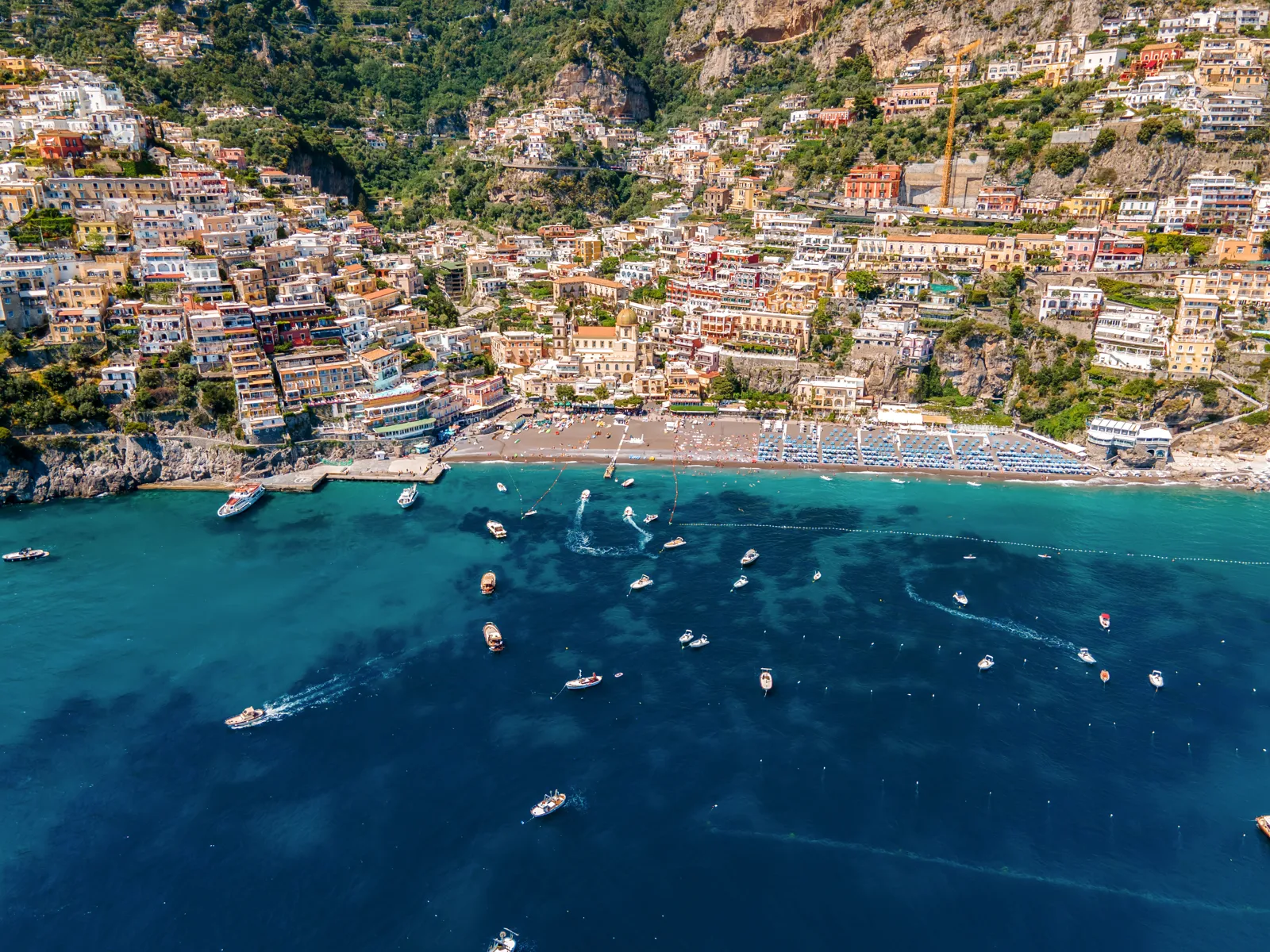
The best time to visit the Amalfi Coast is May to June and September: it is 24 to 28 °C (75 to 82 °F) in the afternoon, rain is rare, the sea is good for swimming and all the boats run. April and October suit hiking and sightseeing, with a higher risk of showers. July and August are hot and overcrowded; from November to March, many hotels and sea links stop operating.
The Amalfi Coast, south of the Bay of Naples, has a Mediterranean climate: hot, dry summers and mild but rainy winters. There are no official normals for Amalfi or Positano; we use the nearest reference station published by ISPRA, Naples-Capodichino airport, about 50 km (31 mi) away. By the sea, the breeze tempers the heat a little, and the Lattari Mountains, which plunge into the sea, often get more rain than Naples. On this coast, the tourist calendar matters as much as the weather: most ferries and a good share of hotels operate from about April to October.
Our travel deals for Amalfi Coast
Affiliate links: we earn a commission, at no extra cost to you.
FlightsKiwi.comCompare flights and airline combinations to Amalfi Coast.
❌ Period to avoid: January, February, November, December
Climate and weather on the Amalfi Coast: temperatures and rain month by month
The table uses the 1991–2020 normals for Naples-Capodichino, the nearest official station with recent normals. It is inland, at an altitude of about 70 m (230 ft): by the sea, in Amalfi or Positano, winter nights are often a little milder and summer afternoons a little less hot.
Month
Avg. max
Avg. min
Rain
Crowds
Prices
Verdict
January
13.4 °C (56 °F)
4.7 °C (40 °F)
92 mm (3.6 in)
Very low
Low (many closures)
❌ Rainy, hotels and ferries often closed
February
13.9 °C (57 °F)
4.9 °C (41 °F)
95 mm (3.7 in)
Very low
Low (many closures)
❌ Cool and damp, few services
March
16.4 °C (62 °F)
7.3 °C (45 °F)
78 mm (3.1 in)
Low
Low
⚠️ Gradual reopening, changeable weather
April
19.4 °C (67 °F)
10.0 °C (50 °F)
99 mm (3.9 in)
Medium (Easter)
Medium
⚠️ Ideal for hiking, but frequent showers
May
23.6 °C (74 °F)
14.3 °C (58 °F)
59 mm (2.3 in)
High
High
✅ Mild, flowers, sea still cool
June
27.7 °C (82 °F)
18.4 °C (65 °F)
33 mm (1.3 in)
High
High
✅ Fine and dry, pleasant swimming
July
30.4 °C (87 °F)
20.9 °C (70 °F)
29 mm (1.1 in)
Very high
Very high
⚠️ Hot, roads and beaches packed
August
31.0 °C (88 °F)
21.4 °C (71 °F)
36 mm (1.4 in)
Very high
Very high
⚠️ The hottest, the most expensive
September
26.8 °C (80 °F)
17.6 °C (64 °F)
89 mm (3.5 in)
High
High
✅ Warm sea, crowds easing
October
23.0 °C (73 °F)
13.8 °C (57 °F)
136 mm (5.4 in)
Medium
Medium
⚠️ Mild but rainy, end of season
November
18.3 °C (65 °F)
9.5 °C (49 °F)
152 mm (6.0 in)
Very low
Low (many closures)
❌ The wettest month
December
14.3 °C (58 °F)
5.9 °C (43 °F)
112 mm (4.4 in)
Low (holidays)
Low
❌ Rainy, many businesses closed
Temperatures and rainfall: 1991–2020 normals for the Naples-Capodichino station (Naples international airport), published by the Istituto Superiore per la Protezione e la Ricerca Ambientale (ISPRA). Nearest reference station, about 50 km (31 mi) from Amalfi. Crowds and prices: our estimate based on the tourist seasons.
Note: according to the same normals, it rains on average 2 to 4 days a month from June to August, against 9 to 10 days from November to February. Sunshine exceeds 300 hours in July and falls to about 105 hours in December. In autumn, rain often takes the form of violent thunderstorms, which can cause rockfalls on the coastal roads.
The seasons on the Amalfi Coast: pros and cons
Spring (March to May): hikers’ season
March marks the gradual reopening of hotels and restaurants. April is mild (19 °C, or 67 °F) but still fairly rainy (99 mm (3.9 in)); May becomes very pleasant (24 °C, or 75 °F) with rain clearly receding. The lemon trees and vegetation are in bloom, and temperatures are ideal for walking the Path of the Gods or the Valley of the Mills. The sea stays cool for swimming until the end of May. Easter and the spring holidays already attract many Italian and international visitors.
Pros: ideal temperatures for hiking, green and flowering landscapes, prices below summer’s
Cons: frequent showers in April, sea still cold, some services not yet open in March
Our tip: May is the best month for combining hiking, sightseeing and the first swims
Summer (June to August): warm sea and crowds
June is hot (28 °C, or 82 °F) and dry, with a pleasant sea. July and August exceed 30 °C (86 °F) at Naples-Capodichino, and the coast is packed: crowded buses, traffic jams on the Amalfi road, pebble beaches taken by morning, hotel prices at their highest. The heat also makes stairs and trails punishing in the middle of the day. Summer festivals, notably in Ravello, and patron saint festivals enliven the villages. Our guide to visiting Ravello presents its villas and gardens.
Pros: warm sea, guaranteed sunshine, all boat links, nightlife
Cons: crowds, traffic, very high prices, heat for walking
Our tip: June, before the July–August peak; if you travel in summer, choose the boat over the road
Autumn (September to November): the shoulder season
September is often the best month of the year for swimming: the sea has stored the summer’s heat, the air is more bearable (27 °C, or 80 °F) and crowds recede once schools are back. October stays mild (23 °C, or 73 °F), but it is the start of the rainy season (136 mm (5.4 in)), with sometimes violent thunderstorms. From late October, ferries, hotels and restaurants begin to close. November is the wettest month of the year.
Pros: sea still warm in September, falling prices, pleasant hiking in October
Cons: autumn thunderstorms, possible rockfalls on roads, seasonal closures from late October
Our tip: the second half of September is the best compromise between sea, weather and crowds
Winter (December to February): a sleepy coast
Winter is mild for the season (13 to 14 °C, or 55 to 57 °F, in the afternoon), but rainy, with 9 to 10 rainy days a month. Many hotels, restaurants and sea links close. The villages, Amalfi first among them, keep a local life and their Christmas lights, but this is a season for a quiet stay, not for enjoying the sea.
Pros: low prices, no crowds, clear roads
Cons: rain, many businesses closed, very few boats, short days
Who is it for? Those who combine the coast with Naples, Pompeii and Herculaneum, open all year
Where to go by season: the coast and its surroundings
The Amalfi Coast is often combined with Sorrento, Capri, Pompeii and Naples. These places have similar climates: the main difference is the seasonality of services.
Place
What makes it special
Best time
Positano, Amalfi, Ravello
Hillside village, pebble beaches, many closures in winter
Reference climate: ISPRA 1991–2020 normals for Naples-Capodichino. Indicative trends according to the tourist season.
The coastal villages
Positano, Amalfi, Ravello, Praiano, Minori, Maiori, Atrani and Cetara live to the rhythm of the tourist season. From April to October, everything operates; from November to March, the villages empty and part of the accommodation closes. Ravello, at more than 300 m (984 ft) above sea level, is a little cooler than the seafront.
Pompeii, Herculaneum and Vesuvius
The archaeological sites can be visited all year, which makes them good stops out of season. In summer the heat is strong and shade is scarce: the U.S. Department of State (travel.state.gov, last updated August 11, 2025) notes that high temperatures, especially in summer, are common in the south. Arrive at opening time, with water and a hat.
When to go to the Amalfi Coast depending on your plans
Plans
Best time
Where?
Swimming and relaxing
June, September
Positano, Praiano, Maiori, Minori
Hiking
April–May, late September–October
Path of the Gods, Valley of the Mills, Ravello
Honeymoon
May–June, September
Positano, Ravello
Cultural visits
April to June, September–October
Amalfi, Ravello, Pompeii, Herculaneum
Small budget
April, second half of October
Sorrento, Maiori, Minori, Salerno as a base
Family
June, September
Maiori, Minori, Sorrento
Major events on the Amalfi Coast
Date
Event
Where
Holy Week (March or April)
Easter processions
Villages of the coast and the Sorrento Peninsula
June 27
Feast of St. Andrew, patron saint of Amalfi
Amalfi
Summer (program varies)
Ravello Festival: concerts, including open-air concerts facing the sea
Ravello (Villa Rufolo)
August 15
Feast of the Assumption, patron saint festivals and fireworks
Positano and other villages
Every four years, in rotation
Regatta of the Historical Maritime Republics (Amalfi, Genoa, Pisa, Venice)
Amalfi in the years when it hosts it
November 30
Feast of St. Andrew
Amalfi
Dates and programs change every year: check them with the municipalities or local tourist offices before booking.
The Amalfi Coast month by month
Amalfi Coast in January: Mild for the season (13 °C, or 56 °F) but rainy (92 mm (3.6 in)). Many hotels and restaurants closed, ferries almost nonexistent. Prefer Naples and Pompeii.
Amalfi Coast in February: Still damp (95 mm (3.7 in)) and quiet. Carnival in some towns depending on the year. A subdued coast.
Amalfi Coast in March: Gradual reopening (16 °C, or 61 °F). A good month for Pompeii and Herculaneum, still uncertain for the coast.
Amalfi Coast in April: Mild (19 °C, or 67 °F) but rainy (99 mm (3.9 in)). Pleasant hikes, boats resume. Easter in high demand.
Amalfi Coast in May: One of the best months: 24 °C (75 °F), rain falling (59 mm (2.3 in)). Ideal for walking; the sea becomes swimmable toward the end of the month.
Amalfi Coast in June: Excellent: 28 °C (82 °F), very little rain (33 mm (1.3 in)), pleasant sea. Feast of St. Andrew in Amalfi on the 27th.
Amalfi Coast in July: Very hot (30 °C, or 86 °F), the driest month. Crowds, traffic and high prices: book very early.
Amalfi Coast in August: The hottest (31 °C, or 88 °F) and the most expensive. August 15 festivities. Beaches and buses packed.
Amalfi Coast in September: Warm sea, 27 °C (80 °F), crowds falling: the best compromise for swimming. A few thunderstorms toward the end of the month.
Amalfi Coast in October: Mild (23 °C, or 73 °F) but rainy (136 mm (5.4 in)). Good for hiking; gradual closures at the end of the month.
Amalfi Coast in November: The wettest month (152 mm (6.0 in)). A very quiet coast, many businesses closed. Feast of St. Andrew on the 30th.
Amalfi Coast in December: Rainy (112 mm (4.4 in)) and quiet. Christmas lights and nativity scenes in the villages, reduced services.
When to book your stay on the Amalfi Coast
Accommodation is limited by geography: the villages are small and cling to the cliff. For June, July, August and September, book 4 to 6 months ahead, especially in Positano and Ravello; for May and October, 2 to 3 months is generally enough. The main airport is Naples-Capodichino, where the climate normals above are recorded.
Time difference: Italy is on Central European Time (UTC+1, UTC+2 in summer): 1 hour ahead of London and generally 6 hours ahead of New York.
Currency: the euro. The UK FCDO (GOV.UK, updated 21 October 2026) says many major Italian cities impose a small tax on tourists, usually paid at the hotel, with rates that vary by city and sometimes by hotel star rating.
Health: UK and US travelers should check their home country’s advice and insurance cover for healthcare abroad; the UK FCDO refers to the NHS page on getting healthcare abroad.
Volcanoes and earthquakes: the UK FCDO (GOV.UK, updated 21 October 2026) says there are several active volcanoes in southern Italy, that national emergency planning is in place for the Phlegraean Fields, an area that remains active with regular tremors, and that many parts of Italy lie on a major seismic fault line. Follow the instructions of the local authorities. The FCDO also notes that wildfires are a risk during the extended summer months.
June and September for combining sea and sightseeing: 27 to 28 °C (81 to 82 °F) in the afternoon and little rain according to the Naples-Capodichino normals. May is ideal for hiking, with the sea still cool.
Can you swim on the Amalfi Coast in May or October?
It is possible, but the water is still cool in May. In early October the sea is often still pleasant after the summer; the most comfortable swimming runs from June to September.
Is the Amalfi Coast open in winter?
The villages stay inhabited, but a large share of hotels, restaurants and sea links close from about November to March. You then need to get around by bus or car and accept a very quiet stay.
When should you visit the Amalfi Coast to avoid the crowds?
In April, outside Easter, and in the second half of October, when most services are still running. In summer, set off early in the morning and favor the boat to avoid traffic jams.
What is the wettest month on the Amalfi Coast?
November, with 152 mm (6.0 in) at Naples-Capodichino according to ISPRA’s 1991–2020 normals, followed by October. The relief of the coast often gets more rain than the Naples station.
Is it too hot on the Amalfi Coast in summer?
July and August exceed 30 °C (86 °F) in the afternoon at Naples-Capodichino. By the sea, the breeze helps, but stairs and trails become punishing in the middle of the day: walk early in the morning.
Should you go to the Amalfi Coast in April?
Yes for hiking and sightseeing: about 19 °C (67 °F) in the afternoon at Naples-Capodichino, but 99 mm (3.9 in) of rain on average; the sea is still cool and the boats resume. Avoid Easter if you want quiet and low prices.
What is the weather like on the Amalfi Coast in May?
Mild and increasingly dry: about 24 °C (75 °F) in the afternoon and 59 mm (2.3 in) of rain according to the Naples-Capodichino 1991–2020 normals. It is one of the best months for walking; swimming becomes pleasant toward the end of the month.
Is the Amalfi Coast in October a good idea?
Yes early in the month: about 23 °C (73 °F) in the afternoon and a sea that is often still pleasant. But October is rainy, with sometimes violent thunderstorms, and hotel and ferry closures begin toward the end of the month.
Our sources
Istituto Superiore per la Protezione e la Ricerca Ambientale (ISPRA): 1991–2020 normals for the Naples-Capodichino station (Naples international airport)
Health, safety and local information read on 26 October 2026: UK FCDO, foreign travel advice for Italy (GOV.UK, updated 21 October 2026), and U.S. Department of State, Italy country information (travel.state.gov, last updated August 11, 2025)


 FlightsKiwi.comCompare flights and airline combinations to Amalfi Coast.Compare flights