Spitsbergen is the largest island of the Norwegian archipelago of Svalbard, halfway between mainland Norway and the North Pole: glaciers, fjords, polar bears and, depending on the season, the midnight sun from 20 April to 25 August or the polar night from 28 October to 15 February (Destination de Voyage calculation). You get there through Longyearbyen, its main settlement. This guide to help you visit Spitsbergen explains what to do, the official rules of the Governor of Svalbard for leaving town, the entry and safety information for US and UK travelers, and the climate month by month.
Time zoneUTC+1 (UTC+2 in summer): 1 hour ahead of London, 6 hours ahead of New York
Midnight sun20 April to 25 August; polar night: 28 October to 15 February (calculation)
Climateaverage high of 9.4 °C (49 °F) in July, average low of −15.5 °C (4 °F) in March (Met Norway, 1991–2020)
EntrySvalbard is outside the Schengen area and a passport is required (U.S. Department of State, UK FCDO); see travel.state.gov and GOV.UK
Outside Longyearbyenpolar bears; a guided trip, or an application to the Governor, depending on the area
What to do in Spitsbergen
Longyearbyen, capital at the end of the world
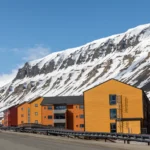
Founded in 1906 by the American John Munro Longyear to mine coal, then bought by a Norwegian company in 1926, Longyearbyen is the administrative capital of Svalbard, at the head of the Adventfjorden. It has hotels, restaurants, the Svalbard Museum (in the university building, UNIS, opened in 1993) and the departure points for excursions. Its road network, about fifty kilometres (31 mi) long, does not reach any other settlement: everything else is done by boat, snowmobile, ski or on foot, with the precautions described below. The U.S. Department of State notes that roads exist in the three largest towns (Longyearbyen, Barentsburg and Ny-Ålesund) but do not connect, so the only options for travelling around Svalbard are sea, snowmobile or limited air service.
Cruises in the fjords and along the glaciers
In summer, expedition ships and day excursions travel the Isfjorden and the island’s coasts in search of Arctic wildlife and glacier fronts. Tourist landings in protected areas are governed by a regulation of the Governor: going through an authorized operator leaves it in charge of the permits.
Barentsburg, Pyramiden and Ny-Ålesund
Spitsbergen has a few other inhabited places: Barentsburg, a Russian mining town; Pyramiden, a former Russian mine closed in 1998 and almost abandoned; and Ny-Ålesund, a former mining village that became an international research town. The U.S. Department of State notes that tourism to Ny-Ålesund is restricted because of its status as a research facility and the danger of polar bear attacks. These places are reached by boat or snowmobile depending on the season, usually on an organized excursion.
The Global Seed Vault
Near the airport, in a former mine, the Svalbard Global Seed Vault has kept millions of seeds from around the world since 2008. You cannot go in, but it is one of the curiosities photographed from the road.
Winter: polar night, northern lights and snowmobiles
During the polar night (28 October to 15 February, calculation), the sun does not rise: this is the period for the northern lights in clear skies. At the end of winter, when the light returns, snowmobile, dog-sled and ski trips are done with authorized providers. Bring extreme-cold gear: in March, the average low is −15.5 °C (4 °F).
Official rules: polar bears and permits
The UK FCDO (GOV.UK, updated 25 August 2026) tells travelers to follow the safety advice of the Governor of Svalbard, including on how to protect yourself from polar bear attacks and on the risks of glaciers, avalanches and other dangers outside the main town of Longyearbyen. The U.S. Department of State (travel.state.gov, last updated July 9, 2026) says Svalbard’s extreme weather and limited transport pose unique dangers, that there have been several reported deaths and injuries to tourists, from animal attacks and boating accidents, and that a clinic in Longyearbyen can provide limited emergency care until medical evacuation to Tromsø is available.
The Governor of Svalbard (page “Application and registration requirement for trips to Svalbard”, updated 23 June 2026, read 12 November 2026 on sysselmesteren.no) applies field safety regulations that came into effect on 1 January 2026. The main points for visitors:
On an organized tour: the tourist company is responsible for ensuring that requirements and obligations are met, and you do not need to submit an application yourself.
As an independent visitor outside the travel area (formerly management area 10): you must apply to the Governor no later than four weeks before the trip starts and receive a reply before it can begin. You must also have insurance covering rescue expenses, carry communication equipment for notification and two-way communication, and send a report to the Governor within four weeks after the trip.
Insurance: the regulations set minimum cover per search, rescue operation or medical transport that depends on the zone (for example 120,000 Norwegian kroner in insurance zone A, 350,000 in zone B and 650,000 in zone C).
In practice, most visitors leave Longyearbyen with a guide. Do not venture out of town alone.
Where to stay in Spitsbergen
Accommodation is concentrated in Longyearbyen: hotels, guesthouses and some more rustic options, including former miners’ housing. Supply is limited: book early, especially for the midnight sun season. Barentsburg and a few remote lodges also take visitors, usually as part of excursions.
Getting to Spitsbergen
Svalbard Airport, Longyear, north-west of the town, is the only airport in the archipelago open to scheduled flights. According to Wikipedia, Scandinavian Airlines links it to Oslo and Tromsø, so you need a connection in Norway: check connections on the airport’s (Avinor) and airlines’ sites. In summer, Spitsbergen is also a cruise port of call.
Excursions, transfers and equipment
For boat, snowmobile or sled trips, compare the direct offer of local operators with that of resellers: authorization from the Governor, presence of a guide, equipment provided (suit, boots), cancellation terms in bad weather. For the airport-to-town transfer, ask your accommodation.
When to go to Spitsbergen: climate month by month
Month
Avg. max
Avg. min
Precipitation
Day/night gap
January
−7.7 °C (18 °F)
−14.2 °C (6 °F)
21 mm (0.8 in)
6.5 °C (12 °F)
February
−8.3 °C (17 °F)
−15.0 °C (5 °F)
17 mm (0.7 in)
6.7 °C (12 °F)
March
−8.8 °C (16 °F)
−15.5 °C (4 °F)
16 mm (0.6 in)
6.7 °C (12 °F)
April
−5.7 °C (22 °F)
−12.1 °C (10 °F)
9 mm (0.4 in)
6.4 °C (12 °F)
May
−0.6 °C (31 °F)
−3.9 °C (25 °F)
8 mm (0.3 in)
3.3 °C (6 °F)
June
5.6 °C (42 °F)
2.2 °C (36 °F)
8 mm (0.3 in)
3.4 °C (6 °F)
July
9.4 °C (49 °F)
5.4 °C (42 °F)
20 mm (0.8 in)
4.0 °C (7 °F)
August
8.2 °C (47 °F)
4.4 °C (40 °F)
23 mm (0.9 in)
3.8 °C (7 °F)
September
4.0 °C (39 °F)
0.3 °C (33 °F)
26 mm (1.0 in)
3.7 °C (7 °F)
October
−1.5 °C (29 °F)
−6.1 °C (21 °F)
18 mm (0.7 in)
4.6 °C (8 °F)
November
−3.8 °C (25 °F)
−9.3 °C (15 °F)
22 mm (0.9 in)
5.5 °C (10 °F)
December
−6.1 °C (21 °F)
−12.2 °C (10 °F)
24 mm (0.9 in)
6.1 °C (11 °F)
Temperatures and precipitation: 1991–2020 normals from the Norwegian Meteorological Institute (Met Norway), Svalbard Lufthavn station (Longyearbyen airport), relayed by Wikipedia. Day/night gap: Destination de Voyage calculation.
Reading the table: only June, July and August have a positive average high (5.6 to 9.4 °C, or 42 to 49 °F). The coldest months are February and March (−15.0 and −15.5 °C / 5 and 4 °F average low). Very little precipitation falls (under 30 mm / 1.2 in a month), mostly as snow. The sun does not set from 20 April to 25 August and does not rise from 28 October to 15 February (Destination de Voyage calculation for Longyearbyen, year 2027): the choice of season depends mainly on the light you want.
Period
Light (calculation)
Best for
Late October to mid-February
Polar night
Northern lights, polar atmosphere
Late February to April
Daylight returns, days lengthening
Snowmobile, dog sled, skiing
Late April to late August
Midnight sun
Cruises, guided hiking, wildlife
September to late October
Days getting shorter
End of season, first northern lights
Entry requirements, health and safety
US citizens: according to the U.S. Department of State (travel.state.gov, last updated July 9, 2026), you need a passport to enter Svalbard. Unlike mainland Norway, Svalbard is not in the Schengen Agreement, so air travelers to Svalbard from Norway leave the Schengen zone before boarding. The State Department adds that the U.S. Embassy has no staff in Svalbard, which limits its ability to provide consular help, and that you should check you have enough travel, medical and medical evacuation insurance.
UK citizens: according to the UK FCDO (GOV.UK, updated 25 August 2026), you need your passport to travel to and enter the Svalbard archipelago. For mainland Norway, Schengen rules apply (no visa for up to 90 days in any 180-day period; passport issued less than 10 years before arrival and valid at least 3 months after you leave the Schengen area).
Insurance: insurance covering rescue expenses is required for independent trips outside the travel area (see above); the State Department strongly advises medical evacuation cover for Svalbard.
The two sources agree that a passport is required. For anything else, check with the Norwegian embassy in your country. See also our guide to entry requirements.
Staying connected
An eSIM may be useful in Longyearbyen; outside the town, coverage is not guaranteed, and the Governor requires suitable communication equipment for trips outside the travel area. See our travel eSIM guide.
If you… then…
If you…
Then…
Want the midnight sun
Come from 20 April to 25 August (calculation)
Dream of the northern lights
Aim for the polar night, in clear skies
Want to go snowmobiling
Late winter, with an authorized operator
Travel alone without a guide
Stay in Longyearbyen, or apply to the Governor to leave the travel area
Want to fly from the UK or US
Plan a connection in Norway and check the airlines’ schedules
Frequently asked questions
Are Spitsbergen and Svalbard the same thing?
No: Svalbard is the archipelago, and Spitsbergen is its largest island, where Longyearbyen and the airport are. Before the 1920 treaty, the whole archipelago was called Spitsbergen.
Do you need a passport for Spitsbergen?
Yes. Svalbard is outside Schengen, and both the U.S. Department of State and the UK FCDO say you need your passport to enter.
Can you walk alone outside Longyearbyen?
There are polar bears. Outside the travel area, an independent visitor must get permission from the Governor, with insurance and communication equipment; on an excursion, the operator takes care of this.
When can you see the midnight sun in Spitsbergen?
In Longyearbyen the sun does not set from 20 April to 25 August (Destination de Voyage calculation).
Is it very cold in Spitsbergen?
In winter, yes: an average low of −15.5 °C (4 °F) in March. In July the average high reaches 9.4 °C (49 °F) (Met Norway, 1991–2020).
Our sources
UK FCDO, Norway foreign travel advice (GOV.UK, updated 25 August 2026): entry requirements, Svalbard; read 26 October 2026
U.S. Department of State, Norway country information (travel.state.gov, last updated July 9, 2026): entry and exit requirements, Svalbard; read 26 October 2026
Governor of Svalbard (Sysselmesteren): “Application and registration requirement for trips to Svalbard” (updated 23 June 2026), read 12 November 2026
Norwegian Meteorological Institute (Met Norway), 1991–2020 normals, Svalbard Lufthavn station (via Wikipedia, article “Longyearbyen”)
Wikipedia articles “Spitsbergen” and “Longyearbyen” (French and English versions)
Astronomical calculations: solar declination (NOAA formula) applied by Destination de Voyage to the latitude of Longyearbyen, year 2027


 FlightsKiwi.comCompare flights and airline combinations to Spitsbergen.Compare flights