There are plenty of things to do in Cartagena (Cartagena de Indias), on Colombia’s Caribbean coast. This fortified colonial city has several kilometers of ramparts, lanes with flower-decked wooden balconies, lively squares and, around it, beaches and islands. Founded in 1533, it was one of the great ports of the Spanish Empire, which earned it the name « de Indias », to set it apart from Cartagena in Spain. To visit Cartagena, allow 3 days for the city and 1 to 2 days for the Rosario Islands or Barú. The dry season runs from December to April.
This guide covers the highlights, official safety advice and the climate, with two calculations other guides lack: the number of rainy days to expect over a week, month by month, and the sunset time so you can enjoy the walls at the right moment.

Our travel deals for Cartagena
Affiliate links: we earn a commission, at no extra cost to you.
 FlightsKiwi.comCompare flights and airline combinations to Cartagena.Compare flights
- eSIMSailyAnother eSIM plan to compare: data, validity, network.See Saily plans


Cartagena at a glance
- Country ColombiaCapital of Bolívar Department, on the Caribbean Sea
- Language Spanish
- Currency Colombian peso (COP), see our currency converter · currencies
- Time zone UTC−5, no daylight saving time · detailsLocal time now: –:–
- Airports Rafael Núñez International Airport (CTG), a few kilometers northeast of the old townMany international itineraries connect through Bogotá
- Entry US and UK citizens: visa-free for up to 90 days · travel.state.gov · GOV.UK
- Health yellow fever certificate required if arriving from certain countries with a transmission risk, and may be requested in high-risk areas of Colombia (UK FCDO)
- Electricity 110 V, 60 Hz, type A/B plugs (two flat pins) · plugsUS plugs fit; UK travelers need an adapter
Things to do in Cartagena: the highlights
The walled city and the Torre del Reloj
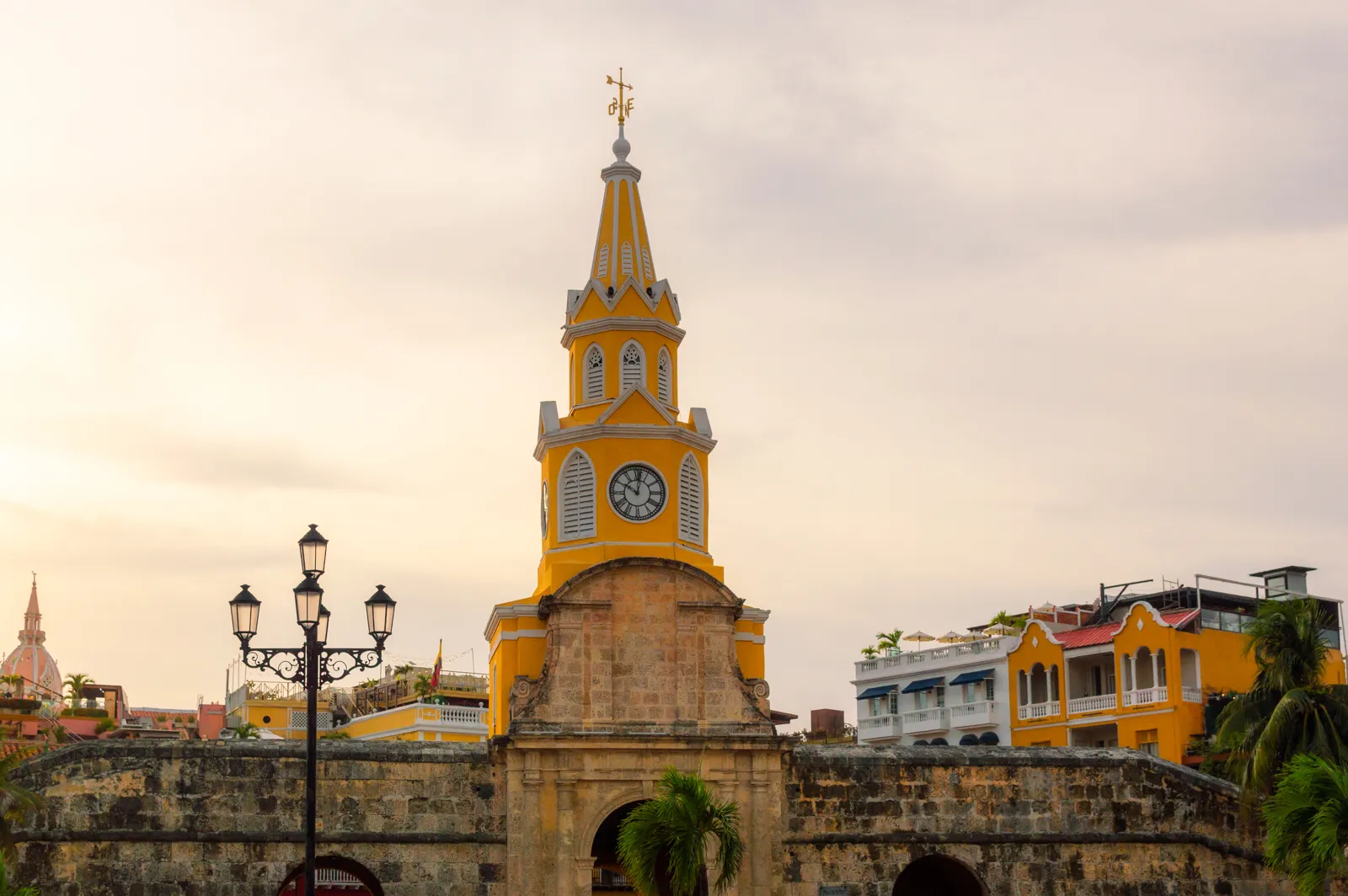
You enter the old town through the Puerta del Reloj, the main gate in the walls, topped by a clock tower. Behind it, Plaza de los Coches, Plaza de la Aduana, Plaza de Santo Domingo, with Botero’s sculpture « Gertrudis », and Plaza de Bolívar are all explored on foot. The port, fortresses and group of monuments of Cartagena have been a UNESCO World Heritage Site since 1984.
Palace of the Inquisition and the Zenú Gold Museum
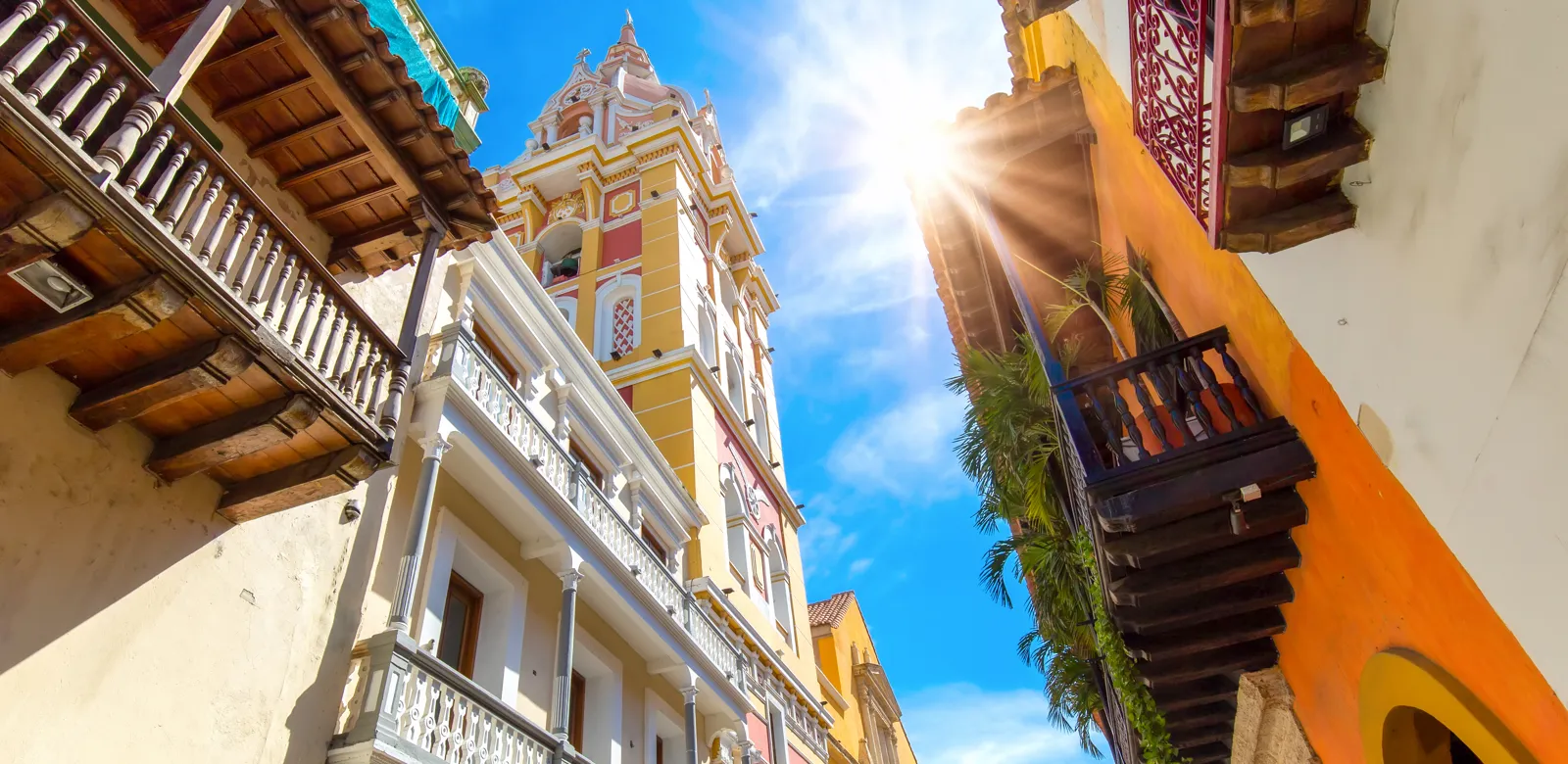
On Plaza de Bolívar, the Palace of the Inquisition, with its baroque facade, houses the city’s history museum. Opposite, the Zenú Gold Museum, run by the Banco de la República, displays the goldwork of the Zenú peoples who lived in the plains of northern Colombia. The cathedral and the San Pedro Claver church, dedicated to the Jesuit who cared for enslaved people landed at the port, complete the visit.
The walls and the sunset
You can walk along the top of the walls for a good part of the old town’s circuit. In the late afternoon, the bastions facing the sea, to the west, are the classic sunset spot; sunset falls between 5:35 pm and 6:30 pm depending on the season (see the climate table). To the north, Las Bóvedas, former vaulted casemates set against the wall, now house craft shops.
Getsemaní, the lively neighborhood
Outside the walls, south of the Torre del Reloj, Getsemaní is the former working-class neighborhood that has become the liveliest part of the city: murals, small colorful streets and, in the evening, Plaza de la Trinidad, where locals and travelers gather.
Castillo San Felipe de Barajas
Within walking distance of Getsemaní, Castillo San Felipe de Barajas is the largest fortress the Spanish built in their colonies. You can explore its underground galleries, ramps and bastions; go early in the morning, as there is little shade.
La Popa Monastery
On the highest hill in the city, the Santa Cruz de la Popa monastery offers the best overall view of Cartagena, the bay and the Bocagrande towers. Go up by taxi.
The Rosario Islands and Barú
Most of the city’s beaches (Bocagrande, Castillogrande, La Boquilla) have murky water. For turquoise water, take a boat to the Rosario Islands, in the Corales del Rosario y San Bernardo National Park, or go to Playa Blanca on the Barú peninsula, also reachable by road. The U.S. Department of State advises caution on small tourist boats between Cartagena and the nearby islands, especially in December and January, when the seas off the northern coast can be dangerous for small boats.
Bazurto market and Caribbean food
Bazurto, a big local market, shows another side of Cartagena, far from the restored facades. Go with someone who knows it and leave valuables behind. At the table, try fried fish with coconut rice and patacones (fried plantains), arepas de huevo and tropical fruit juices.
Islands and day trips: which one to choose?
| Trip | Location | Access | Best for |
|---|---|---|---|
| Playa Blanca (Barú) | to the south | Road or boat | A beach day, often busy |
| Rosario Islands | southwest, offshore | Boat from the La Bodeguita pier | Clear water, snorkeling, a night on an island |
| San Basilio de Palenque | southeast, inland | Road | Afro-Colombian culture, UNESCO intangible heritage |
| El Totumo mud volcano | northeast | Road | An unusual half-day trip |
| Santa Cruz de Mompox | further southeast | Road, long journey | Listed colonial town, 2 days minimum |
Decision guide: if you want a single beach day without a night away from the city, choose Playa Blanca, ideally on a weekday. If you want clear water and quiet, spend a night on the Rosario Islands. If culture interests you more than the beach, go to Palenque. If the sea is rough (more common at the end of the year), boat crossings can be bumpy or canceled: keep a spare day.
Itinerary: Cartagena in 3 or 4 days
- Day 1: Torre del Reloj, the old town squares, Palace of the Inquisition, Zenú Gold Museum; sunset on the walls
- Day 2: Castillo San Felipe early in the morning, La Popa monastery by taxi; evening in Getsemaní
- Day 3: Rosario Islands or Playa Blanca
- Day 4 (optional): San Basilio de Palenque, or Bazurto in the morning then Las Bóvedas
Cartagena fits easily into a wider trip: see our Colombia travel guide.
When to go to Cartagena
The best period runs from December to April: almost no rain from January to March according to IDEAM (less than 1 rainy day a month), and 240 to 270 hours of sunshine. The heat is constant: 31 to 32 °C (88 to 90 °F) in the afternoon and 24 to 26 °C (75 to 79 °F) at night all year, with high humidity. October is the wettest month (236 mm / 9.3 in, 12 rainy days), followed by November and September. December-January and Holy Week are the most expensive periods.
| Month | High °C (°F) | Low °C (°F) | Rain mm (in) | Rain days | Rain days / 7 days | Sunset | Verdict |
|---|---|---|---|---|---|---|---|
| January | 31.1 (88) | 24.0 (75) | 0.5 (0.0) | 0.1 | 0.0 | 5:58 pm | ✅ Dry, high season |
| February | 31.1 (88) | 24.2 (76) | 0.3 (0.0) | 0.1 | 0.0 | 6:10 pm | ✅ Dry and sunny |
| March | 31.2 (88) | 24.9 (77) | 3 (0.1) | 0.4 | 0.1 | 6:12 pm | ✅ Dry and sunny |
| April | 31.7 (89) | 25.8 (78) | 19 (0.7) | 2.0 | 0.5 | 6:13 pm | ✅ Still dry |
| May | 32.0 (90) | 26.1 (79) | 117 (4.6) | 7.0 | 1.6 | 6:16 pm | ⚠️ Showers return |
| June | 32.3 (90) | 26.1 (79) | 92 (3.6) | 8.5 | 2.0 | 6:24 pm | ⚠️ Showers |
| July | 32.2 (90) | 25.7 (78) | 121 (4.8) | 8.5 | 1.9 | 6:28 pm | ⚠️ Showers |
| August | 32.2 (90) | 25.9 (79) | 128 (5.0) | 9.5 | 2.1 | 6:20 pm | ⚠️ Showers, hot and humid |
| September | 32.1 (90) | 25.8 (78) | 133 (5.2) | 10.3 | 2.4 | 6:02 pm | ⚠️ Rainy |
| October | 31.7 (89) | 25.6 (78) | 236 (9.3) | 12.1 | 2.7 | 5:44 pm | ❌ Wettest month |
| November | 31.5 (89) | 25.5 (78) | 178 (7.0) | 8.9 | 2.1 | 5:36 pm | ⚠️ Still rainy |
| December | 31.4 (89) | 24.8 (77) | 45 (1.8) | 2.6 | 0.6 | 5:42 pm | ✅ Dry again, holidays |
How to read it: over a week in February, the chance of seeing rain is almost zero; in October, expect about 2.7 days with rain. Showers often fall late in the day and rarely last all day. To compare with Bogotá, Medellín or the coffee region, see when to go to Colombia.
Budget for Cartagena
Cartagena is one of the most expensive cities in Colombia, especially from mid-December to mid-January and during Holy Week. Hotels in the walled city are much more expensive than in Getsemaní: compare prices for your dates, island trips included.
Getting around Cartagena
- On foot: the walled city and Getsemaní are best explored on foot, ideally in the morning and late afternoon because of the heat.
- Taxis: the UK FCDO advises using licensed telephone or internet-based taxi services or booking through your hotel, and not hailing taxis on the street; there are authorized taxi booths at most Colombian airports.
- Airport: Rafael Núñez airport is a few kilometers northeast of the old town; take a taxi from the official line.
- Boats: island trips leave from the La Bodeguita pier.
Where to stay in Cartagena
| Neighborhood | Best for | Highlights |
|---|---|---|
| Walled city (Centro, San Diego) | First visit, couples | Monuments on foot, boutique hotels; high prices |
| Getsemaní | Budget and mid-range, nightlife | Atmosphere, hostels and small hotels; noisier |
| Bocagrande, Castillogrande | Beach and large hotels | Seafront towers, close to the center by taxi |
| Rosario Islands, Barú | A quiet night | Clear water; few services, book everything in advance |
Entry requirements, health and safety
- US citizens: according to the U.S. Department of State (travel.state.gov, last updated August 11, 2025), you do not need a visa for tourism or business stays of 90 days or less; you need a valid US passport and may be denied entry without a return ticket. Complete the free online Check-Mig form 72 hours before your flight.
- UK citizens: according to the UK FCDO (GOV.UK, updated 15 October 2026), you can visit for up to 90 days without a visa, at the discretion of the immigration officer, with an onward or return ticket; at least 6 months’ passport validity after departure is recommended. The FCDO describes Check-Mig as speeding up entry but not mandatory: complete it to be safe.
- Yellow fever: a certificate is required if you arrive from certain countries with a transmission risk, and you may be asked for it in high-risk areas of Colombia (UK FCDO).
- Mosquitoes: dengue and chikungunya are among the health risks listed by the UK FCDO: use repellent and wear covering clothes.
- Safety: the U.S. Department of State rates Colombia Level 3: Reconsider Travel (advisory updated March 2026). The UK FCDO reports pickpocketing, mugging and armed robbery in major cities including the Caribbean coast, and drugging with scopolamine, including via dating apps: never leave your drink unattended and do not accept anything from strangers.
- Emergencies: 123.
- See our travel insurance guide.
Practical tips for Cartagena
- Money: cards are accepted in most hotels and restaurants; withdraw pesos from ATMs inside banks or shopping centers.
- Vendors: you will be approached often in the old town and on the beaches; always ask the price before any service (massage, photo, drinks on the beach).
- Heat: pack light clothes, carry water and take breaks in the shade between noon and 3 pm.
- Phone: an eSIM makes ride-hailing apps and maps easier (see our travel eSIM guide).
Frequently asked questions
Why is it called Cartagena de Indias?
Founded in 1533 by the Spanish, the city was named after Cartagena, a port in Spain; « de Indias » recalls that the Spanish called their American territories the « Indies », and sets the two cities apart.
Is Cartagena worth visiting?
Yes, for its fortified historic center, a UNESCO World Heritage Site, and the nearby islands. It is, however, more expensive and more touristy than the rest of Colombia, and its city beaches often disappoint.
When is the best time to visit Cartagena?
From December to April, during the dry season. It is hot all year (31 to 32 °C / 88 to 90 °F); October is the wettest month.
Is Cartagena dangerous?
The U.S. Department of State rates Colombia Level 3: Reconsider Travel, and the UK FCDO reports robberies and drugging in major cities including the Caribbean coast. Be careful at night and use pre-booked or app-based taxis.
How many days should you stay in Cartagena?
Three days for the city, four or five with a night on the Rosario Islands or a trip to Palenque.
Our sources
- IDEAM: 1991-2020 normals (Colombian Institute of Hydrology, Meteorology and Environmental Studies), Rafael Núñez airport station, via the Wikipedia article « Cartagena, Colombia »
- Destination de Voyage calculation: rain days per 7 days, sunset on the 15th of each month (NOAA solar algorithm)
- Wikipedia: « Rafael Núñez International Airport »
- U.S. Department of State, Colombia country information (travel.state.gov, last updated August 11, 2025) and Colombia travel advisory (Level 3, updated March 2026), read on 26 October 2026
- UK FCDO, foreign travel advice for Colombia (GOV.UK, updated 15 October 2026), read on 26 October 2026
- Our methodology
Updated October 2026.
To plan the rest of your trip, see our Colombia travel guide and our other destinations in Latin America.