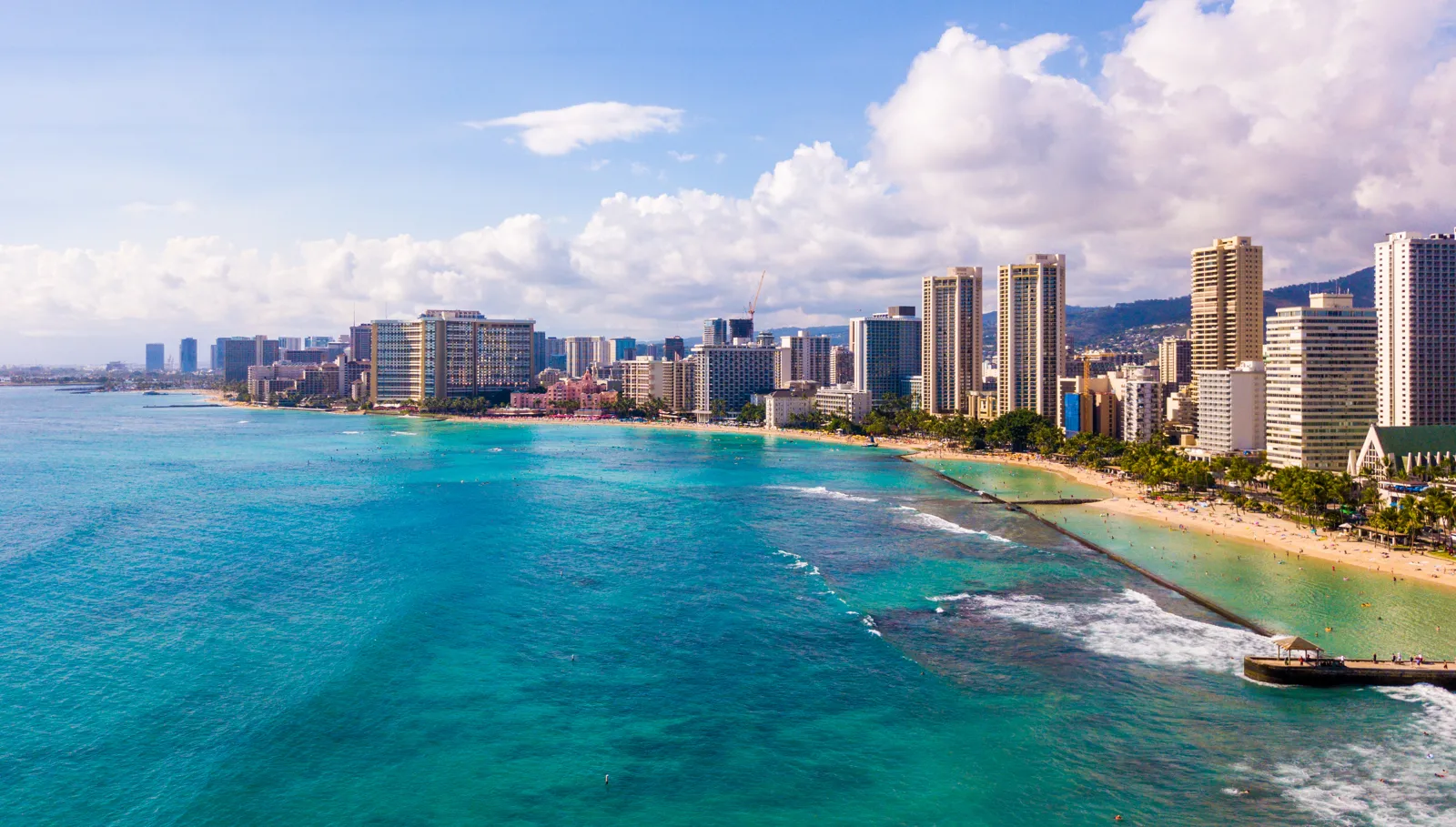
When is the best time to visit Hawaii? April to May and September to October: afternoons reach 28 to 31 °C (82 to 88 °F) in Honolulu, rainfall is low on the leeward coasts, and prices are gentler than in high season. Winter (December to March) is a little cooler and wetter, but it is humpback whale season and the season of the big waves on Oahu’s North Shore.
To decide when to go to Hawaii, keep in mind that the islands have a tropical climate with no real temperature seasons: between winter and summer, the average high varies by only 4 to 5 °C (39 to 41 °F). What changes everything is exposure. The trade winds blow from the northeast and dump their rain on the « windward » coasts (Hilo, Kauai’s north shore, the Road to Hana), while the « leeward » coasts (Waikiki, Kihei, Kona, Poipu) stay dry and sunny. About 420 mm (16.5 in) of rain falls a year at Honolulu airport, against more than 3,000 mm (118.1 in) at Hilo. Here is how to choose your period and your island, based on the official NOAA normals.

Our travel deals for Hawaii
Affiliate links: we earn a commission, at no extra cost to you.
 FlightsKiwi.comCompare flights and airline combinations to Hawaii.Compare flights
- eSIMAiraloData plan to install before you leave (eSIM-compatible phone).See plans


When to go to Hawaii at a glance
- Best times April–May and September–October
- Driest season May to September, with 13 to 22 mm (0.5 to 0.9 in) of rain a month in Honolulu
- Wettest season November to March, especially on trade-wind-exposed coasts
- Hottest month August, with an average high of 31.6 °C (89 °F) in Honolulu
- Coolest month January, with 26.9 °C (80 °F) in the afternoon and 19.3 °C (67 °F) at night in Honolulu
- Humpback whales generally December to April, mostly January to March
- High season mid-December to March, and June to August
- Hurricanes official season June to November in the central Pacific (NOAA); direct hits on the islands remain rare
When to go to Hawaii by priority
- Best weather: April–May and September–October; May to September are the driest months in Honolulu
- Cheapest: April–May and September to mid-November, outside school vacations and holidays
- Fewest crowds: April, May, September and October; the second half of December is the busiest period
- Events: humpback whales from December to April (mostly January to March), big swells on Oahu’s North Shore from November to February, Merrie Monarch Festival the week after Easter, Aloha Festivals in September
Hawaii: the calendar at a glance
✅ Best months: April, may, June, July, August, September, October
Hawaii climate: temperatures and rainfall month by month
The table below gives the normals for the Honolulu airport station, on Oahu’s south coast, close to Waikiki. They represent the islands’ dry coasts well. On windward coasts and at altitude, it rains much more: see the island comparison below.
| Month | Avg. max | Avg. min | Rain | Crowds | Prices | Verdict |
|---|---|---|---|---|---|---|
| January | 26.9 °C (80 °F) | 19.3 °C (67 °F) | 47 mm (1.9 in) | High | High | ⚠️ Cooler, showers, whales |
| February | 26.9 °C (80 °F) | 19.5 °C (67 °F) | 49 mm (1.9 in) | High | High | ⚠️ Showers, peak of whale season |
| March | 27.3 °C (81 °F) | 20.1 °C (68 °F) | 60 mm (2.4 in) | High (spring break) | High | ⚠️ The wettest month in Honolulu |
| April | 28.4 °C (83 °F) | 21.2 °C (70 °F) | 20 mm (0.8 in) | Moderate | Moderate | ✅ Less rain, gentler prices |
| May | 29.3 °C (85 °F) | 21.9 °C (71 °F) | 21 mm (0.8 in) | Moderate | Moderate | ✅ One of the best months |
| June | 30.5 °C (87 °F) | 23.2 °C (74 °F) | 13 mm (0.5 in) | High | High | ✅ Dry and sunny |
| July | 31.2 °C (88 °F) | 23.9 °C (75 °F) | 13 mm (0.5 in) | Very high | High | ✅ Dry, but summer crowds and prices |
| August | 31.6 °C (89 °F) | 24.2 °C (76 °F) | 21 mm (0.8 in) | High | High | ✅ The hottest, sea at its maximum |
| September | 31.3 °C (88 °F) | 23.8 °C (75 °F) | 22 mm (0.9 in) | Moderate | Moderate | ✅ Warm, dry and less busy |
| October | 30.5 °C (87 °F) | 23.3 °C (74 °F) | 38 mm (1.5 in) | Moderate | Moderate | ✅ Good compromise before the rains |
| November | 28.9 °C (84 °F) | 22.1 °C (72 °F) | 57 mm (2.2 in) | Moderate → high | Moderate → high | ⚠️ Rains return, north swells |
| December | 27.7 °C (82 °F) | 20.7 °C (69 °F) | 55 mm (2.2 in) | Very high at the end of the month | Very high | ⚠️ Holidays: prices at their highest |
Note: even in the wet season, Honolulu has only about 8 to 9 days of rain a month, often short showers. The sea stays warm all year in Honolulu, from about 25 °C (77 °F) in February–March to almost 28 °C (82 °F) in September (NOAA monthly averages).
Hawaii’s seasons: pros and cons
Dry season (April to October): sun, calm sea on the north
From April to October, the trade winds are steady, rain is scarce on the leeward coasts (less than 25 mm (1.0 in) a month in Honolulu from April to September) and the heat stays bearable thanks to the wind. The ocean is generally calm on the north coasts, which opens the beaches of Oahu’s North Shore and Kauai to swimming and snorkeling. Swells from the south tend to hit the south coast in summer.
- Pros: the least rain, warm sea, more practical hiking (less muddy trails), swimmable north coasts, long days
- Cons: heavy crowds and high prices in June, July and August; no whales; official hurricane season from June
- Our tip: aim for April–May or September–October to get summer weather with fewer people and more reasonable rates
Wet season (November to March): whales and big waves
From November to March, fronts and lows bring more rain, especially on windward coasts and in the mountains. Days stay warm (27 to 29 °C (81 to 84 °F) in the afternoon in Honolulu) and fine breaks are frequent on the south and west coasts. It is the season of humpback whales, which come to give birth in the islands’ shallow waters, and of winter swells on the north coasts: the waves of Oahu’s North Shore attract the world’s best surfers, but swimming there becomes dangerous.
- Pros: whale watching, the spectacle of big waves, very pleasant temperatures, greenery and waterfalls at their peak
- Cons: more frequent showers, roads and trails sometimes closed after heavy rain, dangerous swimming on the north coasts, prices and crowds at their highest over the year-end holidays
- Who is it for? Whale enthusiasts, experienced surfers and those who want to escape winter. Preferably stay on a leeward coast
When to go to Hawaii by island
The four most visited islands have similar temperatures but very different rainfall depending on the station. Comparison of the official normals for their airports:
| Month | Oahu (Honolulu) | Big Island (Hilo) | Maui (Kahului) | Kauai (Lihue) |
|---|---|---|---|---|
| January | 26.9 °C (80 °F) / 47 mm (1.9 in) | 25.9 °C (79 °F) / 200 mm (7.9 in) | 27.9 °C (82 °F) / 61 mm (2.4 in) | 25.9 °C (79 °F) / 71 mm (2.8 in) |
| February | 26.9 °C (80 °F) / 49 mm (1.9 in) | 25.8 °C (78 °F) / 260 mm (10.2 in) | 27.9 °C (82 °F) / 51 mm (2.0 in) | 25.6 °C (78 °F) / 92 mm (3.6 in) |
| March | 27.3 °C (81 °F) / 60 mm (2.4 in) | 25.8 °C (78 °F) / 322 mm (12.7 in) | 28.3 °C (83 °F) / 67 mm (2.6 in) | 25.8 °C (78 °F) / 142 mm (5.6 in) |
| April | 28.4 °C (83 °F) / 20 mm (0.8 in) | 26.1 °C (79 °F) / 239 mm (9.4 in) | 29.2 °C (85 °F) / 34 mm (1.3 in) | 26.6 °C (80 °F) / 52 mm (2.0 in) |
| May | 29.3 °C (85 °F) / 21 mm (0.8 in) | 27.1 °C (81 °F) / 178 mm (7.0 in) | 30.3 °C (87 °F) / 18 mm (0.7 in) | 27.6 °C (82 °F) / 55 mm (2.2 in) |
| June | 30.5 °C (87 °F) / 13 mm (0.5 in) | 27.7 °C (82 °F) / 185 mm (7.3 in) | 31.3 °C (88 °F) / 4 mm (0.2 in) | 28.5 °C (83 °F) / 45 mm (1.8 in) |
| July | 31.2 °C (88 °F) / 13 mm (0.5 in) | 28.2 °C (83 °F) / 235 mm (9.3 in) | 31.8 °C (89 °F) / 13 mm (0.5 in) | 29.2 °C (85 °F) / 44 mm (1.7 in) |
| August | 31.6 °C (89 °F) / 21 mm (0.8 in) | 28.3 °C (83 °F) / 287 mm (11.3 in) | 32.2 °C (90 °F) / 13 mm (0.5 in) | 29.6 °C (85 °F) / 59 mm (2.3 in) |
| September | 31.3 °C (88 °F) / 22 mm (0.9 in) | 28.5 °C (83 °F) / 221 mm (8.7 in) | 32.2 °C (90 °F) / 11 mm (0.4 in) | 29.6 °C (85 °F) / 55 mm (2.2 in) |
| October | 30.5 °C (87 °F) / 38 mm (1.5 in) | 28.0 °C (82 °F) / 260 mm (10.2 in) | 31.5 °C (89 °F) / 21 mm (0.8 in) | 28.8 °C (84 °F) / 83 mm (3.3 in) |
| November | 28.9 °C (84 °F) / 57 mm (2.2 in) | 26.8 °C (80 °F) / 366 mm (14.4 in) | 29.9 °C (86 °F) / 46 mm (1.8 in) | 27.3 °C (81 °F) / 102 mm (4.0 in) |
| December | 27.7 °C (82 °F) / 55 mm (2.2 in) | 26.0 °C (79 °F) / 307 mm (12.1 in) | 28.5 °C (83 °F) / 71 mm (2.8 in) | 26.2 °C (79 °F) / 118 mm (4.6 in) |
Oahu
Honolulu and Waikiki, on the south coast, are among the driest places in the islands: about 420 mm (16.5 in) a year, most of it from November to March. The windward coast (Kailua, Kaneohe) is wetter. The North Shore sees its big swells from November to February. Oahu can be visited year-round.
Big Island (Hawaii Island)
Hilo, on the east coast, is one of the rainiest cities in the United States: more than 3,000 mm (118.1 in) a year, spread over every month. By contrast, the Kona and Kohala coast, in the west, is dry and sunny. At the summit of Mauna Kea (4,207 m, or 13,803 ft) and in the volcano park, it is cool, even cold at night: pack a fleece and a windbreaker in any season.
Maui
Kahului, on the central isthmus, is very dry from May to October (less than 25 mm (1.0 in) a month). The south coast (Kihei, Wailea) and the west are sunny; the Road to Hana, in the east, crosses rainforest and its waterfalls, more spectacular after rain. At the summit of Haleakalā (3,055 m, or 10,023 ft), the temperature can approach 0 °C (32 °F) at sunrise. The waters between Maui, Lanai and Molokai are among the best whale-watching areas, from December to April.
Kauai
Kauai is the wettest of the four islands: 920 mm (36.2 in) a year at Lihue, and much more on the north coast (Hanalei, Princeville) and in the mountains. The south coast (Poipu) is the sunniest. From May to September, the sea is generally calmer on the Na Pali coast, which favors boat or kayak trips; in winter, the swell limits these excursions.

When to go to Hawaii by trip type
| Trip | Best time | What to plan |
|---|---|---|
| First trip, beaches and hiking | April–May, September–October | Two or three islands, inter-island flights |
| Whale watching | December to April, mostly January to March | Boat trips from Maui (Lahaina, Maalaea) or from Kona |
| Beginner surfing | Year-round at Waikiki | Lessons on the small waves of the south coast |
| Watching the big waves of Oahu’s North Shore | November to February | A spectacle from the beach, dangerous swimming |
| Snorkeling | April to October | Reef-safe sunscreen; check access rules for popular bays |
| Budget | April–May, September to mid-November | Outside school vacations and holidays |
| Honeymoon | May, September–October | Maui or Kauai, book early |
| Volcanoes and Mauna Kea | Year-round | Warm clothes at altitude, check the status of the volcanoes |
Major events to fit into your trip
US public holidays and school vacations (year-end holidays, spring break in March, summer) push up crowds and prices, notably on Oahu and Maui.
| Period | Event | Location |
|---|---|---|
| December to April | Humpback whale season | Mostly around Maui and the Big Island |
| November to February | Season of big swells and surf competitions, held only if the waves allow | Oahu’s North Shore |
| Week after Easter (exact dates at merriemonarch.com) | Merrie Monarch Festival, the major hula festival | Hilo (Big Island) |
| May 1 | Lei Day, flower garland celebration | Whole archipelago |
| June 11 | King Kamehameha Day, parades | Honolulu and other islands |
| September | Aloha Festivals, celebration of Hawaiian culture | Mainly Oahu |
| December | Honolulu Marathon | Honolulu |
Hawaii month by month
January: The coolest month, but still 26.9 °C (80 °F) in the afternoon in Honolulu. More frequent showers, whales well present, big waves on Oahu’s North Shore. High prices at the start of the month.
February: Very close to January, and one of the best periods for whales. Preferably stay on a leeward coast to limit the rain.
March: The wettest month in Honolulu (60 mm (2.4 in)) and very rainy in Hilo and on Kauai. US spring break: crowds rise.
April: Rain drops markedly (20 mm (0.8 in) in Honolulu), the last whales are visible early in the month. Gentler prices after Easter. Merrie Monarch Festival in Hilo.
May: Excellent: 29 °C (84 °F) in the afternoon, little rain, moderate crowds. One of the best weather-to-price ratios of the year. To compare with other destinations, see our picks for where to go in May.
June: Dry and sunny (13 mm (0.5 in) in Honolulu). Start of the summer season and of the official hurricane season. King Kamehameha Day on June 11.
July: Warm (31.2 °C (88 °F)), dry, calm sea on the north. The busiest month of the summer: book accommodation and cars early.
August: The hottest month (31.6 °C (89 °F)) and a very warm sea. Still many families. Watch the bulletins in case of a tropical storm.
September: Still warm and dry, but the families have gone: falling prices and quieter beaches. Aloha Festivals on Oahu.
October: Good compromise: 30.5 °C (87 °F), rain still low, moderate crowds. The first winter swells can reach the north coasts at the end of the month.
November: Rains return gradually (57 mm (2.2 in) in Honolulu, more than 360 mm (14.2 in) in Hilo). Prices still decent before Thanksgiving and the holidays.
December: Pleasant (27.7 °C (82 °F)), first whales, but the second half is the most expensive and in-demand period of the year.
When to book your trip to Hawaii
For the year-end holidays, February vacations and summer, book flights, accommodation and rental car 4 to 6 months ahead: supply is limited on the smaller islands and prices climb fast. In April–May and September–October, 2 to 4 months is generally enough. According to the National Park Service (nps.gov, checked 11 November 2026), a reservation is required to watch the sunrise at the summit of Haleakalā; book it on recreation.gov as soon as your dates are fixed.
Planning your trip to Hawaii
- Entry requirements: Hawaii is a US state; passport, visa and travel authorization rules depend on your nationality: see our entry requirements for the United States.
- Time difference: Hawaii is on Hawaii Standard Time (UTC−10) and does not observe daylight saving time: 5 hours behind New York in winter and 6 in summer; 10 hours behind London in winter and 11 in summer (details).
- Currency: the US dollar (USD). Bank cards are accepted almost everywhere; taxes are added to displayed prices and a tip is customary in restaurants. Our currency converter helps you estimate your budget.
- Health: medical care is very expensive: travel insurance covering medical costs, hospitalization and repatriation is strongly recommended. The sun is very strong all year: protect yourself, with reef-safe sunscreen.
- Natural hazards: according to the UK FCDO (GOV.UK, updated 18 August 2026), hurricanes can affect Hawaii, Hawaii is among the places at higher risk of earthquakes, and it has one of the largest numbers of active volcanoes in the US. Follow the advice of local authorities, including any evacuation orders, and Hawaii Volcanoes National Park updates.
To plan your stay on the ground, see our Hawaii travel guide: islands, must-sees, itineraries and budget.
Frequently asked questions
What is the best month to visit Hawaii?
May and September offer the best balance: about 29 to 31 °C (84 to 88 °F) in the afternoon in Honolulu, very little rain, moderate crowds and gentler prices than in summer or over the holidays. April and October are also excellent choices.
What is the rainy season in Hawaii?
It rains mostly from November to March. In Honolulu, it stays moderate (about 50 to 60 mm (2.0 to 2.4 in) a month at most), but on trade-wind-exposed coasts, such as Hilo, it rains a lot all year, with more than 3,000 mm (118.1 in) a year.
When can you see whales in Hawaii?
Humpback whales are generally present from December to April, with a peak from January to March. The waters around Maui are the most renowned for watching them.
Are there hurricanes in Hawaii?
The official central Pacific hurricane season runs from June to November (Central Pacific Hurricane Center, NOAA). Hurricanes hitting the islands directly are rare, but storms can bring heavy rain and swells: follow the weather bulletins if you travel during this period.
Is Hawaii cold in winter?
No, not by the sea: in January, the average high is 26.9 °C (80 °F) and the average low 19.3 °C (67 °F) in Honolulu. It is cold, however, at the summits of Haleakalā and Mauna Kea, especially at sunrise and sunset.
Which island should you choose by season?
In winter, prefer the leeward coasts: Waikiki on Oahu, Kihei and Wailea on Maui, Kona on the Big Island, Poipu on Kauai. In summer, all coasts are pleasant and Kauai’s very green north coast becomes more accessible.
When should you go to Hawaii to pay less?
April–May and September–October: prices are gentler (« moderate » level in our table) and the weather stays dry and warm in Honolulu (28 to 31 °C (82 to 88 °F) in the afternoon, 20 to 38 mm (0.8 to 1.5 in) of rain a month). Avoid the year-end holidays, February and summer, when prices are at their highest.
What should you pack for Hawaii?
Light clothing, a swimsuit, sunscreen and a windbreaker for showers, in any season. If you go up to the summit of Haleakalā (3,055 m, or 10,023 ft), add warm clothes: according to the National Park Service, temperatures there range from below 0 °C (32 °F) to a maximum of 10–18 °C (50–64 °F), about 17 °C (63 °F) lower than on the coast, with wind.
And the rest of the United States?
Hawaii is often combined with California. To plan a wider trip, see our United States travel guide. Looking for other Pacific islands? See also when to go to French Polynesia.
Our sources
- NOAA (National Weather Service): 1991–2020 normals, Honolulu International Airport station (Oahu); values converted to °C and mm
- Island comparison: 1991–2020 normals from NOAA (National Weather Service), airport stations at Honolulu (Oahu), Hilo (Big Island), Kahului (Maui) and Lihue (Kauai); values converted to °C and mm
- Natural hazards information read on 26 October 2026: UK FCDO, foreign travel advice for the USA (GOV.UK, updated 18 August 2026); Central Pacific Hurricane Center (NOAA), about the CPHC (hurricane season dates, checked 11 November 2026)
- NOAA NCEI, Coastal Water Temperature Guide: average monthly sea temperatures at Honolulu (Oahu), converted to °C, consulted October 2026
- National Park Service, Haleakalā National Park: sunrise reservations and weather (summit temperatures), checked 11 November 2026
- Our methodology
Updated November 2026.