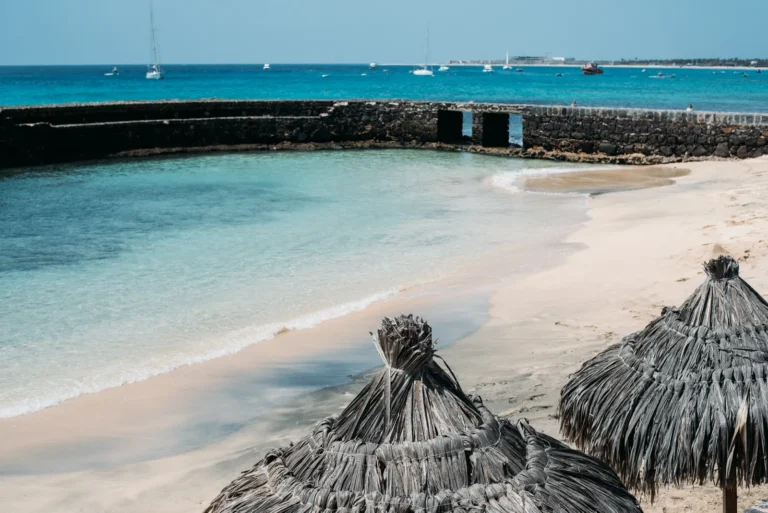
The best time to visit Mauritius is from May to December, and especially from September to mid-December: this is the dry season, with often clear skies, a calm sea on the west side and pleasant temperatures (27 to 30 °C (81 to 86 °F) in the afternoon on the coast). From January to March it is hotter and more humid, the heart of the cyclone season: you can go, but with a risk of a few days of bad weather. Before that peak, our page on the weather in Mauritius in December shows what remains favorable on the coast at the start of the austral summer.
Mauritius is a small island (about 60 km (37 mi) from north to south), but the climate changes noticeably from one coast to another: the east and south receive the trade winds and more showers, the west and northwest are sheltered and drier, and the central plateau, at altitude, is markedly cooler and wetter. Here is how to choose when to go to Mauritius, month by month, based on the official climate normals.

Our travel deals for Mauritius
Affiliate links: we earn a commission, at no extra cost to you.
 FlightsKiwi.comCompare flights and airline combinations to Mauritius.Compare flights
- eSIMAiraloData plan to install before you leave (eSIM-compatible phone).See plans


When to go to Mauritius: the essentials
- Best time: September to mid-December (dry, sunny, warm sea), then April–May
- Austral winter (May to October): cooler (26 to 28 °C (79 to 82 °F) in the afternoon on the coast), dry, stronger trade winds in the east and south
- Austral summer (November to April): hot and humid, more frequent showers, cyclone risk mainly from January to March
- West and north coasts: the driest all year, best in the austral winter
- Whales: roughly July to October, off the west coast
- Highest prices: Christmas, February, Easter, the late-October and early-November holidays, and July–August
When to go to Mauritius by priority
- Best weather: September to mid-December, then April–May
- Cheapest: May–June and September, outside school holidays
- Fewer crowds: March, May and June
- Events: humpback whales from about July to October, Maha Shivaratri in February or March, Divali in late October or November
To choose your coast and your hotel, see our Mauritius travel guide. October is the driest month: compare with our ideas for where to go in October.
Mauritius: the calendar at a glance
🔎 Month by month: Mauritius in January · Mauritius in February · Mauritius in March · Mauritius in April · Mauritius in may · Mauritius in June · Mauritius in July · Mauritius in August · Mauritius in September · Mauritius in October · Mauritius in November · Mauritius in December
✅ Best months: April, may, June, July, August, September, October, November, December
Mauritius climate: temperatures and rainfall month by month
The table below gives the normals for Port-Louis, on the sheltered northwest coast, representative of the beach areas of the west and north (Flic en Flac, Grand Baie, Trou aux Biches). The east and south coasts are a little cooler and wetter: see below. Port-Louis, Grand Baie and Flic en Flac are marked on our map of Mauritius.
| Month | Max | Min | Rain | Crowds | Prices | Verdict |
|---|---|---|---|---|---|---|
| January | 31.5 °C (89 °F) | 24.1 °C (75 °F) | 131 mm (5.2 in) | High (early Jan.) | High, then medium | Very hot, humid, cyclone risk ⚠️ |
| February | 31.4 °C (89 °F) | 24.0 °C (75 °F) | 160 mm (6.3 in) | Medium | Medium (high during February holidays) | Wettest month, cyclone peak ⚠️ |
| March | 31.5 °C (89 °F) | 23.8 °C (75 °F) | 83 mm (3.3 in) | Low | Medium | Still hot, cyclones possible ⚠️ |
| April | 30.7 °C (87 °F) | 23.0 °C (73 °F) | 87 mm (3.4 in) | Medium (Easter) | Medium to high | End of the rainy season, warm sea ✅ |
| May | 29.3 °C (85 °F) | 21.5 °C (71 °F) | 48 mm (1.9 in) | Low | Low | Dry and mild, good value ✅ |
| June | 27.6 °C (82 °F) | 19.9 °C (68 °F) | 24 mm (0.9 in) | Low | Low | Dry, ideal for the west coast, kitesurfing ✅ |
| July | 26.7 °C (80 °F) | 19.3 °C (67 °F) | 18 mm (0.7 in) | Medium to high | High (summer holidays) | Cool evenings, dry, whales ✅ |
| August | 26.8 °C (80 °F) | 19.1 °C (66 °F) | 19 mm (0.7 in) | High | High | Dry, strong wind in the east ✅ |
| September | 27.7 °C (82 °F) | 19.4 °C (67 °F) | 17 mm (0.7 in) | Medium | Medium | Dry, very sunny, whales ✅ |
| October | 28.8 °C (84 °F) | 20.4 °C (69 °F) | 15 mm (0.6 in) | Medium (high at the end-of-October holidays) | Medium to high | Driest month, ideal ✅ |
| November | 30.2 °C (86 °F) | 21.8 °C (71 °F) | 24 mm (0.9 in) | Medium | Medium | Hot and still dry ✅ |
| December | 31.1 °C (88 °F) | 23.2 °C (74 °F) | 85 mm (3.3 in) | High (holidays) | Very high in late December | Start of the rains, very hot ✅ |
Note: on the west coast, very little rain falls from May to November (less than 50 mm (2.0 in) a month in Port-Louis). January–February rainfall comes mostly from heavy thundery showers and cyclonic episodes, concentrated over a few days. The start of the austral winter is covered in our page Mauritius in May.
Mauritius’s seasons: pros and cons
Austral winter (May to October): dry and temperate
This is the dry season. Daytime temperatures remain pleasant, between 26 to 29 °C (79 to 84 °F) in Port-Louis, but nights are cooler (around 19 °C (66 °F) on the coast, 16 °C (61 °F) on the central plateau). The southeast trade winds blow harder, making the east and south coasts windy, with a rougher sea. The water temperature drops, but swimming remains possible.
- Pros: very little rain in the west and north, no cyclones, ideal for hiking (Black River Gorges, Le Morne), kitesurfing and whale watching
- Cons: cool evenings (pack a sweater), wind sometimes bothersome on the east coast, less warm water in July–August
- To avoid: July–August if you want low prices, because of European school holidays
- Our tip: in the austral winter, stay preferably on the west or north coast, more sheltered from the wind
Austral summer (November to April): hot, humid and cyclone season

Summer is hot and humid: more than 31 °C (88 °F) in the afternoon in Port-Louis from December to March, with humidity making the heat feel heavier. The sea is at its warmest. Showers are frequent, often brief and in the late day. This is also the tropical cyclone season, which usually runs from November to May according to the UK FCDO (GOV.UK, updated 19 October 2026), with the highest risk from January to March. A cyclone does not hit Mauritius every year, but a close pass can bring several days of rain and wind. The FCDO says that if a cyclone happens you should follow the advice of the Mauritian government information service, that the Mauritius Meteorological Services has a system of phased warnings, and that during a cyclone you are not allowed to leave your accommodation. November opens this season with a still limited risk: our page Mauritius in November details the weather and the sea that month.
- Pros: the warmest sea of the year, lush vegetation, a good period for diving (clear water between rainy spells) and big-game fishing
- Cons: muggy heat, showers, cyclone risk, very high prices over the year-end holidays
- Who is it for? Travelers who want heat and accept some weather risk, especially in November–December and April, which are safer than the height of summer
The shoulder seasons: April–May and October–November
These are often the best compromises. In April–May, the cyclone season ends, the sea is still warm and crowds thin out (outside the Easter holidays). In October–November, it is the driest time of year on the west coast, with temperatures rising and a warming sea. This driest time on the west coast is covered in our page Mauritius in October, with temperatures and crowds.
When to go to Mauritius by coast
On an island this small, exposure to the wind and altitude matter more than distance. Comparison of the normals for the northwest coast (Port-Louis), the central plateau (Vacoas) and Rodrigues island:
| Month | Port-Louis (northwest) | Vacoas (central plateau) | Rodrigues |
|---|---|---|---|
| January | 31.5 / 24.1 °C (89 / 75 °F), 131 mm (5.2 in) | 28.1 / 21.3 °C (83 / 70 °F), 314 mm (12.4 in) | 29.2 / 23.6 °C (85 / 74 °F), 150 mm (5.9 in) |
| April | 30.7 / 23.0 °C (87 / 73 °F), 87 mm (3.4 in) | 26.7 / 20.4 °C (80 / 69 °F), 176 mm (6.9 in) | 28.7 / 23.0 °C (84 / 73 °F), 117 mm (4.6 in) |
| July | 26.7 / 19.3 °C (80 / 67 °F), 18 mm (0.7 in) | 22.1 / 16.0 °C (72 / 61 °F), 118 mm (4.6 in) | 25.0 / 19.1 °C (77 / 66 °F), 81 mm (3.2 in) |
| September | 27.7 / 19.4 °C (82 / 67 °F), 17 mm (0.7 in) | 23.1 / 16.2 °C (74 / 61 °F), 77 mm (3.0 in) | 25.4 / 19.3 °C (78 / 67 °F), 44 mm (1.7 in) |
| October | 28.8 / 20.4 °C (84 / 69 °F), 15 mm (0.6 in) | 24.5 / 17.2 °C (76 / 63 °F), 61 mm (2.4 in) | 26.3 / 20.1 °C (79 / 68 °F), 41 mm (1.6 in) |
| December | 31.1 / 23.2 °C (88 / 74 °F), 85 mm (3.3 in) | 27.5 / 20.1 °C (82 / 68 °F), 165 mm (6.5 in) | 28.7 / 22.8 °C (84 / 73 °F), 71 mm (2.8 in) |
West and northwest coast (Flic en Flac, Tamarin, Le Morne)
The driest and sunniest coast, sheltered from the trade winds. It suits all year, and it is the best option from May to November. Sunsets can be watched over the sea. Tamarin Bay is known for its dolphins and, from about July to October, for passing humpback whales. In the middle of the austral winter, our page Mauritius in July compares the east and west coasts.
North coast (Grand Baie, Trou aux Biches, Cap Malheureux)
A climate close to the west’s, fairly dry and protected from the wind. This is the liveliest area, with many restaurants and departures for excursions to the northern islets. Pleasant almost all year, especially from May to December.
East and southeast coast (Belle Mare, Trou d’Eau Douce, Mahébourg)
Exposed to the southeast trade winds: windier, a little cooler and wetter, especially in the austral winter. The wind is welcome in summer, when it tempers the heat. The finest months for the east run from September to December. This is also the side of Île aux Cerfs and the Blue Bay lagoon. The international airport, at Plaine Magnien, is in the southeast. Our page Mauritius in September gives the month’s official normals.
South coast (Le Souffleur, Gris-Gris, Bel Ombre)
The wildest coast, with little coral barrier in places and an often strong sea. It is wetter and windier in the austral winter: favor October to December if you stay there.
The central plateau (Curepipe, Vacoas, Grand Bassin)
Located several hundred meters above sea level, it is markedly cooler (about 22 °C (72 °F) in the afternoon and 16 °C (61 °F) at night in July at Vacoas) and wet all year: more than 300 mm (11.8 in) a month in January–February. People pass through for the sights (Grand Bassin, Black River Gorges, Trou aux Cerfs) rather than to stay.
And Rodrigues?
Rodrigues island has a slightly drier climate, but it is also exposed to cyclones from November to April. The driest months there run from September to November, with less than 45 mm (1.8 in) of rain a month in September–October.
Which coast in which month?
The west and north are the driest; the east and south, exposed to the trade winds, are more pleasant from September.
| Region | Jan | Feb | Mar | Apr | May | Jun | Jul | Aug | Sep | Oct | Nov | Dec |
|---|---|---|---|---|---|---|---|---|---|---|---|---|
| West and north coasts (Flic en Flac, Grand Baie) | ⚠️ | ⚠️ | ⚠️ | ✅ | ✅ | ✅ | ✅ | ✅ | ✅ | ✅ | ✅ | ✅ |
| East and southeast coast (Belle Mare, Blue Bay) | ⚠️ | ⚠️ | ⚠️ | ⚠️ | ⚠️ | ⚠️ | ⚠️ | ⚠️ | ✅ | ✅ | ✅ | ✅ |
| South coast (Bel Ombre, Gris-Gris) | ⚠️ | ⚠️ | ⚠️ | ⚠️ | ⚠️ | ⚠️ | ⚠️ | ⚠️ | ⚠️ | ✅ | ✅ | ✅ |
| Rodrigues | ⚠️ | ⚠️ | ⚠️ | ⚠️ | ⚠️ | ⚠️ | ⚠️ | ⚠️ | ✅ | ✅ | ✅ | ⚠️ |

When to go to Mauritius by type of trip
| Your trip | Best time | Where? |
|---|---|---|
| Beach and relaxing | September – December, April – May | West and north coasts; east coast from September to December |
| Honeymoon | October – November, or May | Le Morne, Belle Mare, Grand Baie |
| Diving and snorkeling | October – April, outside cyclonic episodes | Blue Bay, Trou aux Biches, Flic en Flac |
| Whale watching | July – October or so | Off the west coast (Tamarin) |
| Kitesurfing and windsurfing | June – September (steady trade winds) | Le Morne, Pointe d’Esny, Belle Mare |
| Hiking | May – November | Black River Gorges, Le Morne Brabant, Pieter Both |
| Big-game fishing | October – April | West coast (Black River) |
| Budget | May – June, September, outside school holidays | West and north coasts, in an apartment or guesthouse |
| Family trip | Late-October/early-November holidays and April–May | West and north coasts, calm lagoons |
Major events to plan your trip around
| Period | Event | Location |
|---|---|---|
| January or February (lunar calendar) | Chinese New Year | Port Louis (Chinatown) |
| January or February | Thaipoosam Cavadee (Tamil festival) | Temples across the island |
| February or March | Maha Shivaratri: Hindu pilgrimage to Grand Bassin | Grand Bassin (Ganga Talao) |
| March 12 | Independence and Republic Day | Nationwide |
| Late October or November | Divali, the festival of lights | Nationwide |
| July – October or so | Humpback whale season | West coast |
Mauritius month by month: what to expect
January: Very hot (31 °C (88 °F) in the afternoon in Port-Louis), humid, with thundery showers and cyclone risk. Prices stay high until the end of the Christmas holidays, then drop.
February: The wettest month and the heart of the cyclone season. Very warm sea. The February holidays push prices up.
March: Still hot and humid, cyclones possible. Fewer tourists: a possible month if your dates are flexible and your insurance suitable.
April: Rains drop markedly (87 mm (3.4 in) in Port-Louis), the sea stays warm. A good month, outside the Easter holidays.
May: Dry season, 29 °C (84 °F) in the afternoon, few crowds and fairly low prices. One of the best-value months of the year.
June: Dry and mild (27 to 28 °C (81 to 82 °F)). The wind strengthens in the east: stay in the west or north. A good month for hiking and kitesurfing.
July: The coolest month: 27 °C (81 °F) in the afternoon on the coast, 19 °C (66 °F) at night. Start of whale season, but summer holidays and higher prices.
August: Dry, cool weather, steady trade winds on the east coast. Heavy crowds and high prices because of the European holidays.
September: Very dry (17 mm (0.7 in) in Port-Louis) and sunny, temperatures rising, whales still visible. An excellent month, with fewer people.
October: The driest month of the year on the west coast. Temperatures approach 29 °C (84 °F). Book early for the end-of-October holidays.
November: Hot (30 °C (86 °F)) and still dry, the sea warming up. Official start of the cyclone season, but the risk remains low early in the season.
December: Very hot and wetter, showers return. The Christmas holidays make it the most expensive period of the year: book well in advance.
When to book your trip to Mauritius
For Christmas, February, the late-October holidays and July–August, book flights and hotels 4 to 6 months ahead: the best-placed beach hotels fill early and flight fares climb markedly. Outside school holidays (May–June, September, November), 2 to 3 months is generally enough.
Planning your trip to Mauritius
- Entry requirements: they depend on your nationality; see our entry requirements for Mauritius in the Mauritius travel guide.
- Time difference: Mauritius is UTC+4 all year and does not change its clocks.
- Currency: the Mauritian rupee (MUR). Cards are accepted in hotels and most restaurants; keep cash for markets and small shops. Our currency converter helps you estimate your budget.
- Cyclones: if you travel between November and May, follow the Mauritius Meteorological Services bulletins and respect the instructions during an alert (UK FCDO, GOV.UK, updated 19 October 2026).
- Health: the UK FCDO lists dengue, schistosomiasis and chikungunya among the health risks in Mauritius (GOV.UK, updated 19 October 2026). Protect yourself from the sun and mosquitoes. Travel insurance is recommended, in particular to cover a cancellation or postponement linked to a cyclone.
To organize your stay, see our complete Mauritius travel guide, as well as our other destinations in Africa and the Indian Ocean.
Frequently asked questions
What is the best month to visit Mauritius?
October and November are often considered the best months: this is the driest period on the west coast, temperatures exceed 28 °C (82 °F) and the sea warms up. September, April and May are also very good choices.
When is cyclone season in Mauritius?
The tropical cyclone season in Mauritius usually runs from November to May according to the UK FCDO, with the highest risk from January to March. Not every year is affected, but a nearby cyclone can bring several days of rain and wind.
Is it cold in Mauritius in July–August?
No, but it is the austral winter: about 27 °C (81 °F) in the afternoon on the coast and 19 °C (66 °F) at night in Port-Louis, and cooler still on the central plateau. Pack a sweater for evenings and a windbreaker on the east coast. Our page Mauritius in June details the start of the austral winter.
What is the cheapest time to go to Mauritius?
May, June and September, outside school holidays, generally offer the best prices, with dry weather. January to March can also be cheaper outside the holidays, but with cyclone risk.
Which coast should you choose by season?
From May to October, favor the west (Flic en Flac, Le Morne, Tamarin) or the north (Grand Baie), sheltered from the trade winds. From September to April, the east coast (Belle Mare, Trou d’Eau Douce) is also very pleasant, the wind tempering the heat. Our guide to Le Morne presents the mountain and its beach.
When can you see whales in Mauritius?
Humpback whales pass off the west coast from about July to October, during their migration. Boat trips leave mainly from Tamarin and Black River.
Can’t decide between several islands? Compare with when to go to Réunion, when to go to the Seychelles and when to go to the Maldives.
Our sources
- World Meteorological Organization (World Weather Information Service): Port-Louis station normals
- NOAA / WMO: 1991–2020 climate normals for the Vacoas station
- Mauritius Meteorological Services: normals for Rodrigues
- Cyclone and health information read on 26 October 2026: UK FCDO, foreign travel advice for Mauritius (GOV.UK, updated 19 October 2026),
- Our methodology
Updated November 2026.