The best time to visit the Maldives is January to April: this is the dry season of the northeast monsoon, with the most sunshine, a generally calm sea and little rain around Malé (only 38 mm (1.5 in) in February). From May to November, the southwest monsoon brings more frequent showers and a rougher sea, but also lower prices and the manta ray season in Baa. As for temperatures, the Maldives stay hot all year (30 to 32 °C, or 86 to 90 °F, in the afternoon in Malé): it is rain and sea conditions that set the seasons apart.
It is hot all year: between 30 and 32 °C (86 to 90 °F) in the afternoon and about 25 to 27 °C (77 to 81 °F) at night, whatever the month. So the choice of dates comes down mostly to rainfall, sea conditions, budget and how much diving you want to do. Here is how to choose, based on the official 1991–2020 climate normals published by the World Meteorological Organization.

Our travel deals for Maldives
Affiliate links: we earn a commission, at no extra cost to you.
 FlightsKiwi.comCompare flights and airline combinations to Maldives.Compare flights
- eSIMAiraloData plan to install before you leave (eSIM-compatible phone).See plans


When to go to the Maldives at a glance
- Best time overall January to April (dry season, northeast monsoon)
- Driest months in Malé February and March (less than 50 mm (2.0 in) of rain)
- Wetter season May to November (southwest monsoon), with a first rainfall peak in May
- Temperatures stable all year, about 30–32 °C (86–90 °F) by day and 25–27 °C (77–81 °F) at night
- North or south? The northern atolls have a more pronounced dry season; the far south (Addu) gets rain all year
- Best value May–June and September–October, outside peak holiday periods
- Marine life manta rays at Hanifaru (Baa Atoll) usually from June to November; whale sharks in South Ari all year
When to go to the Maldives by priority
- Best weather: January to April, with February and March the driest months in Malé
- Cheapest: May, June, September and October, outside peak holiday periods; the most expensive period runs from mid-December to early January
- Fewest crowds: May, June, September and October (wet season, frequent showers)
- Events and wildlife: manta rays usually from June to November at Hanifaru (Baa), Independence Day on July 26; Ramadan and Eid on variable dates
Maldives: the calendar at a glance
✅ Best months: January, February, March, April
❌ Period to avoid: may
The climate in the Maldives month by month
The table below gives the normals for Malé (Velana International Airport station, on Hulhulé Island), the arrival point for almost all travelers and representative of the central atolls, where most hotels are located (North and South Malé, Ari, Baa). The differences between north and south are detailed further down. Our map of the Maldives shows where these atolls are.
| Month | High (°C) | Low (°C) | Rainfall (mm) | Rainy days | Crowds | Prices | Verdict |
|---|---|---|---|---|---|---|---|
| January | 30.6 °C (87 °F) | 26.0 °C (79 °F) | 87 mm (3.4 in) | 5.5 | Very high | Very high | ✅ Dry and sunny |
| February | 31.0 °C (88 °F) | 26.3 °C (79 °F) | 38 mm (1.5 in) | 3.2 | High | High | ✅ The driest month |
| March | 31.6 °C (89 °F) | 26.8 °C (80 °F) | 49 mm (1.9 in) | 4.5 | High | High | ✅ Dry, sea often very calm |
| April | 31.9 °C (89 °F) | 27.1 °C (81 °F) | 127 mm (5.0 in) | 8.5 | High (Easter) | High | ✅ The hottest month, transition at the end of the month |
| May | 31.5 °C (89 °F) | 26.6 °C (80 °F) | 238 mm (9.4 in) | 15.0 | Low | Low | ❌ Monsoon arrives, one of the two wettest months |
| June | 31.1 °C (88 °F) | 26.4 °C (80 °F) | 146 mm (5.7 in) | 12.9 | Low | Low | ⚠️ Frequent showers, rougher sea |
| July | 30.8 °C (87 °F) | 25.9 °C (79 °F) | 198 mm (7.8 in) | 13.7 | Medium | Medium | ⚠️ Humid, European holidays |
| August | 30.7 °C (87 °F) | 25.9 °C (79 °F) | 193 mm (7.6 in) | 13.0 | Medium | Medium | ⚠️ Humid, European holidays |
| September | 30.5 °C (87 °F) | 25.7 °C (78 °F) | 214 mm (8.4 in) | 15.3 | Low | Low | ⚠️ Rainy, low prices |
| October | 30.5 °C (87 °F) | 25.7 °C (78 °F) | 245 mm (9.6 in) | 15.2 | Low | Low | ⚠️ Rainy, transition between the two monsoons |
| November | 30.4 °C (87 °F) | 25.5 °C (78 °F) | 236 mm (9.3 in) | 14.2 | Medium | Medium | ⚠️ Still rainy, improving at the end of the month |
| December | 30.4 °C (87 °F) | 25.6 °C (78 °F) | 212 mm (8.3 in) | 12.0 | Very high (holidays) | Very high | ⚠️ Start of the dry season, still some showers |
Worth knowing: even in the wet season, it rarely rains all day. Rain often falls in heavy showers or thunderstorms, interspersed with sunny spells. Spells of several gray, windy days do occur, however, especially in May and between September and November.
The seasons in the Maldives: pros and cons
The Maldives’ climate follows two monsoons. The northeast monsoon (iruvai in Dhivehi), from about December to April, brings dry, sunny weather. The southwest monsoon (hulhangu), from about May to November, brings more wind, cloud and rain. The transition months (April–May and November–December) vary the most from year to year. These monsoon months do not have the same effect everywhere in the Indian Ocean: our comparison to help you choose between the Maldives and the Seychelles sets the seasons side by side.
Dry season (December to April): high season

This is the most popular period. In Malé, from January to March, less than 90 mm (3.5 in) of rain falls per month, with only 3 to 6 rainy days. The sky is mostly clear, the wind light and the sea calm: ideal conditions for the beach, snorkeling and seaplane transfers.
- Pros: sunshine, calm sea, very good underwater visibility in many areas, transfers rarely disrupted
- Cons: prices at their highest, especially from mid-December to early January and at Easter; the most popular hotels fill up early
- Good to know: December is still a transition month, with rain around Malé (212 mm (8.3 in) on average)
- Our tip: February and March offer the best conditions, with fewer people than over the holidays
Wet season (May to November): bargain season
The southwest monsoon usually arrives in May, one of the two wettest months in Malé along with October (238 mm (9.4 in), 15 rainy days). Rainfall then stays at around 150 to 250 mm (5.9 to 9.8 in) per month until December. The temperature barely drops, but wind and swell increase, especially on the exposed sides of the atolls.
- Pros: much lower prices, frequent hotel promotions, manta ray season in Baa Atoll, best surfing season
- Cons: more cloudy days, sometimes a rough sea, reduced underwater visibility in places, some boat or seaplane transfers delayed
- Who is it for? Budget travelers, surfers and manta ray enthusiasts
When to go to the Maldives by region
The archipelago stretches about 800 km (497 mi) from north to south, on both sides of the equator. Temperatures vary little from one atoll to another, but the distribution of rainfall changes markedly: the dry season is very pronounced in the north and becomes less and less clear heading south. Comparison of the normals for four stations:
| Month | Hanimaadhoo (north) | Malé (center) | Kadhdhoo (Laamu, south) | Gan (Addu, far south) |
|---|---|---|---|---|
| January | 30.8 °C (87 °F) / 39 mm (1.5 in) | 30.6 °C (87 °F) / 87 mm (3.4 in) | 30.7 °C (87 °F) / 132 mm (5.2 in) | 30.7 °C (87 °F) / 204 mm (8.0 in) |
| February | 31.2 °C (88 °F) / 29 mm (1.1 in) | 31.0 °C (88 °F) / 38 mm (1.5 in) | 31.2 °C (88 °F) / 81 mm (3.2 in) | 31.2 °C (88 °F) / 79 mm (3.1 in) |
| March | 32.1 °C (90 °F) / 33 mm (1.3 in) | 31.6 °C (89 °F) / 49 mm (1.9 in) | 32.0 °C (90 °F) / 85 mm (3.3 in) | 31.6 °C (89 °F) / 121 mm (4.8 in) |
| April | 32.6 °C (91 °F) / 67 mm (2.6 in) | 31.9 °C (89 °F) / 127 mm (5.0 in) | 32.4 °C (90 °F) / 163 mm (6.4 in) | 31.6 °C (89 °F) / 173 mm (6.8 in) |
| May | 32.0 °C (90 °F) / 235 mm (9.3 in) | 31.5 °C (89 °F) / 238 mm (9.4 in) | 31.8 °C (89 °F) / 279 mm (11.0 in) | 31.3 °C (88 °F) / 243 mm (9.6 in) |
| June | 31.0 °C (88 °F) / 229 mm (9.0 in) | 31.1 °C (88 °F) / 146 mm (5.7 in) | 31.7 °C (89 °F) / 112 mm (4.4 in) | 31.2 °C (88 °F) / 144 mm (5.7 in) |
| July | 30.7 °C (87 °F) / 261 mm (10.3 in) | 30.8 °C (87 °F) / 198 mm (7.8 in) | 31.5 °C (89 °F) / 162 mm (6.4 in) | 30.8 °C (87 °F) / 198 mm (7.8 in) |
| August | 30.6 °C (87 °F) / 222 mm (8.7 in) | 30.7 °C (87 °F) / 193 mm (7.6 in) | 31.3 °C (88 °F) / 195 mm (7.7 in) | 30.7 °C (87 °F) / 196 mm (7.7 in) |
| September | 30.7 °C (87 °F) / 174 mm (6.9 in) | 30.5 °C (87 °F) / 214 mm (8.4 in) | 31.2 °C (88 °F) / 239 mm (9.4 in) | 30.6 °C (87 °F) / 224 mm (8.8 in) |
| October | 30.8 °C (87 °F) / 199 mm (7.8 in) | 30.5 °C (87 °F) / 245 mm (9.6 in) | 31.1 °C (88 °F) / 271 mm (10.7 in) | 30.6 °C (87 °F) / 244 mm (9.6 in) |
| November | 30.8 °C (87 °F) / 172 mm (6.8 in) | 30.4 °C (87 °F) / 236 mm (9.3 in) | 31.0 °C (88 °F) / 264 mm (10.4 in) | 30.5 °C (87 °F) / 235 mm (9.3 in) |
| December | 30.7 °C (87 °F) / 108 mm (4.3 in) | 30.4 °C (87 °F) / 212 mm (8.3 in) | 30.7 °C (87 °F) / 261 mm (10.3 in) | 30.5 °C (87 °F) / 226 mm (8.9 in) |
The northern atolls (Haa Alifu, Haa Dhaalu, Shaviyani, Raa, Baa)
The north has the clearest dry season: in Hanimaadhoo, less than 40 mm (1.6 in) of rain falls per month from January to March, and December is already relatively dry (108 mm (4.3 in)). On the other hand, from May to August the rains here are the heaviest in the archipelago (more than 220 mm (8.7 in) per month). December to April is the ideal period. Baa Atoll is an exception for manta ray enthusiasts, as the rays gather there during the southwest monsoon.
The central atolls (North and South Malé, Ari, Vaavu)
Most of the hotels are here, a few dozen minutes by boat or seaplane from the airport. The profile is that of Malé: January to April is dry and sunny, followed by a wet season from May to December. Ari Atoll, to the west, is known for whale sharks, seen in the south of the atoll all year.
The southern atolls (Laamu, Huvadhoo, Fuvahmulah, Addu)
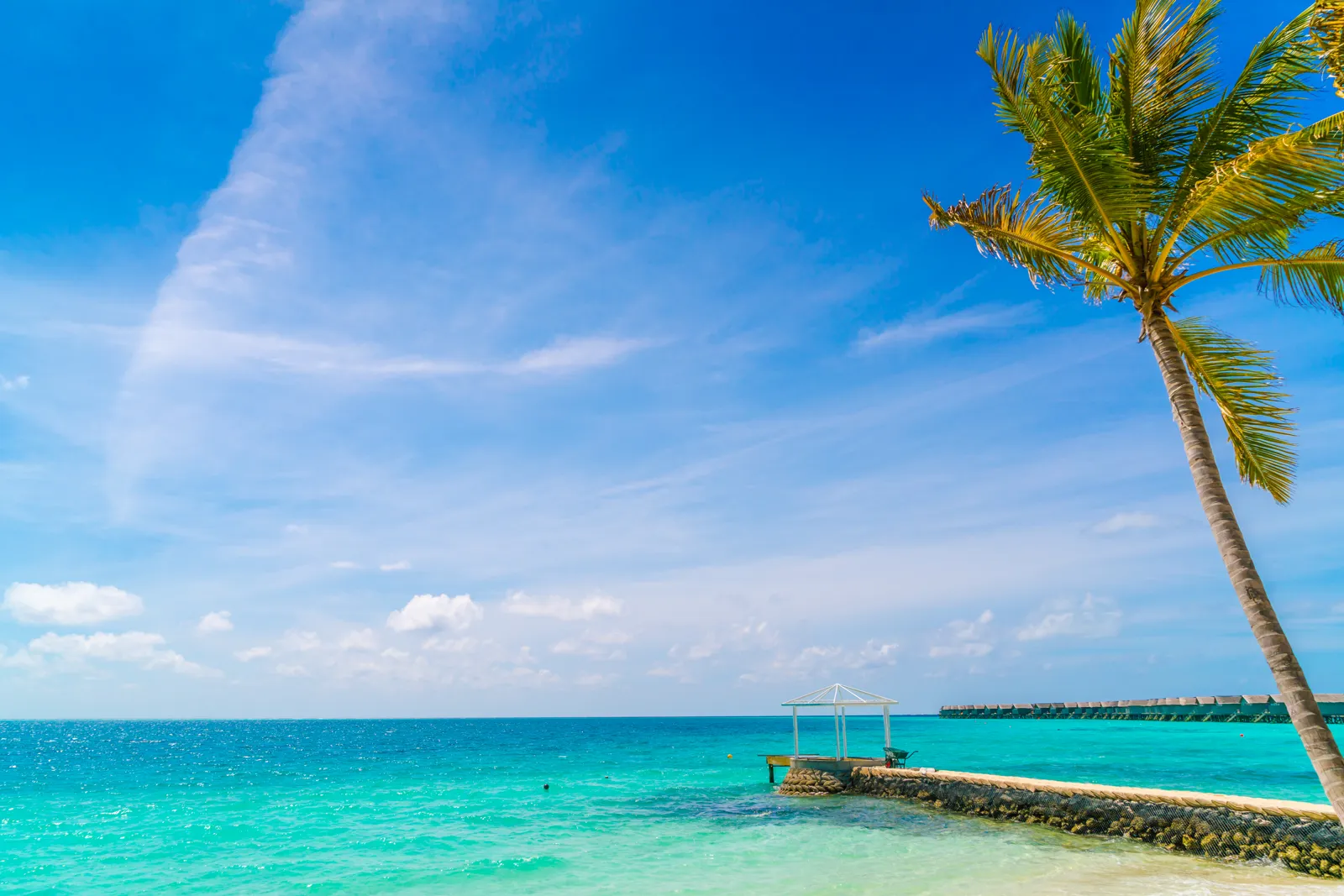
Close to the equator, the seasons are less distinct. In Gan (Addu Atoll), it rains all year, including in January (204 mm (8.0 in)); February is the only really dry month (79 mm (3.1 in)). Conversely, the south is often a little less wet than the north in June. If you travel from June to August, the southern atolls are an option to consider; for a stay in January–March, the central and northern atolls are a safer bet for the weather. Before booking, check the visa and IMUGA guide for the Maldives for entry formalities.
Which atoll by month?
Rainfall varies markedly from north to south of the archipelago. This table rates each month according to the normal rainfall of the four stations mentioned above.
| Region | Jan | Feb | Mar | Apr | May | June | Jul | August | Sep | Oct | Nov | Dec |
|---|---|---|---|---|---|---|---|---|---|---|---|---|
| North (Hanimaadhoo, Baa, Raa) | ✅ | ✅ | ✅ | ✅ | ❌ | ❌ | ❌ | ❌ | ⚠️ | ⚠️ | ⚠️ | ✅ |
| Central (Malé, Ari, Vaavu) | ✅ | ✅ | ✅ | ⚠️ | ❌ | ⚠️ | ⚠️ | ⚠️ | ❌ | ❌ | ❌ | ❌ |
| South (Laamu, Kadhdhoo) | ⚠️ | ✅ | ✅ | ⚠️ | ❌ | ⚠️ | ⚠️ | ⚠️ | ❌ | ❌ | ❌ | ❌ |
| Far south (Addu, Gan) | ❌ | ✅ | ⚠️ | ⚠️ | ❌ | ⚠️ | ⚠️ | ⚠️ | ❌ | ❌ | ❌ | ❌ |
To choose your island and accommodation, see our Maldives travel guide.

When to go to the Maldives by trip type
| Your trip | Best time | Where? |
|---|---|---|
| Beach and relaxation | January to April | All atolls, preferably central and northern |
| Honeymoon | February–March, or June and September for a lower budget | Malé, Ari and Baa atolls |
| Manta rays | Usually June to November (Hanifaru); at other sites the rest of the year | Baa Atoll (Hanifaru Bay), Ari, Addu |
| Whale sharks | All year | South Ari Atoll (Dhigurah, Maamigili) |
| Scuba diving | January to April for visibility; all year depending on the site | Ari, North and South Malé, Vaavu, Fuvahmulah |
| Surfing | Usually March to October | North Malé Atoll, southern atolls |
| Tight budget (local islands) | May–June, September–October | Maafushi, Thoddoo, Dhigurah, Ukulhas |
| Family trip | Winter and spring school holidays; July–August at lower prices | Atolls close to Malé (boat transfer) |
Major events to plan your trip around
| Period | Event | What to know |
|---|---|---|
| Late December – early January | Year-end holidays | Prices at their highest, very early booking needed |
| Depends on the lunar calendar (variable dates) | Ramadan | On local islands, restaurants are often closed during the day; little change in hotels |
| End of Ramadan and about two months later | Eid al-Fitr and Eid al-Adha | Public holidays, festive atmosphere on local islands |
| July 26 | Independence Day | Celebrations in Malé |
| Easter, July–August | School holidays in Europe and North America | Higher prices and demand |
The Maldives month by month
January: Right in the middle of the dry season: sunshine, calm sea and about 31 °C (88 °F). Still a few showers around Malé (87 mm (3.4 in)) and significantly more in the far south. High prices, especially in the first week.
February: The driest month in Malé (38 mm (1.5 in), about 3 rainy days) and across almost the whole archipelago. It is often the best month, but also one of the busiest.
March: Still very dry and sunny, with a sea that is often calm. An excellent month for the beach and diving. Temperatures rise slightly.
April: The hottest month (nearly 32 °C (90 °F) in the afternoon, 27 °C (81 °F) at night). Fine weather at the start of the month, then a transition: showers return in the second half. High demand at Easter.
May: The southwest monsoon arrives: one of the two wettest months in Malé (238 mm (9.4 in), 15 rainy days). Prices drop sharply. Best left to flexible travelers.
June: Rainfall eases a little in Malé (146 mm (5.7 in)) and in the south, but stays heavy in the north. A good time for promotions, and the start of the manta ray season in Baa.
July: Changeable weather, frequent but often brief showers. European holidays: average prices. Manta ray season at Hanifaru and good waves for surfing.
August: Same profile as July, with around 190 mm (7.5 in) of rain in Malé. A good compromise for a family trip in summer, if you accept a few gray days.
September: Rainy (214 mm (8.4 in) in Malé) and often windy. One of the cheapest months of the year. Manta rays are still present in Baa Atoll.
October: The wettest month of the year in Malé (245 mm (9.6 in)), just ahead of May. Low prices. The end of the southwest monsoon is on its way.
November: Still humid (236 mm (9.3 in)), but the weather often improves toward the end of the month as the northeast monsoon arrives. Moderate prices before the holidays.
December: The dry season begins in the north, with still some showers in the center and south. Very high prices and crowds from mid-December.
When to book your trip to the Maldives
For high season, and especially Christmas, New Year and Easter, book 4 to 6 months ahead: the most popular villa categories (overwater, with pool) go first, and flights fill up quickly. For the wet season, 1 to 3 months is generally enough, and hotels often offer deals (free nights, half board included). When you book, check the type of transfer and its price, which can make up a significant part of the budget.
Planning your trip to the Maldives
- Entry requirements: see the entry requirements for the Maldives on our country page, and check the official sources there before you travel.
- Time difference: see our page on the time difference between the Maldives and your home country.
- Currency: the Maldivian rufiyaa (MVR). Use our currency converter to estimate your budget.
- Sun: the sun is intense all year: mineral sunscreen (kinder to corals), a rash guard and a hat.
- Sea: currents can be strong in the channels between reefs. Do not swim alone beyond the reef edge, and follow the instructions of your hotel or dive center.
For more details, see our complete travel guide to the Maldives. For another Indian Ocean island, see also when to go to Mauritius.
Also worth reading: our Maldives travel guide (atolls, budget, resort island or local island), as well as when to go to the Seychelles and when to go to Sri Lanka to compare with other Indian Ocean destinations.
Frequently asked questions
What is the best month to visit the Maldives?
February and March are generally the best months: they are the driest (38 mm (1.5 in) of rain in February in Malé according to the official normals), with a calm sea and lots of sunshine. January and early April are also very favorable.
When is the rainy season in the Maldives?
It corresponds to the southwest monsoon, from about May to November. May and October are the wettest months in Malé, with nearly 240 mm (9.4 in). The rain falls mostly in showers, and it is still around 30 °C (86 °F).
Can you go to the Maldives in July or August?
Yes. It is the wet season, with frequent showers and a rougher sea, but also lower prices than in winter and the manta ray season in Baa Atoll. The weather stays warm and there are plenty of sunny spells.
What is the cheapest time to go to the Maldives?
May, June, September and October, outside peak holiday periods. Hotels often offer promotions then. The most expensive period runs from mid-December to early January.
When can you see manta rays and whale sharks in the Maldives?
Manta rays usually gather from June to November at Hanifaru Bay, in Baa Atoll, and are seen at other sites the rest of the year. Whale sharks are present all year in the south of Ari Atoll.
Is it hot all year in the Maldives?
Yes. In Malé, average highs stay between 30 and 32 °C (86 and 90 °F) all year, and lows around 25 to 27 °C (77 to 81 °F). Sea temperatures also stay high all year.
What is the climate like in the Maldives?
The Maldives has a tropical climate shaped by two monsoons: the dry northeast monsoon from January to April, and the wet southwest monsoon from May to November. In Malé, highs range from 30.4 to 31.9 °C (87 to 89 °F) and lows from 25.5 to 27.1 °C (78 to 81 °F) according to the 1991–2020 normals: temperatures vary very little, rainfall a great deal (38 mm (1.5 in) in February, more than 230 mm (9.1 in) in May and October).
Which months should you avoid in the Maldives?
If sunshine is your priority, avoid May and October: they are the two wettest months in Malé (238 and 245 mm (9.4 and 9.6 in), about 15 rainy days according to the 1991–2020 normals). The sea is also rougher more often. On the other hand, these are low-price months.
Which atoll should you choose by season in the Maldives?
From January to April, favor the northern and central atolls: the dry season is clearest there (less than 40 mm (1.6 in) of rain per month from January to March in Hanimaadhoo, according to the 1991–2020 normals). From June to August, the southern atolls are often a little less wet than the north (112 mm (4.4 in) in June in Kadhdhoo versus 229 mm (9.0 in) in Hanimaadhoo). In Gan, in Addu Atoll, it rains all year. For manta rays, head to Baa Atoll from June to November.
When to go to the Maldives with family?
Winter and spring school holidays fall right in the dry season, but they are also the most expensive periods. July–August is cheaper, in the wet season. In any case, choose an atoll close to Malé, reachable by boat.
Our sources
- World Meteorological Organization, 1991–2020 climate normals (NOAA archive): stations at Malé (Velana Airport), Hanimaadhoo, Kadhdhoo and Gan, operated by the Maldives Meteorological Service
- Our methodology
Updated November 2026.