The best time to visit Laos is from November to February: this is the start of the dry season, with clear skies, very little rain and pleasant temperatures, sometimes cool at night in the north. March and April stay dry but become very hot, and the rainy season sets in from May to October.
Laos has no coastline: the choice of timing depends mostly on rain, heat and the level of the Mekong. This guide is based on the official 1991–2020 climate normals published by the World Meteorological Organization for Vientiane, Luang Prabang and Pakse. To prepare the northern leg, see our guide to visiting Luang Prabang.

Our travel deals for Laos
Affiliate links: we earn a commission, at no extra cost to you.
 FlightsKiwi.comCompare flights and airline combinations to Laos.Compare flights
- eSIMAiraloData plan to install before you leave (eSIM-compatible phone).See plans


When to go to Laos at a glance
- Best time November to February, the dry and “cool” season
- Hot season March to May, nearly 35 °C (95 °F) in the afternoon in April in Vientiane and Luang Prabang
- Rainy season May to October, peaking in July–August (more than 300 mm (11.8 in) a month in Vientiane and Luang Prabang, more than 400 mm (15.7 in) in Pakse)
- Cool nights a low of about 15 °C (59 °F) in December–January in Luang Prabang, less at altitude
- Haze skies are often hazy in the late dry season
- Best value October and May, in the shoulder seasons
- Flagship events Pi Mai Lao (Lao New Year, mid-April), the end of Buddhist Lent and boat races (usually in October), the That Luang Festival (usually in November)
When to go to Laos by priority
- Best weather: November to February, with December the driest month
- Cheapest: May, June and September (low prices), in the rainy season
- Fewest crowds: May, June and September; March and October have moderate crowds
- Events: Pi Mai Lao in mid-April, Boun Bang Fai in May, Ok Phansa and boat races usually in October, the That Luang Festival usually in November
Laos: the calendar at a glance
✅ Best months: January, February, November, December
❌ Period to avoid: July, August
Laos weather and climate month by month
The table gives the normals for Vientiane, the capital, on the Mekong in the central plain. The north (Luang Prabang) and the south (Pakse, Si Phan Don) are covered in more detail below. Our map of Laos shows where these three regions lie along the Mekong.
| Month | Avg. max | Avg. min | Rain | Crowds | Prices | Verdict |
|---|---|---|---|---|---|---|
| January | 29.0 °C (84 °F) | 18.2 °C (65 °F) | 7 mm (0.3 in) | High | High | Dry, sunny, cool nights ✅ |
| February | 31.0 °C (88 °F) | 19.3 °C (67 °F) | 17 mm (0.7 in) | High | High | Dry, pleasant warmth ✅ |
| March | 33.4 °C (92 °F) | 21.7 °C (71 °F) | 44 mm (1.7 in) | Moderate | Moderate | Heat building, air often hazy ⚠️ |
| April | 34.8 °C (95 °F) | 24.2 °C (76 °F) | 89 mm (3.5 in) | Moderate (Pi Mai) | Moderate | Hottest month ⚠️ |
| May | 33.6 °C (92 °F) | 25.0 °C (77 °F) | 226 mm (8.9 in) | Low | Low | Rains arrive ⚠️ |
| June | 32.6 °C (91 °F) | 25.4 °C (78 °F) | 264 mm (10.4 in) | Low | Low | Frequent showers ⚠️ |
| July | 31.8 °C (89 °F) | 25.3 °C (78 °F) | 300 mm (11.8 in) | Moderate | Moderate | Very rainy ❌ |
| August | 31.4 °C (89 °F) | 25.0 °C (77 °F) | 341 mm (13.4 in) | Moderate | Moderate | Wettest month ❌ |
| September | 31.7 °C (89 °F) | 24.6 °C (76 °F) | 265 mm (10.4 in) | Low | Low | Still very wet ⚠️ |
| October | 31.7 °C (89 °F) | 23.9 °C (75 °F) | 87 mm (3.4 in) | Moderate | Moderate | End of the rains, very green landscapes ⚠️ |
| November | 30.8 °C (87 °F) | 21.5 °C (71 °F) | 15 mm (0.6 in) | High | High | The dry weather returns, the best compromise ✅ |
| December | 28.9 °C (84 °F) | 19.2 °C (67 °F) | 5 mm (0.2 in) | High | High | Driest month ✅ |
The rainy season does not mean whole days under water. Showers often fall late in the day as thunderstorms. The real constraints lie elsewhere: damaged mountain roads, possible landslides and journeys that take longer than planned.
Seasons in Laos: pros and cons
As in neighboring Thailand, Laos has three seasons: a cool, dry season (roughly November to February), a hot, dry season (March to May) and a rainy season linked to the southwest monsoon (May to October). Relief matters a lot: it is distinctly cooler at altitude, in the north and on the Plain of Jars.
Cool, dry season (November to February): high season
This is the most comfortable time for a full tour. In Vientiane, less than 20 mm (0.8 in) of rain falls a month from November to February, and only 5 mm (0.2 in) in December. In Luang Prabang, afternoons stay around 27 to 30 °C (81 to 86 °F), but mornings are cool (a low of about 15 °C (59 °F) in December and January). In mountain areas, pack a fleece.
- Pros: clear skies, passable roads, bearable heat, good conditions for trekking and for Mekong boat trips
- Cons: the busiest period, pricier accommodation in Luang Prabang and Vang Vieng, especially over the year-end holidays
- Our tip: book early for December–January, or aim for November and February, which are just as pleasant and a little quieter
Hot, dry season (March to May): heat and haze
Temperatures climb quickly: an average high of 34.8 °C (95 °F) in April in Vientiane, 35.2 °C (95 °F) in Luang Prabang and 35.8 °C (96 °F) in Pakse. Skies are then often hazy and views of the mountains limited.
- Pros: fewer people, falling prices, the Pi Mai Lao festival in mid-April
- Cons: strong heat, hazy air, less spectacular waterfalls
- Who is it for? Travelers who are only free in spring and who adapt their pace (sightseeing early in the morning, a break in the afternoon)
Rainy season (May to October): the green season
The monsoon brings heavy rain across the country, peaking in July–August: 341 mm (13.4 in) in August in Vientiane, 329 mm (13.0 in) in Luang Prabang and 444 mm (17.5 in) in Pakse. The rice paddies are flooded, the Kuang Si and Tad Sae waterfalls flow strongly, and the Mekong rises noticeably. According to the UK FCDO (GOV.UK, updated 13 August 2026), the rainy season normally runs from May to October; river levels can rise dramatically within hours and heavy storms may cause serious flooding, mountain areas are vulnerable to landslides and local road transport is often disrupted.
- Pros: very green landscapes, superb rice paddies, lower prices, few tourists outside July–August
- Cons: slippery or cut mountain roads, longer journeys, harder trekking (mud, leeches), some swimming spots best avoided when the water is muddy and the current strong
- Safety: the UK FCDO notes that cross-country journeys can take substantially longer than posted schedules during the monsoon and that mobile coverage can be limited: travel with extra water and food (GOV.UK, updated 13 August 2026). Unexploded ordnance is a hazard throughout Laos and the risk is higher after flash floods or landslides: keep to main routes in rural areas
- Who is it for? Budget travelers and flexible travelers who favor cities and short journeys
When to go to Laos by region
The climate follows the same rhythm across the country, with nuances. The north, more mountainous, has cool nights in winter. The south is hotter and receives the heaviest rain at the height of the monsoon. Here is a comparison of the normals for three cities:
| Month | Vientiane (center) | Luang Prabang (north) | Pakse (south) |
|---|---|---|---|
| January | 29.0 °C (84 °F) / 7 mm (0.3 in) | 28.4 °C (83 °F) / 17 mm (0.7 in) | 32.2 °C (90 °F) / 4 mm (0.2 in) |
| February | 31.0 °C (88 °F) / 17 mm (0.7 in) | 31.7 °C (89 °F) / 12 mm (0.5 in) | 33.7 °C (93 °F) / 8 mm (0.3 in) |
| March | 33.4 °C (92 °F) / 44 mm (1.7 in) | 34.1 °C (93 °F) / 52 mm (2.0 in) | 35.2 °C (95 °F) / 25 mm (1.0 in) |
| April | 34.8 °C (95 °F) / 89 mm (3.5 in) | 35.2 °C (95 °F) / 102 mm (4.0 in) | 35.8 °C (96 °F) / 60 mm (2.4 in) |
| May | 33.6 °C (92 °F) / 226 mm (8.9 in) | 34.6 °C (94 °F) / 161 mm (6.3 in) | 33.8 °C (93 °F) / 203 mm (8.0 in) |
| June | 32.6 °C (91 °F) / 264 mm (10.4 in) | 33.5 °C (92 °F) / 200 mm (7.9 in) | 32.0 °C (90 °F) / 291 mm (11.5 in) |
| July | 31.8 °C (89 °F) / 300 mm (11.8 in) | 32.2 °C (90 °F) / 283 mm (11.1 in) | 31.0 °C (88 °F) / 422 mm (16.6 in) |
| August | 31.4 °C (89 °F) / 341 mm (13.4 in) | 32.0 °C (90 °F) / 329 mm (13.0 in) | 30.8 °C (87 °F) / 444 mm (17.5 in) |
| September | 31.7 °C (89 °F) / 265 mm (10.4 in) | 32.5 °C (91 °F) / 177 mm (7.0 in) | 31.1 °C (88 °F) / 367 mm (14.4 in) |
| October | 31.7 °C (89 °F) / 87 mm (3.4 in) | 31.9 °C (89 °F) / 87 mm (3.4 in) | 31.8 °C (89 °F) / 115 mm (4.5 in) |
| November | 30.8 °C (87 °F) / 15 mm (0.6 in) | 29.9 °C (86 °F) / 27 mm (1.1 in) | 31.9 °C (89 °F) / 24 mm (0.9 in) |
| December | 28.9 °C (84 °F) / 5 mm (0.2 in) | 27.4 °C (81 °F) / 26 mm (1.0 in) | 31.3 °C (88 °F) / 6 mm (0.2 in) |
In one table: the recommended period for each main region, month by month.
| Region | Jan | Feb | Mar | Apr | May | Jun | Jul | Aug | Sep | Oct | Nov | Dec |
|---|---|---|---|---|---|---|---|---|---|---|---|---|
| Vientiane and Vang Vieng | ✅ | ✅ | ⚠️ | ⚠️ | ⚠️ | ⚠️ | ❌ | ❌ | ⚠️ | ⚠️ | ✅ | ✅ |
| North (Luang Prabang, Nong Khiaw) | ✅ | ✅ | ⚠️ | ⚠️ | ⚠️ | ⚠️ | ❌ | ❌ | ⚠️ | ⚠️ | ✅ | ✅ |
| South (Pakse, 4,000 Islands) | ✅ | ✅ | ✅ | ⚠️ | ⚠️ | ⚠️ | ❌ | ❌ | ⚠️ | ⚠️ | ✅ | ✅ |
| Bolaven Plateau | ✅ | ✅ | ⚠️ | ⚠️ | ⚠️ | ⚠️ | ❌ | ❌ | ⚠️ | ✅ | ✅ | ✅ |
Vientiane and the center (Vang Vieng)
The capital is hot all year, with highs between 29 and 35 °C (95 °F). The best window runs from November to February. Vang Vieng, a few hours to the north, follows the same calendar: river activities (kayaking, tubing) depend on water levels and are best planned in the dry season, when the current is weaker. In the rainy season, rivers can rise dramatically within hours.
The north (Luang Prabang, Nong Khiaw, Luang Namtha)
The north has the most marked winter: 27 to 28 °C (81 to 82 °F) in the afternoon in December–January in Luang Prabang, but about 15 °C (59 °F) at dawn, and often morning fog over the Mekong. November to February is the best time for trekking in the mountain villages. March and April combine heat (35.2 °C (95 °F) in April) with hazy skies. The Plain of Jars, around Phonsavan, lies at more than 1,000 m (3,281 ft): nights are cool there in winter.
The south (Pakse, Bolaven Plateau, Si Phan Don)
The south is the hottest part of the country (more than 35 °C (95 °F) in March–April in Pakse) and the wettest at the height of the monsoon: more than 400 mm (15.7 in) in both July and August. From November to March, however, almost nothing falls (less than 25 mm (1.0 in) a month). This is the right time for the “4,000 Islands” (Si Phan Don) and the Khone Phapheng Falls. The Bolaven Plateau, higher up, stays cooler and its waterfalls are most impressive at the end of the rainy season, in October–November.
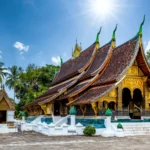
When to go to Laos by trip type
| Trip | Best time | Where? |
|---|---|---|
| First trip (north–south tour) | November to February | Luang Prabang, Vang Vieng, Vientiane, Si Phan Don |
| Trekking and mountain villages | November to February | Nong Khiaw, Muang Ngoi, Luang Namtha |
| Slow boat down the Mekong | November to February (possible year-round) | Huay Xai – Luang Prabang |
| Waterfalls in full flow | Late September to November | Kuang Si, Bolaven Plateau |
| Budget | May–June, September–October | Vientiane, Luang Prabang |
| Festivals and traditions | Mid-April, October, November | Luang Prabang, Vientiane |
| Combined with Thailand, Vietnam or Cambodia | November to February | Depending on the itinerary |
For a combined trip, Laos’s favorable season coincides with that of its neighbors: see our pages on when to go to Thailand, when to go to Vietnam and when to go to Cambodia. For more ideas by month, see where to go in November and where to go in February, and our Laos travel guide.
Major events to plan your trip around
| Period | Event | Location |
|---|---|---|
| Mid-April (usually April 14–16) | Pi Mai Lao, Lao New Year (processions, water splashing) | Nationwide, especially Luang Prabang |
| May (depending on the lunar calendar) | Boun Bang Fai, rocket festival to call the rain | Countryside and villages |
| July (depending on the lunar calendar) | Start of Buddhist Lent (Khao Phansa) | Temples nationwide |
| Usually October (depending on the lunar calendar) | End of Buddhist Lent (Ok Phansa), boat races | Vientiane, Luang Prabang |
| Usually November (full moon) | That Luang Festival | Vientiane |
Laos month by month: what to expect
January: Excellent across the country: dry and sunny, 29 °C (84 °F) in the afternoon in Vientiane, cool nights in the north (about 15 °C (59 °F) in Luang Prabang). High season.
February: Still dry and pleasant, a little warmer. The first haze can appear late in the month in the north.
March: The heat sets in (more than 33 °C (91 °F) in Vientiane, 35 °C (95 °F) in Pakse). Skies often hazy. The south stays dry.
April: The hottest month, and the month of Pi Mai Lao in mid-April: a festive atmosphere, but transport and hotels are in very high demand.
May: The monsoon arrives: more than 200 mm (7.9 in) of rain in Vientiane and Pakse. Heavy heat, falling prices.
June: Green season, frequent showers, flooded rice paddies. Few tourists, good rates. Mountain roads begin to suffer.
July: Very rainy everywhere, more than 400 mm (15.7 in) in Pakse. Higher visitor numbers in Luang Prabang during school holidays in Europe and North America. Allow extra time for journeys.
August: The wettest month in Vientiane (341 mm, 13.4 in) and Luang Prabang (329 mm, 13.0 in). Best left to flexible travelers who favor cities.
September: Rain eases in the north but stays heavy in the south. Waterfalls at their peak, but swimming is sometimes impossible.
October: The end of the rainy season (87 mm (3.4 in) in Vientiane), landscapes still very green, the end-of-Buddhist-Lent festival and boat races. Good value.
November: One of the best months: the dry weather returns, waterfalls still generous, the That Luang Festival in Vientiane. Start of the high season.
December: The driest month (5 mm (0.2 in) in Vientiane), cool mornings in the north. Heavy crowds over the year-end holidays.
When to book your trip to Laos
For a departure between November and February, and especially over the year-end holidays, book your flights 3 to 5 months ahead and your accommodation in Luang Prabang as soon as your dates are set: the town is mostly small guesthouses, which fill up quickly. The same applies to Pi Mai Lao in mid-April. In the rainy season, 1 to 2 months is usually enough.
Check current flight routes with the airlines. Many travelers also arrive overland from Thailand, crossing the Mekong at the Friendship Bridge near Vientiane, which closes from 10 p.m. to 6 a.m. each day according to the U.S. State Department (travel.state.gov, last updated June 18, 2026). If you route through Bangkok before Vientiane, check our Bangkok climate month by month to choose your arrival date.
Planning your trip to Laos
- Entry requirements: see our page on the entry requirements for Laos, with the rules for US and UK citizens.
- Time difference: Laos is on UTC+7 all year (no daylight saving time): 7 hours ahead of London in winter and 6 in summer; 12 hours ahead of New York in winter and 11 in summer.
- Currency: the Lao kip (LAK). Our currency converter helps you estimate your budget.
- Health: dengue and malaria are endemic and dengue cases increase in the rainy season, so take precautions against mosquito bites (GOV.UK, updated 13 August 2026). Medical care outside the capital can be basic and medical evacuation is difficult to organize and very expensive, so make sure your travel insurance covers treatment and repatriation (GOV.UK, updated 13 August 2026; travel.state.gov, last updated June 18, 2026).
- Roads: the U.S. State Department advises avoiding driving at night, because roads are poorly illuminated and construction sites are poorly marked (travel.state.gov, last updated June 18, 2026).
To go further, see our complete Laos travel guide.
Frequently asked questions
What is the best month to visit Laos?
November, December, January and February are the most favorable: it hardly rains (less than 20 mm (0.8 in) a month in Vientiane) and temperatures stay pleasant. November has the advantage of waterfalls that are still well filled and green landscapes.
Can you go to Laos in July or August?
Yes, but it is the heart of the rainy season: more than 300 mm (11.8 in) a month in Vientiane and Luang Prabang, more than 400 mm (15.7 in) in Pakse. Showers often leave sunny spells, but mountain journeys can be long or disrupted. Plan a flexible itinerary.
Is it cold in Laos in winter?
Not during the day: 27 to 30 °C (81 to 86 °F) in the afternoon. Mornings are cool in the north, though, around 15 °C (59 °F) in Luang Prabang in December–January, and more so at altitude, for example on the Plain of Jars.
What is the cheapest time to visit Laos?
The rainy season, from May to September (outside the summer holidays), and the shoulder seasons. October offers a good compromise: the end of the rains, green landscapes and gentler prices than in high season.
When should you avoid going to Laos?
July–August if you plan to travel a lot in the mountains or the south, and March–April if you are sensitive to heat or hazy skies.
When can you see the 4,000 Islands in Laos?
From November to March, when the south is dry and the Mekong is low enough to reveal the islets and rapids. The Khone Phapheng Falls are more powerful at the end of the rainy season.
What is the weather like in Laos in August?
August is the wettest month: 341 mm (13.4 in) of rain in Vientiane, 329 mm (13.0 in) in Luang Prabang and 444 mm (17.5 in) in Pakse (1991–2020 normals), with highs around 31 to 32 °C (88 to 90 °F). Showers often fall late in the day; mountain roads are slower.
What is the weather like in Laos in December?
It is the driest month in Vientiane (5 mm, 0.2 in), with an average high of 28.9 °C (84 °F). In Luang Prabang, mornings are cool, around 15 °C (59 °F). It is one of the best months, but also one of the busiest.
Our sources
- World Meteorological Organization, 1991–2020 climate normals (NOAA archive): Vientiane, Luang Prabang and Pakse stations
- Safety, health and travel conditions read on 24 October 2026: U.S. Department of State, Laos country information (travel.state.gov, last updated June 18, 2026), and UK FCDO, foreign travel advice for Laos (GOV.UK, updated 13 August 2026)
- Our methodology
Updated November 2026.