To visit Muscat, the capital of the Sultanate of Oman, is to explore a city stretched between the Sea of Oman and arid mountains. The highlights are the Sultan Qaboos Grand Mosque, the Royal Opera House, the souk and corniche of Mutrah, old Muscat with Al Alam Palace framed by the Al Jalali and Al Mirani forts, and the National Museum. What to see in Muscat, when to go to avoid the extreme heat, and which entry requirements and precautions to keep in mind according to the UK and US governments: here are the essentials, with official sources.
Safety: the UK FCDO reports strikes and retaliatory attacks by Iran in the region, including Oman, since 8 July, and a risk of further escalation — GOV.UK, updated 22 July 2026
Visa: UK citizens can visit for up to 14 days without a visa; US citizens need a visa (eVisa or on arrival) — see entry requirements
Royal Opera House: guided tours from Saturday to Thursday, 8:30 am – 5:30 pm — checked on 24 October 2026 on rohmuscat.org.om
Best time: November to March; from May to September, maximums of 35 to 40 °C (95 to 104 °F) and nights around 27 to 30 °C (81 to 86 °F)
Dress: covering clothes required at the mosque (arms and legs, hair covered for women)
What to see in Muscat: the highlights
The Sultan Qaboos Grand Mosque
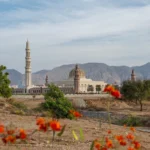
This is the city’s main monument and the largest mosque in the country, with its prayer hall, monumental chandelier and marble courtyards. It is open to non-Muslim visitors only at certain times, outside prayers: check the hours before you go, as they are limited and can change during Ramadan and religious holidays. Covering clothes are required: arms and legs covered for everyone, and hair covered for women.
The Royal Opera House Muscat
Inaugurated under Sultan Qaboos, the Royal Opera House hosts operas, concerts and ballets. Outside performances, you can visit it on a guided tour: according to its official website, these « House Tours » run from Saturday to Thursday, 8:30 am to 5:30 pm (checked on 24 October 2026 on rohmuscat.org.om). The adjoining shopping arcade, the Opera Galleria, completes the visit. The programme and bookings are on the same website.
Mutrah: the souk and the corniche
Mutrah Souk, one of the oldest in the country, is a maze of covered lanes: frankincense, silver, traditional daggers (khanjar), fabrics, spices. Bargaining is customary, with courtesy. The corniche runs along the harbour, with its dhows and Mutrah Fort above; it is pleasant in the late afternoon and at nightfall, when the heat drops. Mutrah fish market comes alive early in the morning.
Old Muscat: Al Alam Palace and the forts
In the small bay of old Muscat, Al Alam Palace, the Sultan’s ceremonial palace, can be seen through its gates: it is not open to visitors. It is framed by two Portuguese-era forts, Al Jalali and Al Mirani, perched on the rocks and admired from outside. The district also has several museums, including the Bait Al Zubair museum, devoted to Omani heritage.
The National Museum of Oman
Opposite Al Alam Palace, the National Museum traces the history and heritage of the sultanate. According to its official website, it was established by royal decree in 2013 and opened on 30 July 2016; it presents itself as the first museum in the Middle East to use Arabic Braille for visually impaired visitors (checked on 24 October 2026 on nm.gov.om). Opening hours and tickets: « Plan your Visit » section of the website.
Beaches and boat trips
Qurum beach, in the city, and the coves to the south-east are suitable for swimming, in modest swimwear outside hotel beaches. In season, boats go out to watch dolphins in the gulf and to snorkel at the Daymaniyat Islands, a nature reserve with regulated access: go through an authorised operator.
Day trips from Muscat
Muscat is a base for Wadi Shab and the Bimmah Sinkhole, on the coast road to Sur, for Nizwa and its fort inland, for Jebel Akhdar in the mountains and for a night in the Wahiba desert. According to GOV.UK, driving can be dangerous outside Muscat: watch out for wandering camels and goats, and for flash floods in dry riverbeds after rain. The U.S. Department of State warns that crossing the Yemen-Oman border can be dangerous.
Booking tours: official site or reseller?
Opera performances and guided tours are booked on its official website. For excursions (wadis, desert, boat trips), local agencies and international resellers offer days out with a driver-guide: check that the vehicle is a 4×4 where the route requires it, what is included (meals, entry fees, snorkelling gear) and the weather-related cancellation terms.
Itinerary: Muscat in two days
Day 1, morning: the Grand Mosque during visiting hours, then the Royal Opera House (guided tour).
Day 1, late afternoon: Mutrah Souk and the corniche at sunset.
Day 2, morning: old Muscat (Al Alam Palace, views of the forts), the National Museum and Bait Al Zubair.
Day 2, afternoon: Qurum beach or a boat trip.
Following days: Wadi Shab, Nizwa, Jebel Akhdar or the Wahiba desert.
When to go to Muscat
Muscat has a hot desert climate: mild, sunny winters and scorching, humid summers on the coast. The table uses the normals published by Oman’s Directorate General of Meteorology on the World Meteorological Organization’s weather information service, with our sunrise and sunset calculations, useful for planning visits at the coolest times.
Month
Max
Min
Precipitation
Sunrise / sunset on the 15th
Day length
Rainy days
Verdict
January
25.1 °C (77 °F)
16.7 °C (62 °F)
13 mm (0.5 in)
6:50 am / 5:40 pm
10 h 50
3.2
✅ Mild and sunny
February
26.4 °C (80 °F)
17.8 °C (64 °F)
14 mm (0.6 in)
6:39 am / 6:01 pm
11 h 22
2.7
✅ Ideal, a few showers
March
29.5 °C (85 °F)
20.3 °C (69 °F)
16 mm (0.6 in)
6:15 am / 6:15 pm
12 h 00
1.9
✅ Very good, heat rising
April
34.7 °C (94 °F)
24.2 °C (76 °F)
11 mm (0.4 in)
5:45 am / 6:27 pm
12 h 42
1.4
⚠️ Already hot in the afternoon
May
39.6 °C (103 °F)
28.7 °C (84 °F)
0.0 mm (0.0 in)
5:24 am / 6:41 pm
13 h 16
0.1
❌ Very hot
June
40.0 °C (104 °F)
30.3 °C (87 °F)
11 mm (0.4 in)
5:19 am / 6:54 pm
13 h 35
0.1
❌ Extreme heat, nights at 30 °C (86 °F)
July
38.0 °C (100 °F)
30.1 °C (86 °F)
3.4 mm (0.1 in)
5:28 am / 6:55 pm
13 h 27
0.3
❌ Heat and humidity
August
35.6 °C (96 °F)
28.2 °C (83 °F)
1.6 mm (0.1 in)
5:41 am / 6:39 pm
12 h 58
0.6
❌ Very hot
September
35.6 °C (96 °F)
26.8 °C (80 °F)
0.0 mm (0.0 in)
5:52 am / 6:10 pm
12 h 18
0.0
❌ Very hot
October
34.6 °C (94 °F)
24.2 °C (76 °F)
0.8 mm (0.0 in)
6:03 am / 5:40 pm
11 h 37
0.2
⚠️ Hot, start of the season
November
30.3 °C (87 °F)
20.8 °C (69 °F)
1.6 mm (0.1 in)
6:20 am / 5:21 pm
11 h 01
0.7
✅ Pleasant
December
26.8 °C (80 °F)
18.3 °C (65 °F)
16 mm (0.6 in)
6:40 am / 5:22 pm
10 h 42
1.4
✅ Mild and sunny
Temperatures, precipitation and rainy days: Muscat station (Seeb International Airport), normals published by Oman’s Directorate General of Meteorology on the World Meteorological Organization’s World Weather Information Service (stated period: 1986-2009). Sunrise, sunset and day length on the 15th of each month: Destination de Voyage calculation (NOAA solar algorithm, Oman time). Verdicts: editorial summary.
How to read it: from November to March, maximums stay between 25.1 and 29.5 °C (77 and 85 °F), with a few rare showers (2 to 3 rainy days a month at most, in January and February). From April, afternoons exceed 34 °C (93 °F). From May to August, even the nights are stifling: the average minimum reaches or exceeds 28 °C (82 °F) in May, June, July and August (Destination de Voyage calculation based on the WMO normals). In summer, sightsee at sunrise, around 5:19 am in mid-June, and keep the hot hours for air-conditioned museums. GOV.UK notes that extreme heat in Oman has caused deaths.
To compare with Nizwa, Sur, Jebel Akhdar or Salalah, see the best time to visit Oman. Muslim holidays and Ramadan follow the lunar calendar: opening hours of sites and restaurants may change during this period.
Getting to Muscat and getting around
Airport and transfers
Muscat International Airport, at Seeb, is the country’s main gateway, reached with connections via the major Gulf and international hubs. Official taxis and ride-hailing apps serve the city; a transfer booked in advance is handy for a night arrival.
In the city
Muscat is a sprawling city laid out along the coast: a car (rental, taxi, ride-hailing) is the simplest way to get from one district to another. The city bus network serves the main roads. For trips inland, a rental car or a driver-guide is the norm; some mountain routes require a 4×4.
Where to stay in Muscat
Mutrah, near the souk and the corniche, suits those who want to explore on foot in the evening. Qurum and the areas near the beaches have large seafront hotels; the beach resorts south-east of the city are more isolated and need a car. For a tour, a night on arrival and one before departure, near the airport or in the centre, simplify the logistics.
If you… then…
If you…
Then…
Have only one day
The Grand Mosque in the morning, the Opera House, old Muscat, Mutrah Souk in the evening
Come in summer (May-September)
Sightsee at sunrise, museums in the hot hours, the corniche in the evening
Love music
Programme and guided tours on the Royal Opera House website
Plan to drive inland
Watch for animals on the road and avoid wadis after rain (GOV.UK)
Are a UK citizen staying more than 14 days
Apply online for a visa before travel (GOV.UK)
Entry requirements, health and safety
US citizens: you need a passport valid for at least six months and a visa: apply in advance on the Royal Oman Police eVisa website (tourist visas are also available on arrival). You must have proof of adequate funds and an onward or return ticket (U.S. Department of State, travel.state.gov, last updated April 16, 2026).
UK citizens: you can visit Oman for up to 14 days without a visa; for longer stays apply online before travel (the « unsponsored visit visa » for tourists) or get a visit visa on arrival at an airport. Your passport must be valid for at least 6 months after the date you arrive, and you must be able to show a return or onward ticket, proof of accommodation and proof of travel health insurance (UK FCDO, GOV.UK, updated 22 July 2026).
Safety: according to the UK FCDO (GOV.UK, updated 22 July 2026), there have been strikes and retaliatory attacks by Iran in a number of locations across the region, including Oman, since 8 July, and there is a risk of further attacks; in July 2024, six people were killed in a shooting near a mosque in the Wadi Kabir area of Muscat. Follow the news and the instructions of the authorities. See our travel formalities guide.
Health: visitors must use private healthcare, so travel insurance is essential; some UK prescription and over-the-counter medicines are illegal in Oman (GOV.UK). Vapes and e-cigarettes are illegal.
Practical tips for Muscat
Heat: water, a hat and sunscreen, even in winter; in summer, limit outdoor effort between late morning and late afternoon.
Dress: GOV.UK advises dressing modestly in public areas, including shopping malls, with the tops of the arms and legs (below the knee) covered; covering clothes are compulsory at the mosque.
Ramadan: do not eat, drink, smoke or chew gum in public in the daytime, including in your car (GOV.UK).
Money: the currency is the Omani rial; our currency converter helps you follow the rate.
Internet: an eSIM avoids roaming charges (see our eSIM guide).
Two days let you see the Grand Mosque, the Royal Opera House, old Muscat, the National Museum and Mutrah Souk; add days for excursions (Wadi Shab, Nizwa, the desert).
What is the best time to visit Muscat?
From November to March, with maximums of 25 to 30 °C (77 to 86 °F) according to the normals published by Oman’s meteorological service. From May to September, it is 35 to 40 °C (95 to 104 °F) by day and the nights stay very hot.
Do you need a visa for Oman?
UK citizens can visit for up to 14 days without a visa (GOV.UK, updated 22 July 2026). US citizens need a visa, ideally applied for in advance on the Royal Oman Police eVisa website (travel.state.gov, last updated April 16, 2026). Your passport must be valid for at least 6 months.
Can you visit the Grand Mosque in Muscat?
Yes, non-Muslims are admitted at certain times, in covering clothes (hair covered for women). Check the visiting hours before you go.
Is Muscat safe?
The UK FCDO reports Iranian strikes in the region, including Oman, since 8 July, and a risk of further attacks; follow the latest travel advice. The U.S. Department of State warns that crossing the Yemen-Oman border can be dangerous.
Our sources
Royal Opera House Muscat (rohmuscat.org.om), guided tours, checked on 24 October 2026
National Museum of Oman (nm.gov.om), checked on 24 October 2026
World Meteorological Organization, World Weather Information Service: normals for Muscat (Seeb) supplied by Oman’s Directorate General of Meteorology (stated period 1986-2009)
Astronomical calculations: NOAA solar algorithm, applied by Destination de Voyage to Muscat’s coordinates (15th of each month, year 2027)


 FlightsKiwi.comCompare flights and airline combinations to Muscat.Compare flights