
Choose Corsica for the mountains meeting the sea: perched villages, the GR20, the Piana calanques and the Scandola reserve, Genoese citadels. Choose Sardinia for beaches and coves (Gulf of Orosei, La Maddalena, Chia), a hotter and drier summer, Nuragic archaeology and a comparable budget. The two islands are separated only by the Strait of Bonifacio: a ferry lets you combine them.
Corsica or Sardinia? The two neighboring islands resemble each other in their indented coasts, slow roads, the need for a car and an identical ideal season: June and September. They differ in terrain, access and atmosphere. Corsica is French and mountainous. Sardinia, the second-largest island in the Mediterranean, is Italian, larger and more oriented toward the sea. This comparison uses only the data published in our guides to Corsica and Sardinia.
Corsica or Sardinia: key points
- Hiking and mountains: Corsica (GR20, Bavella, Restonica)
- Beaches and coves: Sardinia (Gulf of Orosei, La Maddalena, Chia, Villasimius), although Corsica has Palombaggia and Rondinara
- Heat: Sardinia is hotter in summer (about 32 °C (90 °F) in August in Cagliari, against 29 °C (84 °F) in Ajaccio)
- Budget: almost identical, roughly €80 to 130-135 per day on a tight budget
- Combining them: ferry Bonifacio – Santa Teresa Gallura
- Entry: Corsica follows France’s rules, Sardinia Italy’s; both are Schengen (see below)
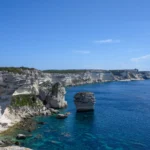
Corsica or Sardinia: criterion-by-criterion comparison
| Criterion | Corsica | Sardinia | Advantage |
|---|---|---|---|
| Best time to go | June and September; May and early October for walking | Late May to late June and September to early October | Tie |
| August climate | 29.2 °C (85 °F) high, 16 mm (0.6 in) (Ajaccio) | 32.1 °C (90 °F) high, 11 mm (0.4 in) (Cagliari) | Corsica if you dislike heat |
| Autumn rain | November wettest (112 mm (4.4 in) in Ajaccio) | November wettest (74 mm (2.9 in) in Cagliari) | Sardinia |
| Ferries | From Marseille, Toulon, Nice and Italy | From Corsica and the mainland, depending on the season | Tie |
| Entry rules | France’s rules (Schengen) | Italy’s rules (Schengen) | Tie |
| Budget per day (tight / comfort) | Roughly €80 to 130 / 170 to 300 | Roughly €80 to 135 / 170 to 325 | Tie |
| Beaches | Palombaggia, Santa Giulia, Rondinara, Saleccia | Chia, Villasimius, Cala Luna, Cala Goloritzé, La Maddalena, La Pelosa | Sardinia |
| Mountains and hiking | GR20, Mare e Monti, Bavella, Restonica | Supramonte, Gorropu canyon | Corsica |
| Heritage | Genoese citadels, Bonifacio, Maison Bonaparte, Sartène menhirs | Su Nuraxi di Barumini (UNESCO), Nora, Tharros, Alghero | Tie |
| Roads | 40 to 50 km/h (25 to 31 mph) average in the mountains | Cagliari-Sassari expressway; winding roads elsewhere | Sardinia |
| Safety | High fire risk in summer (UK FCDO: highest along the Mediterranean coast, in Corsica); slow rescue in the interior | Normal vigilance; theft from rental cars (our guide), heat and wildfires | Tie |
Climate: Sardinia is hotter and drier
Both islands have a Mediterranean climate, with very dry summers and autumn rains. The reference stations in our guides show a clear summer gap: an average August high of 32.1 °C (90 °F) in Cagliari, in southern Sardinia, against 29.2 °C (85 °F) in Ajaccio. Sardinia is also less rainy in autumn. Note that Corsica is a mountain in the sea, with Monte Cinto at over 2,700 m (8,858 ft), and the interior is much cooler, with snow on the summits in winter. Sardinia is often swept by the mistral (maestrale), which stirs up the sea on the west coast and the north.
| Month | Ajaccio (Corsica): high / rain | Cagliari (Sardinia): high / rain |
|---|---|---|
| April | 18.5 °C (65 °F) / 53 mm (2.1 in) | 19.9 °C (68 °F) / 46 mm (1.8 in) |
| May | 22.1 °C (72 °F) / 50 mm (2.0 in) | 24.1 °C (75 °F) / 26 mm (1.0 in) |
| June | 25.9 °C (79 °F) / 26 mm (1.0 in) | 28.7 °C (84 °F) / 13 mm (0.5 in) |
| July | 28.6 °C (83 °F) / 9 mm (0.4 in) | 31.7 °C (89 °F) / 3 mm (0.1 in) |
| August | 29.2 °C (85 °F) / 16 mm (0.6 in) | 32.1 °C (90 °F) / 11 mm (0.4 in) |
| September | 26.1 °C (79 °F) / 58 mm (2.3 in) | 28.1 °C (83 °F) / 39 mm (1.5 in) |
| October | 22.8 °C (73 °F) / 86 mm (3.4 in) | 23.9 °C (75 °F) / 44 mm (1.7 in) |
| November | 18.3 °C (65 °F) / 112 mm (4.4 in) | 19.0 °C (66 °F) / 74 mm (2.9 in) |
In Corsica, the sea goes from about 16 °C (61 °F) in May to 23 °C (73 °F)-24 °C (75 °F) in July-August, and stays at 22.5 °C (72 °F) in September: the late season is a very good swimming period on both islands. For details: when to go to Corsica and when to go to Sardinia.
What to see: Corsican mountains or Sardinian coves
Corsica
Corsica is discovered through contrasts: within an hour’s drive you go from a beach to a village perched at 800 m (2,625 ft). In the south, Bonifacio on its limestone cliffs, the Lavezzi islands, Porto-Vecchio and the beaches of Palombaggia, Santa Giulia and Rondinara, then the Bavella needles. In the west, the Gulf of Porto, the Piana calanques and the Scandola reserve, listed as World Heritage. In the north, Calvi and its citadel, the villages of Balagne, Bastia and the Cap Corse loop. In the center, Corte, its citadel and the Museum of Corsica, the Restonica valley. The Corsican railway links Ajaccio, Corte and Bastia. In the south, away from Balagne and Cap Corse, our guide to traveling to Porto-Vecchio presents beaches, Bavella and the best time to go.
Sardinia
Sardinia is larger and more beach-oriented. In the south, Cagliari and its Castello district, the Poetto beach, then Chia, Nora and Villasimius. In the east, the cliffs of the Gulf of Orosei hide coves reachable by boat or on foot (Cala Luna, Cala Goloritzé), at the foot of the Supramonte. In the north-east, the Costa Smeralda, the most expensive area, and the La Maddalena archipelago, a national park. In the north-west, Alghero and its Catalan past, Neptune’s Grotto, La Pelosa, where access is limited in season. The interior preserves thousands of nuraghi, including Su Nuraxi di Barumini, a UNESCO site, and the villages of the Barbagia.
Budget: a tie, July-August very expensive
| Item (per person per day) | Corsica | Sardinia |
|---|---|---|
| Accommodation, tight budget / comfort | Roughly €35 to 60 / 90 to 180 | Roughly €35 to 55 / 80 to 160 |
| Meals | Roughly €25 to 40 / 50 to 80 | Roughly €20 to 35 / 40 to 70 |
| Transport (shared rental, fuel) | Roughly €15 to 25 / 25 to 40 | Roughly €15 to 25 / 25 to 45 |
| Activities | Roughly €5 to 15 / 20 to 50 | Roughly €10 to 20 / 25 to 50 |
| Total | Roughly €80 to 130 / 170 to 300 | Roughly €80 to 135 / 170 to 325 |
Accommodation and meals are slightly cheaper in Sardinia according to our guides, but activities (boats, sunbed rental) weigh more. On both islands prices climb sharply in July-August: in Corsica, accommodation and rentals can double compared with May or October; in Sardinia, the Costa Smeralda and the month of August are clearly more expensive. Taking your car on the ferry, possible to Corsica from Marseille, Toulon or Nice, avoids the cost of a rental. In Sardinia, agriturismi offer fixed-price meals of local produce.
Corsica or Sardinia by traveler profile
| Profile | Verdict | Why |
|---|---|---|
| Hiking | Corsica | GR20 for experienced walkers, Mare e Monti and Mare a Mare more accessible |
| Beach | Sardinia | More choice and a drier summer; Orosei and La Maddalena coves |
| Family | Tie | Calvi beach, Valinco, the Balagne little train; or southern beaches and shallow La Pelosa |
| Couple | Tie | Balagne, Cap Corse, Bonifacio by boat; or Orosei coves, sunsets in Alghero |
| Culture | Tie | Citadels, Corte, Sartène; or nuraghi, Nora, Tharros |
| Late season | Sardinia | October still mild and clearly less rainy |
Hikers
Our guide presents the GR20 as one of the best-known trails in Europe: it crosses the island from north to south and is demanding, while the Mare e Monti and Mare a Mare trails link the sea and the mountains. Sardinia offers remarkable routes in the Supramonte and the Gorropu canyon, some of them demanding and best done with a guide. Walk in May or October on both islands.
Beach lovers
Sardinia has more coastline and a beach style for every wind: in a mistral, prefer the east coast or the south. Our guide rates it very suitable for a beach holiday. Corsica holds its own with the southern beaches, very busy in July-August, and Saleccia, reachable by boat or on foot.
Families
Both islands suit families, with a car. Corsica has the advantage of simplicity and plenty of campsites. Sardinia offers shallow beaches, such as La Pelosa, by reservation in season. Beware of the slow roads on both islands: limit the stages with children.
Entry requirements for Corsica and Sardinia
Corsica is part of France and Sardinia part of Italy; both follow Schengen rules.
US citizens
- Corsica (France): according to the U.S. Department of State (travel.state.gov, last updated August 11, 2025), you may enter the Schengen area, including France, for up to 90 days for tourist and business purposes without a visa. Immigration officers may ask you to show sufficient funds and a return airline ticket.
- Sardinia (Italy): according to the U.S. Department of State (travel.state.gov, last updated August 11, 2025), US citizens may enter Italy for up to 90 days for tourist or business purposes without a visa, with a passport valid for at least 3 months beyond the period of stay, proof of sufficient funds and a return plane ticket.
UK citizens
- France (updated 22 October 2026) and Italy (updated 21 October 2026), according to the UK FCDO (GOV.UK): you can travel without a visa to the Schengen area for up to 90 days in any 180-day period as a tourist. Your passport must have been issued less than 10 years before arrival and expire at least 3 months after the date you plan to leave the Schengen area. The FCDO adds that wildfires can occur across France in summer, with the highest risk in the south, including the Mediterranean coast and Corsica, and that wildfires are also a risk in Italy during the extended summer months.
Check travel.state.gov and GOV.UK (and the equivalent Italy pages) before you go.
Why not both?
Ferries link Bonifacio, at the southern tip of Corsica, to Santa Teresa Gallura, in the north of Sardinia; schedules vary with the season and the wind. A two-week combination can pair southern Corsica (Ajaccio, Bonifacio, Porto-Vecchio) with northern Sardinia (Palau, La Maddalena, Gulf of Orosei, Alghero). Arriving at one airport and leaving from another avoids doubling back. Our comparison Sicily or Sardinia also compares Sardinia with the other big Italian island.
Frequently asked questions
Corsica or Sardinia for beaches?
Sardinia, generally: more coastline, coves reachable by boat or on foot (Gulf of Orosei, La Maddalena) and a drier summer. Corsica also has well-known beaches in the south, such as Palombaggia, Santa Giulia and Rondinara.
Which is cheaper?
The budgets in our guides are very close: roughly €80 to 130 per person per day on a tight budget in Corsica, €80 to 135 in Sardinia, excluding flights or the crossing. July-August is clearly more expensive on both islands.
Where is it hotter?
In Sardinia: an average August high of 32.1 °C (90 °F) in Cagliari, against 29.2 °C (85 °F) in Ajaccio, according to the 1991-2020 normals used in our guides.
Can you go from Corsica to Sardinia?
Yes, by ferry between Bonifacio and Santa Teresa Gallura. Schedules and frequencies vary with the season and the wind: check them with the operators.
Do you need a car?
Yes on both islands: most beaches, villages and trailheads are reachable only by car. Roads are slow: in Corsica, allow an average of 40 to 50 km/h (25 to 31 mph) in the mountains.
Which should you choose for hiking?
Corsica, with the GR20 and the Mare e Monti and Mare a Mare trails. Sardinia also has fine routes in the Supramonte and toward Cala Goloritzé.
Our sources
- Our published guides, the source of all the data on this page: Corsica, when to go to Corsica, Sardinia, when to go to Sardinia
- The sources cited in those guides: 1991-2020 normals from Météo-France and the World Meteorological Organization (published by NOAA)
- Entry and safety information read on 12 November 2026: U.S. Department of State, France and Italy country information (travel.state.gov, last updated August 11, 2025); UK FCDO, France (GOV.UK, updated 22 October 2026) and Italy (GOV.UK, updated 21 October 2026)
- Method: our methodology
More head-to-heads await in our destination comparisons, for example Crete or Sicily. Updated November 2026.