
For a cruise in Europe, two main families coexist: river cruises (Rhine, Danube, Douro, Seine), short and centered on cities and vineyards, and sea cruises on the Baltic, which link Copenhagen, Stockholm or Gdańsk in a week. The best period runs from May to September; winter is reserved for Christmas and Advent-market cruises on the Rhine and Danube.
This guide presents typical itineraries, the ports of call and what makes them worth a stop, the climate month by month and the cruise lines that run these cruises. For general points (cabins, extra costs, entry requirements), see our guide to choosing a cruise and our cruise line comparison.
Cruises in Europe at a glance
- River from 5 days (Seine) to 6–8 days (Danube, Rhine, Douro), up to 19 days for a trans-European crossing
- Sea 7 nights on the Baltic from Kiel or Copenhagen
- Best period May to September; December for the Christmas markets
- Documents a valid passport; US and UK citizens should check the entry requirements of each country on the itinerary (see below)
- Budget from about €830 per person for 5 days on the Seine and €1,275 for 6 days on the Danube with CroisiEurope (all-inclusive on board); from about €1,070 for 7 nights on the Baltic with Costa, excluding service charges (prices noted on 5 October 2026)
River or sea cruise: what is the difference?
A river ship generally carries a few dozen to about two hundred passengers. It often sails at night or on short stretches by day, docks in the heart of cities and is not affected by swell: it is a calm format, focused on sightseeing and food. Onboard entertainment stays simple (talks, dance evenings), with no casino or big shows.
A seagoing cruise ship carries several thousand passengers, with pools, multiple restaurants and shows. Ports of call are large ports, sometimes at a distance from the city center. On the Baltic, a day at sea can be windy, even in summer.
| Criterion | River cruise | Sea cruise (Baltic) |
|---|---|---|
| Ship size | Small capacity | Several thousand passengers |
| Typical length | 5 to 8 days | 7 nights, sometimes 14 |
| Docking | In city centers | Port, sometimes on the outskirts |
| Format | All-inclusive on board with CroisiEurope | Drinks and service charges often extra |
| Audience | Couples, seniors, culture lovers | Families, all audiences |
Typical itineraries
The Rhine: from Strasbourg to Amsterdam
The Rhine is one of the most frequently scheduled rivers departing from France. Cruises leave Strasbourg and go down to the Romantic Rhine valley (Lorelei rock, castles), Koblenz, Cologne and Amsterdam. CroisiEurope also runs “Christmas Traditions on the Rhine” cruises devoted to the Advent markets. The Rhine combines with the Main and the Danube on trans-European crossings: the line offers, for example, a 19-day voyage from Amsterdam to Budapest via Strasbourg, from about €4,350 per person (April 2027 departure). A cruise that ends in Amsterdam can be extended with a two- or three-day stay in Amsterdam before the journey home.
The Danube: Vienna, Bratislava, Budapest
The Danube links Germany, Austria, Slovakia, Hungary and, further downstream, Croatia, Serbia, Bulgaria and Romania. The classic itinerary, “the Beautiful Blue Danube”, runs from Budapest to Passau (or the reverse) via Bratislava, Vienna, Melk and the Wachau valley: 6 days, from about €1,275 per person on a port-to-port basis with CroisiEurope for May 2027 departures. A version with transport included also exists. Longer itineraries go down to the Iron Gates and the delta, on the Black Sea.
The Douro: from Porto towards Spain
The Douro starts at Porto and goes up the UNESCO World Heritage valley, with its terraced vineyards and quintas, to the Spanish border. Excursions lead to Salamanca, Braga or Guimarães depending on CroisiEurope’s programs. The valley is hot in midsummer: spring and the September grape harvest are more comfortable. To extend the trip, see our guide to Portugal.
The Seine: Paris, Rouen, Honfleur
The Seine suits short cruises without a flight. CroisiEurope runs a 5-day loop starting in Paris: night sailing through Paris, Poissy (optional excursion to Versailles), Honfleur and the Alabaster Coast, Rouen, then back to Paris. The headline price noted was about €833 per person. It is a good introduction to river cruising.
The Baltic Sea: Copenhagen, Stockholm, Gdańsk
By sea, the Baltic is covered in 7 nights. Example noted with Costa Cruises for May 2027: Kiel, Copenhagen, Gdynia (for Gdańsk), Visby on the island of Gotland, Stockholm, back to Kiel. The headline price was about €1,069 per person in an inside cabin, excluding service charges. 14-night combinations add the fjords of Norway (Geiranger, Bergen); see our page on fjord cruises.
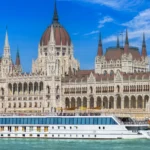
The main ports of call
| Port of call | What to see | Typical length |
|---|---|---|
| Strasbourg (France) | Cathedral, Petite France, Christmas market in December | Embarkation port |
| Romantic Rhine valley (Germany) | Castles, Lorelei rock | Daytime sailing |
| Cologne (Germany) | Cathedral, old town | Half a day |
| Amsterdam (Netherlands) | Canals, museums | Departure or arrival port |
| Melk and the Wachau (Austria) | Melk Abbey, Dürnstein, vineyards | Half a day |
| Vienna (Austria) | Hofburg, Schönbrunn, St. Stephen’s Cathedral | One day |
| Bratislava (Slovakia) | Old town, castle | Half a day |
| Budapest (Hungary) | Parliament, Buda district, thermal baths | Departure or arrival port |
| Porto (Portugal) | Ribeira, port wine cellars | Departure port |
| Douro valley (Portugal) | Terraced vineyards, quintas | Daytime sailing |
| Honfleur and Rouen (France) | Old basin, cathedral, half-timbered houses | Half a day to one day |
| Stockholm (Sweden) | Gamla Stan, Vasa Museum | One day |
| Copenhagen (Denmark) | Nyhavn, Tivoli | Embarkation or port of call |
On a river ship, stops are often short, but the ship docks a few steps from the center. Excursions may be included or optional: CroisiEurope distinguishes the two in its day-by-day program. Check this before comparing prices.
When to take a cruise in Europe
The following table gives the normals for Vienna, at the heart of the Danube itineraries and representative of the continental climate of the Rhine and Danube. The Douro is hotter and drier in summer, the Baltic cooler. The Douro has a page of its own: our guide to Douro cruises details itineraries and seasons.
| Month | Avg. max | Avg. min | Rain | Verdict |
|---|---|---|---|---|
| January | 4.2 °C (40 °F) | −0.1 °C (32 °F) | 37.6 mm (1.5 in) | ❌ Cold, few departures |
| February | 7.0 °C (45 °F) | 1.1 °C (34 °F) | 33.5 mm (1.3 in) | ❌ Cold, few departures |
| March | 11.0 °C (52 °F) | 4.0 °C (39 °F) | 46.3 mm (1.8 in) | ⚠️ Cool, start of the river season |
| April | 17.4 °C (63 °F) | 8.6 °C (47 °F) | 39.6 mm (1.6 in) | ⚠️ Mild, spring |
| May | 21.1 °C (70 °F) | 12.3 °C (54 °F) | 78.3 mm (3.1 in) | ✅ Pleasant, long days |
| June | 25.7 °C (78 °F) | 16.4 °C (62 °F) | 82 mm (3.2 in) | ✅ Warm, high season |
| July | 26.9 °C (80 °F) | 17.7 °C (64 °F) | 80.3 mm (3.2 in) | ✅ Warm, thunderstorms possible |
| August | 26.6 °C (80 °F) | 17.5 °C (64 °F) | 73.8 mm (2.9 in) | ✅ Warm, thunderstorms possible |
| September | 21.6 °C (71 °F) | 13.8 °C (57 °F) | 67.3 mm (2.6 in) | ✅ Mild, grape harvest |
| October | 15.0 °C (59 °F) | 8.9 °C (48 °F) | 47.7 mm (1.9 in) | ⚠️ Cool, end of season |
| November | 9.5 °C (49 °F) | 5.0 °C (41 °F) | 42.9 mm (1.7 in) | ⚠️ Cold, Christmas markets at month end |
| December | 4.7 °C (40 °F) | 0.7 °C (33 °F) | 39.9 mm (1.6 in) | ⚠️ Cold, Christmas markets |
Spring (April–May)
The river season starts in spring. Afternoon temperatures in Vienna climb from 17 to 21 °C (63 to 70 °F). After heavy rain or snowmelt, high water can prevent passage under some bridges: the cruise line then adapts the itinerary. These spring temperatures match our page on the climate in Vienna month by month, useful for placing your departure.
Summer (June to August)
This is high season, with average maximums around 26–27 °C (79–81 °F) in Vienna. June and July are also the wettest months, with thunderstorms. On the Baltic, summer brings very long days. At the end of a dry summer, low water can disrupt sailing on the Rhine or Danube.
Autumn (September–October)
September is a good compromise: 21–22 °C (70–72 °F), grape harvests in the Wachau, on the Rhine and the Douro, and fewer crowds. October is cooler, around 15 °C (59 °F).
Winter (November–December)
The season ends with the Christmas-market cruises on the Rhine and Danube and New Year cruises. It is cold (under 10 °C, 50 °F, in the afternoon), but the atmosphere is the main attraction. January and February have few departures.
Which cruise line for a cruise in Europe?
- CroisiEurope: a line founded in Strasbourg in 1976, which says it has 50 ships and barges and 170 itineraries. It runs the Rhine, Danube, Douro, Seine, Loire, Rhône and Elbe. Its “all-inclusive on board” formula includes full board, drinks with meals and at the bar, port taxes and assistance-repatriation insurance, according to the Seine cruise description we viewed
- Costa Cruises: Baltic cruises from Kiel and Copenhagen (Costa Diadema in the 2027 program we viewed)
- MSC Cruises and other international lines also schedule Northern Europe in summer
Budget and costs to expect
An all-inclusive river cruise looks more expensive at the outset than a cruise ship, but it includes drinks and taxes. On a cruise ship, add the service charges billed per night per person, drinks outside a package and excursions.
| Cruise | Length | From (per person) |
|---|---|---|
| Seine, Paris – Honfleur – Rouen (CroisiEurope) | 5 days | About €833 |
| Danube, Budapest – Passau, port-to-port (CroisiEurope) | 6 days | About €1,275 |
| Amsterdam – Strasbourg – Budapest (CroisiEurope) | 19 days | About €4,350 |
| Baltic from Kiel (Costa) | 8 days / 7 nights | About €1,069, excluding service charges |
Entry requirements for US and UK citizens
Itineraries cross several countries, each with its own rules, so check every country on your itinerary and ask the cruise line what documents it requires. As an example of Schengen-area rules (Austria follows them), the two governments say:
- US citizens (travel.state.gov, Austria page, last updated 10 September 2026): your passport should be valid for at least three months beyond the period of stay; you may be asked to show proof of sufficient funds and a return plane ticket; stays longer than 90 days require the appropriate visa.
- UK citizens (GOV.UK, Austria page, updated 11 August 2026): you can travel to the Schengen area without a visa for up to 90 days in any 180-day period; your passport must have been issued less than 10 years before you arrive and have an expiry date at least 3 months after the day you plan to leave the Schengen area.
- EES: GOV.UK says the EU’s Entry/Exit System is being implemented across the Schengen area, so you may need to register biometric details (fingerprints and a photo) on entry, at no cost, and should allow extra time at the border.
Sources read on 26 October 2026. Countries outside the Schengen area on some itineraries (Serbia on the Danube, for example) have their own rules: check travel.state.gov and GOV.UK for each one.
Practical tips
- Transport: plan how you will reach the embarkation city (Strasbourg, Paris, Budapest, Porto, Kiel…) and check whether the cruise line offers a package with transport
- Water levels: in case of flood or low water, a river itinerary may be changed, sometimes with a coach transfer; read the general conditions
- Luggage: river cabins are smaller than on a cruise ship; a soft-sided suitcase is better
- Excursions: check which are included; many city centers can be visited on foot from the ship
- Mobility: access ashore may be by a sloping gangway and not all ships have a lift; ask the cruise line if you have reduced mobility
- Health: check that your travel insurance covers medical care and repatriation; CroisiEurope’s all-inclusive formula includes assistance-repatriation insurance according to the cruise description we viewed
Also read: the mini-cruise for a weekend, departures from Le Havre to Northern Europe and Ponant for small ships.
Frequently asked questions
What is the best time for a river cruise in Europe?
May to September for the weather. September is a good compromise (grape harvest, fewer crowds). December attracts visitors for the Christmas markets, with cold days.
Which river cruise should you choose for a first time?
The Seine over 5 days starting in Paris lets you try the format without a flight. The Danube between Budapest and Passau, over 6 days, is the classic itinerary to see Vienna, Bratislava and Budapest.
Are drinks included on a river cruise?
With CroisiEurope, the formula includes full board and drinks with meals and at the bar, according to the description we viewed. On a cruise ship on the Baltic, drinks are generally extra or sold as a package.
Do you need a passport for a cruise in Europe?
Yes, a valid passport. For Schengen countries such as Austria, US citizens’ passports should be valid for at least three months beyond the period of stay (State Department) and UK citizens’ passports must have been issued less than 10 years before arrival and expire at least 3 months after departure (GOV.UK). If the itinerary calls at a country outside the EU (Serbia on the Danube, for example), check the documents required by the cruise line and the governments’ advice.
How much does a Danube cruise cost?
With CroisiEurope, from about €1,275 per person for 6 days between Budapest and Passau on a port-to-port basis (price noted on 5 October 2026 for 2027 departures).
What is the most beautiful river cruise in Europe?
It depends on what you want. The classic Danube itinerary links Budapest, Bratislava, Vienna and the Wachau in 6 days; the Rhine, from Strasbourg to Amsterdam, crosses the Romantic Rhine valley; the Douro, from Porto, is focused on vineyards. For a first time, the Rhine or Danube on a short itinerary lets you try the format.
Our sources
- CroisiEurope, official website: Danube, Germany, Southern Europe and Seine programs, inclusions and headline prices (viewed 5 October 2026)
- Costa Cruises, official website: 2027 Baltic itineraries and headline prices (viewed 5 October 2026)
- GeoSphere Austria (formerly ZAMG): 1991–2020 climate normals for Vienna
- U.S. Department of State, travel.state.gov: Austria (last updated September 10, 2026); UK FCDO, GOV.UK foreign travel advice: Austria (updated 11 August 2026); both read 26 October 2026
- Our methodology
Updated November 2026.