Looking for things to do on Belle-Île-en-Mer? Climb up to the Vauban citadel in Le Palais, stroll around the colorful port of Sauzon, see the Port-Coton needles painted by Monet, walk to the Pointe des Poulains, swim at Les Grands Sables or watch the rollers at Donnant, and hike part of the GR 340 coastal path. The largest island in Brittany, about 50 minutes by boat from Quiberon, Belle-Île-en-Mer deserves two days at least, ideally four or five. If coastal paths and big beaches appeal to you, our guide to a stay on the Crozon peninsula offers another side of wild Brittany.
The island covers about 85 km² (33 sq mi) and has four municipalities: Le Palais, where most boats arrive, Sauzon in the north, Bangor in the center-west and Locmaria in the southeast. Its west coast, the Côte Sauvage, alternates cliffs, needles and coves; the east coast, facing the mainland, is more sheltered, with the biggest beaches. The interior is a farming plateau cut by small valleys. This guide brings together the highlights, itineraries, access, budget and the month-by-month climate according to Météo-France. On the mainland, our guide to Vannes and the Gulf of Morbihan pairs well with a stay on the island.

Our travel deals for Belle-Île-en-Mer
Affiliate links: we earn a commission, at no extra cost to you.
 FlightsKiwi.comCompare flights and airline combinations to Belle-Île-en-Mer.Compare flights

Belle-Île-en-Mer at a glance
- Department Morbihan(southern Brittany), off the Quiberon peninsula
- Municipalities Le Palais, Sauzon, Bangor, Locmaria
- Access boats all year from Quiberon · detailsBreizhGo Océane, about 50 min
- Entry Schengen area: US and UK citizens need no visa for short tourist stays · details
- Getting around bike rentalScooters and cars in Le Palais, buses in season
- Currency euro (€) · currencies
- Suggested stay 2 days minimum, 4 to 5 for hiking
- Budget see our budget section
Things to do on Belle-Île-en-Mer: the highlights
Le Palais and the Vauban citadel
Le Palais is the island’s gateway: port, shops, market and rental agencies are here. The citadel overlooking the harbor was strengthened in the late 17th century following Vauban’s recommendations; it houses a museum on the island’s history. Take time to walk around the ramparts, which offer a fine view of the port and the mainland.
Sauzon
In the northeast, Sauzon is the most photographed village on Belle-Île: a small port at the end of an estuary, houses with colorful shutters and a few terraces on the quay. From the port, a path leads to the Pointe du Cardinal, at the mouth of the ria. In summer, some boat services from Quiberon go straight to Sauzon. As these crossings leave from the peninsula, our Quiberon travel guide helps you plan a night there before or after the crossing.
The Pointe des Poulains and Fort Sarah Bernhardt
At the northwestern tip, the Pointe des Poulains is joined to the land at low tide and topped by a lighthouse. The actress Sarah Bernhardt owned a small fort here, bought and restored by the Conservatoire du Littoral, which can be visited in season. The site is very exposed: stay away from the rocks in heavy seas and check the tides.
The Port-Coton needles
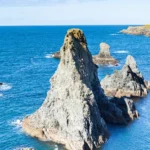
On the Côte Sauvage, near Bangor, needles of rock rise from the sea at the foot of the cliffs. Claude Monet stayed on the island from September to November 1886 and painted them many times. The coastal path offers several viewpoints; the light is best late in the day.
The Grand Phare
Built between 1826 and 1835, the Goulphar lighthouse, known as the « Grand Phare », is 52 m (171 ft) tall. It can be visited in season: the climb up the staircase gives a view over much of the island. It stands in the municipality of Bangor, near Port-Coton and the little port of Goulphar.
Donnant, Les Grands Sables and other beaches
Belle-Île has many beaches. Donnant, on the Côte Sauvage, is framed by dunes and cliffs; its rollers attract surfers, but swimming there is dangerous. On the east side, Les Grands Sables, the island’s longest beach, is more sheltered and family-friendly. In between, small coves such as Herlin or Ster Vras are reached by footpath.
The Apothicairerie cave
North of Sauzon, this cave cuts through a rocky headland. Its name is said to come from the birds’ nests that once lined its walls like the jars of an apothecary. The site is now a bird reserve: it is viewed from the clifftop, as access to the cave itself is dangerous.
Locmaria and the southeast
Locmaria is the quietest village, surrounded by coves such as Port-Maria and Port-Andro. The southeast coast, between Locmaria and the Pointe de Kerdonis, is less busy than the Côte Sauvage and has lovely stretches of path.
Hiking the GR 340
The GR 340 circles the island along the coast. Walking it in full takes a good week; most visitors do one or two stages, for example from the Pointe des Poulains to Donnant, or from Port-Coton to Port-Goulphar. The terrain is hilly: climbs and descents to each cove follow one after another.
When to go to Belle-Île-en-Mer
The best months are June and September, with July-August for swimming. The climate is oceanic and mild: at the Belle-Île-Le Talut station, highs range from 10 °C (50 °F) in winter to nearly 22 °C (72 °F) in August, and the difference between day and night is small. June and July are the driest months (about 35 mm, or 1.4 in), November the wettest (about 84 mm, or 3.3 in). The island is very windy, which can disrupt crossings on stormy days.
When to go to Belle-Île: the essentials
- Best times: June and September
- Swimming: July to September, on the sheltered east-coast beaches
- Hiking the GR 340: April to June, September-October
- Warmest month: August, average high 21.6 °C (71 °F)
- Driest month: June, 34.4 mm (1.4 in)
- Wettest month: November, 83.6 mm (3.3 in)
- Avoid if possible: August if you have not booked your boat and accommodation
| Month | High | Low | Rain | Crowds | Prices | Verdict |
|---|---|---|---|---|---|---|
| January | 10 °C (50 °F) | 6.4 °C (44 °F) | 81 mm (3.2 in) | Very low | Low | ❌ Island asleep, storms possible |
| February | 10 °C (50 °F) | 5.9 °C (43 °F) | 59.2 mm (2.3 in) | Very low | Low | ⚠️ Spectacular sea, few services |
| March | 11.8 °C (53 °F) | 7.1 °C (45 °F) | 48.4 mm (1.9 in) | Low | Low | ⚠️ Cool, windy walks |
| April | 13.9 °C (57 °F) | 8.5 °C (47 °F) | 47.2 mm (1.9 in) | Medium (Easter) | Medium | ✅ Moors in bloom, quiet paths |
| May | 16.8 °C (62 °F) | 11.2 °C (52 °F) | 43.3 mm (1.7 in) | Medium (public holidays) | Medium | ✅ Good month for the GR 340 |
| June | 19.5 °C (67 °F) | 13.7 °C (57 °F) | 34.4 mm (1.4 in) | Medium | Medium to high | ✅ Driest, long days |
| July | 21.3 °C (70 °F) | 15.4 °C (60 °F) | 37.1 mm (1.5 in) | Very high | Very high | ⚠️ Swimming, but a very busy island |
| August | 21.6 °C (71 °F) | 15.6 °C (60 °F) | 40.3 mm (1.6 in) | Very high | Very high | ⚠️ Warmest, boats and lodging fully booked |
| September | 19.9 °C (68 °F) | 14 °C (57 °F) | 53 mm (2.1 in) | Medium | Medium | ✅ Sea still good, calm returns |
| October | 16.5 °C (62 °F) | 12.3 °C (54 °F) | 71.7 mm (2.8 in) | Low | Medium to low | ⚠️ Mild, rain returns |
| November | 13.3 °C (56 °F) | 9.4 °C (49 °F) | 83.6 mm (3.3 in) | Very low | Low | ❌ The wettest |
| December | 11 °C (52 °F) | 7.2 °C (45 °F) | 81.6 mm (3.2 in) | Very low | Low | ❌ Damp and windy |
- Spring (March to May): 12 to 17 °C (54 to 63 °F) in the afternoon, gorse and wildflowers on the cliffs. The ideal season for walking.
- Summer (June to August): 19 to 22 °C (66 to 72 °F), little rain. Crossings are more frequent, but you need to book boat, vehicle and accommodation well in advance.
- Fall (September to November): September stays summery and calmer; rain and gales return in October.
- Winter (December to February): mild but damp; many restaurants and rental agencies close. Boats run all year, with fewer sailings.
To compare with other early-summer ideas, see our selection of where to go in June.
Itinerary ideas for Belle-Île
2 days on Belle-Île
- Day 1: Le Palais and the citadel, then Sauzon and the Pointe des Poulains; sunset on the Côte Sauvage
- Day 2: the Port-Coton needles, the Grand Phare, Donnant beach, then Locmaria and an east-coast beach
4 to 5 days with hiking
- Day 1: Le Palais, the citadel, the path to the Pointe de Taillefer
- Day 2: Sauzon, the Pointe du Cardinal, the Apothicairerie cave
- Day 3: Pointe des Poulains – Donnant on foot
- Day 4: Port-Coton, the Grand Phare, Port-Goulphar
- Day 5: Locmaria, Port-Andro and Les Grands Sables
Before or after the island, spend a day on the Quiberon peninsula or in Carnac; more ideas in our Brittany guide.
Budget for a stay on Belle-Île
| Item (per person per day) | Tight budget | Comfort |
|---|---|---|
| Accommodation (shared double room) | roughly €35 to 60 (campsite, simple room) | roughly €90 to 180 |
| Meals | roughly €25 to 35 | roughly €45 to 80 |
| Local transport (bike, bus, scooter) | roughly €15 to 20 | roughly €20 to 30 |
| Crossing (return trip spread over the stay) | roughly €10 to 15 | roughly €10 to 15 |
| Total | roughly €90 to 130 | roughly €170 to 300 |
Getting there and getting around Belle-Île
- Boat: according to BreizhGo Océane and the island’s tourist office (checked 26 October 2026), daily passenger and vehicle crossings link Quiberon to Le Palais all year, in about 50 minutes, with more sailings in July-August; other companies run summer services from Quiberon, Vannes, Port-Navalo, Le Croisic or La Turballe. To reach Quiberon, see our tips for cheap train travel (Auray station, then bus, or the Tire-Bouchon train in summer).
- Air: the island has an airfield; seasonal flights exist in some years.
- Bike: the most pleasant option, but the island is hilly; an e-bike makes the climbs easier.
- Car or scooter: rental in Le Palais, handy for seeing the island in two days; no need to bring your own vehicle over for a short stay.
- Bus: a network serves the villages and main sites in season.
Where to stay on Belle-Île-en-Mer
Le Palais is the most practical without a vehicle: boat arrivals, rental agencies, restaurants. Sauzon offers a more charming, quieter setting. Bangor and Locmaria suit nature lovers and hikers, with gîtes, B&Bs and campsites. Supply is limited on an island: for July-August, book several months ahead, at the same time as the crossing.
Entry requirements, health and safety
- US citizens (travel.state.gov, last updated August 11, 2025): you may enter the Schengen area, including France, for up to 90 days for tourism or business without a visa; your passport should be valid at least three months beyond your stay, and officers may ask for proof of sufficient funds and a return ticket.
- UK citizens (GOV.UK, updated 22 October 2026): no visa for up to 90 days in any 180-day period as a tourist; your passport must have been issued less than 10 years before you arrive and be valid at least 3 months after you leave the Schengen area. The EU Entry/Exit System (EES) is being implemented: fingerprints and a photo may be taken at your first entry, free of charge.
- Health: take out travel insurance that covers medical costs; UK residents can also use a GHIC or a valid EHIC (GOV.UK). The State Department advises being up to date on CDC-recommended vaccinations.
- Côte Sauvage: strong currents make swimming dangerous at Donnant and in exposed coves; GOV.UK notes that local sea conditions can be dangerous even for strong swimmers: follow the lifeguards’ flags.
- Cliffs and tides: stay on the path and check tide times before heading to the Pointe des Poulains.
- Medical care: the island has medical services, but serious emergencies are evacuated to the mainland; bring your medication.
- Emergencies at sea: 196 from the shore to reach the CROSS sea rescue center, according to the French Ministry for the Sea (mer.gouv.fr).
- Emergencies: 112 (European emergency number), 15 for medical emergencies (travel.state.gov, GOV.UK).
For hiking, surfing or kayaking, check what your travel insurance covers.
Practical tips for Belle-Île-en-Mer
- Book your crossing: essential in summer, especially with a car; arrive early in Quiberon to park.
- Money: ATMs in Le Palais and Sauzon; carry cash for small producers and markets.
- With children: favor Les Grands Sables and the east-coast beaches; see our ideas for family trips.
- Mobile data: decent coverage in the villages, weaker in some valleys and on the Côte Sauvage.
Frequently asked questions
What can you do on Belle-Île-en-Mer in one day?
Arrive early in Le Palais, rent an e-bike or a car, head up to Sauzon and the Pointe des Poulains, then on to the Port-Coton needles and the Grand Phare before the return boat.
How do you get to Belle-Île-en-Mer?
By boat from Quiberon all year (BreizhGo Océane, about 50 minutes to Le Palais). In summer, other companies sail from Vannes, Port-Navalo, Le Croisic or La Turballe. The island also has an airfield.
Do you need to take your car to Belle-Île?
Not for a short stay: bikes, scooters, cars and buses are available on the island. Crossing with a vehicle is expensive and must be booked well ahead in summer.
What is the best time to visit Belle-Île-en-Mer?
June and September: 19 to 20 °C (66 to 68 °F) in the afternoon according to Météo-France 1991-2020 normals at Belle-Île-Le Talut, little rain and fewer people than in July-August.
How long do you need to visit Belle-Île?
Two days for the main sites, four to five to hike the GR 340 and enjoy the beaches. The full loop of the path takes about a week.
Where can you swim on Belle-Île-en-Mer?
On the sheltered east-coast beaches, such as Les Grands Sables. Donnant and the coves of the Côte Sauvage are stunning but dangerous for swimming.
Our sources
- Météo-France: climate data sheet, 1991-2020 statistics, Belle-Île-Le Talut station (Bangor) (via the French Wikipedia article « Bangor (Morbihan) »)
- Wikipedia: « Belle-Île-en-Mer » (French article: geography, links, heritage), checked 14 October 2026
- BreizhGo Océane timetables and the Belle-Île tourist office (belle-ile.com, from Quiberon), checked 26 October 2026
- French Ministry for the Sea: how to alert sea rescue (196), checked 26 October 2026
- Entry requirements, health and safety checked on 26 October 2026: U.S. Department of State, France country information (last updated August 11, 2025) and UK FCDO, GOV.UK foreign travel advice for France (updated 22 October 2026).
- Our methodology
Updated October 2026.
For more ideas, see our France travel guide.