
Looking for things to do on the Crozon peninsula? Walk the GR 34 from the Pointe de Pen-Hir to the Tas de Pois, see Camaret-sur-Mer and its Vauban tower, follow the Cap de la Chèvre, visit the Morgat sea caves by boat, swim at Morgat or on the big beaches of La Palue and Goulien, and climb the Ménez-Hom. In Finistère, facing Brest, the peninsula takes two days to discover, ideally four or five. For another Breton escape out at sea, our guide to visiting Belle-Île-en-Mer covers the coastal path, ports and crossings.
Bordered by the Brest roadstead to the north, the Iroise Sea to the west and the Bay of Douarnenez to the south, the Crozon peninsula is shaped like a cross facing the ocean. It lies entirely within the Armorique Regional Nature Park, and a regional nature reserve has protected twenty-seven of its geological sites since 2013. Its seven municipalities (Crozon-Morgat, Camaret-sur-Mer, Roscanvel, Lanvéoc, Landévennec, Telgruc-sur-Mer, Argol) offer cliffs, moors, beaches and small ports. This guide brings together the highlights, itineraries, safety advice and the month-by-month climate according to Météo-France. For more cliffs and moors elsewhere in Brittany, our Quiberon travel guide presents the Côte Sauvage and boats to the islands.

Our travel deals for Crozon
Affiliate links: we earn a commission, at no extra cost to you.
 FlightsKiwi.comCompare flights and airline combinations to Crozon.Compare flights

Crozon peninsula at a glance
- Department Finistère (Brittany), between Brest and Douarnenez
- Main towns Crozon-Morgat(services, beach), Camaret-sur-Mer (port), Roscanvel, Landévennec
- Access by car via the Térénez bridge; nearest airports Brest and Quimper · details
- Entry Schengen area: US and UK citizens need no visa for short tourist stays · details
- Protection Armorique Regional Nature ParkPart of the sea lies within the Iroise Marine Nature Park
- Currency euro (€) · currencies
- Suggested stay 2 days for the essentials, 4 to 5 for hiking
- Budget see our budget section
Things to do in Crozon: the highlights
The Pointe de Pen-Hir and the Tas de Pois
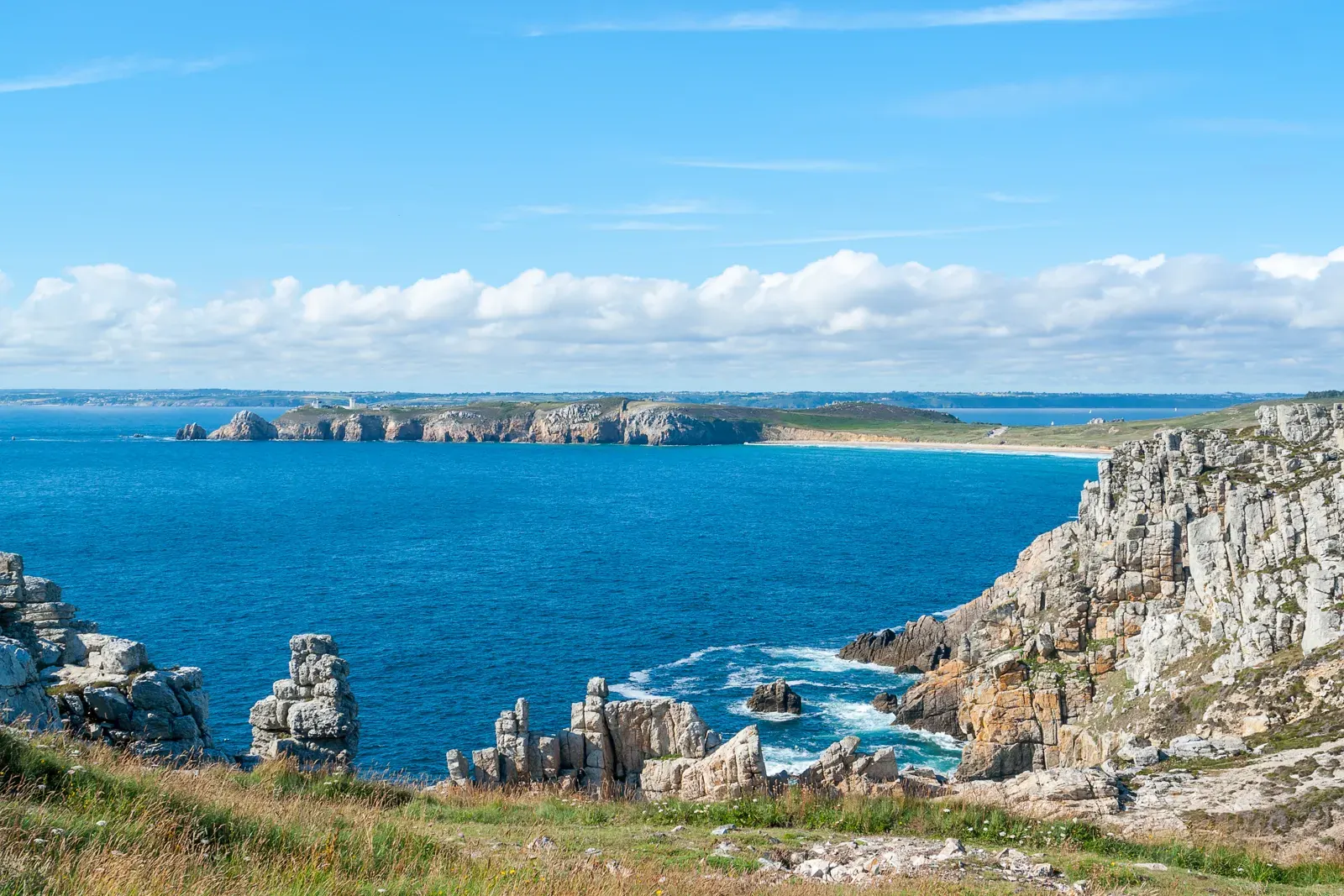
This is the peninsula’s most famous site. From the car park, a few minutes’ walk takes you to the tip of the headland, above dizzying cliffs, facing the three great rocks of the Tas de Pois. The coastal path continues north to Pen-Hat beach and on to Camaret. The site is home to the monument to the Bretons of the Free French. Do not cross the barriers: the cliff edge is unstable.
Camaret-sur-Mer and the Vauban tower
Camaret is a fishing and leisure port at the head of a cove. On the shingle spit enclosing the harbor, the golden tower built to Vauban’s plans is part of the UNESCO-listed fortifications. Next to it, the Notre-Dame-de-Rocamadour chapel keeps sailors’ votive offerings. On the edge of town, the Lagatjar alignments line up several dozen standing stones facing the sea.
The Cap de la Chèvre and the Pointe de Dinan
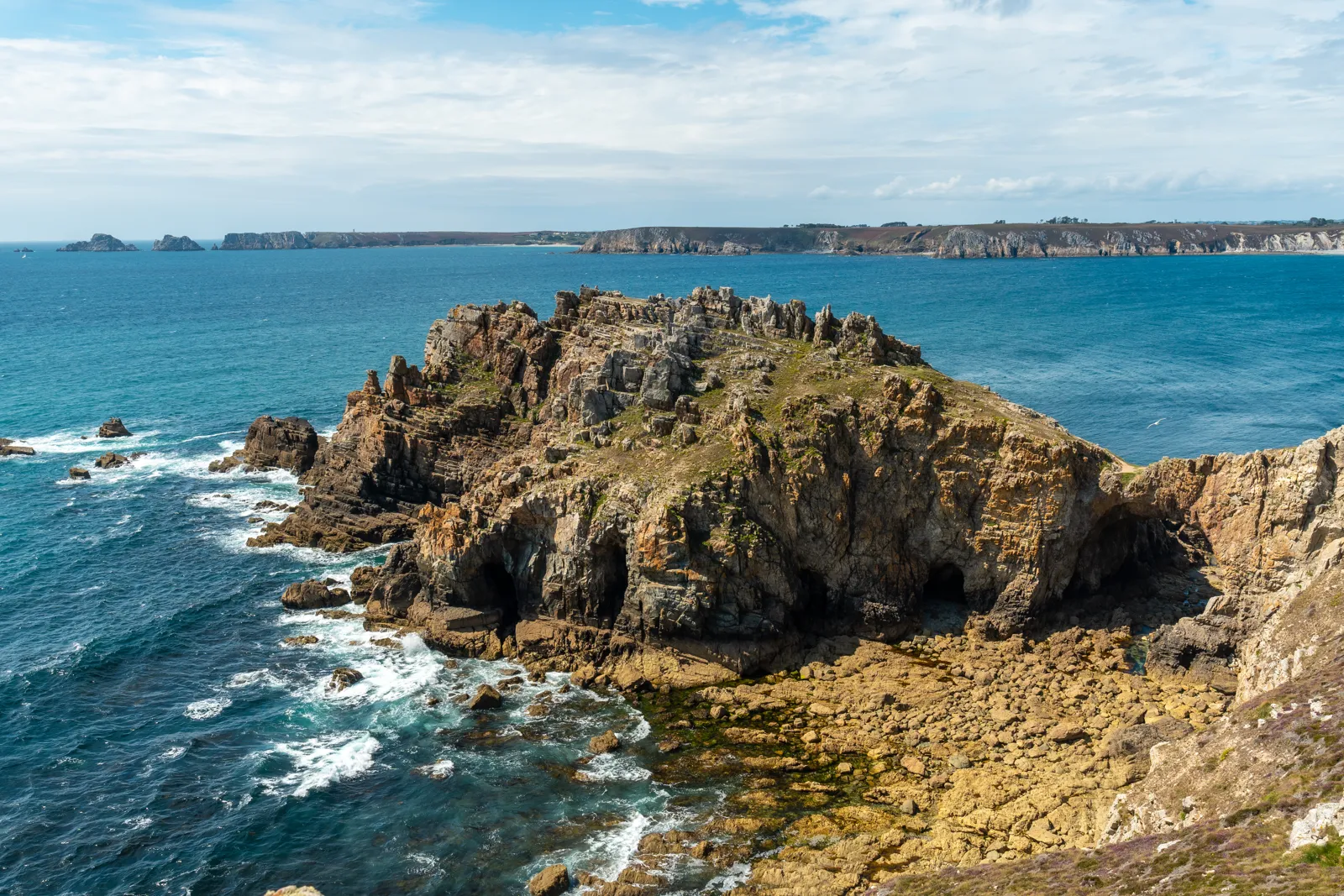
To the southwest, the Cap de la Chèvre juts out between the Iroise Sea and the Bay of Douarnenez: low moorland, a signal station and a panorama along the coast to Cap Sizun. Further north, the Pointe de Dinan is known for its « castle », a rock arch joined to the mainland. Between the two, the big beaches of La Palue and Lostmarc’h are mostly frequented by surfers.
Morgat and its sea caves
A seaside resort facing the Bay of Douarnenez, Morgat has a long sheltered sandy beach, a port and a seafront. It is the starting point for boat trips or guided kayak outings to the sea caves carved into the cliffs, depending on the weather and tide. On the way to the Cap de la Chèvre, the Île Vierge beach, at the foot of the Saint-Hernot cliffs, is reached by a steep path: good shoes are essential.
Roscanvel and the Pointe des Espagnols
To the north, the small Roscanvel peninsula ends at the Pointe des Espagnols, facing the Goulet strait and the city of Brest. The view over the roadstead is one of the widest in Finistère. A loop road circles Roscanvel, lined with old military forts.
Landévennec and the Ménez-Hom
To the east, Landévennec sits in a meander of the Aulne: you can visit the ruins of the old abbey and its museum, next to the still-active Benedictine abbey. The Ménez-Hom, which marks the entrance to the peninsula, is a moorland summit with a 360-degree view over the peninsula, the Bay of Douarnenez and the Aulne.
The beaches
With children, choose the sheltered beaches: Morgat, Le Portzic, or those on the roadstead around Lanvéoc and Roscanvel. The big ocean beaches (La Palue, Goulien, Lostmarc’h, Pen-Hat) are superb but exposed to currents and waves; only swim there if they are supervised. L’Aber, in Crozon, combines beach, dunes and marshes at low tide.
Hiking the GR 34
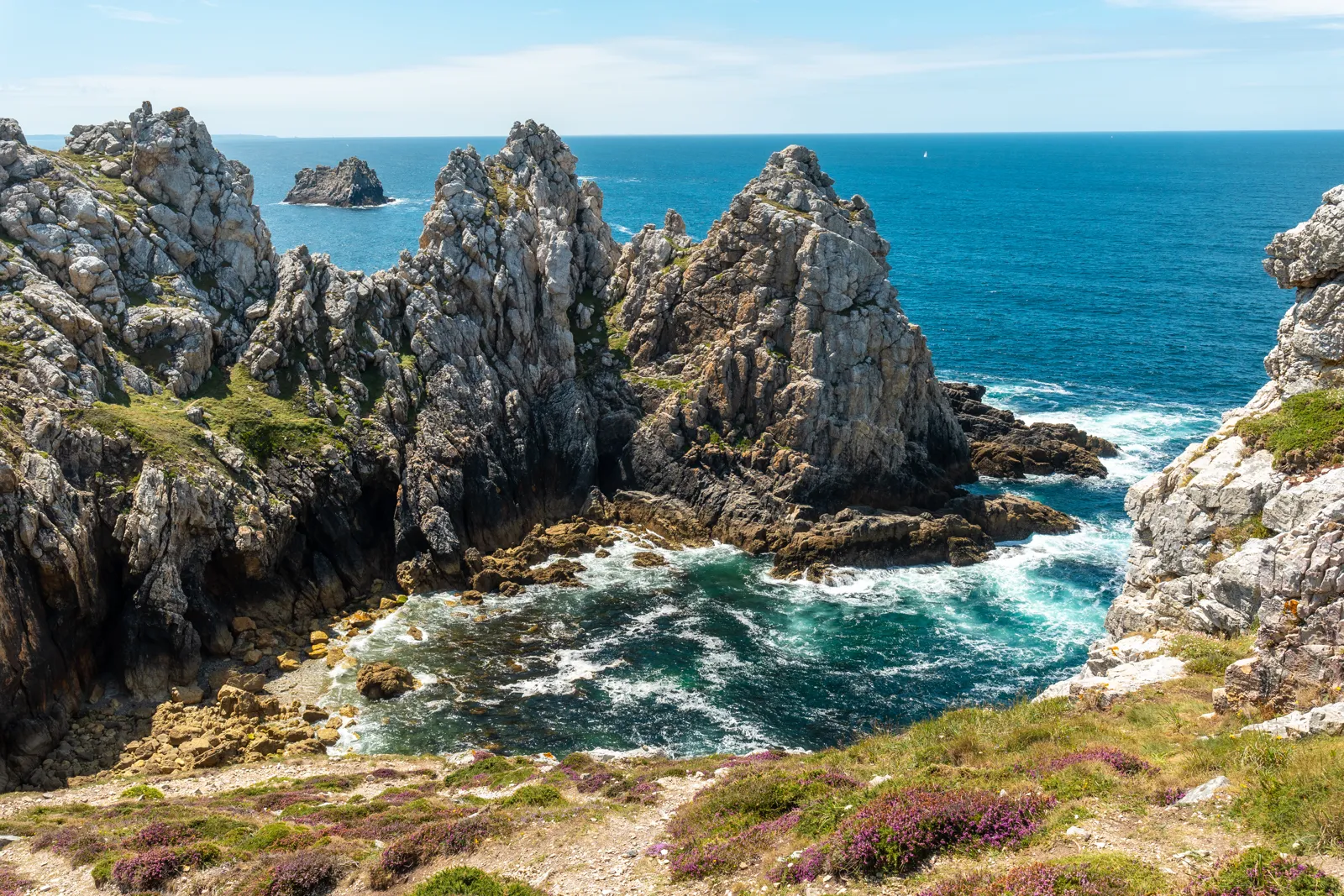
The customs officers’ path circles almost the entire peninsula. You only need to walk one section to see the best of it: Pen-Hir – Camaret, Morgat – Cap de la Chèvre, or the Pointe de Dinan loop. Distances between headlands are long by road: pick two or three areas a day.
When to go to the Crozon peninsula
The best months are June and September; May and July-August also work depending on your priorities. The climate is oceanic, cool and very wet in winter: at Lanvéoc, more than 100 mm (3.9 in) of rain falls each month from October to January, against 55 to 62 mm (2.2 to 2.4 in) from May to August. Summers stay mild (about 21 °C, or 70 °F, in the afternoon), and the Iroise Sea stays cool. The wind can be strong in any season, especially on the headlands.
When to go to Crozon: the essentials
- Best times: June and September
- Swimming: July to September, on the sheltered beaches
- Hiking: April to October
- Warmest month: August, average high 21 °C (70 °F)
- Least rainy month: June, 55.6 mm (2.2 in)
- Wettest month: November, 126.9 mm (5.0 in)
- Avoid if possible: November to January for rain and storms
| Month | High | Low | Rain | Crowds | Prices | Verdict |
|---|---|---|---|---|---|---|
| January | 9.8 °C (50 °F) | 5.2 °C (41 °F) | 118.1 mm (4.6 in) | Very low | Low | ❌ Rain and storms |
| February | 10.1 °C (50 °F) | 4.8 °C (41 °F) | 97.8 mm (3.9 in) | Very low | Low | ⚠️ Spectacular waves, changeable weather |
| March | 12 °C (54 °F) | 5.9 °C (43 °F) | 71.8 mm (2.8 in) | Low | Low | ⚠️ Windy walks, few shops open |
| April | 14.1 °C (57 °F) | 7.1 °C (45 °F) | 75.2 mm (3.0 in) | Low (Easter) | Medium | ✅ Moors in bloom, quiet paths |
| May | 16.8 °C (62 °F) | 9.7 °C (49 °F) | 61.3 mm (2.4 in) | Medium (public holidays) | Medium | ✅ Hiking and light, cold sea |
| June | 19.2 °C (67 °F) | 12.1 °C (54 °F) | 55.6 mm (2.2 in) | Medium | Medium | ✅ Least rainy, long days |
| July | 20.9 °C (70 °F) | 13.8 °C (57 °F) | 57.3 mm (2.3 in) | High | High | ✅ Swimming, boat trips to the caves |
| August | 21 °C (70 °F) | 14 °C (57 °F) | 61.8 mm (2.4 in) | Very high | High | ⚠️ Warmer, but headland car parks full |
| September | 19.5 °C (67 °F) | 12.5 °C (55 °F) | 69.8 mm (2.7 in) | Medium | Medium | ✅ Still mild, fewer people |
| October | 16.1 °C (61 °F) | 10.5 °C (51 °F) | 108 mm (4.3 in) | Low | Low | ⚠️ Mild, but heavy rain returns |
| November | 12.7 °C (55 °F) | 7.9 °C (46 °F) | 126.9 mm (5.0 in) | Very low | Low | ❌ The wettest |
| December | 10.5 °C (51 °F) | 5.9 °C (43 °F) | 126.5 mm (5.0 in) | Very low | Low | ❌ Damp and windy |
- Spring (March to May): 12 to 17 °C (54 to 63 °F) in the afternoon, the moors turn gold with gorse. A good time for the GR 34, with few people.
- Summer (June to August): 19 to 21 °C (66 to 70 °F), the driest months. Boat trips run more regularly.
- Fall (September to November): September stays pleasant; rain increases sharply from October.
- Winter (December to February): mild but very wet (about 100 to 127 mm, or 3.9 to 5.0 in, a month). Storms draw photographers; take care on the headlands.
For more late-season ideas, see our selection of where to go in September.
Itinerary ideas for the Crozon peninsula
A weekend on the peninsula
- Day 1 morning: the Pointe de Pen-Hir and the Tas de Pois, then the path to Camaret
- Day 1 afternoon: Camaret, the Vauban tower, the Lagatjar alignments; sunset at the Pointe de Dinan
- Day 2 morning: Morgat caves by boat (weather permitting) and Morgat beach
- Day 2 afternoon: the Cap de la Chèvre, then the Pointe des Espagnols
4 to 5 days of hiking
- Day 1: Pen-Hir – Camaret on foot
- Day 2: Morgat – Île Vierge – Cap de la Chèvre
- Day 3: the Pointe de Dinan, La Palue and Goulien beaches
- Day 4: Roscanvel and the Pointe des Espagnols
- Day 5: Landévennec and the Ménez-Hom, then Locronan or Brest
For a short break, see also our ideas for cheap weekend breaks, and to continue your trip, our Brittany guide.
Budget for a stay in Crozon
| Item (per person per day) | Tight budget | Comfort |
|---|---|---|
| Accommodation (shared double room) | roughly €30 to 55 (campsite, simple room) | roughly €80 to 150 |
| Meals | roughly €25 to 35 (crêperies, picnics) | roughly €40 to 70 |
| Local transport | roughly €10 to 15 (fuel, bike) | roughly €15 to 20 |
| Activities (boat, kayak, museums) | roughly €5 to 10 | roughly €15 to 30 |
| Total | roughly €70 to 110 | roughly €140 to 240 |
Getting around the peninsula
- Car: the simplest option, as the headlands are far apart. The Pen-Hir and beach car parks fill up in summer: arrive early.
- Train + bus: the nearest stations are Brest and Quimper, linked to the peninsula by bus. See our tips for cheap train travel.
- Bike: possible, but the terrain and distances call for good fitness; an e-bike is a good compromise.
- On foot: the GR 34 links the main sites; plan a return by car or bus.
Where to stay on the Crozon peninsula
Crozon-Morgat is the most practical base: shops, restaurants, a sheltered beach and boat departures. Camaret-sur-Mer suits those who want to be near Pen-Hir and the harbor atmosphere. For peace and quiet, Roscanvel, Telgruc-sur-Mer or the inland hamlets offer gîtes and B&Bs. Campsites are plentiful, especially near the beaches. Book early for July-August.
Entry requirements, health and safety
- US citizens (travel.state.gov, last updated August 11, 2025): you may enter the Schengen area, including France, for up to 90 days for tourism or business without a visa; your passport should be valid at least three months beyond your stay, and officers may ask for proof of sufficient funds and a return ticket.
- UK citizens (GOV.UK, updated 22 October 2026): no visa for up to 90 days in any 180-day period as a tourist; your passport must have been issued less than 10 years before you arrive and be valid at least 3 months after you leave the Schengen area. The EU Entry/Exit System (EES) is being implemented: fingerprints and a photo may be taken at your first entry, free of charge.
- Health: take out travel insurance that covers medical costs; UK residents can also use a GHIC or a valid EHIC (GOV.UK). The State Department advises being up to date on CDC-recommended vaccinations.
- Cliffs: stay on the path and behind the barriers, especially in strong winds; the edges crumble.
- Swimming: GOV.UK notes that local sea conditions can be dangerous even for strong swimmers, with strong undercurrents on some Atlantic beaches; swim at supervised beaches and follow the flags.
- Tides: check the times before going down into the coves or approaching the caves on foot.
- Emergencies at sea: 196 from the shore to reach the CROSS sea rescue center, according to the French Ministry for the Sea (mer.gouv.fr).
- Emergencies: 112 (European emergency number), 15 for medical emergencies (travel.state.gov, GOV.UK).
For surfing, kayaking or hiking, check what your travel insurance covers.
Practical tips for the Crozon peninsula
- Clothing: a windproof and a warm layer in any season, walking shoes for the paths and the Île Vierge.
- When it rains: the Landévennec abbey museum, Camaret’s houses and museums, or Océanopolis in Brest.
- Respect the sites: stay on marked paths to protect the moors and geological sites.
- Mobile data: the signal can be weak below the cliffs; download your maps before setting out.
Frequently asked questions
What can you do on the Crozon peninsula in one day?
Start with the Pointe de Pen-Hir and the Tas de Pois, go down to Camaret for the Vauban tower, then spend the afternoon between Morgat and the Cap de la Chèvre. Finish with sunset at the Pointe de Dinan.
How long do you need to visit the Crozon peninsula?
Two days are enough for the main sites. Allow four to five days if you want to hike the GR 34 and see Landévennec and the Ménez-Hom.
Can you get to Crozon without a car?
Yes, but it is less flexible: train to Brest or Quimper, then bus. Once there, combine buses, bikes and walking.
What is the best time to visit Crozon?
June and September: about 19 °C (66 °F) in the afternoon according to Météo-France 1991-2020 normals at Lanvéoc, among the least rainy months, and fewer people than in August.
Where can you swim on the Crozon peninsula?
At Morgat and on the sheltered beaches of the bay or the roadstead. The big ocean beaches (La Palue, Goulien, Pen-Hat) have dangerous currents: swim only if they are supervised.
What can you do in Crozon when it rains?
Visit Landévennec abbey and its museum, the museums of Camaret, or head to Brest and Océanopolis.
Our sources
- Météo-France: climate data sheet, 1991-2020 statistics, Lanvéoc station, on the peninsula (via the French Wikipedia article « Crozon »)
- Wikipedia: « Presqu’île de Crozon » (French article), checked 14 October 2026
- French Ministry for the Sea: how to alert sea rescue (196), checked 26 October 2026
- Entry requirements, health and safety checked on 26 October 2026: U.S. Department of State, France country information (last updated August 11, 2025) and UK FCDO, GOV.UK foreign travel advice for France (updated 22 October 2026).
- Our methodology
Updated October 2026.
For more ideas, see our France travel guide.

