Quito, the capital of Ecuador, stretches along an Andean valley at around 2,850 m (9,400 ft), on the slopes of Pichincha volcano, a few kilometers south of the equator. Its colonial center was added to the UNESCO World Heritage list in 1978. To visit Quito is to walk the squares and churches of the historic center, ride the TelefériQo, look over the city from El Panecillo and head out to the Mitad del Mundo. Here is what to see, where to stay, how to get around, the official safety advice and the month-by-month climate, based on official sources.
Quito is the starting point for most trips in the country: see our Ecuador travel guide, our best time to visit Ecuador calendar and our page on the Galápagos.

Our travel deals for Quito
Affiliate links: we earn a commission, at no extra cost to you.
 FlightsKiwi.comCompare flights and airline combinations to Quito.Compare flights
- Airport transferKiwitaxiPrivate driver booked in advance at a fixed price.Book a transfer
- eSIMAiraloData plan to install before you leave (eSIM-compatible phone).See plans



Quito essentials
- Altitude: around 2,850 m (9,400 ft); plan a gentle first day (see the health section)
- Time zone: UTC-5 all year (no daylight saving time), the same as New York in winter
- TelefériQo: US$9 adults, US$7 under-18s (standard fare); open 10 am-6 pm Monday to Thursday — checked 26 October 2026 on teleferico.com.ec
- Climate: 21-22 °C (70-72 °F) in the afternoon and 9-10 °C (48-50 °F) at night all year; driest season June to September
- Safety: mugging and pickpocketing are common in the old town and at transport hubs, according to the UK FCDO; book taxis rather than hailing them
Things to do in Quito: the highlights
The historic center and Plaza Grande
The colonial center is best explored on foot. Around Plaza Grande (Independence Square) stand the Carondelet Palace, seat of government, the Metropolitan Cathedral, completed in 1565, and the Archbishop’s Palace. Wikipedia lists several dozen 16th- and 17th-century churches and convents in this area, including San Agustín (1580) and Santo Domingo (1581). The UNESCO listing of 8 September 1978 recognizes one of the best-preserved historic centers in Latin America.
La Compañía de Jesús and San Francisco
The Church of the Society of Jesus, dated by Wikipedia to 1605, is famous for its gilded interior. Plaza San Francisco (1534) and the church and convent of San Francisco (1535) are among the oldest ensembles in the city. Opening hours and entrance fees vary from building to building: check them on site or with the Quito tourist office.
La Ronda and the Basílica del Voto Nacional
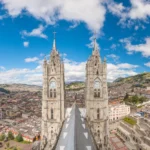
La Ronda, a 16th-century colonial street, is lined with balconied houses, workshops and cafés. Further north, the Basílica del Voto Nacional, dating from 1893, towers over the district.
El Panecillo and the Virgin of Quito
El Panecillo hill, south of the center, is topped by the monumental statue of the Virgin of Quito and offers a sweeping view of the city. Given the robbery risk around the old town reported by the UK FCDO (GOV.UK, updated 2 October 2026), go up by taxi or on an organized tour rather than on foot.
The TelefériQo and Pichincha
Quito’s cable car climbs the slopes of Pichincha. The upper station, Cruz Loma, is at 4,050 m (13,287 ft), according to GOV.UK, and the air is much colder and thinner than in the city. GOV.UK reports accidents on the route to Rucu Pichincha, including deaths from hypothermia: hikes to the summits are only for walkers who are already acclimatized and properly equipped.
| TelefériQo | Hours / fares |
|---|---|
| Monday to Thursday | 10 am – 6 pm |
| Friday | 8 am – 6 pm |
| Saturday and Sunday | 8 am – 7 pm |
| Last ticket | 5 pm Monday to Friday, 5:30 pm at weekends and on public holidays |
| Standard adult fare | US$9 |
| Standard under-18 fare | US$7 |
| Seniors, people with disabilities | US$6.50 |
Museums and parks
The Guayasamín Museum and the Chapel of Man (Capilla del Hombre) present the work of painter Oswaldo Guayasamín; the Ecuadorian Center for Contemporary Art hosts temporary exhibitions. In the modern city, the large La Carolina park is served by the metro station of the same name.
The Mitad del Mundo
North of the city, Ciudad Mitad del Mundo symbolically marks the equator with a monument and museums. Allow half a day; go by taxi, bus or on an excursion.
Itinerary: Quito in 2 or 3 days
- Day 1: arrival and a quiet day (altitude), then the historic center: Plaza Grande, La Compañía, San Francisco, La Ronda.
- Day 2: TelefériQo in the morning, when the sky is often clearer, then the Guayasamín Museum and La Carolina park.
- Day 3: Mitad del Mundo, or an organized trip to Otavalo, Mindo or Cotopaxi.
Where to stay in Quito
The historic center lets you do everything on foot by day, but the UK FCDO notes that mugging and pickpocketing are common in the old town. The modern city to the north, around La Carolina park, is served by the metro and has many hotels. If you arrive late, choose accommodation that arranges your airport transfer.
Getting around Quito
The Quito metro has 15 stations on one north-south line, from Quitumbe to El Labrador, via San Francisco, La Alameda, El Ejido and La Carolina. On weekdays it runs from 5:30 am to 11 pm, every 5 minutes at peak times and every 8 minutes off-peak, according to the official site — checked 26 October 2026 on metrodequito.gob.ec. Keep an eye on your belongings at transport hubs.
For taxis, GOV.UK advises booking through your hotel or a known radio-dispatched service; with a yellow registered taxi in Quito, make sure the driver resets the meter. The U.S. Department of State warns that criminals may enter a taxi and force victims to withdraw money from ATMs: avoid hailing taxis in the street.
Airport transfer
Mariscal Sucre International Airport is outside the city, a long way from the historic center. GOV.UK notes authorized taxi booths at the airport; shuttles, buses and pre-booked private transfers also exist. Before booking, check the meeting point, the waiting time included in case of delay and the total price; for a night arrival, an organized transfer saves you looking for a taxi on the spot.
When to go to Quito: month-by-month climate
At 2,850 m (9,400 ft) and almost on the equator, Quito has no summer or winter: the temperature barely changes from month to month. What varies is the rain. The table below combines the official normals with our own calculations: day-night range, sunrise and sunset times and day length.
| Month | High °C (°F) | Low °C (°F) | Rain mm (in) | Rain days | Day/night range °C (°F) | Sunrise / sunset on the 15th | Day length |
|---|---|---|---|---|---|---|---|
| January | 21.2 (70) | 9.8 (50) | 82 (3.2) | 13 | 11.4 (21) | 6:19 am / 6:27 pm | 12 h 08 |
| February | 21.0 (70) | 10.1 (50) | 111 (4.4) | 14 | 10.9 (20) | 6:24 am / 6:31 pm | 12 h 07 |
| March | 20.8 (69) | 10.1 (50) | 147 (5.8) | 19 | 10.7 (19) | 6:19 am / 6:26 pm | 12 h 07 |
| April | 20.9 (70) | 10.2 (50) | 171 (6.7) | 20 | 10.7 (19) | 6:10 am / 6:17 pm | 12 h 06 |
| May | 21.0 (70) | 10.1 (50) | 106 (4.2) | 17 | 10.9 (20) | 6:07 am / 6:13 pm | 12 h 06 |
| June | 21.1 (70) | 9.8 (50) | 40 (1.6) | 10 | 11.3 (20) | 6:11 am / 6:17 pm | 12 h 07 |
| July | 21.5 (71) | 9.4 (49) | 22 (0.9) | 7 | 12.1 (22) | 6:16 am / 6:23 pm | 12 h 07 |
| August | 22.2 (72) | 9.6 (49) | 28 (1.1) | 7 | 12.6 (23) | 6:15 am / 6:21 pm | 12 h 06 |
| September | 22.3 (72) | 9.4 (49) | 69 (2.7) | 12 | 12.9 (23) | 6:06 am / 6:12 pm | 12 h 06 |
| October | 21.8 (71) | 9.5 (49) | 115 (4.5) | 18 | 12.3 (22) | 5:56 am / 6:03 pm | 12 h 07 |
| November | 21.3 (70) | 9.6 (49) | 108 (4.3) | 16 | 11.7 (21) | 5:54 am / 6:02 pm | 12 h 08 |
| December | 21.3 (70) | 9.7 (49) | 100 (3.9) | 15 | 11.6 (21) | 6:05 am / 6:13 pm | 12 h 08 |
How to read it: day length stays between 12 h 06 and 12 h 08 all year and the sun sets around 6:00-6:30 pm: useful for planning visits, as it gets dark early whatever the season. July and August are the driest months (under 30 mm / 1.2 in, 7 rain days); April is the wettest (171 mm / 6.7 in over 20 days). The gap between day and night exceeds 11 °C (20 °F): bring a warm layer for the evening, even in the dry season.
Entry requirements, health and safety
- US citizens (travel.state.gov, last updated February 18, 2026): no visa for business or tourism stays of up to 90 days in any 12-month period; carry ID and a photocopy of your passport with the entry stamp at all times.
- UK citizens (GOV.UK, updated 2 October 2026): no visa for up to 90 days in any 12-month period; your passport must be valid for at least 6 months after your arrival date, and you may be asked for proof of a return or onward journey.
- Altitude: Quito is at 9,400 ft (2,850 m); the U.S. Department of State advises consulting your doctor about medication and precautions at high altitude, and GOV.UK lists altitude sickness among the health risks.
- Health: the U.S. Department of State lists yellow fever and malaria among the diseases present in Ecuador; check vaccine and malaria advice for your itinerary with a travel health professional at least 8 weeks before you go. Adequate health facilities are available in Quito. Take out insurance covering medical costs and evacuation.
- Safety: GOV.UK reports common mugging and pickpocketing in Quito’s old town and at transport hubs, and criminals posing as bus inspectors in some Quito bus stations; use ATMs inside banks or shopping centers and avoid withdrawing money after dark. Quito has a tourism police unit with branches in the north, the old town, the airport and the bus terminals.
- Emergencies: 911; the ECU 911 app lets you request help and register medical issues (GOV.UK).
See also our guides to altitude sickness and travel vaccines.
Staying connected
An eSIM for Ecuador bought before you leave gives you data as soon as you land, for example to order a taxi through an app. Check that your phone is compatible and that the plan covers Ecuador: our travel eSIM guide explains what to look out for.
If you… then…
| If you… | Then… |
|---|---|
| Arrive on a long-haul flight late in the day | Book an airport transfer and keep your first day quiet |
| Only have two days | Historic center on day one, TelefériQo and Mitad del Mundo on day two |
| Want the best weather | Aim for June to September, the least rainy months |
| Go out in the evening | Use a booked taxi rather than hailing one in the street |
| Travel with young children | Ask a doctor before going up to altitude (TelefériQo, hikes) |
| Are continuing to the Galápagos | Plan a night in Quito to recover before the flight |
Frequently asked questions
How many days do you need to visit Quito?
Two to three days let you see the historic center, the TelefériQo and the Mitad del Mundo, while keeping one quiet day to adjust to the altitude.
How much does the Quito TelefériQo cost?
US$9 for adults and US$7 for under-18s at the standard fare, according to the official site (teleferico.com.ec), checked 26 October 2026.
What is the altitude of Quito?
Around 2,850 m (9,400 ft), according to the U.S. Department of State. Altitude sickness is a risk: take it easy on the first day and consult your doctor before you go.
What is the weather like in Quito?
Around 21-22 °C (70-72 °F) in the afternoon and around 10 °C (50 °F) at night all year round (INAMHI 1981-2010 normals). June to September is the driest period.
Is Quito safe to visit?
The UK FCDO (GOV.UK, updated 2 October 2026) says mugging and pickpocketing are common in Quito’s old town and at transport hubs. Do not hail taxis in the street, use ATMs inside banks or shopping centers, and avoid withdrawing cash after dark.
Do I need a visa for Quito?
No for US and UK citizens visiting for up to 90 days (travel.state.gov, last updated February 18, 2026; GOV.UK, updated 2 October 2026). UK travellers need a passport valid at least 6 months after arrival.
Our sources
- Entry requirements, health and safety read on 26 October 2026: U.S. Department of State, Ecuador country information (travel.state.gov, last updated February 18, 2026), and UK FCDO, foreign travel advice for Ecuador (GOV.UK, updated 2 October 2026)
- TelefériQo (teleferico.com.ec): hours and fares, checked 26 October 2026
- Metro de Quito (metrodequito.gob.ec): stations and hours, checked 26 October 2026
- World Meteorological Organization, World Weather Information Service: 1981-2010 normals for the Quito Inamhi station (INAMHI)
- Wikipedia article “Quito” (UNESCO listing, monuments)
- Astronomical calculations: NOAA solar algorithm, applied by Destination de Voyage to Quito’s coordinates (15th of each month, year 2027)
- Our methodology
Updated October 2026.