The best time to visit Ecuador depends on the region, but for a trip centered on the Andes (Quito, Cotopaxi, Otavalo, Cuenca), aim for June to September: this is the dry season in the Sierra, with 22 to 69 mm (0.9 to 2.7 in) of rain a month in Quito against more than 140 mm (5.5 in) in March–April. For the Galápagos, there is no bad season: December to May brings warmer, calmer seas, June to November cooler water that is very rich in marine life.
Ecuador is crossed by the equator: temperatures change very little through the year. What matters is altitude (about 21 °C (70 °F) in the afternoon in Quito, at 2,800 m (9,186 ft), against more than 30 °C (86 °F) on the coast) and the rainfall calendar, which is not the same in the Andes, on the Pacific coast, in the Amazon and in the Galápagos. The figures on this page are official normals published by the World Meteorological Organization (WMO) or by national weather services.

Our travel deals for Ecuador
Affiliate links: we earn a commission, at no extra cost to you.
 FlightsKiwi.comCompare flights and airline combinations to Ecuador.Compare flights
- eSIMAiraloData plan to install before you leave (eSIM-compatible phone).See plans


Ecuador: areas the UK FCDO advises against
- Border with Colombia: the FCDO (GOV.UK, updated 2 October 2026) advises against all but essential travel to areas within 20 km (12 mi) of the Ecuador–Colombia border, with exceptions in Carchi province (the town of Tulcán, the Rumichaca border crossing, the Pan-American Highway and the El Ángel Ecological Reserve)
- Coastal region: the FCDO advises against all but essential travel to the coastal provinces of Esmeraldas, Manabí, Santa Elena, Guayas and El Oro, as well as Los Ríos and Santo Domingo de los Tsáchilas. Guayaquil is in Guayas; airside transit through its airport is not affected
- Nueva Loja (Lago Agrio): it lies within the 20 km border zone, as does San Lorenzo. For Cuyabeno, the Napo River and El Ángel, the FCDO advises staying alert, traveling in daylight with a reputable official guide and having an emergency plan
- State of emergency: according to the FCDO, the Ecuadorean government declared a 60-day state of emergency from 15 September for security reasons in eight provinces, including Pichincha (Quito), with night curfews in some provinces. The U.S. State Department (travel.state.gov, last updated February 18, 2026) publishes its own advisory levels
- The situation can change: check the current FCDO and State Department pages before booking and during your trip
When to go to Ecuador at a glance
- Andes (Quito, Cotopaxi, Otavalo, Cuenca) June to September, the dry season; March–April are the wettest months
- Galápagos all year. December to May: warmer air and water, calm sea, showers. June to November: dry weather, cooler water, rougher sea, abundant marine wildlife
- Amazon (Cuyabeno, Yasuní, Tena) rain all year; mostly visited as an add-on to a tour
- Temperatures stable, about 21 to 22 °C (70 to 72 °F) in the afternoon and 9 to 10 °C (48 to 50 °F) at night in Quito, whatever the month
- High season July–August (European and North American summer holidays) and late December–early January, especially in the Galápagos
- Safety the mainland coast, including Guayaquil, is subject to FCDO advice against all but essential travel (see the box above)
When to go to Ecuador by priority
- Best weather: June to September in the Andes (22 mm (0.9 in) of rain in July in Quito); all year in the Galápagos
- Cheapest: March to May and October–November, outside the holidays
- Fewest crowds: March to May and October–November; September keeps the Andes’ dry weather with fewer people than in July–August
- Events: Carnival in February or March, Inti Raymi around the June solstice in Otavalo, Day of the Dead on November 2, Quito festivities in early December; check dates
To compare with other destinations, see our picks for where to go in July.
Ecuador: the calendar at a glance
✅ Best months: June, July, August, September
❌ Period to avoid: March, April
Climate and weather in Ecuador, month by month
The table below gives the normals for Quito (Quito Inamhi station, 1981–2010), the gateway for most travelers and representative of the Andean Sierra. It clearly shows a dry season from June to September and a rainy season from October to May, peaking in March–April. The other regions are covered further down.
| Month | Avg. max | Avg. min | Rain | Crowds | Prices | Verdict |
|---|---|---|---|---|---|---|
| January | 21.2 °C (70 °F) | 9.8 °C (50 °F) | 82 mm (3.2 in) | High in early January | High, then moderate | ⚠️ Frequent showers, a good month for the Galápagos |
| February | 21.0 °C (70 °F) | 10.1 °C (50 °F) | 111 mm (4.4 in) | Moderate (Carnival in some years) | Moderate | ⚠️ Rainy in the Andes |
| March | 20.8 °C (69 °F) | 10.1 °C (50 °F) | 147 mm (5.8 in) | Low | Low | ❌ Very rainy in the Andes |
| April | 20.9 °C (70 °F) | 10.2 °C (50 °F) | 171 mm (6.7 in) | Low (Holy Week in some years) | Low | ❌ The wettest month in Quito |
| May | 21.0 °C (70 °F) | 10.1 °C (50 °F) | 106 mm (4.2 in) | Low | Low | ⚠️ Rain easing late in the month |
| June | 21.1 °C (70 °F) | 9.8 °C (50 °F) | 40 mm (1.6 in) | Moderate | Moderate | ✅ Start of the dry season, Inti Raymi |
| July | 21.5 °C (71 °F) | 9.4 °C (49 °F) | 22 mm (0.9 in) | High | High | ✅ The driest month |
| August | 22.2 °C (72 °F) | 9.6 °C (49 °F) | 28 mm (1.1 in) | High | High | ✅ Dry and sunny, wind possible |
| September | 22.3 °C (72 °F) | 9.4 °C (49 °F) | 69 mm (2.7 in) | Moderate | Moderate | ✅ Good compromise, fewer people |
| October | 21.8 °C (71 °F) | 9.5 °C (49 °F) | 115 mm (4.5 in) | Low | Low | ⚠️ Afternoon rain returns |
| November | 21.3 °C (70 °F) | 9.6 °C (49 °F) | 109 mm (4.3 in) | Low | Low | ⚠️ Rainy, low prices |
| December | 21.3 °C (70 °F) | 9.7 °C (49 °F) | 100 mm (3.9 in) | High at the end of the month | High in late December | ⚠️ Quito festivities, showers |
In Quito, nights stay cool all year (9 to 10 °C (48 to 50 °F) minimum). Even in the dry season, bring a sweater, a windproof jacket and serious sun protection: at this altitude, radiation is strong. In the rainy season, showers mostly fall in the afternoon; mornings are often clear.
The seasons in Ecuador: pros and cons
Ecuadorians speak of « verano » (summer) for the dry season and « invierno » (winter) for the rainy season. These terms do not correspond to the same months in each region: in the Sierra, « summer » runs from June to September; on the coast and in the Galápagos, the hot, wet season runs from December to May.
Andean dry season (June to September)
This is the most favorable period for the Sierra: in Quito, 22 mm (0.9 in) of rain falls in July and 28 mm (1.1 in) in August, against 171 mm (6.7 in) in April. In Cuenca, July and August are also the driest months (less than 30 mm (1.2 in)). The volcanoes along the Avenue of the Volcanoes (Cotopaxi, Chimborazo) clear more often, which matters for hiking and summit views.
- Pros: clearer skies, dry trails (Quilotoa, Cotopaxi), coincides with the summer vacation in Europe and North America, Inti Raymi in late June around Otavalo
- Cons: tourist high season in July–August, sometimes strong wind at altitude, cold nights above 3,500 m (11,483 ft)
- Galápagos at this time: cool, dry season (« garúa »), colder water, rougher sea, but very active marine wildlife
- Our tip: September offers almost the same climate as July–August in Quito, with fewer people
Andean rainy season (October to May)
Rain does not fall without interruption: most often the morning is clear and clouds build in the afternoon. March and April are the wettest months in Quito (147 mm (5.8 in) and 171 mm (6.7 in)) and in Cuenca (113 mm (4.4 in) and 123 mm (4.8 in)). The rest of the period remains workable, with flexibility in the program.
- Pros: lower prices (outside the year-end holidays), fewer tourists, very green landscapes
- Cons: summits often in cloud, muddy trails, mountain roads exposed to landslides
- Galápagos at this time: warm season (December to May), calmer sea and warmer water, ideal for snorkeling
- Who is it for? Travelers combining a few days in the Andes with a stay in the Galápagos, or looking for low prices
When to go to Ecuador by region
Four very different regions coexist in a small country. Comparison of the normals for four stations (average maximum temperature / rainfall):
| Month | Quito (Andes) | Cuenca (southern Andes) | Guayaquil (coast) | San Cristóbal (Galápagos) |
|---|---|---|---|---|
| January | 21.2 °C (70 °F) / 82 mm (3.2 in) | 22.0 °C (72 °F) / 58 mm (2.3 in) | 31.4 °C (89 °F) / 224 mm (8.8 in) | 29.2 °C (85 °F) / 83 mm (3.3 in) |
| March | 20.8 °C (69 °F) / 147 mm (5.8 in) | 21.4 °C (71 °F) / 113 mm (4.4 in) | 31.8 °C (89 °F) / 315 mm (12.4 in) | 30.5 °C (87 °F) / 106 mm (4.2 in) |
| May | 21.0 °C (70 °F) / 106 mm (4.2 in) | 20.9 °C (70 °F) / 86 mm (3.4 in) | 31.6 °C (89 °F) / 64 mm (2.5 in) | 29.2 °C (85 °F) / 42 mm (1.7 in) |
| July | 21.5 °C (71 °F) / 22 mm (0.9 in) | 18.6 °C (65 °F) / 28 mm (1.1 in) | 29.5 °C (85 °F) / 4 mm (0.2 in) | 26.4 °C (80 °F) / 19 mm (0.7 in) |
| September | 22.3 °C (72 °F) / 69 mm (2.7 in) | 20.3 °C (69 °F) / 50 mm (2.0 in) | 30.6 °C (87 °F) / 2 mm (0.1 in) | 25.7 °C (78 °F) / 8 mm (0.3 in) |
| November | 21.3 °C (70 °F) / 109 mm (4.3 in) | 22.2 °C (72 °F) / 86 mm (3.4 in) | 31.6 °C (89 °F) / 9 mm (0.4 in) | 27.0 °C (81 °F) / 13 mm (0.5 in) |
Quito and the northern Sierra (Otavalo, Cotopaxi, Quilotoa)
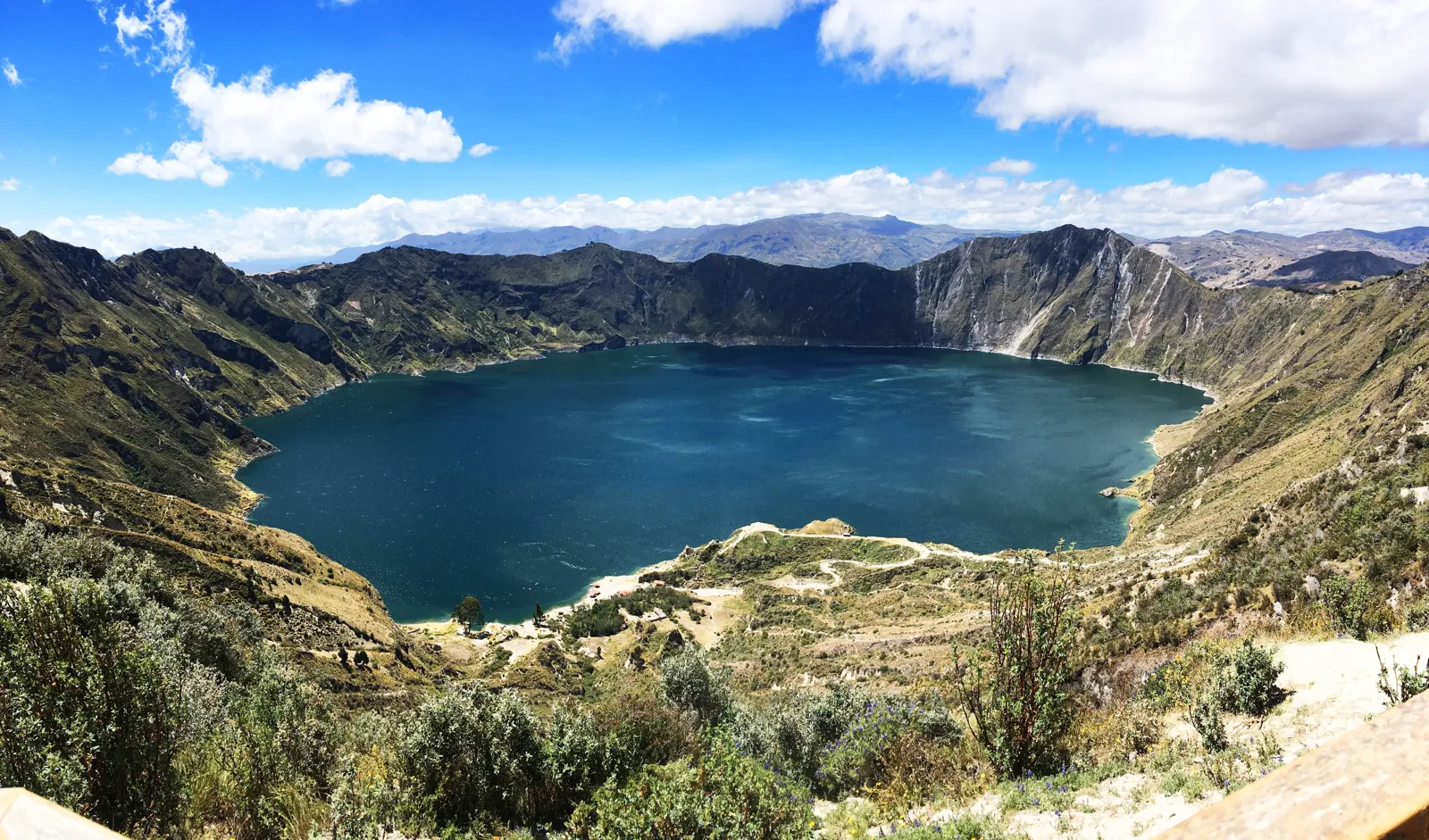
This is the heart of most itineraries. The climate follows the Quito pattern described above: June to September is the best window for hiking and views of the volcanoes. Above 3,500 m (11,483 ft) (Quilotoa lagoon, Cotopaxi refuge), it is much colder, and frost is possible at night. GOV.UK says high mountaineering in Cotopaxi National Park must comply with mandatory national park rules and safety regulations (updated 2 October 2026). Quito, Cotopaxi and the Quilotoa lagoon are shown on our map of Ecuador.
Cuenca and the southern Andes
Cuenca, at 2,545 m (8,350 ft), is a little milder in the austral winter and a little cooler in July (18.6 °C (65 °F) maximum). Its driest months are July and August. The nearby El Cajas National Park peaks above 4,000 m (13,123 ft): fog is frequent there, especially in the afternoon.
The Pacific coast (Guayaquil, Manabí, Santa Elena)
Hot climate all year (about 30 to 32 °C (86 to 90 °F) in the afternoon), with a marked rainy season from January to April (more than 300 mm (11.8 in) in March in Guayaquil) and a drier, grayer season from June to November. Warning: the UK FCDO advises against all but essential travel to the coastal provinces, including Guayas (Guayaquil), Santa Elena and Manabí (GOV.UK, updated 2 October 2026). We therefore do not recommend staying there on a tourist trip.
The Galápagos
The archipelago has two seasons. From December to May, the warm season: highs of 29 to 30 °C (84 to 86 °F), occasional showers (about 100 mm (3.9 in) in February–March in San Cristóbal), generally calm sea and warmer water. From June to November, the cool, dry season: highs around 26 °C (79 °F), often hazy skies, drizzle (« garúa ») on the highlands, rougher sea and colder water, but rich in nutrients, which attracts abundant marine wildlife. Both seasons work; choose according to your tolerance for seasickness and cool water (a wetsuit is useful from June to November).
The Amazon (Cuyabeno, Yasuní, Tena)
It rains all year in the Ecuadorian Amazon, with constant heat (about 28 °C (82 °F) in the afternoon in Tena according to normals published by the FAO). River levels vary by month, which affects canoe access to some lagoons. A lodge stay should be planned in any season, preferably with a recognized operator; for Cuyabeno, note that Nueva Loja (Lago Agrio) lies within the border zone where the FCDO advises against all but essential travel, and that the FCDO recommends traveling in daylight with a reputable official guide.
Region-by-region summary: the right month depending on the part of the country you are heading for. The mainland coast, subject to FCDO advice against all but essential travel, is not included.
| Month | Quito and the northern Sierra | Cuenca and the southern Andes | Galápagos | Amazon |
|---|---|---|---|---|
| January | ⚠️ Showers | ⚠️ Showers | ✅ Warm season, calm sea | ⚠️ Rain all year |
| February | ⚠️ Rainy | ⚠️ Showers | ✅ Warm season, warm water | ⚠️ Rain all year |
| March | ❌ Very rainy | ⚠️ The wettest | ✅ Warm season | ⚠️ Rain all year |
| April | ❌ The wettest | ⚠️ The wettest | ✅ Warm season | ⚠️ Rain all year |
| May | ⚠️ Rain easing | ⚠️ Showers | ✅ End of the warm season | ⚠️ Rain all year |
| June | ✅ Start of the dry season | ⚠️ Transition | ✅ Cool season, marine wildlife | ⚠️ Rain all year |
| July | ✅ The driest | ✅ The driest | ✅ Cool season, marine wildlife | ⚠️ Rain all year |
| August | ✅ Dry and sunny | ✅ The driest | ✅ Rougher sea, marine wildlife | ⚠️ Rain all year |
| September | ✅ Good compromise | ✅ Fairly dry | ✅ Cool season, marine wildlife | ⚠️ Rain all year |
| October | ⚠️ Showers return | ⚠️ Showers | ✅ Cool season, marine wildlife | ⚠️ Rain all year |
| November | ⚠️ Rainy | ⚠️ Showers | ✅ Cool season, marine wildlife | ⚠️ Rain all year |
| December | ⚠️ Showers | ⚠️ Showers | ✅ Start of the warm season | ⚠️ Rain all year |
✅ favorable conditions, ⚠️ possible with reservations, ❌ to avoid. Summary based on the normals cited on this page and the regional advice above.

When to go to Ecuador by trip type
| Trip | Best time | Where? |
|---|---|---|
| Hiking and volcanoes | June to September | Cotopaxi, Quilotoa, Chimborazo |
| First cultural trip | June to September, or December–January to combine with the Galápagos | Quito, Otavalo, Cuenca |
| Snorkeling in the Galápagos (warm water) | December to May | Santa Cruz, San Cristóbal, Isabela |
| Marine wildlife in the Galápagos | June to November | Cruise or stay on the inhabited islands |
| Amazon | All year | Cuyabeno, Yasuní (organized trip), Tena |
| Budget | March to May, October–November | Andes (outside the holidays) |
| Family trip | July–August (book early) | Quito, Baños, Galápagos |
| Honeymoon | December to May for the Galápagos, June to September for the Andes | Galápagos, Cuenca |
Major events to build into your trip
| Date | Event | Location |
|---|---|---|
| February or March (variable dates) | Carnival, very popular festivities | Nationwide, notably Guaranda and Ambato |
| March or April (variable dates) | Holy Week, processions | Quito and Andean towns |
| Late June, around the solstice | Inti Raymi, Andean solstice festival | Otavalo, Cotacachi and the Imbabura region |
| November 2 | Day of the Dead (Día de los Difuntos) | Nationwide |
| Early December | Quito festivities (anniversary of the city’s founding) | Quito |
| December 24 | Pase del Niño Viajero, Christmas Eve procession | Cuenca |
Ecuador month by month: what to expect
January: Showers in the Andes (82 mm (3.2 in) in Quito), warm season in the Galápagos with a calm sea. High demand in the first days of the year, then things calm down.
February: More frequent rain in the Sierra. A good month for the Galápagos (warm water). Carnival falls in February or March depending on the year.
March: One of the wettest months in the Andes and on the coast. In the Galápagos it is hot (30.5 °C (87 °F) maximum in San Cristóbal) and the sea stays calm.
April: The wettest month in Quito (171 mm (6.7 in)). Low prices, but summits are often hidden. The Galápagos remain a good option.
May: Transition: rain eases in the Sierra late in the month. In the Galápagos, the end of the warm season, still plenty of sun.
June: Start of the dry season in the Andes (40 mm (1.6 in) in Quito). Inti Raymi around the June solstice in the Otavalo region. Galápagos waters begin to cool.
July: The driest month in Quito (22 mm (0.9 in)). Excellent conditions for the volcanoes, but high season: book early.
August: Dry and sunny in the Sierra, wind possible at altitude. Rougher sea and cool water in the Galápagos. Heavy crowds.
September: Still dry in the Andes (69 mm (2.7 in) in Quito), fewer people than in summer. A very good compromise.
October: Afternoon showers return in the Sierra. Gentler prices. Cool, dry season in the Galápagos.
November: Rainy in the Andes, low prices. Day of the Dead on November 2. Sea still cool in the Galápagos.
December: Quito festivities in early December, regular showers. Start of the warm season in the Galápagos; high demand for the year-end holidays.
When to book your trip to Ecuador
For July–August and the year-end holidays, book flights and accommodation 3 to 5 months ahead. For a Galápagos cruise, supply is limited by national park regulations: the best-rated boats often fill up 6 months or more ahead in high season. In the low season (March to May, October–November), 2 months is usually enough for the mainland.
Planning your trip to Ecuador
- Entry requirements: for visa rules, passport validity and arrival procedures, see our page on the entry requirements for Ecuador.
- Galápagos: according to GOV.UK (updated 2 October 2026), tourists can stay up to 60 days and must buy a transit control card at their departure airport before checking in; travel health insurance is mandatory for foreign tourists. Check the current requirements before you travel.
- Time difference: mainland Ecuador is on UTC−5 all year, and the Galápagos are one hour behind (UTC−6); there is no daylight saving time.
- Currency: the U.S. dollar (USD). Carry small bills, which are often hard to change.
- Health: the U.S. State Department (travel.state.gov, last updated February 18, 2026) lists Chagas disease, chikungunya, dengue, malaria, yellow fever and Zika among the diseases present in Ecuador; check the latest vaccine recommendations before you travel (GOV.UK, updated 2 October 2026). GOV.UK also says altitude sickness is a risk in parts of the country, so allow time to acclimatize.
- Insurance: essential. GOV.UK notes that medical facilities in the Galápagos are limited and that your travel insurance should include air ambulance evacuation.
For help organizing your tour, see our Ecuador travel guide. Combining with a neighboring country? Also see when to go to Peru and when to go to Colombia.
Also worth reading: travel in Colombia and when to go to Bolivia, two other Andean destinations.
Frequently asked questions
What is the best month to visit Ecuador?
For the Andes (Quito, Cotopaxi, Cuenca), July and August are the driest months, followed by June and September. For the Galápagos, every month works: December to May for a warm, calm sea, June to November for very active marine wildlife.
When should you go to the Galápagos?
All year. From December to May it is warmer, the sea is generally calm and the water warmer, with showers. From June to November the weather is cooler and drier, the water colder and the sea rougher, but marine life is abundant.
What is the rainy season in Ecuador?
In the Andes, from October to May, peaking in March–April (171 mm (6.7 in) in April in Quito). On the coast, from January to April. In the Amazon, it rains all year.
Is it cold in Quito?
Days are mild all year (about 21 to 22 °C (70 to 72 °F) in the afternoon), but nights are cool (9 to 10 °C (48 to 50 °F)) because of the 2,800 m (9,186 ft) altitude. Pack warm clothes for the evening and for excursions at altitude.
Can you visit Ecuador in the rainy season?
Yes. Showers mostly fall in the afternoon in the Sierra, and it is a good period for the Galápagos. Just avoid planning high-altitude hikes on bad-weather days and leave some slack in the itinerary.
Which regions should you avoid in Ecuador?
The UK FCDO (GOV.UK, updated 2 October 2026) advises against all but essential travel to areas within 20 km (12 mi) of the Colombian border, and to the coastal provinces (including Guayaquil), Los Ríos and Santo Domingo de los Tsáchilas. Check the current advice before booking.
What is the weather like in Ecuador in July and August?
In the Andes, this is the heart of the dry season: 22 mm (0.9 in) of rain in July and 28 mm (1.1 in) in August in Quito, with 21 to 22 °C (70 to 72 °F) in the afternoon and 9 to 10 °C (48 to 50 °F) at night. Wind can blow at altitude. In the Galápagos, the sea is rougher and the water cooler. It is also high season: book early.
What is the climate of Ecuador?
It varies mainly with altitude and region: cool temperatures all year in the Andes (about 21 °C (70 °F) by day and 9 to 10 °C (48 to 50 °F) at night in Quito), humid heat on the Pacific coast and in the Amazon, and seasons of their own in the Galápagos. In the Sierra, the dry season runs from June to September.
Our sources
- INAMHI, via the WMO’s World Weather Information Service: 1981–2010 normals for the Quito Inamhi station; World Meteorological Organization (WMO): 1991–2020 normals for Guayaquil, 1981–2010 for Cuenca, normals for Puerto Baquerizo Moreno (San Cristóbal, Galápagos)
- FAO: normals for Tena (Amazon), temperatures
- Safety and health information read on October 26, 2026: UK FCDO, foreign travel advice for Ecuador (GOV.UK, updated 2 October 2026), and U.S. Department of State, Ecuador country information (travel.state.gov, last updated February 18, 2026)
- Our methodology
Updated November 2026.