The best time to visit Peru is May to September: it is the dry season in the Andes, the one that suits Cusco, Machu Picchu, Lake Titicaca and high-altitude hikes best. Skies are often clear and it hardly rains, but nights are cold. By contrast, from December to March the rainy season soaks the Andes and the Amazon, and the Inca Trail closes every year in February.
Peru combines three very different climates, though: a coastal desert where it almost never rains (Lima, Paracas, Nazca), the Andean highlands between 2,300 m (7,550 ft) and more than 4,000 m (13,120 ft) above sea level, and the Amazon rainforest, hot and humid all year. Here is how to choose when to go to Peru, based on the climate normals published by Peru’s National Meteorology and Hydrology Service (SENAMHI).
Safety: the UK FCDO (GOV.UK, updated 9 October 2026) advises against all but essential travel to the area within 20 km (12 mi) south of the Putumayo River and the Peru-Colombia border (Loreto region), with some exceptions, and to the Valley of the Apurímac, Ene and Mantaro Rivers (VRAEM) in the center of the country. The main tourist sites are outside these areas: check the latest advice before you go. Lima, Cusco and the Amazon are shown on our map of Peru.

Our travel deals for Peru
Affiliate links: we earn a commission, at no extra cost to you.
 FlightsKiwi.comCompare flights and airline combinations to Peru.Compare flights
- eSIMSailyAnother eSIM plan to compare: data, validity, network.See Saily plans


When to go to Peru at a glance
- Best time overall May to September (dry season in the Andes)
- Machu Picchu and the Inca Trail May to September; the Inca Trail closes for the whole of February for maintenance
- Best balance of weather and crowds May, September and October
- Peak season June to August, with Inti Raymi (June 24) and the national holidays (July 28 and 29)
- Rainy season (Andes) roughly November to March, peaking in January and February
- Lima and the coast sunny summer from December to April, skies often gray from June to October
- Amazon rainy all year; slightly less rain from June to August in Iquitos
When to go to Peru by priority
- Best weather: May to September in the Andes (less than 10 mm (0.4 in) of rain a month from May to August in Cusco); December to April on the coast
- Cheapest: April and October-November; January to March outside the holidays, if you accept rain in the Andes
- Fewest crowds: May, September and October, before and after the June-August peak at Machu Picchu
- Events: Virgen de la Candelaria festival in Puno in February, Inti Raymi on June 24 in Cusco, national holidays on July 28 and 29, Señor de los Milagros in Lima in October; Inca Trail closed in February
To compare with other destinations, see our picks for where to go in May.
Peru: the calendar at a glance
✅ Best months: April, may, June, July, August, September, October
❌ Period to avoid: January, February
Climate in Peru: temperatures and rainfall month by month
The table below gives the normals for Cusco, at about 3,400 m (11,150 ft) above sea level: it is the base for almost every trip, for visiting the Sacred Valley and Machu Picchu. The coast, Lake Titicaca and the Amazon are covered in more detail below.
| Month | Avg. max | Avg. min | Rain | Crowds | Prices | Verdict |
|---|---|---|---|---|---|---|
| January | 18.9 °C (66 °F) | 6.6 °C (44 °F) | 145 mm (5.7 in) | Low | Moderate (holidays), then low | ❌ The wettest month |
| February | 18.8 °C (66 °F) | 6.5 °C (44 °F) | 134 mm (5.3 in) | Low | Low | ❌ Very wet, Inca Trail closed |
| March | 19.1 °C (66 °F) | 6.2 °C (43 °F) | 107 mm (4.2 in) | Low | Low | ⚠️ Still wet, very green landscapes |
| April | 19.7 °C (67 °F) | 4.9 °C (41 °F) | 43 mm (1.7 in) | Moderate | Moderate | ✅ End of the rains, good compromise |
| May | 19.8 °C (68 °F) | 2.5 °C (37 °F) | 9 mm (0.4 in) | Moderate | Moderate | ✅ Start of the dry season |
| June | 19.5 °C (67 °F) | 0.3 °C (33 °F) | 2 mm (0.08 in) | High (Inti Raymi) | High | ✅ Dry and sunny, cold nights |
| July | 19.1 °C (66 °F) | 0.1 °C (32 °F) | 4 mm (0.2 in) | Very high | Very high | ✅ Dry, the coldest month at night |
| August | 19.8 °C (68 °F) | 1.6 °C (35 °F) | 9 mm (0.4 in) | Very high | Very high | ✅ Dry, heavy crowds |
| September | 19.8 °C (68 °F) | 3.9 °C (39 °F) | 22 mm (0.9 in) | Moderate | Moderate | ✅ Still dry, fewer people |
| October | 20.9 °C (70 °F) | 5.5 °C (42 °F) | 39 mm (1.5 in) | Moderate | Moderate | ✅ First showers, good value |
| November | 20.7 °C (69 °F) | 6.1 °C (43 °F) | 72 mm (2.8 in) | Low | Low | ⚠️ Rains gradually return |
| December | 19.4 °C (67 °F) | 6.4 °C (44 °F) | 123 mm (4.8 in) | Low (high at the holidays) | Low, then high | ⚠️ Rainy season under way |
Note: in Cusco, the afternoon temperature changes little through the year, at around 19 to 21 °C (66 to 70 °F). What changes is the rain and the cold at night. In the dry season, the gap between day and night often exceeds 18 °C (64 °F): pack warm clothes for the evening and early morning, even if the days are sunny.
The seasons in Peru: pros and cons
In the Southern Hemisphere and in the tropics, seasons are defined mostly by rain: in the Andes and the Amazon, the rainy season corresponds to the austral summer (roughly November to March) and the dry season to the austral winter (May to September). On the desert coast, the opposite matters: summer (December to April) is sunny, winter gray and cool.
Dry season (May to September): peak season in the Andes
This is the period most travelers aim for. In Cusco, less than 10 mm (0.4 in) of rain falls per month from May to August, and the days are often bright. Nights, however, are cold: the average minimum drops to 0.1 °C (32 °F) in July in Cusco, and below 0 °C (32 °F) in Puno, on the shores of Lake Titicaca.
- Pros: clear skies, dry trails for the Inca Trail, the Salkantay or the Cordillera Blanca treks, safer mountain roads
- Cons: heavy crowds from June to August at Machu Picchu, tickets and trains booked long in advance, prices at their highest; gray, cool skies in Lima
- Our tip: May and September offer the same dry weather with fewer people than July-August
Shoulder seasons (April, October and November): the good compromise
April marks the end of the rains: the mountains are still green and the sites are less crowded. October is mostly dry, with 39 mm (1.5 in) of rain on average in Cusco, and the first showers arrive late in the day. November becomes more uncertain in the Andes, but it is the start of the good season on the coast.
- Pros: moderate prices, fewer tourists
- Cons: risk of showers, especially in November
- Who is it for? Travelers who want to combine the Andes with a reasonable price
Rainy season (December to March): green, quiet, but wet
In the Andes, the rains peak in January and February: 145 mm (5.7 in) in January in Cusco, nearly 160 mm (6.3 in) in Puno. Showers are frequent and clouds often hide the peaks. The UK FCDO (GOV.UK, updated 9 October 2026) says the rainy season in Peru runs from November to May, with heavy rain and snow in northern Peru and the Andes, including Cusco, and that it can disrupt travel services, road travel between provinces, flights and tourist sites. The FCDO also expects the El Niño weather event to bring heavy rainfall, possible flooding and landslides from late 2026 to April 2027, especially on the northern and central coast.
- Pros: very green landscapes, quieter sites (outside the year-end holidays), sunny season on the coast (Lima, Paracas, north coast)
- Cons: muddy hikes, roads and railways sometimes cut, Inca Trail closed in February
- Who is it for? Travelers who accept the rain or put the coast first
When to go to Peru by region
The terrain means you have to think region by region. On the coast, the cold Humboldt Current cools the air and blocks the rain: almost nothing falls in Lima. In the Andes, altitude makes nights cold all year. In the Amazon, humid heat lasts twelve months. Here are the normals for five cities, every other month:
| Month | Lima (coast) | Cusco (Andes) | Arequipa (south) | Puno (Titicaca) | Iquitos (Amazon) |
|---|---|---|---|---|---|
| January | 25.8 °C (78 °F) / 1 mm (0.04 in) | 18.9 °C (66 °F) / 145 mm (5.7 in) | 21.5 °C (71 °F) / 28 mm (1.1 in) | 16.0 °C (61 °F) / 159 mm (6.3 in) | 31.2 °C (88 °F) / 266 mm (10.5 in) |
| March | 26.0 °C (79 °F) / 5 mm (0.2 in) | 19.1 °C (66 °F) / 107 mm (4.2 in) | 21.4 °C (71 °F) / 21 mm (0.8 in) | 15.6 °C (60 °F) / 116 mm (4.6 in) | 30.9 °C (88 °F) / 317 mm (12.5 in) |
| May | 21.7 °C (71 °F) / 0 mm (0 in) | 19.8 °C (68 °F) / 9 mm (0.4 in) | 21.8 °C (71 °F) / 0 mm (0 in) | 15.5 °C (60 °F) / 7 mm (0.3 in) | 30.1 °C (86 °F) / 292 mm (11.5 in) |
| July | 18.7 °C (66 °F) / 0 mm (0 in) | 19.1 °C (66 °F) / 4 mm (0.2 in) | 21.4 °C (71 °F) / 0 mm (0 in) | 14.9 °C (59 °F) / 3 mm (0.1 in) | 29.9 °C (86 °F) / 187 mm (7.4 in) |
| September | 18.7 °C (66 °F) / 5 mm (0.2 in) | 19.8 °C (68 °F) / 22 mm (0.9 in) | 22.3 °C (72 °F) / 1 mm (0.04 in) | 16.6 °C (62 °F) / 24 mm (0.9 in) | 31.6 °C (89 °F) / 210 mm (8.3 in) |
| November | 21.9 °C (71 °F) / 0 mm (0 in) | 20.7 °C (69 °F) / 72 mm (2.8 in) | 22.5 °C (73 °F) / 1 mm (0.04 in) | 17.7 °C (64 °F) / 40 mm (1.6 in) | 31.6 °C (89 °F) / 287 mm (11.3 in) |
Lima and the desert coast (Paracas, Nazca)
The capital receives almost no rain, a few millimeters a year. The austral summer, from December to April, is the sunny season, with 24 to 26 °C (75 to 79 °F) in the afternoon. From June to October, the sky is usually covered by a layer of low cloud, with a fine drizzle (the garúa) and highs around 18 to 20 °C (64 to 68 °F). Further south, Paracas and Nazca are sunnier.
Cusco, the Sacred Valley and Machu Picchu
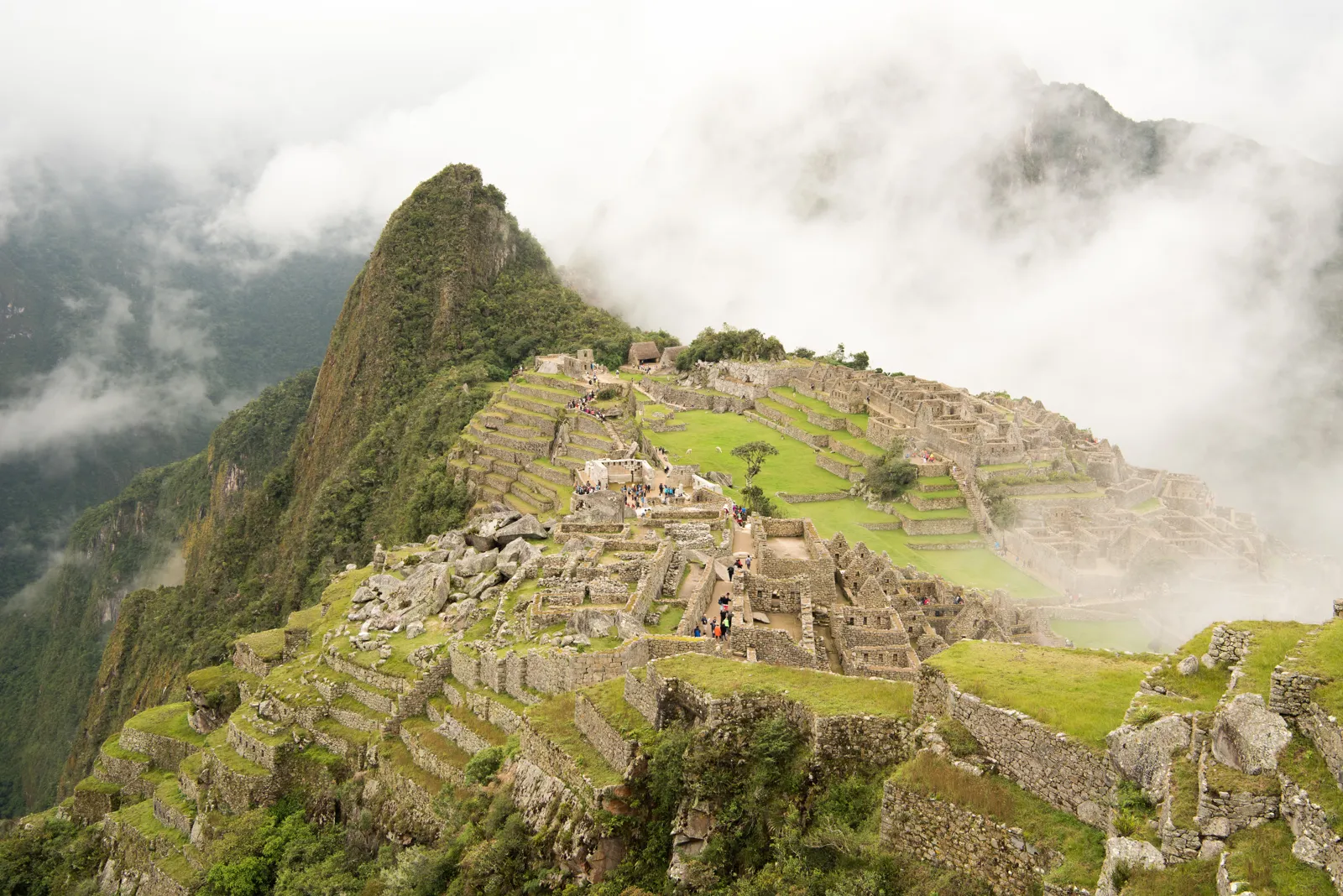
The country’s tourist heart follows the Andean rhythm: May to September for dry weather, with crowds peaking from June to August. Machu Picchu, lower (about 2,400 m (7,870 ft)) and on the edge of the forest, is warmer and more humid than Cusco: even in the dry season, morning cloud is common. Because it is warmer and more humid than Cusco, the site calls for some precautions: a stay at Machu Picchu needs suitable clothing.
Arequipa and the Colca Canyon
Arequipa, at about 2,300 m (7,550 ft), is the driest of the major Andean stops: it only really rains from January to March, and less than 40 mm (1.6 in) a month. The rest of the year the sun is almost constant, with 21 to 23 °C (70 to 73 °F) in the afternoon. In the higher Colca Canyon, nights are freezing in the dry season: at Chivay, 3,644 m (11,960 ft) above sea level, the average minimum drops to -1.8 °C (29 °F) in July according to the 1991-2020 normals of the SENAMHI station.
Puno and Lake Titicaca
At about 3,800 m (12,470 ft), Puno has the harshest climate of the major stops: around 15 to 18 °C (59 to 64 °F) in the afternoon all year, but nights close to 0 °C (32 °F) from June to August (an average minimum of -0.8 °C (31 °F) in July). The dry season, from May to September, brings very clear skies over the lake. From December to March it rains a lot. In early February, the Virgen de la Candelaria festival draws huge crowds.
The Amazon (Iquitos, Puerto Maldonado)
It is hot all year (30 to 32 °C (86 to 90 °F) in the afternoon in Iquitos) and it rains every month, more than 170 mm (6.7 in) even in the driest month. In Iquitos, the driest months run from June to August; river levels are generally higher in the rainy season, which lets you explore the flooded forest by boat, and lower in the dry season, which makes walking easier.
Region-by-region summary: the right month depending on the part of the country you are aiming for.
| Month | Cusco and Machu Picchu | Lake Titicaca (Puno) | Arequipa and Colca | Lima and coast | Amazon |
|---|---|---|---|---|---|
| January | ❌ Wettest | ❌ Very wet | ⚠️ Rainy season | ✅ Sunny summer | ⚠️ Rain |
| February | ❌ Very wet, Inca Trail closed | ❌ Wet, Candelaria | ⚠️ Rainy season | ✅ Sunny summer | ⚠️ Rain |
| March | ⚠️ Still wet | ⚠️ Wet | ⚠️ Rainy season | ✅ Sunny summer | ⚠️ Rain |
| April | ✅ End of the rains | ⚠️ End of the rains | ✅ Sunny | ✅ Sunny summer | ⚠️ Rain |
| May | ✅ Dry season | ✅ Clear skies | ✅ Sunny | ⚠️ Transition | ⚠️ Rain |
| June | ✅ Dry, cold nights | ✅ Dry, freezing nights | ✅ Sunny, cold nights in Colca | ⚠️ Gray skies (garúa) | ✅ Slightly less rain |
| July | ✅ Dry, cold nights | ✅ Dry, freezing nights | ✅ Sunny, cold nights in Colca | ⚠️ Gray skies (garúa) | ✅ Slightly less rain |
| August | ✅ Dry | ✅ Dry, freezing nights | ✅ Sunny, cold nights in Colca | ⚠️ Gray skies (garúa) | ✅ Slightly less rain |
| September | ✅ Dry, fewer people | ✅ Dry | ✅ Sunny | ⚠️ Gray skies (garúa) | ⚠️ Rain |
| October | ✅ First showers | ✅ Good | ✅ Sunny | ⚠️ Gray skies (garúa) | ⚠️ Rain |
| November | ⚠️ Rains return | ⚠️ Rains return | ✅ Sunny | ✅ Sun returns | ⚠️ Rain |
| December | ⚠️ Rainy season | ⚠️ Wet | ✅ Sunny | ✅ Sunny summer | ⚠️ Rain |
✅ favorable conditions, ⚠️ possible with reservations, ❌ best avoided. Summary based on the normals quoted on this page and the regional advice above.
When to go to Peru by trip type
| Your trip | Best time | Where? |
|---|---|---|
| First trip (Lima, Cusco, Machu Picchu) | May to September | Lima, Cusco, Sacred Valley, Machu Picchu |
| Inca Trail (4 days) | May to September; never in February (closed) | From Km 82 to Machu Picchu |
| High-mountain treks | May to September | Cordillera Blanca (Huaraz), Salkantay, Ausangate |
| Lake Titicaca | May to October | Puno, Uros Islands, Taquile, Amantaní |
| Amazon | June to August (slightly less rain) | Iquitos, Puerto Maldonado (Tambopata) |
| Beach and coastal desert | December to April | Paracas, Huacachina, north coast |
| Budget | April, October-November, or January to March outside the holidays | Everywhere, accepting rain in the Andes |
| Traditional festivals | February (Candelaria), June (Inti Raymi) | Puno, Cusco |
| Family trip | Summer school holidays (July-August) or other peak holiday periods | Lima, Cusco, Sacred Valley, Arequipa (watch the altitude with young children) |
Major events in Peru
| Period | Event | Location |
|---|---|---|
| February (main day February 2) | Virgen de la Candelaria festival: costumed dances and parades | Puno |
| February or March (depending on the year) | Carnival | Andes, notably Cajamarca and Puno |
| March or April | Holy Week (processions, high demand for transport) | Nationwide |
| May or June (depending on the religious calendar) | Corpus Christi | Cusco |
| June 24 | Inti Raymi, the Festival of the Sun | Cusco and Sacsayhuamán |
| July 28 and 29 | National holidays (Fiestas Patrias): time off and high demand for transport | Nationwide |
| October | Señor de los Milagros processions | Lima |
| Late December – early January | Year-end holidays (prices rise) | Nationwide |
Peru month by month: what to expect
Peru in January: The wettest month in the Andes (145 mm (5.7 in) in Cusco) and in the rainy season in the Amazon. Full sunny summer in Lima.
Peru in February: Heavy rain in the Andes and the Inca Trail closed all month for maintenance. Candelaria festival in Puno.
Peru in March: The rains ease but stay heavy in Cusco (107 mm (4.2 in)) and Puno. The Inca Trail reopens on March 1.
Peru in April: End of the rainy season: 43 mm (1.7 in) in Cusco, almost dry in Arequipa. A good compromise between weather, crowds and prices, except during Holy Week.
Peru in May: Start of the dry season, nature still green, moderate crowds: one of the best months for Machu Picchu.
Peru in June: Dry and sunny, cold nights. Inti Raymi on June 24 in Cusco: hotels full and prices up around this date. Gray skies in Lima.
Peru in July: The heart of peak season, with school holidays in Europe and North America and the national holidays on July 28 and 29. Book everything very early.
Peru in August: Still dry and very busy. In Iquitos, one of the driest months.
Peru in September: Still dry in the Andes, with crowds dropping noticeably after the end of August.
Peru in October: A few showers late in the day in the Andes, but conditions are still good. Señor de los Milagros processions in Lima. Moderate prices.
Peru in November: Rains gradually return in Cusco (72 mm (2.8 in)). Arequipa stays dry.
Peru in December: Rainy season under way in the Andes and the Amazon, but sunny summer in Lima. Prices rise during the holidays.
When to book your trip to Peru
For a trip from June to August, book your flights 4 to 6 months ahead. The tightest constraint is Machu Picchu: the number of visitors is limited each day, tickets are named, and peak-season slots go early. For the Inca Trail, permits are limited and sold only through authorized agencies: in May-June and July-August, they are often sold out several months before the date. Book the train to Aguas Calientes at the same time. In the low season, 1 to 2 months is generally enough.
Planning your trip to Peru
- Entry requirements: passport and visa rules depend on your nationality and change over time: see the entry requirements for Peru in our country guide.
- Time difference: Peru is UTC-5 all year (no daylight saving time): 5 hours behind London in winter and 6 in summer; the same as New York in winter and 1 hour behind in summer.
- Currency: the sol (PEN). Cards are accepted in hotels and restaurants in the big cities, but markets and small transport are paid in cash. Our currency converter helps you estimate your budget.
- Altitude: Cusco is at about 3,400 m (11,150 ft) and Puno at about 3,800 m (12,470 ft). Both the UK FCDO (GOV.UK, updated 9 October 2026) and the U.S. State Department (travel.state.gov, last updated August 20, 2026) warn of altitude sickness in parts of Peru, including Cusco, Puno and the Colca Canyon, and advise people with existing medical conditions to talk to a doctor before traveling to high altitude.
- Health: both governments list yellow fever and malaria among the health risks in Peru, and GOV.UK reports a major dengue outbreak following floods. Check which vaccines and precautions apply to your route with your doctor or a travel clinic before you leave.
To go further, see our complete Peru travel guide. Hesitating with another Latin American destination? See also when to go to Mexico.
Frequently asked questions
What is the best month to visit Peru?
May and September are the best compromises: it is the dry season in the Andes, with often clear skies in Cusco and at Machu Picchu, but fewer people than in July-August. June, July and August offer the same dry weather, with heavy crowds and higher prices.
When should you hike the Inca Trail?
From May to September, during the dry season. The Inca Trail is closed every year in February for maintenance and conservation work, and reopens on March 1. Permits are limited: book them several months ahead through an authorized agency.
Can you visit Peru in February?
Yes, but it is one of the wettest months in the Andes (134 mm (5.3 in) in Cusco) and the Inca Trail is closed. On the other hand, it is summer on the coast, in Lima and Paracas, and the month of the Candelaria festival in Puno.
Is it cold in Peru?
In the Andes, yes, especially at night. In Cusco, afternoons hover around 19 to 21 °C (66 to 70 °F) all year, but the average minimum drops to 0.1 °C (32 °F) in July. In Puno, near Lake Titicaca, it falls below 0 °C (32 °F) in June and July. On the coast and in the Amazon, it is mild to hot.
When should you go to the Peruvian Amazon?
It rains all year in the Amazon. In Iquitos, the driest months run from June to August, which are also the best period for the Andes. Check the health advice from GOV.UK and travel.state.gov for this region, including yellow fever and malaria, before you travel.
What is the weather like in Peru in August?
August is in the middle of the dry season in the Andes: in Cusco, about 20 °C (68 °F) in the afternoon, 1.6 °C (35 °F) at night and 9 mm (0.4 in) of rain over the month (SENAMHI normals). Pack warm clothes for the nights and book Machu Picchu early: it is one of the busiest months. In Iquitos, in the Amazon, it is one of the driest months.
Our sources
- Peru’s National Meteorology and Hydrology Service (SENAMHI), via the World Meteorological Organization’s World Weather Information Service: normals for the Lima, Cusco, Arequipa and Iquitos stations
- SENAMHI: 1991-2020 climate normals for the Puno and Chivay (Colca Canyon) stations
- Peru’s Ministry of Culture: annual closure of the Machu Picchu Inca trail network in February and reopening on March 1
- Safety and health information read on 26 October 2026: UK FCDO, foreign travel advice for Peru (GOV.UK, updated 9 October 2026), and U.S. Department of State, Peru country information (travel.state.gov, last updated August 20, 2026)
- Our methodology
Updated November 2026.
To plan what comes next, see our Peru travel guide (what to see, itineraries, budget). To extend your trip to the Bolivian side of Lake Titicaca, see when to go to Bolivia.