To visit Machu Picchu takes more planning than most of the world’s great sites: named tickets with a fixed entry time, daily quotas, set circuits, a train to Aguas Calientes and altitude to manage in Cusco. This guide brings together what you need to know to make the visit a success: which circuit to choose, how to buy official tickets, how to get there from Cusco and the Sacred Valley, when to go and how many days to allow.

Our travel deals for Machu Picchu
Affiliate links: we earn a commission, at no extra cost to you.
 FlightsKiwi.comCompare flights and airline combinations to Machu Picchu.Compare flights
- eSIMSailyAnother eSIM plan to compare: data, validity, network.See Saily plans


Machu Picchu at a glance
- Location in the Andes, above the Urubamba valleyAt about 2,400 m (7,900 ft); the village below the site is Aguas Calientes (Machu Picchu Pueblo)
- Access no road from Cusco to the village · detailsTrain from Cusco (Poroy or San Pedro station depending on the season) or Ollantaytambo, then bus or walk to the site
- Airports international flight to Lima, then a domestic flight Lima – Cusco
- Tickets official sales on tuboleto.cultura.pe (Ministry of Culture of Peru)Fixed entry time, between 6 am and 3 pm
- 2026 quotas 4,500 visitors a day, 5,600 in high seasonIncluding 19 June to 2 November 2026
- Best time May to September (dry season)April and October for a good compromise
- Recommended length 1 day on the site4 to 6 days with Cusco and the Sacred Valley
- Entry US and UK: passport valid 6 months from arrival; UK: visa-free, normally up to 90 days · travel.state.gov · GOV.UK
- Time zone UTC−5, no daylight saving; same as New York in winter, 5 to 6 h behind London · detailsLocal time now: –:–
- Currency the Peruvian sol (PEN) · currencies
- Budget see our budget section
Machu Picchu tickets: circuits, quotas and booking
You can no longer wander freely around Machu Picchu. Peru’s Ministry of Culture divides the citadel (the « Llaqta ») into three circuits, themselves split into one-way routes. Each ticket corresponds to one route and one entry time: you cannot see the whole citadel with a single ticket. So choose your route before you buy.
| Circuit | Routes (tickets) | What you see |
|---|---|---|
| Circuit 1 – Panoramic | Upper terrace; Machu Picchu Mountain; Sun Gate (Intipunku); Inca Bridge | The postcard view from above, without going through the heart of the temples |
| Circuit 2 – Classic Machu Picchu | Classic route; lower terrace | A walk through the citadel: the classic route is the most complete for a first visit |
| Circuit 3 – Royal Machu Picchu | Royalty route; Huayna Picchu mountain (Waynapicchu); Great Cavern; Huchuy Picchu | The lower part and the royal temples, with the neighbouring peaks as options |
Quotas are set each year by ministerial resolution. For 2026, Resolution No. 285-2025-MC of 30 October 2025 provides for 5,600 visitors a day on 1 January, from 2 to 5 April, from 19 June to 2 November and on 30 and 31 December 2026, and 4,500 visitors a day for the rest of the year. Entries are staggered hour by hour, from 6 am to 3 pm. According to the annex, the vast majority of places are sold online; a small allocation is sold on site, in Machu Picchu Pueblo, for some routes.
- Where to buy: on the ministry’s official portal, tuboleto.cultura.pe. Resellers and agencies often sell the same tickets with a commission.
- When to buy: as soon as your dates are fixed, especially from June to October and for the Huayna Picchu and Machu Picchu Mountain routes, which sell out first.
- Tickets are in your name: carry the passport used for the purchase.
- Prices: they vary by nationality and age (reduced rates for students and children); check the amount shown on the official portal when you buy.
- Visiting rules: set direction of travel, limited duration, banned items (large bags, walking poles without rubber tips, drones…). Read the rules published on machupicchu.gob.pe before you go.
For a first visit, the most common combination is the classic route of circuit 2, possibly with a circuit 1 route (upper terrace) for the overall view. Hikers add Huayna Picchu, steep and vertiginous, or Machu Picchu Mountain, higher and longer.
What to see at Machu Picchu and around
The Inca citadel
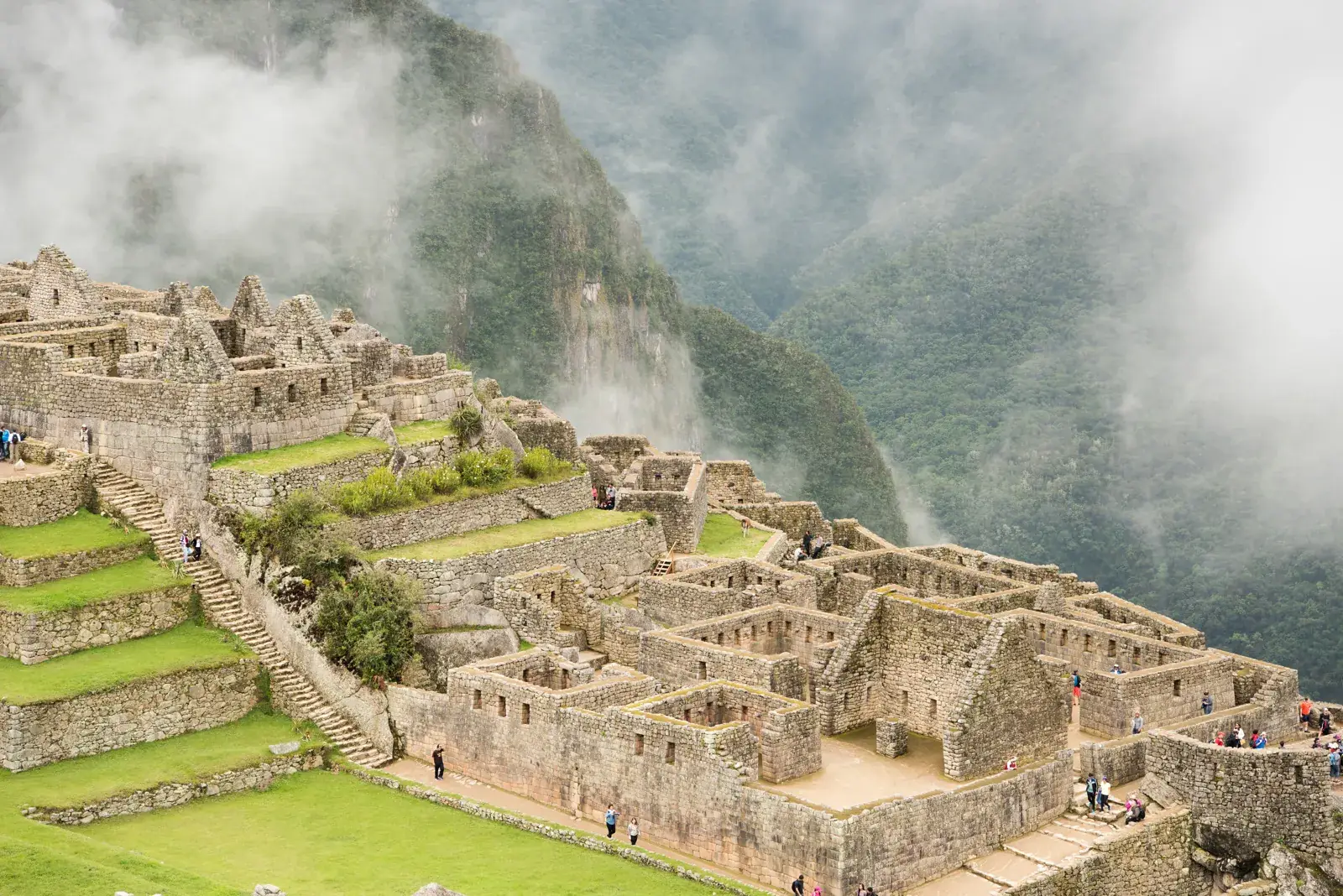
Built in the 15th century, the citadel sits on a ridge between two peaks, above the Urubamba gorge. Depending on your route, you walk through the farming terraces, the urban sector, the main square, the Temple of the Sun, the Temple of the Three Windows and the Intihuatana. A UNESCO World Heritage Site, it is visited on foot, with many stairs.
Huayna Picchu and Machu Picchu Mountain
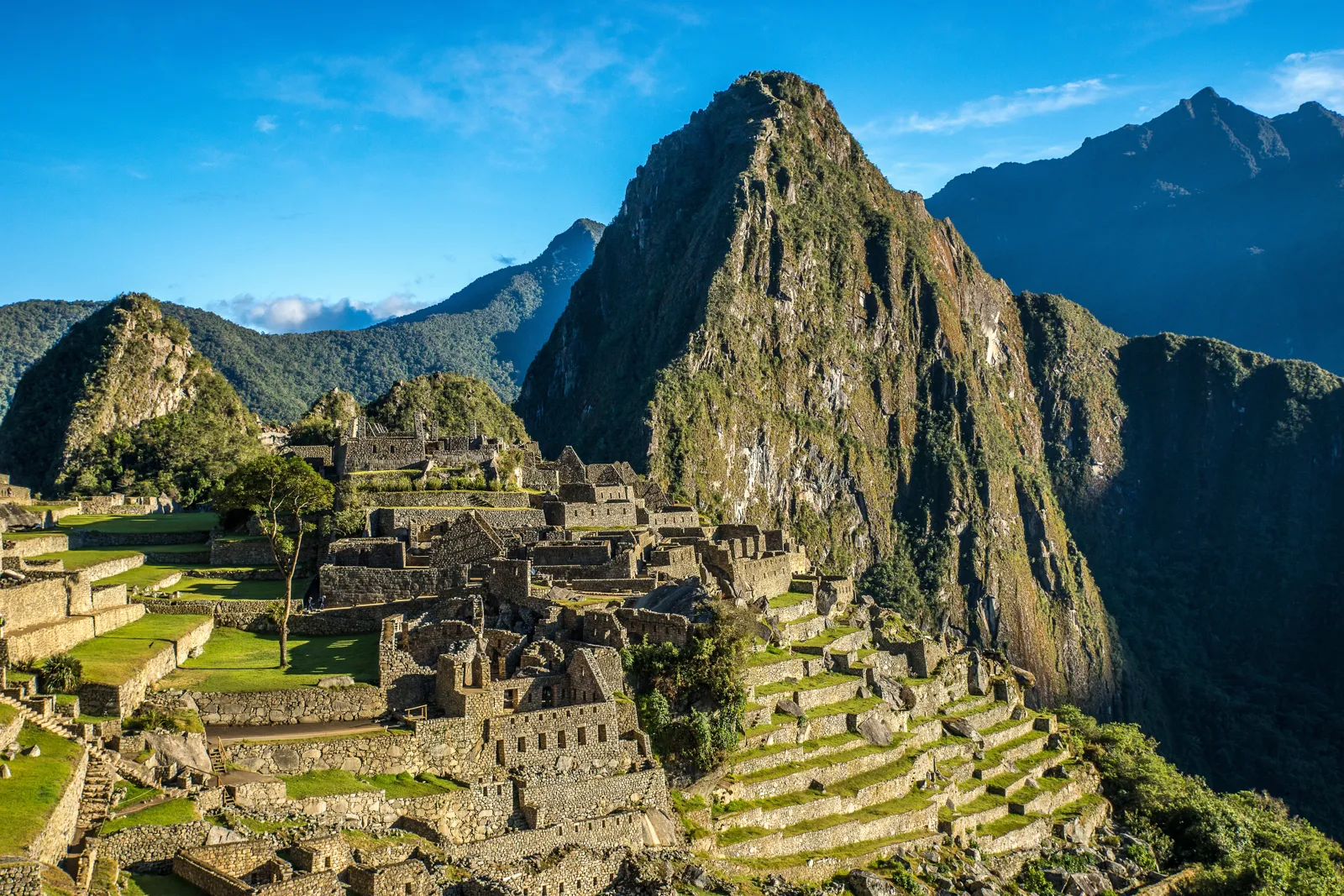
Huayna Picchu is the peak that towers over the citadel in photos. The very steep trail has narrow steps above sheer drops: not recommended if you suffer from vertigo. The UK FCDO reports that several climbers have died or been seriously injured after falling while climbing Huayna Picchu, and that only basic medical services are available at Machu Picchu (GOV.UK, updated 9 October 2026). Machu Picchu Mountain, on the other side, is higher and longer to climb but less exposed. Both are sold as separate routes, with limited places.
The Sun Gate and the Inca Bridge
The Intipunku, the Sun Gate, is the end point of the Inca Trail: the view takes in the whole citadel. The Inca Bridge, shorter, leads to a passage cut into the cliff face. These two circuit 1 routes suit those who want to walk a little without climbing a peak.
Aguas Calientes (Machu Picchu Pueblo)
The village at the foot of the site lives entirely from tourism: hotels, restaurants, hot springs and the station. The bus up to the citadel entrance runs continuously from dawn; you can also walk up a stepped trail, allowing about an hour and a half of sustained effort. Staying overnight lets you enter the site in the first time slots.
Cusco
The former capital of the Inca Empire, at about 3,400 m (11,155 ft), Cusco is the base for almost every trip to Machu Picchu. The Plaza de Armas, the cathedral, the Qorikancha (Inca temple topped by the Santo Domingo convent), the San Blas district and the Inca walls of Hatun Rumiyoc street can be seen in a day. On the heights, Sacsayhuamán fortress hosts Inti Raymi, the Festival of the Sun, on 24 June. Allow at least two days to acclimatise to the altitude. The rest of the city is covered in our guide things to do in Cusco.
The Sacred Valley
Between Cusco and Machu Picchu, the Urubamba Valley is lower (about 2,800 to 3,000 m / 9,200 to 9,800 ft) and milder: a good stop for acclimatising. Pisac combines a market with a terraced Inca site; Ollantaytambo, an Inca village still inhabited, is overlooked by its fortress and serves as the station for Machu Picchu. Around Maras, the terraced salt pans and the farming circles of Moray are worth the detour, as is the village of Chinchero and its weavers.
Treks to Machu Picchu
The classic Inca Trail takes four days and arrives through the Sun Gate. Permits are limited and only available through a licensed agency; the trail closes every February for maintenance. A short one-day version also exists. The Salkantay trek, higher and without named permits, reaches Aguas Calientes in four to five days. GOV.UK advises always registering when entering national parks. In every case, you need an entry ticket for the citadel.
Getting to Machu Picchu
- To Cusco: a domestic flight from Lima (about 1 hour 30 minutes), or a bus from Arequipa or Puno.
- Train: two companies, PeruRail and Inca Rail, link Cusco (Poroy or San Pedro station depending on the season) and Ollantaytambo with Aguas Calientes. From Ollantaytambo, the journey takes about 1 hour 30 minutes. Book trains at the same time as entry tickets. GOV.UK notes that train services to and from Machu Picchu are occasionally suspended or disrupted because of protests.
- Bus to the site: shuttles from Aguas Calientes to the citadel entrance, about 25 minutes of hairpin bends; ticket bought separately.
- Budget option: minibus to the hydroelectric plant (Hidroeléctrica), then about 2 h 30 to 3 h on foot along the railway. Longer and less comfortable.
- With an agency: a day return from Cusco is possible but very long; a night in Aguas Calientes or the Sacred Valley makes the visit more comfortable.
Itinerary: 2 to 6 days
- Day 1: arrive in Cusco, a quiet day for the altitude, the historic centre on foot
- Day 2: Cusco (Qorikancha, San Blas, Sacsayhuamán), or go straight down to the Sacred Valley to sleep lower
- Day 3: Sacred Valley: Pisac, Chinchero, Maras and Moray, night in Ollantaytambo
- Day 4: Ollantaytambo fortress in the morning, train to Aguas Calientes in the afternoon
- Day 5: Machu Picchu in the first time slot, then the train back to Ollantaytambo or Cusco
- Day 6: back in Cusco, museums or San Pedro market
With only two days from Cusco, take the train to Aguas Calientes on the first day and visit the site the next morning. This pace is tight if you have just arrived from Lima: acclimatisation comes first. For the rest of your trip, see our Peru travel guide.
When to go to Machu Picchu
The best time to visit Machu Picchu is from May to September, during the Andean dry season: less than 80 mm (3.1 in) of rain a month at the site, compared with more than 300 mm (11.8 in) from January to March. It is also the busiest period, especially from June to August. April and October offer a good compromise. The site, lower and on the edge of the forest, stays humid all year: morning clouds often lift during the day.
| Month | Max | Min | Rain | Crowds | Prices | Verdict |
|---|---|---|---|---|---|---|
| January | 20.6 °C (69 °F) | 11.8 °C (53 °F) | 341 mm (13.4 in) | Medium (holidays) | Medium | ❌ Very rainy, slippery trails |
| February | 20.6 °C (69 °F) | 11.9 °C (53 °F) | 325 mm (12.8 in) | Low | Low | ❌ Wettest, Inca Trail closed |
| March | 21.0 °C (70 °F) | 11.9 °C (53 °F) | 341 mm (13.4 in) | Low | Low | ❌ Still very rainy |
| April | 21.5 °C (71 °F) | 11.7 °C (53 °F) | 184 mm (7.2 in) | Medium (Holy Week) | Medium | ⚠️ End of the rains, green landscapes |
| May | 21.9 °C (71 °F) | 10.8 °C (51 °F) | 73 mm (2.9 in) | Medium to high | Medium → high | ✅ Start of the dry season |
| June | 22.0 °C (72 °F) | 10.0 °C (50 °F) | 51 mm (2.0 in) | High (Inti Raymi) | High | ✅ Dry, cold nights in Cusco |
| July | 22.1 °C (72 °F) | 9.4 °C (49 °F) | 54 mm (2.1 in) | Very high | Very high | ✅ Dry, book tickets early |
| August | 23.1 °C (74 °F) | 10.0 °C (50 °F) | 61 mm (2.4 in) | Very high | Very high | ✅ Dry, very busy |
| September | 23.4 °C (74 °F) | 11.1 °C (52 °F) | 76 mm (3.0 in) | High | High | ✅ Still dry, slightly fewer crowds |
| October | 22.8 °C (73 °F) | 11.5 °C (53 °F) | 163 mm (6.4 in) | Medium to high | Medium | ⚠️ First showers, good compromise |
| November | 22.8 °C (73 °F) | 12.0 °C (54 °F) | 173 mm (6.8 in) | Medium | Medium | ⚠️ Rain returns |
| December | 21.2 °C (70 °F) | 12.0 °C (54 °F) | 275 mm (10.8 in) | Low (high at holidays) | Medium | ❌ Rainy season set in |
In Cusco, higher up, afternoons stay around 19 to 21 °C (66 to 70 °F) all year, but nights drop close to 0 °C (32 °F) in June and July (average minimum of 0.1 °C (32 °F) in July), and less than 10 mm (0.4 in) of rain falls a month from May to August, according to the normals published by SENAMHI for the Cusco station, via the WMO World Weather Information Service. Bring layers: warm in the sun, cold as soon as night falls.
- Dry season (May-September): mostly clear skies, hikes and the Inca Trail in the best conditions. On the other hand, quotas reached, trains full and prices at their highest.
- Shoulder seasons (April, October-November): fewer crowds, green mountains, showers mainly in the afternoon.
- Rainy season (December-March): frequent rain, clouds, a risk of the railway being cut during heavy rain. The Inca Trail closes in February. The U.S. Department of State notes that train services are occasionally disrupted by landslides, derailments, strikes or protests.
| Plan | Best time |
|---|---|
| First visit, photos of the site | May to September |
| Inca Trail | May to September; never in February (closed) |
| Fewer crowds | April, October, November |
| Inti Raymi in Cusco | Around 24 June (book very early) |
| Budget travel | November, January to March (outside holidays) |
For the rest of the country (coast, Lake Titicaca, Amazon), see our page on the best time to visit Peru, and to compare, where to go in July or where to go in September.
Budget for Machu Picchu
Machu Picchu is the most expensive stop on a trip to Peru: entry ticket, train and bus add up. Rough amounts per person per day in the Cusco region, excluding international flights:
| Item | Budget | Comfort |
|---|---|---|
| Accommodation (based on a shared double room) | roughly US$20 to $45 | roughly US$80 to $170 |
| Meals | roughly US$15 to $30 | roughly US$40 to $65 |
| Local transport and sightseeing | roughly US$20 to $40 | roughly US$45 to $80 |
| Total per day (excluding the Machu Picchu day) | roughly US$80 to $125 | roughly US$170 to $315 |
To keep costs down: early-morning or late-evening trains, which are cheaper; the route via Hidroeléctrica; nights in the Sacred Valley rather than in Aguas Calientes, where prices are high for the comfort on offer.
Machu Picchu: who is it for?
Our verdict by travel style, based on the information in this guide:
- Culture and archaeology: ideal: a UNESCO-listed Inca citadel, Cusco and the Qorikancha, the Pisac and Ollantaytambo sites in the Sacred Valley.
- Hiking: yes: the four-day Inca Trail (permit through a licensed agency, closed in February), the Salkantay trek, Machu Picchu Mountain; Huayna Picchu is not recommended if you suffer from vertigo.
- Families: possible with precautions: many stairs on the site and Cusco’s altitude (about 3,400 m / 11,155 ft); starting with the lower Sacred Valley helps acclimatisation.
- Travellers short on time: doable in a day from Cusco, by train or on a tour, but the day is very long; a night in Aguas Calientes or the Sacred Valley is more comfortable.
- Budget travellers: plan ahead: it is the most expensive stop on a trip to Peru, with roughly US$80 to $125 per person per day in the Cusco region, plus the ticket, train and bus on the day of the visit.
Where to stay to visit Machu Picchu
- Aguas Calientes: the most practical option for entering in the first time slot; hotels are expensive for their standard, book early in the dry season.
- Ollantaytambo: quiet, 1 h 30 by train from the site, ideal for combining the Sacred Valley and Machu Picchu.
- Urubamba and the Sacred Valley: country hotels, lower than Cusco, good for acclimatising.
- Cusco: the widest choice, from dorms to historic hotels; prefer the centre or San Blas, and a heated room in June-August.
Entry requirements, health and safety
- US citizens: your passport must be valid for at least six months from the date of entry. Your length of stay is set by border officials on arrival, and overstays lead to fines; make sure your entry is recorded, even at remote land crossings (U.S. Department of State, travel.state.gov, last updated August 20, 2026).
- UK citizens: you can travel to Peru without a visa for tourism; you will normally be allowed to stay up to 90 days in a 180-day period. Your passport must be valid for at least 6 months after the date you arrive. At international airports your entry is registered digitally; if you arrive by land, make sure you get an entry stamp (UK FCDO, GOV.UK, updated 9 October 2026).
- Altitude sickness: Cusco is above 3,000 m (9,800 ft). The UK FCDO describes altitude sickness as a serious risk in Cusco, and the U.S. Department of State advises people with pre-existing conditions to see a doctor before travelling to high elevations. Limit effort in the first days, go up gradually, drink regularly and avoid alcohol. If symptoms get worse, go down and see a doctor.
- Vaccines: check vaccine recommendations at least 8 weeks before your trip (GOV.UK), especially if you continue into the Amazon, where yellow fever is among the risks listed.
- Safety: street crime is a significant problem in Cusco; use licensed or app-based taxis, watch your belongings on buses and at terminals, and check for protests, which sometimes block roads and the railway (GOV.UK; travel.state.gov).
- Hiking: register when entering national parks and be particularly careful in steep, slippery or unfenced areas (GOV.UK).
Before you go, see our travel insurance guide: good cover for medical costs and repatriation is essential at altitude.
Practical tips for Machu Picchu
- Arrive early: the first time slots (6-7 am) often have the most beautiful mist, but not necessarily the best view: the sky often clears during the morning.
- Gear: walking shoes, a waterproof windbreaker, sunscreen, insect repellent (small biting flies at Aguas Calientes), a small bag.
- Money: withdraw soles in Cusco; ATMs in Aguas Calientes are sometimes empty.
- Guide: an official guide can be found at the site entrance or arranged in Cusco; check the current rules on guides on the official website.
- Mobile data: coverage is decent in Cusco and the towns, weak on the trails.
Read also
Machu Picchu is usually part of a tour: see the best time to visit Peru for the dry season and our Peru travel guide for the rest of the country. Before you go, check the time difference with Peru; to continue to Lake Titicaca, see also our Bolivia guide.
Frequently asked questions
How do you buy a ticket for Machu Picchu?
On tuboleto.cultura.pe, the portal of Peru’s Ministry of Culture. First choose the circuit and route, then the entry time. The ticket is in your name: carry the passport used for the purchase.
How many visitors a day at Machu Picchu in 2026?
4,500 visitors a day, and 5,600 in high season: 1 January, 2 to 5 April, 19 June to 2 November and 30 and 31 December 2026, according to Ministerial Resolution No. 285-2025-MC.
Which circuit should you choose for a first visit?
The classic route of circuit 2 goes through the citadel. Add a circuit 1 route (upper terrace) for the overall view, or Huayna Picchu (circuit 3) if you like steep climbs.
What is the best time to visit Machu Picchu?
May to September, the dry season: less than 80 mm (3.1 in) of rain a month against more than 300 mm (11.8 in) from January to March, according to the SENAMHI normals. April and October are a good compromise, with fewer crowds.
Can you do Machu Picchu as a day trip from Cusco?
Yes, by train or on an organised tour, but the day is very long. A night in Aguas Calientes or the Sacred Valley makes the visit more enjoyable.
Should you worry about the altitude?
The site is at about 2,400 m (7,900 ft), but Cusco is above 3,000 m (9,800 ft). Plan one or two quiet days on arrival, or start with the lower Sacred Valley.
Our sources
- Ministry of Culture of Peru: Ministerial Resolution No. 285-2025-MC of 30 October 2025 and its annex « Aforo dinámico del año 2026 » (gob.pe), official website machupicchu.gob.pe (circuits and visiting routes), ticket portal tuboleto.cultura.pe
- Entry requirements, health and safety checked on 26 October 2026: U.S. Department of State, Peru country information (last updated August 20, 2026) and UK FCDO, GOV.UK foreign travel advice for Peru (updated 9 October 2026)
- Machu Picchu climate: 1991-2020 normals for the Machu Picchu station (2,399 m), Peru’s National Meteorology and Hydrology Service (SENAMHI)
- Cusco climate: normals published by SENAMHI for the Cusco station, via the WMO World Weather Information Service
- European Central Bank: euro reference rates of 23 October 2026 (budget conversion into US dollars)
- Our methodology
Updated October 2026.
To extend your trip, see our Peru travel guide, our guides to Bolivia, Ecuador and Chile, our tips for an overland trip and our other destinations in Latin America.