Things to do in Belgrade? Climb up to Kalemegdan fortress to watch the Danube and the Sava meet, stroll down the pedestrian Knez Mihailova street, have dinner in the bohemian Skadarlija quarter, step inside the huge Temple of Saint Sava, spend an afternoon in the old town of Zemun and end the evening on a floating bar. Allow 2 to 3 days to visit Belgrade. Best times: May-June and September.
The capital of Serbia works well for a long weekend. This guide covers the main sights, an itinerary, the neighborhoods to stay in, the budget and the climate, with our own calculations: hours of sunshine, sunset time and expected rainy days over a week, month by month.
Our travel deals for Belgrade
Affiliate links: we earn a commission, at no extra cost to you.
FlightsKiwi.comCompare flights and airline combinations to Belgrade.
Time zoneUTC+1 (UTC+2 in summer)1 h ahead of London and 6 h ahead of New York
AirportsBelgrade Nikola Tesla (BEG)Check current routes with the airlines
EntryUS and UK: visa-free up to 90 days; police registration within 24 hours · travel.state.gov · GOV.UK
Electricitycheck the plug type with your adapter supplier · plugs
Ideal stay2 to 3 days
Things to do in Belgrade: the top sights
Belgrade Fortress and Kalemegdan Park
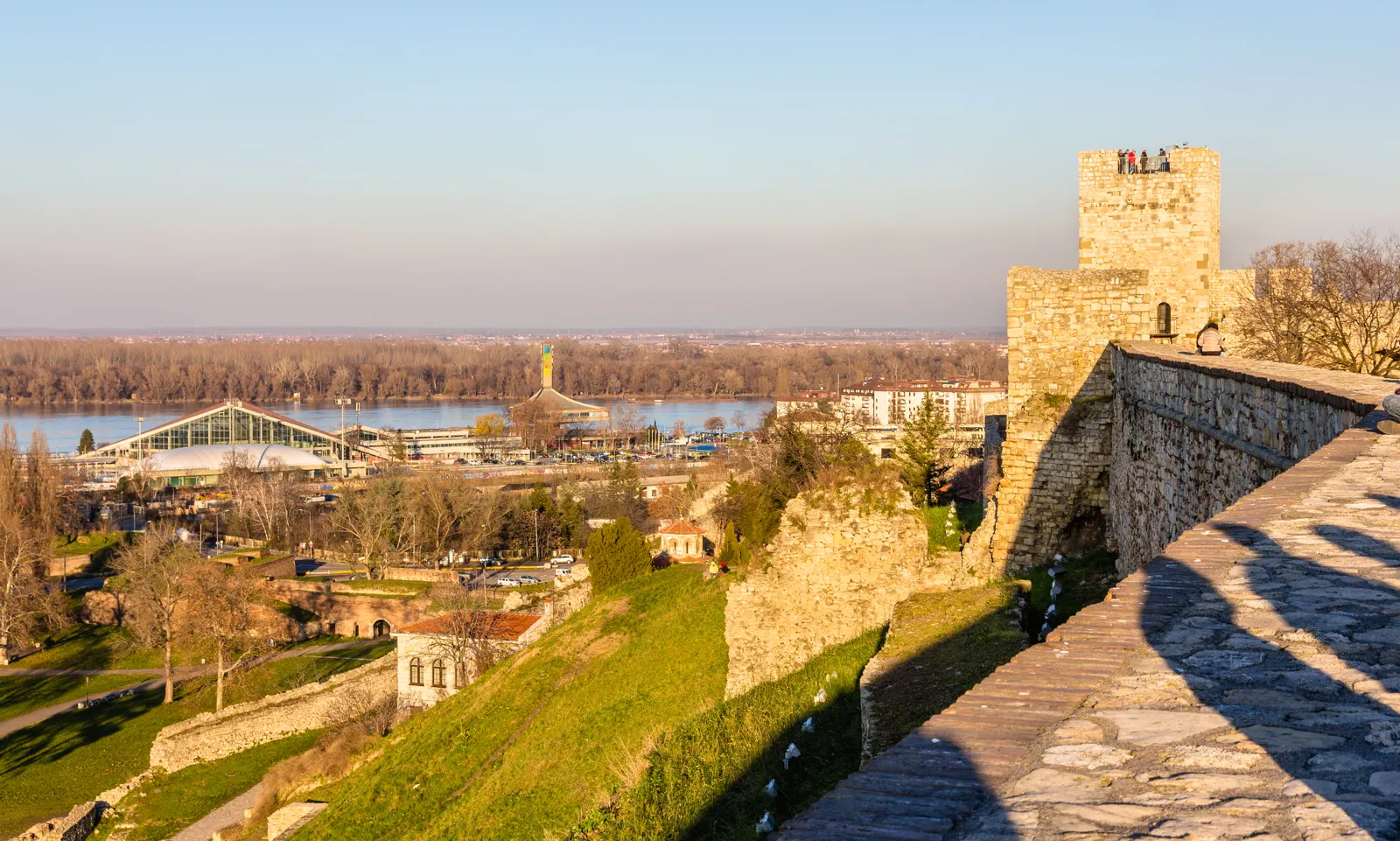
From the ramparts of Kalemegdan.
On a headland above the confluence of the Danube and the Sava, the fortress is the historic heart of the city. The surrounding Kalemegdan Park is free to enter. Here you will find the Victor statue (Pobednik), the symbol of the city, the small Ružica and St Petka churches, the Military Museum and the ramparts, which are busy at sunset.
Knez Mihailova and Republic Square
The pedestrian Knez Mihailova street links Kalemegdan with Republic Square, home to the National Museum and the National Theatre. Its 19th- and early 20th-century façades house cafés, bookshops and stores.
Skadarlija, the bohemian street
A sloping cobbled street, Skadarlija is lined with traditional restaurants (kafana) where dinner often comes with live musicians. In the 19th century the quarter drew artists and writers.
The Temple of Saint Sava
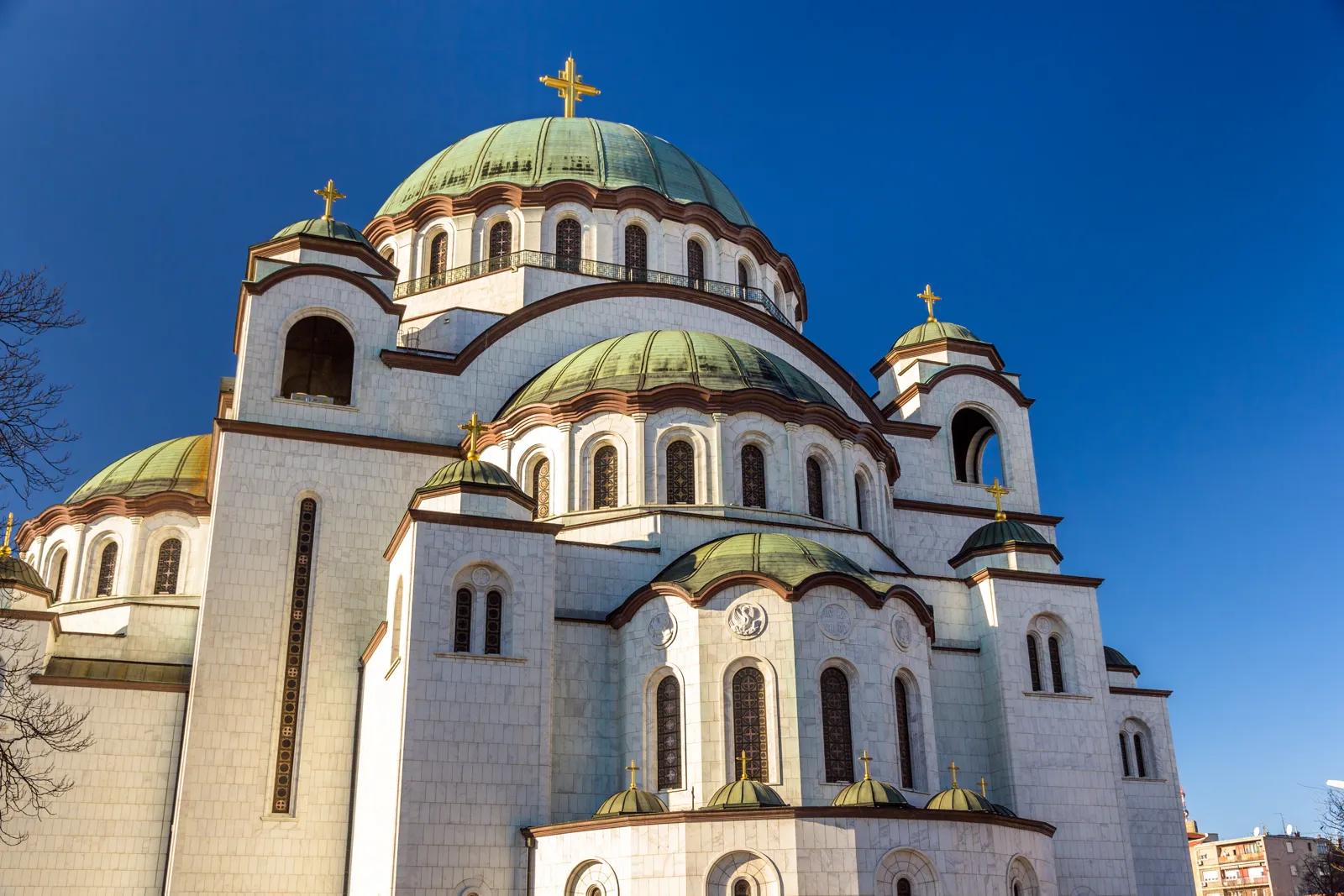
The Temple of Saint Sava.
On the Vračar plateau, the Temple of Saint Sava is one of the largest Orthodox churches in the world. Construction began between the two world wars and lasted for decades; the crypt is covered in gilded mosaics. Modest dress is expected.
Zemun and Gardoš Tower
A former frontier town of the Austro-Hungarian Empire, joined to Belgrade in the 20th century, Zemun has kept its lanes and its Danube quay lined with fish restaurants. Gardoš Tower offers a view over the river. Get there by bus or on foot along the riverbanks.
Museums: Tesla, Yugoslavia, National Museum
The Nikola Tesla Museum displays the inventor’s archives and devices, as well as the urn containing his ashes; visits are guided. The Museum of Yugoslavia includes the House of Flowers, where Tito is buried. The National Museum, on Republic Square, covers archaeology and Serbian and European art.
Ada Ciganlija and the Sava riverbanks
A peninsula on the Sava turned into a leisure lake, Ada Ciganlija is the city’s summer « beach »: swimming, cycling and water sports. The redeveloped banks of the Sava and the Danube are good for walking and cycling.
Splavovi and nightlife
The splavovi, bars and clubs on barges moored along the Sava and the Danube, are a Belgrade nightlife institution, especially in summer. The Savamala district and the center also have plenty of bars.
Memories of the 20th century
On Kneza Miloša street, the former army headquarters buildings, bombed by NATO in 1999, have been left in ruins. In Kalemegdan, the Monument of Gratitude to France recalls the ties between the two countries during the First World War.
Mount Avala
South of the city, Mount Avala offers forests and a panorama from its rebuilt TV tower. Combine it with half a day in nature.
Itinerary: Belgrade in 2 or 3 days
Day 1, morning: Belgrade Fortress and Kalemegdan Park, Military Museum or Ružica church
Day 1, afternoon: Knez Mihailova, Republic Square, National Museum; evening in Skadarlija
Day 2, morning: Temple of Saint Sava and the Vračar district, Nikola Tesla Museum
Day 2, afternoon: Museum of Yugoslavia and House of Flowers; evening on a splav
Day 3: Zemun and Gardoš Tower in the morning, Ada Ciganlija or Avala in the afternoon; or a day trip to Novi Sad
May, June and September are the best months to visit Belgrade: average highs of 23.6 to 27.1 °C (74 to 81 °F) in May-June and 24.3 °C (76 °F) in September. July and August are hot (close to 30 °C, 86 °F) but very sunny, with the fewest rainy days of the year. Winter is grey and cold, and air pollution can be a significant problem, according to the U.S. Department of State (travel.state.gov, last updated September 3, 2026). October is still pleasant (18.7 °C, 66 °F).
Month
High °C (°F)
Low °C (°F)
Rain mm (in)
Rainy days
Sun (h/day)
Verdict
January
5.2 (41)
−0.7 (31)
47.9 (1.9)
13.5
2.3
❌ Cold, grey, air pollution
February
7.8 (46)
0.6 (33)
43.5 (1.7)
12.3
3.4
⚠️ Cold, little sun
March
13.1 (56)
4.2 (40)
48.7 (1.9)
11.3
4.7
⚠️ Milder, still cool
April
18.9 (66)
8.8 (48)
51.5 (2.0)
12.4
6.2
✅ Spring, few crowds
May
23.6 (74)
13.2 (56)
72.3 (2.8)
13.5
7.2
✅ Very pleasant
June
27.1 (81)
16.7 (62)
95.6 (3.8)
12.2
8.5
✅ Warm, thunderstorms
July
29.3 (85)
18.4 (65)
66.5 (2.6)
10.0
9.0
⚠️ Hot, festivals
August
29.7 (85)
18.5 (65)
55.1 (2.2)
8.4
8.5
⚠️ Hot, dry
September
24.3 (76)
14.1 (57)
58.6 (2.3)
9.5
6.4
✅ Ideal, grape harvest
October
18.7 (66)
9.4 (49)
54.8 (2.2)
10.5
5.0
✅ Mild, autumn colours
November
12.2 (54)
5.1 (41)
49.6 (2.0)
10.8
3.1
⚠️ Cool and grey
December
6.1 (43)
0.5 (33)
54.8 (2.2)
13.8
1.9
⚠️ Cold, Christmas markets
Temperature, precipitation, precipitation days and sunshine: 1991-2020 normals of the Republic Hydrometeorological Service of Serbia (RHMZ), Belgrade station. Sun per day: Destination de Voyage calculation. Verdict: our editorial summary.
A week in Belgrade: rain, sun and sunset
To help you pick your dates, we combined the official normals with an astronomical calculation: number of rainy days expected over a 7-day stay, hours of sunshine per day and sunset time on the 15th of the month, so you know how late you can enjoy the terraces and the view from Kalemegdan.
Month
Rainy days in 7 days
Sun (h/day)
Sunset (15th)
Day length
January
3.0
2.3
16:23
9 h 11 min
February
3.1
3.4
17:06
10 h 28 min
March
2.6
4.7
17:43
11 h 53 min
April
2.9
6.2
19:22
13 h 29 min
May
3.0
7.2
19:59
14 h 50 min
June
2.8
8.5
20:25
15 h 34 min
July
2.3
9.0
20:21
15 h 15 min
August
1.9
8.5
19:44
14 h 04 min
September
2.2
6.4
18:49
12 h 33 min
October
2.4
5.0
17:54
11 h 00 min
November
2.5
3.1
16:10
9 h 35 min
December
3.1
1.9
15:57
8 h 49 min
Destination de Voyage calculation: monthly RHMZ precipitation days (1991-2020) scaled to 7 days; monthly sunshine divided by the number of days; sunset and day length on the 15th of each month in 2026 (NOAA solar algorithm, Belgrade local time).
August is the month when a week has the fewest rainy days (1.9), with 8.5 h of sunshine per day.
July is the sunniest (9.0 h per day); in mid-June the sun sets around 20:25.
December has the least sunshine (1.9 h per day) and sunset around 15:57.
September offers the best balance: 24.3 °C (76 °F), 2.2 rainy days in a week and 6.4 h of sunshine per day.
Budget for visiting Belgrade
Accommodation: hostels and apartments on a small budget, central hotels for more comfort; book early during festivals.
Food: grilled meat, burek and kafanas are the cheapest options.
Transport: buses and trams are cheap; taxis cost more, so prefer those booked through an app.
Activities: museums are affordable, guided tours cost more; Kalemegdan and Zemun are free to explore.
Getting around Belgrade
From Nikola Tesla Airport: buses to the center and taxis; prefer official taxis or those booked through an app.
In town: the center (Stari Grad, Kalemegdan, Skadarlija) is walkable; buses, trams and trolleybuses serve the other districts, including Zemun and Ada Ciganlija.
To Novi Sad and Subotica: fast trains from Belgrade Centre station (Prokop).
Take care: pickpockets work in tourist areas, airports and on public transport, according to the UK FCDO (GOV.UK, updated 22 October 2026).
Where to stay in Belgrade
Neighborhood
Best for
Highlights
Stari Grad (old town)
First visit
Kalemegdan, Knez Mihailova and Skadarlija on foot
Vračar
Longer, quieter stay
Residential, cafés, Saint Sava, close to the center
Savamala
Nightlife
Bars, Sava riverbanks, near the bus station
Zemun
Small-town feel
Danube quay, fish restaurants; further from the center
Novi Beograd
Business hotels, drivers
Large hotels, motorway access, conference centers
Book ahead during the big summer festivals.
Entry requirements, health and safety
US citizens: according to the U.S. Department of State (travel.state.gov, last updated September 3, 2026), you do not need a visa to stay in Serbia for up to 90 days. You cannot enter with an expired passport or one reported lost or stolen.
UK citizens: according to the UK FCDO (GOV.UK, updated 22 October 2026), you can visit without a visa for up to 90 days within a 6-month period. Your passport must be valid for at least 90 days after the date you plan to leave Serbia. Make sure your passport is stamped on entry.
Police registration: you must register with the local police within 24 hours of arrival; hotels do it for you, but if you stay in a private home you must register in person (travel.state.gov; GOV.UK).
Customs: declare cash of more than €10,000 on arrival (GOV.UK). Carry prescription medication in its original packaging with your prescription and check that it is legal in Serbia (U.S. Department of State). For the return, check your home country’s customs allowances (e.g. CBP in the US, HMRC in the UK).
Health: the UK FCDO advises checking vaccine recommendations at least 8 weeks before your trip and mentions biting insects and ticks (see our travel vaccines page). The U.S. Department of State says some private hospitals require advance payment and ambulance services are not widely available: take out insurance covering medical costs and evacuation (see our travel insurance guide).
Air quality: air pollution can be a significant problem; NASA publishes a three-day air quality forecast for Serbia (U.S. Department of State).
Safety: according to the UK FCDO (GOV.UK, updated 22 October 2026), mass gatherings and demonstrations are taking place in Belgrade and other cities, sometimes at short notice and occasionally turning violent: stay away from them and keep some cash in case electronic payments are disrupted. Violence is common around Red Star – Partizan derby matches.
Money: the currency is the Serbian dinar. Exchange money only at banks or official exchange offices (GOV.UK), and keep some cash for small purchases.
Internet: Serbia is outside the EU, so check your roaming charges, or get a local SIM card or an eSIM (see our eSIM guide).
Gatherings: keep away from demonstrations and from stadiums on match days.
Frequently asked questions
How many days do you need to visit Belgrade?
Two days for the essentials (Kalemegdan, the center, Skadarlija, Saint Sava, Zemun), three with the museums, Ada Ciganlija or a day trip to Novi Sad.
What is the best time to go to Belgrade?
May, June and September. July and August are hot but the sunniest; winter is cold, grey and sometimes polluted.
Is Belgrade safe?
Most visits are trouble-free, but the UK FCDO (GOV.UK, updated 22 October 2026) reports pickpockets in tourist areas and on public transport, and demonstrations in Belgrade that can occasionally turn violent: stay away from them.
Do I need a visa for Belgrade?
No, not for short stays: US citizens can stay up to 90 days without a visa (travel.state.gov), and UK citizens up to 90 days within 6 months (GOV.UK). You must register with the police within 24 hours; hotels do it for you.
What currency is used in Belgrade?
The Serbian dinar (RSD). The euro is not the official currency.
Our sources
Republic Hydrometeorological Service of Serbia (RHMZ): 1991-2020 normals, Belgrade station (via the Wikipedia article « Belgrade »)
Destination de Voyage calculation: rainy days over 7 days, hours of sunshine per day, sunset and day length in Belgrade (NOAA solar algorithm)
Entry, health and safety information read on 26 October 2026: U.S. Department of State, Serbia country information (travel.state.gov, last updated September 3, 2026), and UK FCDO, foreign travel advice for Serbia (GOV.UK, updated 22 October 2026)


 FlightsKiwi.comCompare flights and airline combinations to Belgrade.Compare flights