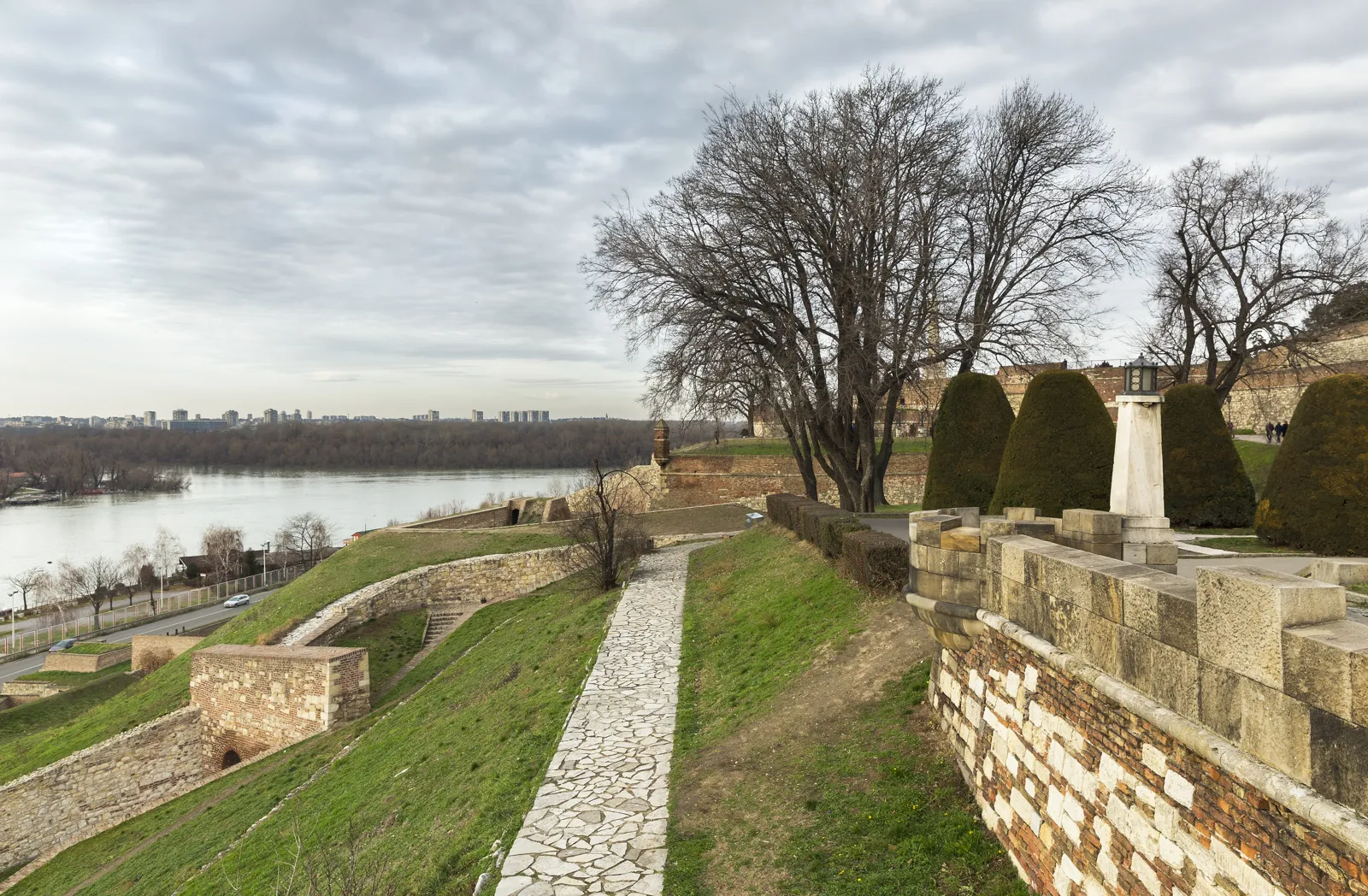
Things to do in Ljubljana? Ride the funicular up to the castle, cross the Triple Bridge and the Dragon Bridge, stroll along the café-lined Ljubljanica river, shop at the central market designed by the architect Jože Plečnik, explore the alternative Metelkova quarter and walk in Tivoli Park. Allow 2 days to visit Ljubljana, or 3 to 4 with Lake Bled and the Postojna caves. The best time is from May to September.
The capital of Slovenia, Ljubljana is a small city with a largely pedestrian center, reshaped in the first half of the 20th century by Plečnik, several of whose works are on the UNESCO World Heritage List. This guide covers the main sights, two itineraries, the budget, the neighborhoods to stay in and the month-by-month climate from the Slovenian Environment Agency, with a figure few guides mention: Ljubljana is one of the wettest capitals in Europe.
Our travel deals for Ljubljana
Affiliate links: we earn a commission, at no extra cost to you.
FlightsKiwi.comCompare flights and airline combinations to Ljubljana.
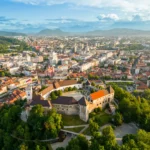
Perched on its hill above the old town, the castle can be reached by funicular in a minute, or on foot by several paths in a quarter of an hour. From the watchtower, the view takes in the red roofs, the city and, on clear days, the Kamnik Alps. There is also a permanent exhibition on Slovenian history and events in summer.
Prešeren Square and the Triple Bridge
The heart of the city is Prešeren Square, with the statue of the national poet and the pink Franciscan church. The Triple Bridge (Tromostovje), to which Plečnik added the two side footbridges in the 1930s, links it to the old town. Nearby are the Cobblers’ Bridge, another Plečnik work, and the Dragon Bridge, with its four bronze dragons, the emblem of the city.
The old town and the Ljubljanica
Between the river and the castle, Mestni trg, Stari trg and Gornji trg streets are lined with Baroque façades, the town hall and the Robba Fountain of the three Carniolan rivers. The willow-shaded, terrace-lined banks of the Ljubljanica are the place for an evening stroll. Boats offer short cruises, and you can rent canoes and paddleboards in summer.
Plečnik’s central market
The open-air market on Vodnik Square and its colonnaded halls along the river sell fruit, cheese, cured meats, honey and flowers. On Fridays in season, the neighboring square hosts a street food market. St Nicholas Cathedral, with its sculpted bronze doors, is right next door.
Metelkova and the museum quarter
A former barracks turned into an autonomous cultural center, Metelkova is covered in graffiti and sculptures; in the evening, its bars and concert venues draw the alternative scene. The neighboring museum quarter brings together the Slovene Ethnographic Museum and the Museum of Contemporary Art.
Tivoli Park and the art museums
The city’s largest park links the center with the wooded Rožnik hill. Jakopič Promenade hosts open-air photo exhibitions. On its edge, the National Gallery and the Moderna galerija show Slovenian art. Plečnik House, in the Trnovo district, can be visited by reservation.
Lake Bled, Postojna Cave and Predjama Castle
Lake Bled, with its island and church, is about an hour away by road or bus; the wilder Lake Bohinj is a little further. To the southwest, Postojna Cave is visited by underground train, and Predjama Castle, built into a cliff, is close by. The whole country is compact: see our Slovenia travel guide.
Itinerary: Ljubljana in 2 days (and more)
Day 1, morning: Prešeren Square, Triple Bridge, central market, cathedral, Dragon Bridge
Day 1, afternoon: old town, up to the castle, back down on foot by the paths; evening on the Ljubljanica embankments
Day 2, morning: Tivoli Park, National Gallery or Moderna galerija
Day 2, afternoon: Trnovo and Plečnik House, a boat on the Ljubljanica; evening in Metelkova
Day 3: Lake Bled (and Bohinj); Day 4: Postojna Cave and Predjama Castle
Wedged between the Alps and the Adriatic coast, Ljubljana gets a lot of rain: 1,368 mm (53.9 in) a year on average, more than Brussels or Amsterdam. We ranked 23 European capitals by annual precipitation: Ljubljana comes 2nd.
Rank
Capital
Annual precipitation mm (in)
1
Podgorica
1,693 (66.7)
2
Ljubljana
1,368 (53.9)
3
Tirana
1,152 (45.4)
4
Bern
1,022 (40.2)
5
Zagreb
874 (34.4)
6
Amsterdam
850 (33.5)
7
Brussels
837 (33.0)
8
Oslo
835 (32.9)
9
Lisbon
794 (31.3)
10
Rome
752 (29.6)
Destination de Voyage calculation: sum of the 1991-2020 average monthly precipitation published by the national weather services (Wikipedia climate tables for each capital). Top 10 of the 23 capitals compared.
The wettest month is September (160 mm, 6.3 in), followed by October and November: autumn is the wettest season.
In summer, July is the sunniest month (288 hours): summer rain often comes as short thunderstorms.
Over a week, expect around 2.5 to 3.7 rainy days depending on the month (calculation below): an umbrella is useful all year round.
In practice: keep the museums, the covered market and the cafés for grey days, and the Bled trip for fine weather.
When to go to Ljubljana
The best months are May to September, with afternoon highs of 21 to 28 °C (70 to 82 °F) and 230 to 290 hours of sunshine from May to August. July and August are warm (an average high of 27.9 °C, 82 °F, in July) and lively with the summer festival. Autumn is very rainy (September is the wettest month); winter is cold and often foggy, with lows below 0 °C (32 °F) from December to February, but the Christmas markets light up the center.
Month
High °C (°F)
Low °C (°F)
Rain mm (in)
Rainy days
In 7 days
Sun (h)
Crowds
Prices
Verdict
January
4.1 (39)
−1.7 (29)
67 (2.6)
11
2.5
73
Low
Low
❌ Cold, fog
February
7.0 (45)
−1.2 (30)
84 (3.3)
10
2.5
102
Low
Low
⚠️ Cold
March
12.3 (54)
2.4 (36)
83 (3.3)
11
2.5
156
Low
Low
⚠️ Cool
April
17.2 (63)
6.3 (43)
97 (3.8)
14
3.3
189
Medium
Medium
✅ Mild spring
May
21.8 (71)
10.6 (51)
114 (4.5)
14
3.2
232
High
Medium
✅ Pleasant, café terraces
June
25.8 (78)
14.4 (58)
125 (4.9)
14
3.3
253
High
High
✅ Warm, festivals
July
27.9 (82)
16.0 (61)
122 (4.8)
13
2.9
288
High
High
✅ The sunniest
August
27.6 (82)
15.9 (61)
124 (4.9)
12
2.7
265
High
High
✅ Warm, thunderstorms
September
21.8 (71)
11.7 (53)
160 (6.3)
13
3.0
176
Medium
Medium
⚠️ The wettest month
October
16.1 (61)
7.9 (46)
150 (5.9)
13
2.9
115
Medium
Medium
⚠️ Rainy, autumn colours
November
9.6 (49)
3.9 (39)
138 (5.4)
16
3.7
56
Low
Low
❌ Grey and rainy
December
4.2 (40)
−0.9 (30)
104 (4.1)
14
3.2
55
Medium
Medium
⚠️ Cold, Christmas markets
Temperature, precipitation, precipitation days and sunshine: 1991-2020 normals of the Slovenian Environment Agency (ARSO), Ljubljana-Bežigrad station. « In 7 days »: Destination de Voyage calculation (precipitation days in the month × 7 / number of days in the month). Crowds and prices: estimate.
Indicative estimates, excluding flights. The city tourist card bundles transport and admissions: compare it with your plans.
Getting around Ljubljana
From the airport: Jože Pučnik Airport is about 25 km (16 mi) north of the city; shuttles and buses run to the bus station, or take a taxi.
In town: the center is pedestrianized and there are plenty of bike-share stations.
City buses: they serve the districts outside the center; check fares and ticketing with the city operator.
Day trips: buses to Bled and Postojna leave from the bus station, next to the railway station.
Abroad: trains and buses to Zagreb, Vienna, Trieste or Venice.
Where to stay in Ljubljana
Neighborhood
Best for
Highlights
Old town and Ljubljanica banks
First visit, couples
In the middle of everything, more expensive
Center (Prešeren Square, Miklošičeva)
Convenience
Between the station and the old town
Around the station
Small budgets, day trips
Bus departures for Bled and Postojna
Trnovo and Krakovo
Quiet, village feel
Low houses, 10 minutes’ walk from the center
Book early for summer and December weekends.
Entry requirements, health and safety
US citizens: according to the U.S. Department of State (travel.state.gov, last updated May 21, 2026), you need a valid passport but no visa for tourism of less than 90 days in the Schengen area. Your passport must be valid for at least three months beyond your stay, and you need proof of sufficient funds and a return ticket.
UK citizens: according to the UK FCDO (GOV.UK, updated 11 August 2026), you can travel without a visa for up to 90 days in any 180-day period. Your passport must have been issued less than 10 years before you arrive and expire at least 3 months after the day you plan to leave the Schengen area. Under the EU Entry/Exit System (EES), you may need to register your fingerprints and photo.
Registration: you must register within 3 days of arrival; registered hotels and guesthouses do it for you (GOV.UK; travel.state.gov).
Health: the UK FCDO flags tick bites and tick-borne encephalitis (relevant for forest hikes in spring and summer); UK travellers need a GHIC or EHIC for medically necessary state healthcare. The U.S. Department of State recommends insurance covering medical evacuation. See our travel insurance guide.
Safety: the overall crime rate is low, but pickpocketing and purse snatching occur in tourist areas (U.S. Department of State). Always carry ID (GOV.UK).
Practical tips for Ljubljana
Money: the currency is the euro.
Internet: check your provider’s roaming charges before you leave, or see our eSIM guide.
Water: tap water is drinkable (GOV.UK); public drinking fountains dot the city.
Motorway vignette: an e-vignette is required to drive a passenger car on Slovenian motorways, according to the official DARS e-vignette website (checked 5 October 2026).
Frequently asked questions
How many days do you need to visit Ljubljana?
Two days are enough for the city. Allow three to four days to add Lake Bled and Postojna Cave.
What is the best time to visit Ljubljana?
From May to September. Autumn is the wettest season, September being the rainiest month according to the ARSO 1991-2020 normals.
How do you get to Ljubljana?
Ljubljana Jože Pučnik Airport (LJU) is about 25 km (16 mi) north of the city; check current routes with the airlines. Trains and buses also link Ljubljana with Zagreb, Vienna, Trieste and Venice.
Can you visit Lake Bled from Ljubljana?
Yes, as a day trip: Bled is about an hour away by car or bus.
Is Ljubljana expensive?
Prices have risen, but it remains reasonable: allow roughly €60 to €90 per person per day on a small budget, by our estimate.
Do US and UK citizens need a visa for Slovenia?
No, not for short stays: Slovenia applies Schengen rules, with visa-free stays of up to 90 days (travel.state.gov; GOV.UK, which also mentions the EU Entry/Exit System).
Our sources
Slovenian Environment Agency (ARSO): 1991-2020 normals, Ljubljana-Bežigrad station, via the climate table of the Wikipedia article « Ljubljana »
1991-2020 normals of the European capitals compared (national weather services, via the climate tables of each city’s Wikipedia article)
Destination de Voyage calculation: ranking of capitals by annual precipitation; rainy days over 7 days


 FlightsKiwi.comCompare flights and airline combinations to Ljubljana.Compare flights