Things to do in Melbourne? Get lost in the street-art-covered laneways such as Hosier Lane, start the day at Federation Square, visit the National Gallery of Victoria, shop at the Queen Victoria Market, stroll through the Botanic Gardens, go up to the Skydeck and end the evening in Fitzroy or by the sea in St Kilda. To visit Melbourne, allow 3 to 4 days, plus the Great Ocean Road; the best time is from November to April.
Australia’s second city and the capital of Victoria, Melbourne is more European and more changeable than Sydney: people come for the cafés, museums, arts scene, sport and trips to the coast. This guide brings together the main sights, two itineraries, budget, transport, where to stay and month-by-month climate from the Bureau of Meteorology, with an original calculation to test the city’s famous « four seasons in one day » reputation.
Our travel deals for Melbourne
Affiliate links: we earn a commission, at no extra cost to you.
FlightsKiwi.comCompare flights and airline combinations to Melbourne.
Opposite Flinders Street Station, whose yellow facade and clocks are Melbourne’s best-known image, Federation Square is the city’s big cultural square. It houses the Australian Centre for the Moving Image (ACMI) and a gallery devoted to Australian and Aboriginal art (the NGV’s Ian Potter Centre). Just behind, the promenade along the Yarra River leads to Southbank.
The laneways and street art
The centre (CBD) is criss-crossed by lanes hiding cafés, bars and shops: Degraves Street, Centre Place, and the Block Arcade and Royal Arcade, 19th-century covered galleries. Hosier Lane and AC/DC Lane are covered in ever-changing graffiti and murals. Guided street-art tours are available.
The National Gallery of Victoria
On St Kilda Road, NGV International is Australia’s oldest and one of its most visited art museums, with European, Asian and contemporary collections; entry to the permanent collections is free. The neighboring Arts Centre is topped by a spire visible from afar.
The Queen Victoria Market
This large covered market, open since the late 19th century, sells fruit, meat, cheese, food from around the world and souvenirs. It is closed on some days of the week: check opening hours. On some summer evenings, a night market offers street food.
The Royal Botanic Gardens and the Shrine of Remembrance
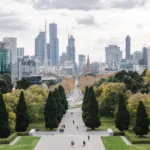
The Royal Botanic Gardens stretch south of the Yarra, with lawns, a lake and century-old trees; entry is free. On its edge, the Shrine of Remembrance, Victoria’s war memorial, offers a view from its terrace along St Kilda Road and the towers of the centre.
The Skydeck and Southbank
At the top of the Eureka Tower in Southbank, the Skydeck offers panoramic views of the city, the bay and, on clear days, the Dandenong Ranges. Southbank lines up restaurants and bars along the river.
Fitzroy, Collingwood and Carlton
North of the centre, Fitzroy and Collingwood are the neighborhoods of vintage shops, bars, record stores and specialty coffee; Brunswick Street and Smith Street are the main drags. Carlton, the old Italian quarter, is home to the UNESCO-listed Royal Exhibition Building and the Melbourne Museum.
St Kilda and the bay beaches
A tram ride from the centre, St Kilda is Melbourne’s seaside neighborhood: esplanade, pier, Luna Park and the cake shops of Acland Street. Little penguins live near the pier; watch them without flash and follow the instructions. Further south, Brighton is known for its colourful bathing boxes.
Sport: the MCG, the Australian Open, the Melbourne Cup
Melbourne calls itself Australia’s sporting capital: the Melbourne Cricket Ground (MCG) hosts cricket in summer and Australian rules football (AFL) in winter, with the Grand Final in September; the Australian Open tennis tournament is held in January; and the Melbourne Cup horse race is run on the first Tuesday in November. Check exact dates on the official websites.
Day trips: Great Ocean Road, Phillip Island, Yarra Valley
The Great Ocean Road follows the coast south-west to the Twelve Apostles, limestone stacks in the ocean: doable in a very long day, better in two or three. On Phillip Island, to the south-east, the parade of little penguins returning from the sea at sunset can be seen with a ticket. To the east, the Yarra Valley is a wine region, and the Dandenong Ranges are crossed by the Puffing Billy steam train.
Itinerary: Melbourne in 3 or 6 days
Melbourne in 3 days
Day 1: Flinders Street, Federation Square, the laneways and Hosier Lane, the arcades, then the Skydeck and dinner in Southbank
Day 2: the Queen Victoria Market in the morning, the NGV, the Botanic Gardens and the Shrine of Remembrance
Day 3: Fitzroy and Carlton (Royal Exhibition Building, Melbourne Museum), then St Kilda by tram for sunset
Melbourne in 6 days
Days 1 to 3: as above
Days 4 and 5: the Great Ocean Road by car, a night on the coast, the Twelve Apostles
Day 6: Phillip Island and the penguin parade, or the Yarra Valley and the Dandenongs
Melbourne and Sydney combine easily: a flight of about 1.5 hours or a coastal road trip over several days. For the rest of the country, see our Australia travel guide; for a long stay, our working holiday guide.
« Four seasons in one day »: Melbourne vs Sydney in figures
Melbourne has a reputation for weather that changes by the hour. Climate normals don’t capture these mood swings, but they do show the average range between the night-time low and the afternoon high. We compared it with Sydney’s, along with day length on the 15th of each month.
Month
Melbourne high / low °C
Melbourne range
Sydney high / low °C
Sydney range
Day length on the 15th (Melbourne / Sydney)
January
26.6 / 15.6
11.0 °C
27.7 / 20.0
7.7 °C
14 h 29 / 14 h 09
February
26.5 / 15.7
10.8 °C
27.1 / 20.0
7.1 °C
13 h 29 / 13 h 17
March
24.5 / 14.3
10.2 °C
25.8 / 18.5
7.3 °C
12 h 21 / 12 h 19
April
21.0 / 11.6
9.4 °C
23.3 / 15.2
8.1 °C
11 h 07 / 11 h 15
May
17.5 / 9.7
7.8 °C
20.6 / 12.1
8.5 °C
10 h 06 / 10 h 22
June
14.6 / 7.9
6.7 °C
18.1 / 9.8
8.3 °C
9 h 33 / 9 h 55
July
14.1 / 7.3
6.8 °C
17.7 / 8.5
9.2 °C
9 h 47 / 10 h 06
August
15.3 / 7.9
7.4 °C
19.1 / 9.3
9.8 °C
10 h 40 / 10 h 52
September
17.5 / 9.0
8.5 °C
21.6 / 11.9
9.7 °C
11 h 50 / 11 h 52
October
19.8 / 10.3
9.5 °C
23.6 / 14.4
9.2 °C
13 h 03 / 12 h 55
November
22.3 / 12.2
10.1 °C
24.6 / 16.5
8.1 °C
14 h 10 / 13 h 53
December
24.3 / 13.9
10.4 °C
26.4 / 18.4
8.0 °C
14 h 46 / 14 h 23
Destination de Voyage calculation: range = average high − average low, based on the Bureau of Meteorology 1991-2020 normals (Melbourne Olympic Park, Sydney Airport); day length calculated for the 15th of each month in 2026 with the NOAA solar algorithm. An average range does not reflect sudden changes within a day.
Range: in Melbourne, the average gap between night and afternoon runs from 6.7 °C to 11.0 °C (January); in Sydney, from 7.1 °C to 9.8 °C. So the gap is not spectacular on average: it is mostly day-to-day swings and gusty winds that earn Melbourne its reputation.
Cooler than Sydney: in July, a high of 14.1 °C (57 °F) in Melbourne against 17.7 °C (64 °F) in Sydney; in January, 26.6 °C (80 °F) against 27.7 °C (82 °F).
More light in summer, less in winter: further south, Melbourne gets 14 h 46 of daylight on 15 December against 14 h 23 in Sydney, but only 9 h 33 on 15 June. The sun sets around 8:38 pm in December.
In practice: whatever the season, bring a warm layer and a windbreaker, even if the morning is sunny.
When to go to Melbourne
The best time is from November to April: 22 to 27 °C (72 to 81 °F) in the afternoon, long days, festivals and outdoor terraces. February and March are often the most settled months. The southern summer (December to February) can bring short heatwaves with very hot days. Winter (June to August) is cool, around 14 to 15 °C (57 to 59 °F) in the afternoon and 7 to 8 °C (45 to 46 °F) at night, but rarely icy: it is the season of Australian rules football and museums. Rain is regular all year, with no marked rainy season (about 40 to 58 mm / 1.6 to 2.3 in a month).
Month
High °C (°F)
Low °C (°F)
Rain mm (in)
Crowds
Prices
Verdict
January
26.6 (80)
15.6 (60)
43.1 (1.7)
Very high
Very high
✅ Summer, Australian Open, possible heatwaves
February
26.5 (80)
15.7 (60)
40.5 (1.6)
High
High
✅ Warm and often settled
March
24.5 (76)
14.3 (58)
41.2 (1.6)
High
High
✅ End of summer, festivals
April
21.0 (70)
11.6 (53)
51.5 (2.0)
Medium
Medium
✅ Mild autumn
May
17.5 (64)
9.7 (49)
51.1 (2.0)
Low
Low
⚠️ Cool, greyer
June
14.6 (58)
7.9 (46)
49.3 (1.9)
Low
Low
⚠️ Cool winter
July
14.1 (57)
7.3 (45)
47.7 (1.9)
Low
Low
⚠️ Coolest month
August
15.3 (60)
7.9 (46)
50.8 (2.0)
Low
Low
⚠️ Cool, windy
September
17.5 (64)
9.0 (48)
54.1 (2.1)
Medium
Medium
⚠️ Changeable spring, AFL Grand Final
October
19.8 (68)
10.3 (51)
55.4 (2.2)
Medium
Medium
✅ Spring, milder
November
22.3 (72)
12.2 (54)
54.2 (2.1)
High
High
✅ Mild, Melbourne Cup
December
24.3 (76)
13.9 (57)
58.3 (2.3)
High
High
✅ Summer, long days
Temperature and rainfall: 1991-2020 normals from the Bureau of Meteorology (BoM, Australia’s weather service), Melbourne (Olympic Park) station, via the Wikipedia article « Climate of Melbourne ». Crowds and prices: estimate based on tourist seasons and major events.
Summer (December to February): bay beaches, the Great Ocean Road, the Australian Open; book early, as prices rise.
Autumn (March to May): still mild days in March-April, autumn colours in the Yarra Valley vineyards.
Winter (June to August): cool and grey, but lower prices; ideal for museums, cafés and a game at the MCG.
Spring (September to November): changeable weather, gardens in bloom, the Melbourne Cup in November.
To combine with the tropical north or the Red Centre, see our page on when to go to Australia. For a longer trip in the region, also consider New Zealand.
Budget for visiting Melbourne
Item (per person per day)
Budget
Comfort
Accommodation (sharing a double room)
roughly A$55 to A$95 (hostel, apartment)
roughly A$160 to A$285 (4-star hotel)
Meals
roughly A$40 to A$65 (markets, Asian food, cafés)
roughly A$95 to A$160 (restaurants)
Transport
free by tram in the centre, roughly A$8 to A$15 beyond
roughly A$25 to A$50 (taxis, ride-hailing)
Activities
roughly A$0 to A$30 (NGV, gardens, street art are free)
roughly A$65 to A$130 (Skydeck, day trips)
Total
roughly A$145 to A$225 per person per day
roughly A$320 to A$560 per person per day
Indicative estimates excluding flights, converted from euros at the European Central Bank rate of 23 October 2026 and rounded.
Getting there and getting around Melbourne
From Melbourne Airport (Tullamarine): about 20 km (12 mi) north-west of the city; the SkyBus shuttle links the terminal to Southern Cross Station in about half an hour, depending on traffic. International flights connect via Asia, the Middle East or other Australian cities.
Tram: Melbourne has one of the world’s largest tram networks. In the centre, trams are free within the Free Tram Zone (CBD and Docklands), and you should not tap on or off if your trip starts and ends inside it; beyond it, you need a myki card, according to Transport Victoria (checked 26 October 2026).
Train: suburban trains leave from Flinders Street and Southern Cross; V/Line regional trains serve the rest of Victoria.
Car: traffic drives on the left (U.S. Department of State). UK visitors can drive with a UK photocard licence as temporary overseas visitors and must carry their licence and passport when driving (GOV.UK); US drivers should check the rules of the state they will drive in.
To Sydney: many daily flights of about 1.5 hours, or the overnight train and the coastal road.
Where to stay in Melbourne
Neighborhood
Best for
Highlights
CBD (centre)
First visit, short stay
Free trams, laneways, everything on foot
Southbank
Comfort, views
Yarra riverbank, Arts Centre, recent hotels
Fitzroy and Collingwood
Atmosphere, nightlife
Bars, cafés, shops; noisier at night
St Kilda
Beach, tight budget
Seafront, hostels; 20 to 30 min by tram from the centre
Book early for January (Australian Open) and Melbourne Cup week.
Entry requirements, health and safety
US citizens: according to the U.S. Department of State (travel.state.gov, last updated August 13, 2026), you need a valid US passport and a visa or an approved Electronic Travel Authority (ETA). For tourism or business stays of less than 90 days, the ETA, obtained through the Australian ETA app for a small fee, is enough. Overstaying, even briefly, can lead to detention and removal.
UK citizens: according to the UK FCDO (GOV.UK, updated 19 March 2026), you must have a visa to visit Australia: usually an eVisitor visa (no application charge) or an ETA through the ETA app (no visa charge, but there may be a service fee). Your passport must be valid for the length of your planned stay.
Customs and quarantine: you must fill in an Incoming Passenger Card and declare risk goods such as food, animal products and plant material (GOV.UK). For allowances on your return, check your home country’s rules (e.g. CBP in the US, HMRC in the UK).
Beaches: rip currents are the main hazard for swimmers and can occur at any beach (UK FCDO); swim only between the flags where a lifeguard is present, and never alone (U.S. Department of State).
Bushfires and heat: the bushfire risk is higher in spring and summer, from October to February, and extreme heat is a serious risk (UK FCDO, GOV.UK, updated 19 March 2026).
Health: UK visitors get essential and urgent hospital treatment free under a reciprocal agreement, with charges for GP visits and prescriptions (GOV.UK); US travelers should check their insurance covers care abroad.
Emergencies: dial 000 for ambulance, fire and police.
Entry requirements checked on 26 October 2026; check them again before you travel. See also our travel insurance guide.
Practical tips for Melbourne
Payment: contactless cards are accepted almost everywhere, even for a coffee.
Coffee: Melbourne is known for its specialty cafés; the flat white is the most common order.
Weather: check the Bureau of Meteorology forecast in the morning and always bring an extra layer.
Tipping: not compulsory; people round up for good service.
Mobile data: a local SIM card or an eSIM is cheaper than roaming; see our eSIM guide.
Frequently asked questions
How many days do you need in Melbourne?
Three to four days for the centre, the museums, Fitzroy and St Kilda. Allow two or three more days for the Great Ocean Road and Phillip Island.
What is the best time to visit Melbourne?
November to April: 22 to 27 °C (72 to 81 °F) in the afternoon according to the Bureau of Meteorology 1991-2020 normals. Winter (June-August) is cool, around 14 °C (57 °F).
Melbourne or Sydney: which to choose?
Sydney for the harbour, the Opera House and the ocean beaches; Melbourne for cafés, museums, street art, sport and the Great Ocean Road. The two combine with a 1.5-hour flight.
Are trams free in Melbourne?
Yes, within the Free Tram Zone covering the CBD and Docklands, according to Transport Victoria. Beyond it, you need a myki card.
Do you need a visa for Melbourne?
Yes, an authorization before you travel: US citizens need an Electronic Travel Authority (ETA) for stays under 90 days, according to the U.S. Department of State; UK citizens usually get an eVisitor visa or an ETA, according to the UK FCDO.
Our sources
Bureau of Meteorology (BoM): 1991-2020 normals, Melbourne (Olympic Park) station, via the Wikipedia article « Climate of Melbourne »; 1991-2020 normals for Sydney Airport via the article « Climate of Sydney »
Destination de Voyage calculation: temperature range and day length (NOAA solar algorithm)


 FlightsKiwi.comCompare flights and airline combinations to Melbourne.Compare flights