Things to do in Kuala Lumpur? The capital of Malaysia mixes skyscrapers, mosques, Chinese and Hindu temples, night markets and tropical parks. Visiting Kuala Lumpur takes two to four days: the Petronas Towers, the Batu Caves, Chinatown, Little India, Merdeka Square and the street food are the highlights. This guide covers the must-sees, the neighborhoods, an itinerary, the budget and tips for planning your trip to Kuala Lumpur.
⚠️ Safety: Kuala Lumpur is not in the areas the UK FCDO advises against, which concern the islands and dive sites off eastern Sabah (GOV.UK, updated 19 March 2026). However, the U.S. Department of State says petty theft and crime remain concerns in Kuala Lumpur (travel.state.gov, last updated February 26, 2026), and the FCDO warns that bag-snatching by thieves on motorbikes is common in big cities. Check the latest advice before you go.

Our travel deals for Kuala Lumpur
Affiliate links: we earn a commission, at no extra cost to you.
 FlightsKiwi.comCompare flights and airline combinations to Kuala Lumpur.Compare flights
- Airport transferKiwitaxiPrivate driver booked in advance at a fixed price.Book a transfer
- Tickets and toursTiqetsEntry tickets and guided tours to book online; compare with the official price.See tickets
- eSIMAiraloData plan to install before you leave (eSIM-compatible phone).See plans




Kuala Lumpur at a glance
- Status capital of MalaysiaThe government sits in Putrajaya, about 30 km (19 mi) to the south
- Languages Malay(official language), English widely spoken, Chinese and Tamil
- Airports Kuala Lumpur International Airport (KLIA)Two terminals, T1 and T2, about 50 km (31 mi) south of the city
- Ideal length 2 to 4 days, plus a day for Malacca
- Best time all year · month by month
- Time zone UTC+8, no daylight saving: 8 hours ahead of London in winter (7 in summer), 13 hours ahead of New York in winter (12 in summer) · detailsLocal time now: –:–
- Entry no visa for tourist stays of up to 90 days for US and UK citizens; online arrival card (MDAC) · travel.state.gov · GOV.UK
- Currency Malaysian ringgit (MYR) · currencies
- Budget see our budget section
When to go to Kuala Lumpur
✅ Best months: January, February, may, June, July, August
❌ Period to avoid: November
Kuala Lumpur is a year-round destination: expect 32 °C (90 °F) to 34 °C (93 °F) in the afternoon and about 24 °C (75 °F) at night in every season. Rain makes the difference. June, July and August are the least rainy months (146 mm (5.7 in) to 174 mm (6.9 in)), along with February; April and above all October-November are the stormiest, peaking at 356 mm (14.0 in) in November, according to normals for the Subang station. Storms mostly break in the late afternoon. All the month-by-month details are on our page on the best time to visit Kuala Lumpur.
Things to do in Kuala Lumpur: the highlights
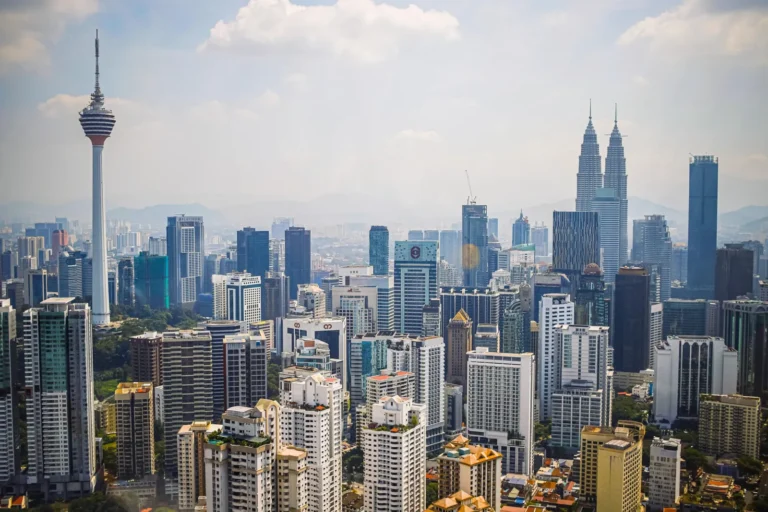
The Petronas Towers and KLCC Park
The Petronas Twin Towers, 452 m (1,483 ft) high, were the tallest buildings in the world from 1998 to 2004. The paid visit takes you to the skybridge linking the two towers, then to the observation deck at the top: tickets are timed, limited in number and booked online. At the foot of the towers, KLCC Park offers a shady walk, a water playground for children and, in the evening, a fountain show on the lake. Suria KLCC mall and the Aquaria KLCC aquarium are linked by a covered walkway.
The Batu Caves
North of the city, the Batu Caves are a major Hindu shrine set in a limestone hill. A colorful staircase of 272 steps, guarded by a giant golden statue of the god Murugan, leads to the main cave (Temple Cave). Come early in the morning to avoid the heat and the crowds, watch your belongings around the macaques, and wear clothing that covers your shoulders and knees. The KTM Komuter suburban train stops at the foot of the site. During the Thaipusam festival, in January or February, hundreds of thousands of devotees come in procession.
Merdeka Square and the historic center
It was on Merdeka Square (Independence Square) that the Malaysian flag was first raised, on August 31, 1957. It is lined by the Neo-Mughal Sultan Abdul Samad Building and the former colonial club. A few steps away, Masjid Jamek, the city’s oldest mosque, stands at the confluence of the Klang and Gombak rivers, where Kuala Lumpur was born; the « River of Life » promenade lights up in the evening. The Moorish-style old railway station lies farther south.
Chinatown, Central Market and Petaling Street
Around Petaling Street, the Chinese quarter is packed with stalls, shops and restaurants, with the Taoist Sin Sze Si Ya temple and, close by, the Hindu Sri Mahamariamman Temple. Central Market, a former Art Deco covered market, gathers crafts and souvenirs from all over Malaysia. The lanes around Kwai Chai Hong have been restored with murals. As everywhere in the city, carry your bag on the side away from the road: the UK FCDO warns about bag-snatching by thieves on motorbikes (GOV.UK).
Little India and Brickfields
Little India, around Jalan Masjid India near the center, and above all Brickfields, near KL Sentral station, are the capital’s Indian districts: sari shops, flower garlands, spices and restaurants serving « banana leaf rice », a meal served on a banana leaf. The streets light up for Deepavali, the festival of lights, in October or November depending on the year.
Bukit Bintang and Jalan Alor
Bukit Bintang is the district for shopping and nightlife, with big malls, bars and massage parlors. In the evening, Jalan Alor turns into a large street-food market: satay, grilled fish, noodles, tropical fruit. It is lively and touristy; for more local food, also try the hawker centers and neighborhood canteens.
The garden district: Perdana, museums and the National Mosque
West of the center, the Perdana Botanical Gardens bring together a large park, KL Bird Park, a butterfly garden and an orchid garden. Next door, the Islamic Arts Museum, one of the richest in Southeast Asia, and the National Museum tell the country’s history. The National Mosque (Masjid Negara), with its umbrella-shaped roof, can be visited outside prayer times, with robes provided at the entrance. The National Monument (Tugu Negara) is in the same area.
KL Tower and Bukit Nanas forest
The Menara KL telecommunications tower, 421 m (1,381 ft) high, offers a view of the Petronas Towers from its observation deck. It stands in the Bukit Nanas forest reserve, one of the oldest protected forests in the country: KL Forest Eco Park has a canopy walkway right in the city center.
Around Kuala Lumpur
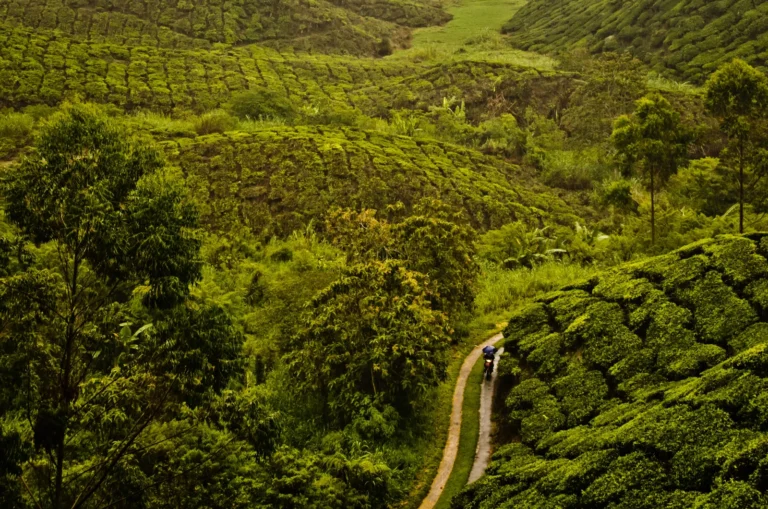
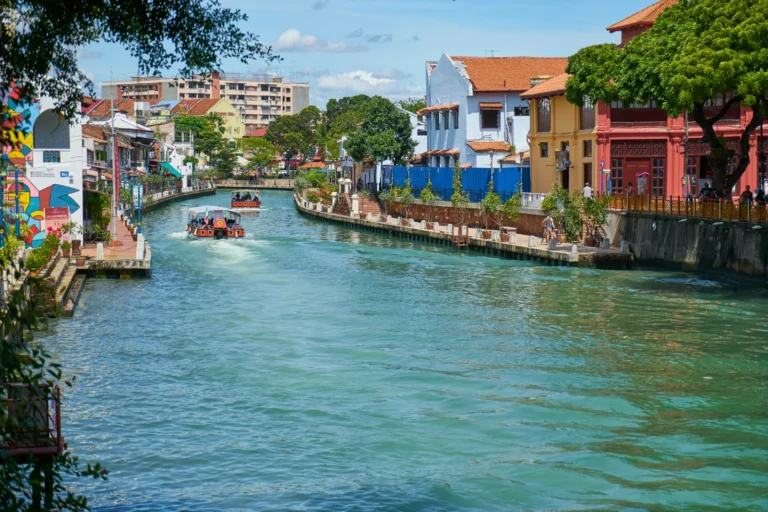
Thean Hou Temple, a multi-tiered Chinese temple on a hill south of the center, is spectacular at sunset and during Chinese New Year. Putrajaya, the administrative capital, is worth a visit for its monumental buildings and pink mosque. Malacca, a historic city and World Heritage Site, is about two hours’ drive to the south: a day trip is possible, but a night there is more enjoyable. The Genting Highlands, about an hour away, and the Cameron Highlands, farther, offer cooler mountain air. To plan these trips on arrival, see our page on the time difference in Malaysia.
Kuala Lumpur neighborhoods
| Area | Atmosphere | Best for |
|---|---|---|
| KLCC | Petronas Towers, park, malls | First visit, comfort |
| Bukit Bintang | Shopping, nightlife, street food | Lively, central stay |
| Chinatown and Merdeka | Historic, markets, temples | Budget, culture |
| Brickfields and KL Sentral | Indian quarter, main station | Arriving by train from the airport |
| Kampung Baru | Malay village at the foot of the towers | Local atmosphere, Malay food |
| Bangsar | Residential, cafés, restaurants | A quieter stay |
Itinerary: 3 days in Kuala Lumpur
- Day 1: Merdeka Square, Masjid Jamek, Central Market, Chinatown and the Petaling Street temples; evening at the Petronas Towers and KLCC Park
- Day 2: Batu Caves early in the morning, then the Perdana gardens, the Islamic Arts Museum and the National Mosque; dinner on Jalan Alor
- Day 3: KL Tower and KL Forest Eco Park, Little India or Brickfields, Kampung Baru, then Thean Hou Temple at sunset
- Day 4 (optional): a trip to Malacca, or to Putrajaya and the Genting Highlands
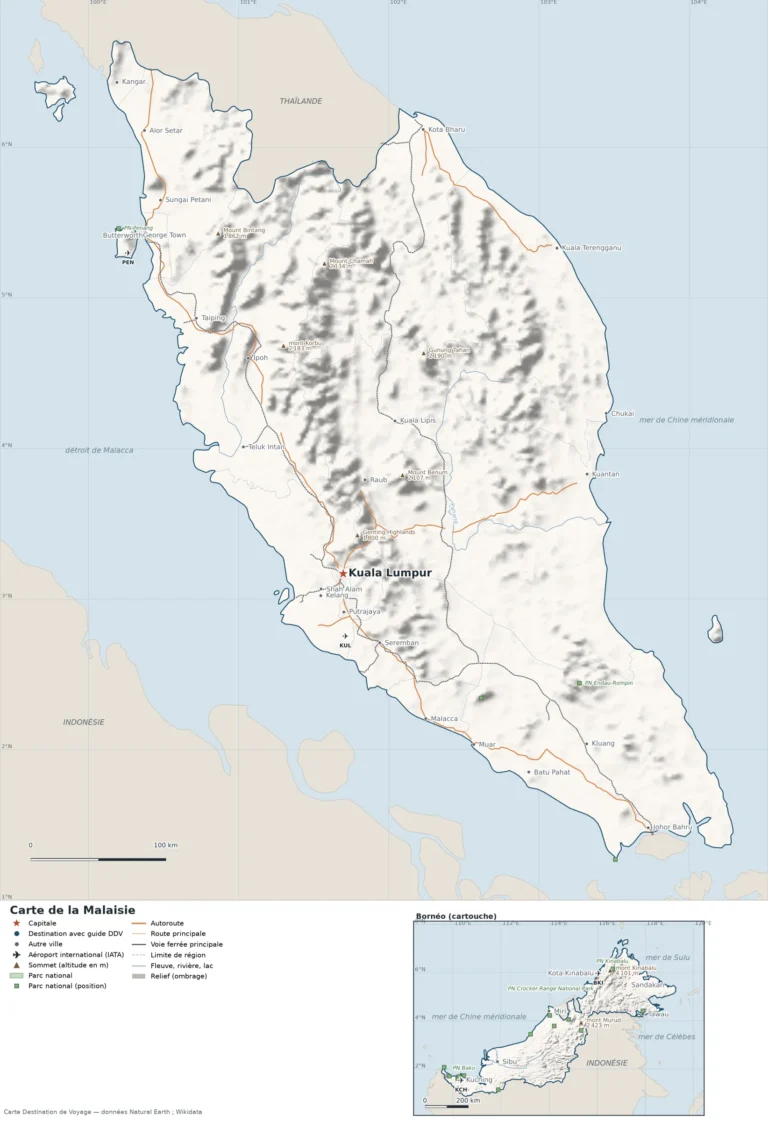
Kuala Lumpur is a good starting point for a tour of Malaysia: Malacca, Penang, the Cameron Highlands, Langkawi or the east coast islands, covered in our Malaysia travel guide. The city also combines well with Singapore, about an hour away by air or a few hours by bus, or with Bangkok.
Budget for a stay in Kuala Lumpur
Kuala Lumpur is an affordable capital, especially for food and transportation. The Petronas Towers, KL Tower and attractions are the main expenses. Rough amounts per person per day, excluding flights:
| Item | Budget | Comfort |
|---|---|---|
| Accommodation (shared double room) | about RM70 to 135 (hostel, simple hotel) | about RM230 to 455 |
| Meals | about RM45 to 70 (stalls, canteens) | about RM115 to 205 |
| Transportation (metro, Grab) | about RM14 to 27 | about RM45 to 70 |
| Sights and activities | about RM23 to 46 | about RM70 to 115 |
| Total per day | roughly RM160 to 275 per person per day | roughly RM455 to 825 per person per day |
Getting around Kuala Lumpur
- From the airport (KLIA): the KLIA Ekspres train links both terminals with KL Sentral station in about half an hour; cheaper buses, taxis and ride-hailing complete the options. The airport is about 50 km (31 mi) south of the city.
- Metro and trains: the LRT and MRT lines, the monorail and KTM Komuter suburban trains serve most sights; buy tokens or a rechargeable Touch ‘n Go card.
- Free GoKL buses: several free routes link the central districts.
- Ride-hailing: the Grab app is widely used, convenient and cheap. The U.S. Department of State reports that taxi drivers in central Kuala Lumpur have committed violent crimes against passengers (travel.state.gov, last updated February 26, 2026): prefer an app or an official taxi rank.
- On foot: covered, air-conditioned walkways link KLCC with Bukit Bintang; elsewhere, sidewalks are sometimes patchy and the heat quickly tires you out.
Kuala Lumpur airport transfer (KLIA): KLIA Ekspres, bus, taxi and private transfer
Kuala Lumpur International Airport (KLIA) has two terminals, T1 and T2. The city center is far away: the express train is the most predictable option, especially at rush hour when the road is congested.
KLIA Ekspres: the nonstop train
According to the official KLIA Ekspres site (kliaekspres.com, checked 26 October 2026), the KL Sentral – KLIA (T1 and T2) fare is RM55 one way for an adult and RM25 for a child aged 6 to 15; children under 6 travel free (up to 3 per adult); returns cost RM100 (adult) and RM45 (child). Operator Express Rail Link announced on 30 September 2026 that the adult one-way fare will rise to RM65 (RM118 return) and the child fare to RM29 (RM53 return) from 1 January 2027, as reported by the Malaysian press. KLIA Ekspres tickets are not valid on KLIA Transit, the other train, which makes intermediate stops. Check timetables on the official site before you travel.
Bus, taxi and ride-hailing
Buses also link the terminals with KL Sentral; they are cheaper but subject to traffic jams, and fares vary by operator: check at the counter. For a taxi, use the official airport rank rather than a driver who approaches you; the Grab app, widely used in Malaysia, shows the price before you book. KL Sentral is also the interchange for the metro, monorail and suburban trains.
| Option | Where to catch it | Official fare | Source |
|---|---|---|---|
| KLIA Ekspres | T1 and T2 terminal stations | RM55 adult; RM25 child (6-15); RM65 / RM29 from 1 January 2027 | kliaekspres.com |
| KLIA Transit | Same stations, with intermediate stops | Separate ticket from KLIA Ekspres | kliaekspres.com |
| Bus to KL Sentral | Terminals | Depends on the operator, check | — |
| Taxi or ride-hailing (Grab) | Official rank or pickup point | Price shown in the app or at the counter | — |
Booking a private transfer in Kuala Lumpur
A private transfer booked in advance is useful if you arrive late at night, travel as a family or with a lot of luggage, or if your accommodation is far from bus and train lines. Before paying, check the total price (tolls, luggage, child seats, night surcharge), the meeting point at the airport, flight tracking in case of delay, the waiting time included and the cancellation terms. Compare with the official fares in the table above: for a single traveler with light luggage, public transportation is often enough. For a group, with children or for a hotel far from a station, a fixed-price transfer can cost less than several train tickets.
Source: KLIA Ekspres (Express Rail Link), fares page, checked 26 October 2026. Fares in Malaysian ringgit (RM).
Where to stay in Kuala Lumpur
- Bukit Bintang: the most convenient for a first visit, with every budget and street food nearby.
- KLCC: large hotels with views of the Petronas Towers.
- Chinatown: hostels and characterful hotels, close to the historic center.
- KL Sentral and Brickfields: ideal for catching the train to the airport.
- Bangsar: quieter, with cafés and restaurants, a little out of the way.
Entry requirements, health and safety
- US citizens: according to the U.S. Department of State (travel.state.gov, last updated February 26, 2026), you do not need a visa for tourism or business stays of 90 days or less. Your passport must be valid for at least six months beyond your arrival date, with at least one blank page. All travelers must complete the Malaysia Digital Arrival Card (MDAC).
- UK citizens: according to the UK FCDO (GOV.UK, updated 19 March 2026), you can visit without a visa for tourism and will normally be allowed to stay 90 days. Your passport must be valid for at least 6 months after the date you arrive and be undamaged. You must submit an arrival card online before you travel.
- Health: health risks include dengue (UK FCDO); the U.S. Department of State also lists measles, chikungunya, leptospirosis and Zika, and says tap water is not reliably safe to drink. Protect yourself from mosquitoes day and night, and see a doctor or travel health clinic before you leave.
- Safety: bag-snatching by thieves on motorbikes is common in big cities: carry your bag on the side away from the road (GOV.UK). The authorities have a zero-tolerance policy on drugs, and drug trafficking can carry the death penalty: never carry a bag or parcel for someone else (GOV.UK). By law you must carry ID, so keep your passport with you (GOV.UK).
- Emergencies: police and ambulance 999; ambulance from a mobile 112 (GOV.UK).
Before you leave, see our travel insurance guide.
Practical tips for Kuala Lumpur
- Dress: for mosques and temples, cover shoulders and knees and remove your shoes at the entrance; according to the UK FCDO, you may be refused entry to places of worship if your shoulders and knees are not covered. Mosques often lend robes.
- Air conditioning: malls and transportation are heavily air-conditioned; bring a light long-sleeved layer.
- Money: credit cards are accepted throughout the country, but keep your card in sight because of fraud; Malaysian PINs have six digits and some travelers have had trouble with four-digit PINs at ATMs (travel.state.gov). Keep cash for stalls and small restaurants.
- Etiquette: use your right hand to give or receive (GOV.UK), avoid public displays of affection and respect prayer times.
- During Ramadan: restaurants stay open, but avoid eating or drinking conspicuously in the street during the day.
- Internet: an eSIM or a local SIM card, sold at the airport, is inexpensive.
Frequently asked questions
How many days do you need to visit Kuala Lumpur?
Allow 2 to 3 days for the Petronas Towers, the Batu Caves, the historic center, Chinatown, the Perdana gardens and the street food, and one more day for Malacca or Putrajaya.
What is the best time to visit Kuala Lumpur?
All year, with 32 °C (90 °F) to 34 °C (93 °F) in the afternoon. According to 1991-2020 normals for the Subang station, June to August and February are the least rainy months and November the wettest.
Are there direct flights to Kuala Lumpur?
Kuala Lumpur International Airport (KLIA) is a major hub with flights from Europe, the Middle East and Asia; many travelers from North America connect via a Middle Eastern or Asian hub. Check current routes when you book.
Do you need a visa to visit Kuala Lumpur?
Not for tourist stays of up to 90 days for US and UK citizens. Your passport must be valid at least six months after arrival, and you must complete the online Malaysia Digital Arrival Card (MDAC) (travel.state.gov, last updated February 26, 2026; GOV.UK, updated 19 March 2026).
Is Kuala Lumpur safe?
It is not in an area the UK FCDO advises against, but petty theft is a concern (U.S. Department of State) and bag-snatching by motorbike thieves is common (UK FCDO). Keep an eye on your bags and phone, especially by the roadside.
Our sources
- Entry, health and safety information read on 26 October 2026: U.S. Department of State, Malaysia country information (travel.state.gov, last updated February 26, 2026), and UK FCDO, foreign travel advice for Malaysia (GOV.UK, updated 19 March 2026)
- Climate: 1991-2020 normals for the Subang station (Kuala Lumpur), Malaysian Meteorological Department, published by the World Meteorological Organization (NOAA archive)
- KLIA Ekspres (Express Rail Link): official fares page, checked 26 October 2026; fare increase from 1 January 2027 announced on 30 September 2026 (The Star, Bernama)
- European Central Bank, euro reference exchange rates of 23 October 2026 (budget conversion)
- Our methodology
Updated October 2026.
To extend your trip, see our Malaysia travel guide, our page on the best time to visit Malaysia, our Singapore guide and our other destinations in Asia.