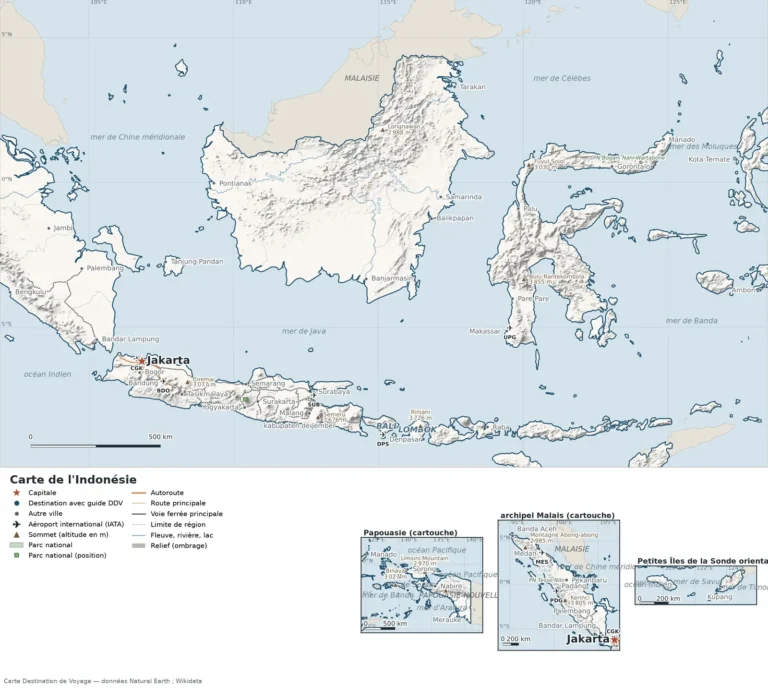
Bali’s neighbour, Lombok is more rural and quieter. The island is dominated in the north by the Rinjani volcano, edged in the south by large sandy bays and, in the northwest, by the three small car-free Gili Islands. The population is mainly Sasak and Muslim, with a Balinese Hindu minority in the west. Things to do in Lombok, where to stay, which itinerary to follow: this Lombok travel guide helps you choose your stops, your accommodation and your route.
Our travel deals for Lombok
Affiliate links: we earn a commission, at no extra cost to you.
FlightsKiwi.comCompare flights and airline combinations to Lombok.
Airport: Lombok International Airport (Zainuddin Abdul Madjid), in the south-centre, near Praya
Getting there: usually via a domestic or regional flight (from Bali, Jakarta or a Southeast Asian hub), or by boat from Bali
Ideal length: 5 to 7 days, 8 to 10 days with the Rinjani trek
Best time: May to October (dry season)
Time zone: UTC+8 all year: 8 hours ahead of London in winter, 7 in summer; 13 hours ahead of New York in winter
Entry: passport valid at least 6 months, 30-day visa on arrival or e-VOA (IDR 500,000), All Indonesia arrival card (GOV.UK, travel.state.gov)
Currency: the Indonesian rupiah (IDR)
Indicative budget: roughly IDR 610,000 to IDR 1,100,000 per person per day on a budget, roughly IDR 1,800,000 to IDR 4,050,000 in comfort, excluding the trek
Things to do in Lombok: the highlights
The Gili Islands: Trawangan, Meno and Air
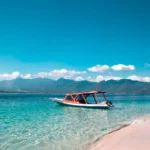
Off the northwest coast, these three small islands have no cars or scooters: you get around on foot, by bike or by cidomo, a horse-drawn cart. Gili Trawangan is the liveliest, with bars and nightlife; Gili Air strikes a good balance; Gili Meno is the quietest. Snorkelling often lets you see turtles, and many centres offer dives. Choose a reputable centre: the U.S. State Department notes that diving can be hazardous due to light regulation in Indonesia.
Mount Rinjani
The second-highest volcano in Indonesia (3,726 m / 12,224 ft), Rinjani holds a crater lake, Segara Anak, and an active volcanic cone in its caldera. The trek takes two to four days from Senaru or Sembalun, with nights in a tent. Check the current registration and guide rules with the Gunung Rinjani National Park authority before booking; most trekkers go with a licensed operator. The effort is real: steep slopes, slippery volcanic ground, cold at the summit before dawn. A shorter version to the crater rim is possible.
Kuta Lombok and the southern beaches
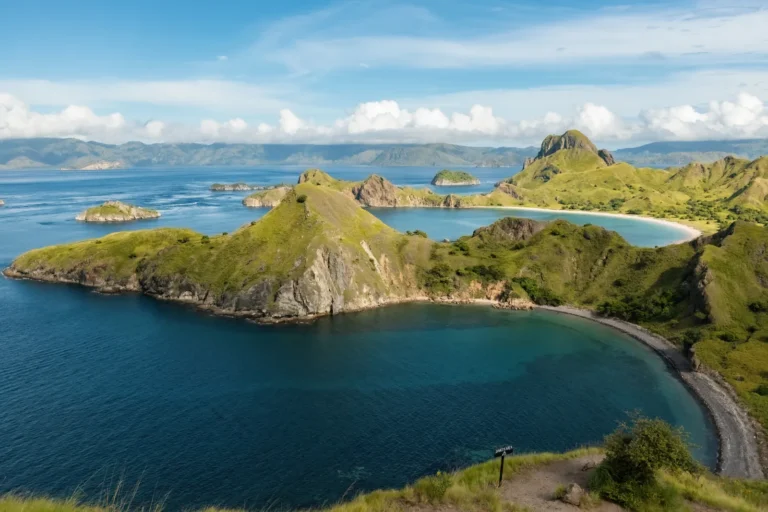
The south of the island alternates pale sandy bays and rocky headlands: Tanjung Aan, Selong Belanak (popular with beginner surfers), Mawun, Mawi. The village of Kuta Lombok, not to be confused with Kuta in Bali, is the base, with guesthouses, surf schools and restaurants. The Mandalika area, east of Kuta, is developing around hotels and a racing circuit. Beware of currents: many beaches are not supervised.
Senggigi and the west coast
The island’s original beach resort, Senggigi is less fashionable than the south but practical: close to Mataram, to the airport via the coast road and to Bangsal harbour for the Gilis. The road along the coast to the north offers many viewpoints over the strait and, on clear days, Bali’s Mount Agung.
Senaru and the waterfalls
At the northern foot of Rinjani, the village of Senaru is the starting point for the trek and for the island’s two best-known waterfalls, Sendang Gile and Tiu Kelep, reached by a forest path. Neighbouring traditional villages keep Sasak houses with thatched roofs.
Tetebatu and the rice fields
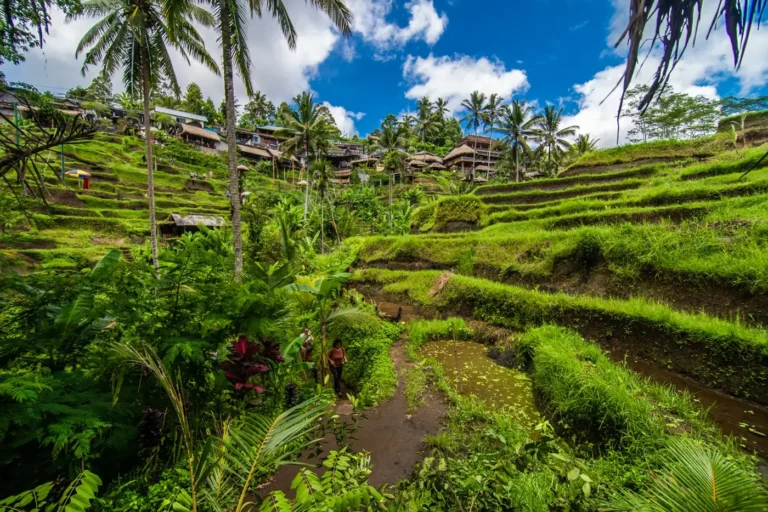
On the southern slopes of Rinjani, Tetebatu is surrounded by terraced rice fields, plantations and forests where monkeys live. You stay in homestays or small eco-lodges and walk with a local guide between fields and waterfalls.
Sasak villages and crafts
In the centre and south, several villages are known for their crafts: weaving in Sukarara, pottery in Banyumulek and Penujak. The village of Sade presents traditional Sasak housing, with a rather touristy guided tour. Choose respectful visits and buy directly from the artisans.
Mataram and the western temples
The provincial capital has markets, mosques and Balinese heritage. Lingsar temple, shared by Hindus and Wetu Telu Muslims, and the Narmada garden, with its pools, recall the Balinese presence on the island. The great Islamic Center mosque dominates the city with its minarets.
Lombok’s areas: where to base yourself
Gili Islands: beach and snorkelling; Trawangan for buzz, Air for balance, Meno for peace
Kuta Lombok: surf, southern beaches, plenty of guesthouses; a scooter or driver is useful
Senggigi: a practical base with hotels of all categories, close to the harbour for the Gilis
Senaru or Sembalun: the night before and after the trek
Tetebatu: for rice fields and a rural atmosphere
Itinerary ideas for Lombok
Lombok in 7 days:
Days 1 and 2: the Gili Islands (snorkelling, a bike ride around the island)
Day 3: back to Lombok via Bangsal, coast road to Senaru; Sendang Gile and Tiu Kelep waterfalls
Day 4: Tetebatu, its rice fields and villages
Day 5: the craft villages of Sukarara and Sade, then Kuta Lombok
Days 6 and 7: southern beaches (Tanjung Aan, Selong Belanak, Mawun), a surf lesson
Lombok in 10 days, with Rinjani:
Days 1 and 2: the Gili Islands
Day 3: Senaru and the waterfalls
Days 4 to 6: the Rinjani trek (depending on whether the park is open), with a licensed guide
Day 7: rest in Tetebatu
Days 8 to 10: Kuta Lombok and the southern beaches
✅ Best months: April, may, June, July, August, September, October
The best time is the dry season, from May to October: according to the 1991-2020 normals for the Lombok airport station, sunshine exceeds 200 hours a month, peaking in August. It is also the usual trekking season on Rinjani. From November to March, the rainy season brings showers and storms, at lower prices. Month-by-month details: our article on when to go to Lombok.
Budget for a stay in Lombok
Lombok remains more affordable than Bali, except on the Gilis in high season, where everything arrives by boat. Indicative amounts per person per day, excluding flights (converted from euros at the European Central Bank rate of 23 October 2026):
Item
Budget
Comfort
Accommodation (based on a shared double room)
roughly IDR 200,000 to IDR 510,000
roughly IDR 1,000,000 to IDR 2,450,000
Meals
roughly IDR 160,000 to IDR 300,000
roughly IDR 410,000 to IDR 910,000
Transport (scooter, public boat, shared driver)
roughly IDR 100,000 to IDR 200,000
roughly IDR 410,000 to IDR 810,000 (private driver)
Activities (snorkelling, surf lessons, guides)
roughly IDR 100,000 to IDR 200,000
roughly IDR 300,000 to IDR 810,000
Total per day
roughly IDR 610,000 to IDR 1,100,000
roughly IDR 1,800,000 to IDR 4,050,000
Indicative estimates, varying with the season. The Rinjani trek comes on top: its price depends on the length, starting point and level of comfort, and usually includes the guide, porters, equipment and park fees.
To cut costs: eat in warungs, small local restaurants, take the public boat between Bangsal and the Gilis, and travel outside July-August.
Getting around Lombok
Private driver: the most common option for transfers and day trips; agree the price before setting off.
Scooter: handy in Kuta Lombok, but the State Department reports that US citizens are frequently injured on rented motorbikes; helmets are required by law. UK citizens need a UK-issued International Driving Permit (GOV.UK).
Boats to the Gilis: public and fast boats from Bangsal; fast boats from Bali (Padang Bai, Serangan). Cancellations are possible in rough seas.
Public ferry: between Padang Bai (Bali) and Lembar (Lombok), slower but cheaper.
On the Gilis: on foot, by bike or by cidomo; no motor vehicles.
The U.S. State Department notes that boat and ferry incidents are frequent in Indonesia and that vessels often lack adequate life jackets, so passengers should bring their own. Choose established companies and give up if the sea is rough.
Where to stay in Lombok
Options range from family homestays to beach bungalows, villas with pools and a few large hotels in Senggigi and Mandalika. On the Gilis, accommodation is plentiful, but fresh water and electricity can be limited in the simplest places. In Senaru and Tetebatu, accommodation is simple and often family-run.
For a first stay, combine two or three bases: a Gili island, Kuta Lombok and, if you do the trek, Senaru or Sembalun. Book ahead for July-August and the end-of-year holidays.
Entry requirements, health and safety
US citizens
According to the U.S. Department of State (travel.state.gov, last updated July 9, 2026), you need a passport with at least 6 months of validity and a return or onward flight booking. You can apply in advance for an electronic visa on arrival (e-VOA) when entering at Jakarta or Bali (Ngurah Rai) airports: it costs IDR 500,000, is valid for 30 days and can be extended once for 30 days. Overstaying is fined IDR 1 million per day and can lead to detention, deportation or a ban.
UK citizens
According to the UK FCDO (GOV.UK foreign travel advice, updated 18 September 2026), you must have a visa. A 30-day, single-entry visa on arrival (VOA) is available for tourism; it costs IDR 500,000 (cash or card). Your passport must be valid for at least 6 months after arrival with at least 2 blank pages, and you need proof of an onward or return journey. You can also apply online at least one week before travel. Complete the free All Indonesia arrival card within 72 hours of arrival, and avoid sites that ask for payment for it.
Health: GOV.UK states that tap water is not safe to drink in Indonesia and that rabies is present, with many street dogs in Bali and elsewhere and monkeys around temples: seek immediate medical help after any bite or scratch. See a travel health clinic before you go.
Drugs: Indonesia has a zero-tolerance policy; possession, use or trafficking can lead to long prison sentences (GOV.UK).
Drinks: methanol poisoning and drink spiking have been reported in tourist areas (GOV.UK, travel.state.gov); be careful with spirits and never leave a drink unattended.
Natural hazards: volcanic eruptions, earthquakes, tsunamis and floods occur; follow local authorities’ advice on exclusion zones (GOV.UK).
Emergencies: ambulance 118, police 110 (GOV.UK).
Women travellers: GOV.UK notes that reported cases of sexual assault are high in Bali and Lombok, and drink spiking has been reported in Bali, Lombok and the Gili Islands; be alert at night and avoid poorly lit areas.
Mosquitoes: GOV.UK lists malaria and dengue among health risks in Indonesia; the State Department recommends malaria prevention medicine for some areas. Ask a travel health clinic about Lombok.
Practical tips for Lombok
Money: ATMs are found in Mataram, Senggigi, Kuta Lombok and Gili Trawangan, more rarely elsewhere. Keep cash in small notes and watch your card when paying.
Dress: the island is mainly Muslim: cover shoulders and knees away from the beach, especially in villages and mosques.
Ramadan: restaurant hours may change; avoid eating and drinking conspicuously in public in villages during the day.
Mobile data: good coverage in tourist areas, weaker in the mountains. An eSIM or local SIM card is handy.
Gilis: medical services are limited: bring a small first-aid kit.
Etiquette: remove your shoes to enter a home or a mosque, and use your right hand to give or receive.
Lombok: who is it for?
Hikers and adventurers: yes: the Rinjani trek in two to four days with a licensed guide, the Senaru waterfalls, walks in the Tetebatu rice fields. The trek requires good fitness.
Beach and snorkelling: yes: turtles seen while snorkelling around the Gilis, southern bays such as Tanjung Aan or Mawun. Many beaches are not supervised.
Beginner surfers: yes: surf schools in Kuta Lombok, with Selong Belanak popular with beginners.
Budget travellers: yes: roughly IDR 610,000 to IDR 1,100,000 per person per day, more affordable than Bali, except on the Gilis in high season.
Couples or travellers seeking peace: yes: Gili Meno is the quietest of the three Gilis, and the island remains more rural than Bali.
Nightlife: only on Gili Trawangan, the liveliest of the Gilis.
Five to seven days let you discover the Gili Islands, the north and the southern beaches. Add two to four days for the Rinjani trek.
How do you get to Lombok?
Usually with at least one connection: you reach Lombok International Airport on a domestic or regional flight, for example from Bali or Jakarta, or by boat from Bali to the Gilis and Lombok.
Do you need a visa for Lombok?
Yes: US and UK citizens can get a 30-day visa on arrival or e-VOA (IDR 500,000). Your passport must be valid at least 6 months, and you must complete the All Indonesia arrival card within 72 hours of arrival (GOV.UK, travel.state.gov).
Lombok or Bali?
Bali offers more temples, culture and services; Lombok is quieter, more rural and often cheaper, with Rinjani and the Gili Islands. The two islands combine easily.
Is the Rinjani trek difficult?
Yes: steep slopes, volcanic ground and cold at the summit. It requires good fitness. Check the current registration and guide rules with the national park authority, as well as seasonal closures, before booking.
What budget do you need for a week in Lombok?
Excluding flights, allow roughly IDR 610,000 to IDR 1,100,000 per person per day on a budget, or roughly IDR 4,250,000 to IDR 7,800,000 for 7 days, and roughly IDR 1,800,000 to IDR 4,050,000 per day in comfort (roughly IDR 12,750,000 to IDR 28,400,000). The Rinjani trek comes on top.
Where should you stay in Lombok?
Kuta Lombok for the southern beaches and surf, Senggigi for the west coast, Senaru or Tetebatu for Rinjani, the waterfalls and the rice fields, and the Gili Islands for snorkelling. Combine two or three bases depending on your itinerary.
Our sources
World Meteorological Organization, 1991-2020 normals (NOAA NCEI archive): Lombok airport station (WMO 97240)


 FlightsKiwi.comCompare flights and airline combinations to Lombok.Compare flights