Things to do in Bastia: stroll across Place Saint-Nicolas, walk up Rue Napoléon to the Vieux-Port, visit the citadel and the Governors’ Palace, follow the Aldilonda promenade below the ramparts, then head off round Cap Corse or birdwatch at the Étang de Biguglia. Allow 1 to 2 days to visit Bastia, plus a day for Cap Corse.
Corsica’s second town, Bastia looks towards Italy from the north-east coast, at the foot of Cap Corse. The island’s former Genoese capital has kept a Baroque old town, a colourful fishing harbour and a real neighbourhood life, far from the beach-resort image. It is also one of the main arrival ports in Corsica. This guide covers the sights, a one-day route around Cap Corse, a budget, where to stay and the climate according to Météo-France, with an original calculation of the rain to expect over a week. For the whole island, see our Corsica travel guide.

Our travel deals for Bastia
Affiliate links: we earn a commission, at no extra cost to you.
 FlightsKiwi.comCompare flights and airline combinations to Bastia.Compare flights

Bastia at a glance
- Location north-east coast of Corsica, at the base of Cap CorseAbout 90 km (56 mi) from the Italian coast
- Airport Bastia-Poretta (BIA), south of the town · detailsMany routes are seasonal; from further afield, most travellers connect via mainland France
- Ferries links with Toulon, Marseille, Nice and ItalyIncluding Livorno
- Train the Chemins de fer de la Corse link Bastia with CorteAjaccio and, via Ponte-Leccia, Calvi
- Ideal length 1 day for the town3 days with Cap Corse and Saint-Florent
- Entry Schengen area: no visa for up to 90 days for US and UK citizens · US: travel.state.gov · UK: GOV.UK
- Currency the euro (€) · currenciesestimated budget: roughly €75 to €110 per person per day on a tight budget, €170 to €280 for more comfort
Things to do in Bastia: the highlights
Place Saint-Nicolas
A huge esplanade planted with plane trees and palms, Place Saint-Nicolas opens onto the commercial port and the ferries. A statue of Napoleon faces the sea. Its cafés and terraces make it the town’s living room, from breakfast to the evening apéritif.
Terra Vecchia, Rue Napoléon and Place du Marché
Between Place Saint-Nicolas and the Vieux-Port, the Terra Vecchia district is the historic heart. Rue Napoléon and the neighbouring lanes hold richly decorated Baroque oratories, such as those of Saint-Roch and the Immaculate Conception. Place du Marché, or Place de l’Hôtel-de-Ville, hosts the morning market with the island’s producers.
The Vieux-Port and the church of Saint-Jean-Baptiste
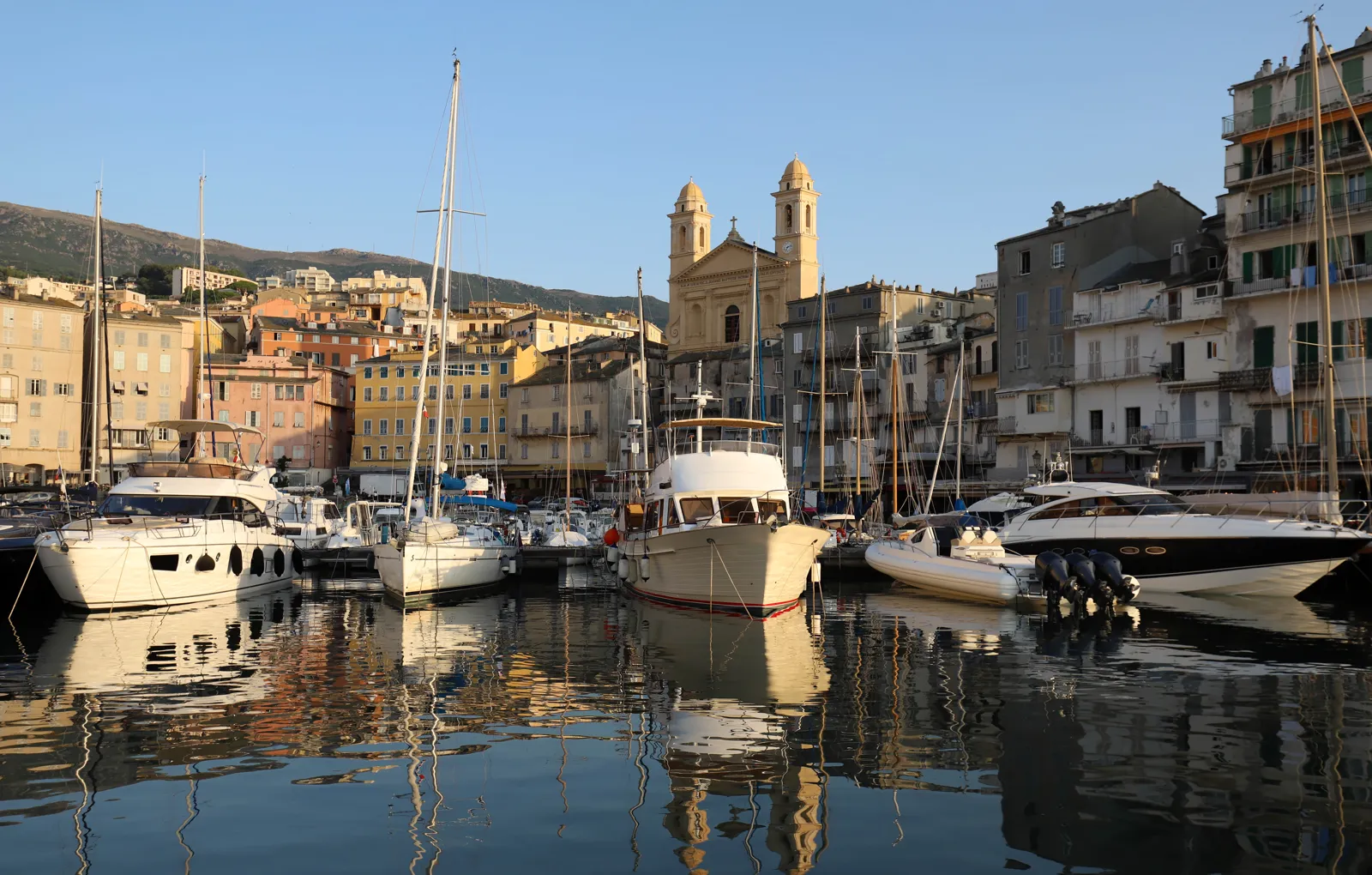
The Vieux-Port, with its tall, colourful façades, fishing boats and restaurants, is Bastia’s best-known image. Its two bell towers belong to the church of Saint-Jean-Baptiste, one of the largest on the island. The best overall view is from the Jetée du Dragon or from the citadel, late in the day.
The Aldilonda promenade
This walkway at water level runs along the foot of the citadel ramparts, between the Vieux-Port and the beach. It is the most pleasant walk in town, with the sea on one side and the cliff on the other. It may be closed in bad weather.
The citadel (Terra Nova) and the Governors’ Palace
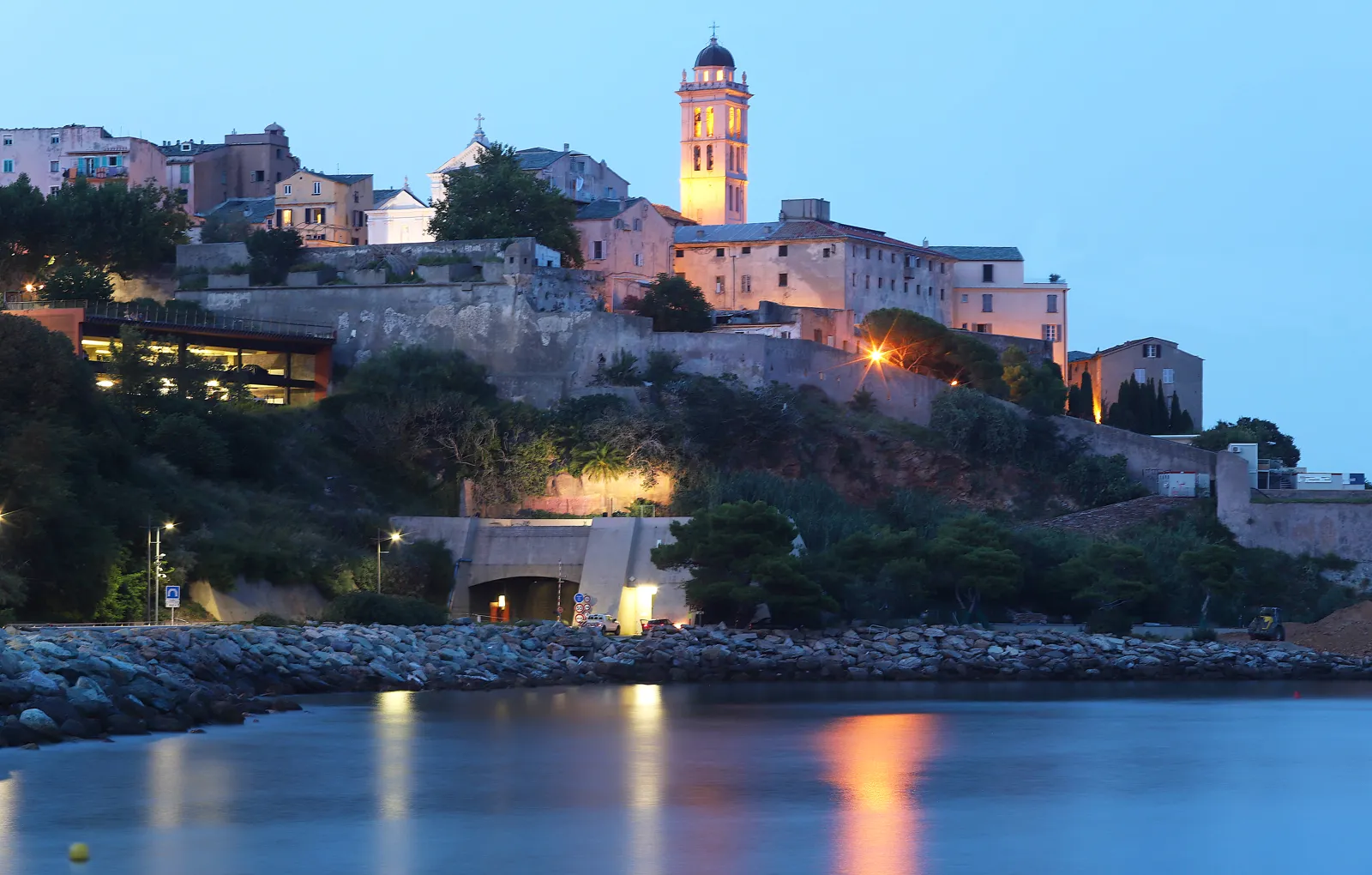
On the promontory south of the harbour, the Genoese citadel forms the Terra Nova district. The Governors’ Palace, former seat of Genoese power, now houses the Musée de Bastia, devoted to the history of the town. In the nearby lanes, Sainte-Marie cathedral and the Sainte-Croix oratory are worth a stop. The terraced Jardin Romieu, below the citadel, links the two districts by a staircase.
The Étang de Biguglia
South of town, between the sea and the airport road, the Étang de Biguglia is the largest wetland in Corsica and a nature reserve. A trail and an eco-museum let you watch the birds. The long sand spit of La Marana, between the lagoon and the sea, has the beaches closest to Bastia.
Coastal villages and the heights
Above the town, the road up the Serra di Pigno offers a view over Bastia, the lagoon and, on clear days, the Tuscan islands. To the north, the village of Erbalunga, with its Genoese tower by the water, is only about 10 km (6 mi) away: it is the first stop on Cap Corse.
The Agriates desert and Saint-Florent
On the other side of the Col de Teghime, Saint-Florent and its gulf are less than an hour’s drive away. From there, boats run in season to the Lotu and Saleccia beaches in the Agriates desert, a vast expanse of maquis with no villages. Allow a full day.
Cap Corse in one day: our route
The narrow, winding road around Cap Corse covers about 100 km (62 mi) between Bastia and Saint-Florent. It can be done in a day, provided you set off early and limit your stops. Here is an order of visit that follows the coast clockwise.
| Stop | What to see | Tip |
|---|---|---|
| 1. Erbalunga | Fishing village, Genoese tower | Coffee stop early in the morning |
| 2. Sisco and Pietracorbara | Pebble and sand beaches, hillside villages | A swim if you leave late |
| 3. Macinaggio | Marina, start of the Sentier des Douaniers coastal path | The path to Barcaggio needs a whole day on its own |
| 4. Col de la Serra and the Mattei windmill | View over both coasts of the Cap | Very windy |
| 5. Centuri | Fishing port known for its spiny lobster | Lunch |
| 6. Pino and Canari | Villages, Genoese towers, steep west coast | The road is narrower on the west side |
| 7. Nonza | Hilltop village, tower, dark pebble beach | Steep steps down to the beach |
| 8. Saint-Florent | Harbour and citadel, back via the Col de Teghime | Sunset over the gulf |
Checklist before driving round Cap Corse
- Fill up in Bastia: filling stations are rare around the Cap
- Leave before 9 am in summer to avoid camper vans and coaches on the narrow road
- Bring water, a picnic and cash for small shops
- Save swimming stops for the east coast, which is more sheltered
- Check the weather: the west-coast road is exposed to the wind
- Do not try to do everything: the Sentier des Douaniers deserves a separate day
Itinerary: how many days in Bastia?
Bastia in 1 day
- Morning: Place Saint-Nicolas, the market, Rue Napoléon and the oratories
- Lunch: at the Vieux-Port
- Afternoon: the Aldilonda, the citadel, the Governors’ Palace and the museum
- Late afternoon: Jardin Romieu and the view from the Jetée du Dragon
Bastia in 3 days
- Day 1: the town
- Day 2: the tour of Cap Corse
- Day 3: Saint-Florent and the Agriates beaches by boat, or the Étang de Biguglia and the Marana beaches
Bastia is often the starting point of a Corsica road trip: towards Corte and the centre, towards the Balagne and Calvi, or down the east coast to Porto-Vecchio. Ajaccio is a few hours away on the mountain railway.
When to go to Bastia
The best months to visit Bastia are May, June and September: 22 to 26 °C (72 to 79 °F) in the afternoon, little rain and long days for Cap Corse. July and August are the hottest (nearly 30 °C, or 86 °F) and driest, but also the busiest. Bastia gets more rain than Ajaccio in autumn: October and November each exceed 125 mm (4.9 in). Winter is mild (14 °C, or 57 °F) and the town stays lively.
When to go to Bastia: key points
- Best months: May, June and September
- For Cap Corse: May-June and September, with quieter roads
- Hottest month: August, average high of 29.8 °C (86 °F)
- Driest month: July, 14 mm (0.6 in)
- Wettest month: November, 134 mm (5.3 in)
- Sunshine: about 2,645 hours a year according to Météo-France
| Month | Max | Min | Rain | Rainy days | Crowds | Prices | Verdict |
|---|---|---|---|---|---|---|---|
| January | 13.8 °C (57 °F) | 5.4 °C (42 °F) | 67 mm (2.6 in) | 5.8 | Very low | Low | ⚠️ Mild by day, quiet |
| February | 13.9 °C (57 °F) | 5.1 °C (41 °F) | 64 mm (2.5 in) | 6.2 | Very low | Low | ⚠️ Quiet, cold sea |
| March | 15.8 °C (60 °F) | 6.8 °C (44 °F) | 64 mm (2.5 in) | 6.7 | Low | Low | ⚠️ Changeable weather |
| April | 18.3 °C (65 °F) | 9.1 °C (48 °F) | 72 mm (2.8 in) | 6.9 | Medium (Easter) | Medium | ⚠️ Pleasant but still showery |
| May | 22.4 °C (72 °F) | 12.6 °C (55 °F) | 54 mm (2.1 in) | 5.3 | Medium | Medium | ✅ Ideal for the town and Cap Corse |
| June | 26.4 °C (80 °F) | 16.4 °C (62 °F) | 39 mm (1.5 in) | 3.1 | High | High | ✅ Warm sea, long days |
| July | 29.4 °C (85 °F) | 19.4 °C (67 °F) | 14 mm (0.6 in) | 1.5 | Very high | Very high | ⚠️ Hot, dry, big crowds |
| August | 29.8 °C (86 °F) | 19.8 °C (68 °F) | 21 mm (0.8 in) | 2.2 | Very high | Very high | ⚠️ Hottest month, busy roads |
| September | 26.0 °C (79 °F) | 16.7 °C (62 °F) | 74 mm (2.9 in) | 5.3 | High | High | ✅ Warm sea, crowds thinning |
| October | 22.0 °C (72 °F) | 13.4 °C (56 °F) | 126 mm (5.0 in) | 7.1 | Medium | Medium | ⚠️ Mild, but autumn rain |
| November | 17.7 °C (64 °F) | 9.5 °C (49 °F) | 134 mm (5.3 in) | 9.3 | Very low | Low | ❌ Wettest month |
| December | 14.8 °C (59 °F) | 6.4 °C (44 °F) | 88 mm (3.5 in) | 8.0 | Low | Low | ⚠️ Mild, damp |
A week in Bastia or Ajaccio: how much rain to expect?
Here is our exclusive figure: the rainfall and number of rainy days you can expect over a 7-day stay in Bastia and Ajaccio. Destination de Voyage calculation based on Météo-France 1991-2020 normals: monthly value × 7 / number of days in the month. This is an average: any given week can be drier or wetter, especially in autumn when rain falls in a few stormy episodes.
| Month | Bastia: rain over 7 days | Ajaccio: rain over 7 days |
|---|---|---|
| January | 15 mm (0.6 in) · 1.3 days | 12 mm (0.5 in) · 1.6 days |
| February | 16 mm (0.6 in) · 1.5 days | 12 mm (0.5 in) · 1.7 days |
| March | 14 mm (0.6 in) · 1.5 days | 11 mm (0.4 in) · 1.4 days |
| April | 17 mm (0.7 in) · 1.6 days | 12 mm (0.5 in) · 1.7 days |
| May | 12 mm (0.5 in) · 1.2 days | 11 mm (0.4 in) · 1.1 days |
| June | 9 mm (0.4 in) · 0.7 days | 6 mm (0.2 in) · 0.7 days |
| July | 3 mm (0.1 in) · 0.3 days | 2 mm (0.1 in) · 0.3 days |
| August | 5 mm (0.2 in) · 0.5 days | 4 mm (0.2 in) · 0.3 days |
| September | 17 mm (0.7 in) · 1.2 days | 13 mm (0.5 in) · 1.2 days |
| October | 29 mm (1.1 in) · 1.6 days | 19 mm (0.7 in) · 1.7 days |
| November | 31 mm (1.2 in) · 2.2 days | 26 mm (1.0 in) · 2.2 days |
| December | 20 mm (0.8 in) · 1.8 days | 17 mm (0.7 in) · 1.9 days |
- From June to August, a week in Bastia has on average less than one rainy day (0.3 in July): the risk is minimal.
- Bastia gets more rain, but not more often: in October, about 29 mm (1.1 in) per week against 19 mm (0.7 in) in Ajaccio, for a similar number of rainy days (1.6 to 1.7). Showers there are therefore heavier.
- In November, expect about 2 rainy days and 31 mm (1.2 in) per week in Bastia: the riskiest month for Cap Corse.
- In winter, Bastia has slightly fewer rainy days than Ajaccio (1.3 against 1.6 per week in January).
To compare with the rest of the island, see our page on the best time to visit Corsica, or our selections of where to go in May and in September. Pack a rain jacket in autumn (see our packing list).
Budget for visiting Bastia
| Item (per person per day) | Tight budget | Comfort |
|---|---|---|
| Accommodation (based on a shared double room) | roughly €40 to €65 | roughly €90 to €170 |
| Meals | roughly €25 to €35 | roughly €50 to €75 |
| Transport (shared car hire, fuel) | roughly €10 to €20 | roughly €25 to €40 |
| Activities (museum, boat to the Agriates) | roughly €5 to €15 | roughly €20 to €50 |
| Total | roughly €75 to €110 | roughly €170 to €280 |
Getting to Bastia and getting around
- By air: Bastia-Poretta airport, about 20 km (12 mi) south of town, has links with mainland France, some of them seasonal; a shuttle bus runs between the airport and the centre.
- By ferry: Bastia is one of the busiest ports in Corsica, with crossings to Toulon, Marseille and Nice, and to Italy, Livorno above all. The port is right in the centre, next to Place Saint-Nicolas.
- By train: the Chemins de fer de la Corse link Bastia with Corte and Ajaccio, and with Calvi via Ponte-Leccia; suburban trains serve the south of the urban area.
- In town: everything is walkable between Place Saint-Nicolas, the Vieux-Port and the citadel (uphill). A little tourist train tours the districts in season. For Cap Corse, a car is essential.
Where to stay in Bastia
| Area | Best for | Good to know |
|---|---|---|
| Place Saint-Nicolas and the port | Ferry arrivals, sightseeing on foot | Convenient, lively |
| Vieux-Port and Terra Vecchia | Charm and restaurants | Narrow lanes, parking difficult |
| Citadel (Terra Nova) | Peace and views | Uphill walk |
| South (Marana, Biguglia) | Beach, families, close to the airport | Car needed |
| North (Pietranera, Erbalunga) | Gateway to Cap Corse | Small beaches, a few minutes from town |
Entry requirements, health and safety
- US citizens: you may enter the Schengen area, including France, for up to 90 days for tourism or business without a visa. Your passport should be valid at least three months beyond your stay (six months recommended), and immigration officers may ask for proof of sufficient funds and a return ticket (U.S. Department of State, travel.state.gov, last updated August 11, 2025).
- UK citizens: no visa for up to 90 days in any 180-day period as a tourist; your passport must have been issued less than 10 years before you arrive and be valid at least 3 months after the day you plan to leave the Schengen area. Under the EU Entry/Exit System (EES), fingerprints and a photo may be taken at your first entry, free of charge (UK FCDO, GOV.UK, updated 22 October 2026).
- Health: UK travellers need a GHIC or a valid EHIC for medically necessary state healthcare; whatever your nationality, take out travel insurance that covers medical costs. Emergency number: 112 (GOV.UK).
- Cap Corse road: narrow, without guardrails in places, shared with cyclists and camper vans: drive slowly.
- Wildfires: according to GOV.UK, the risk is highest in summer along the Mediterranean coast and in Corsica; respect access restrictions to forests and hills, and remember that causing a fire, even by accident, is illegal.
- Sea: check whether beaches are lifeguarded and follow the flags (GOV.UK); the west coast of the Cap is exposed to wind and swell.
- See our travel insurance guide.
For hiking the Sentier des Douaniers and boat trips, check your travel insurance or usual insurance.
Practical tips for Bastia
- Market: come in the morning, especially at weekends.
- Specialities: brocciu fritters, canistrelli biscuits, Cap Corse wines and muscat, citron liqueur.
- Arriving by ferry: overnight boats arrive early; the cafés on Place Saint-Nicolas open early too.
- Parking: use the underground car parks in the centre rather than searching the lanes.
- Mobile data: good coverage in town, possible dead zones on Cap Corse; check your home carrier’s roaming charges.
Frequently asked questions
What to do in Bastia in one day?
Start with Place Saint-Nicolas and the market, walk up Rue Napoléon to the Vieux-Port, follow the Aldilonda to the citadel, visit the Governors’ Palace and finish in the Jardin Romieu or on the Jetée du Dragon.
Can you drive round Cap Corse in one day?
Yes, if you leave early: the road covers about 100 km (62 mi) between Bastia and Saint-Florent, but it is narrow and winding. Limit yourself to four or five stops, for example Erbalunga, Macinaggio, Centuri and Nonza.
What is the best time to visit Bastia?
May, June and September: 22 to 26 °C (72 to 79 °F) in the afternoon and little rain according to Météo-France 1991-2020 normals, with fewer people than in July and August. If possible, avoid November, the wettest month.
Is Bastia rainier than Ajaccio?
Yes in total: about 817 mm (32.2 in) a year in Bastia against 635 mm (25.0 in) in Ajaccio according to Météo-France. But the number of rainy days is almost the same: in Bastia, showers are heavier, especially in October and November.
How do you get to Bastia?
By air to Bastia-Poretta, usually connecting via mainland France, or by ferry from Toulon, Marseille, Nice or Italy. The port is right in the town centre.
Where can you swim near Bastia?
On the Marana beaches to the south, along the Étang de Biguglia, or in the coves of Pietranera and Erbalunga to the north. For the big white-sand beaches, head to the Agriates from Saint-Florent.
Our sources
- Météo-France: 1991-2020 normals, Bastia station (Bastia-Poretta airport); 1991-2020 normals for Ajaccio, as reproduced in the Wikipedia articles « Bastia » and « Ajaccio »
- Destination de Voyage calculation: rainfall and rainy days expected over 7 days (monthly value × 7 / number of days in the month)
- Wikipedia: « Bastia » article (location, port traffic), consulted on 14 October 2026
- Bastia tourist office: « Top 10 must-sees », consulted on 14 October 2026
- Entry requirements, health and safety checked on 26 October 2026: U.S. Department of State, France country information (last updated August 11, 2025) and UK FCDO, GOV.UK foreign travel advice for France (updated 22 October 2026).
- Our methodology
Updated October 2026.
To continue your trip, see our guides to Calvi and Porto-Vecchio, our Corsica or Sardinia comparison, our France travel guide and our destinations in Europe.